
ELV-420 · Lesson 1 of 12 · 21 min
Maintenance in the elevator trade
The second half of Tamsin's fourth year began with a change of desk. For three years she had worked on installation, modernization and repair crews, moving from job to job with Ray Abernethy and the adjusters. Now Lena Ostrander put her on Route 7 as the second mechanic beside Ray, and told her that for the rest of the year she would learn the part of the trade that most elevator mechanics spend most of their working lives doing: keeping equipment that already runs safe, reliable and legal. “Installing an elevator takes months,” Lena said. “Maintaining it takes thirty or forty years. Every test you have watched, every device you have adjusted, has to be done again and again for as long as the equipment is in service, and somebody has to be able to prove it was done.” The term would end with two jobs on the same week: an audit of the whole route's maintenance records by Northcrest's maintenance quality manager, Hugh Mbeki, and the acceptance inspection of a new car at Larchmont's second building. This lesson describes what maintenance is, who is responsible for it, how a route is organized and how much work it takes.
What maintenance means in the code
The code uses the word maintenance for the work that keeps equipment in compliance with the code in force when it was installed or last altered, and in safe working order. That includes examinations, lubrication, cleaning, adjustment, the replacement of worn parts with parts of the same kind, and the periodic tests in Part 8. It does not include alterations, which change the equipment and bring in current requirements, and it is separate from repairs and replacements, which have their own rules and which were sorted out in ELV-410 lesson 11. The maintenance requirements themselves are in Section 8.6, which applies to every kind of equipment the code covers: electric and hydraulic elevators, escalators and moving walks, dumbwaiters and material lifts, and special application equipment. Section 8.6 also requires a written maintenance control program for each unit, which lesson 2 covers.
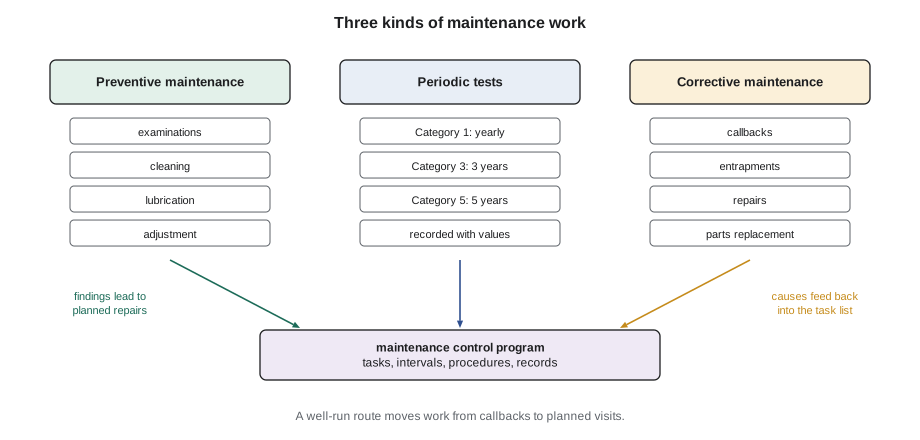
In practice, maintenance work falls into three kinds. Preventive maintenance is the scheduled work: examining, cleaning, lubricating and adjusting on a fixed interval, before anything fails. Periodic tests are the scheduled proofs that safety devices still work: the annual, three-year and five-year tests that lessons 5 to 9 cover. Corrective maintenance is the unscheduled work: callbacks when a car is out of service or a passenger is trapped, and the repairs that follow. A well-run route shifts work from the third kind to the first, because an hour spent cleaning a door track on a planned visit saves several hours of callback and a stranded passenger later.
Who is responsible
The owner of an elevator is responsible for keeping it maintained and safe. Almost no owner does the work directly. Instead the owner hires an elevator contractor, and the contractor's licensed mechanics do the maintenance and tests under the contractor's program. In Washington, the owner must keep each conveyance maintained by a licensed elevator contractor and its mechanics, licensed by L&I, and inside Seattle the conveyance must also pass SDCI's annual inspection to keep its certificate of operation; L&I's maintenance control program forms set out what must be kept on site for each unit. The authority having jurisdiction does not maintain anything: it licenses the contractors and mechanics, inspects equipment, audits records and issues orders when something is wrong.
The contract between owner and contractor decides how much of the work the contractor carries. A full maintenance contract covers examinations, lubrication, adjustment, tests and the repair or replacement of most parts, so the contractor carries the cost of wear. A parts-oil-and-grease contract covers routine work and small parts but bills larger repairs separately. An examination-only or time-and-material arrangement leaves almost everything to the owner. Whatever the contract says, the code and the regulation still require the maintenance to be done, and a mechanic who finds a hazard must deal with it whether or not the contract covers it. Moira's line from the code block was that “the contract decides who pays; the code decides what gets done.”
| Party | Main responsibilities in maintenance |
|---|---|
| Owner | keeps the equipment maintained and safe; hires a licensed contractor; gives access; pays for repairs the contract does not cover |
| Contractor | holds the license; writes and keeps the maintenance control program; schedules visits and tests; keeps records |
| Mechanic | does the examinations, maintenance and tests; records what was done; reports hazards and takes equipment out of service when needed |
| Authority having jurisdiction | licenses contractors and mechanics; inspects; audits records; issues orders, certificates and permits |
| Maker | supplies maintenance, examination and test procedures and the tools needed for its equipment |
Route 7
Ray's route was a fair sample of the trade. It had fourteen units in eleven buildings, all within a short drive of the Northcrest shop: Tillicum's two cars, the old geared car 1 and the gearless car 2; the hydraulic car at the Marlowe; the machine-room-less car at Larchmont Residences, with a second car about to start up in the new Larchmont East building; Ashgrove Clinic's twin-post holeless hydraulic; Dunmore Square's roped hydraulic; Holloway Memorial Hospital's two hydraulic bed cars; two hydraulic cars at Birchwood Apartments; a geared traction car at the Pemberton Block; two traction cars at Seaview Medical; and a freight elevator at a bakery warehouse. The route had cars from four makers, controllers from 1962 to 2025, and owners ranging from a hospital with a facilities department to a small strata council that met once a month.
Each unit had a maintenance control program on file, a log on site and a place in Ray's schedule. Most units got a planned visit every month; the busiest hospital cars got two; a few lightly used hydraulic cars could go longer under the maker's limits and the jurisdiction's maximum. Around those visits Ray fitted the periodic tests, the callbacks and the repair work the visits turned up. On a typical week he spent about two-thirds of his time on planned work and a third on callbacks and repairs, and he was proud of how small the callback share had become since he took the route over.
How much work a route takes
Contractors estimate the time each unit needs from its type, the number of stops, its usage and the condition of the equipment, and then add the periodic tests and an allowance for callbacks. The figures vary widely between makers and contractors, so every company keeps its own, but the method is the same: add up the planned hours, add the tests, add the callbacks, and compare the total with the hours a mechanic is actually available. Lena asked Tamsin to work out whether Route 7 would still fit one mechanic and a helper once the Larchmont East car was added.
# Route 7: planned maintenance hours per year, with tests and callbacks (illustrative company figures)
units = [  # (unit, type, stops, visits per year, hours per visit, callbacks per year)
    ("Tillicum 1",      "geared traction", 10, 12, 2.5, 6),
    ("Tillicum 2",      "gearless",        10, 12, 1.8, 3),
    ("Marlowe 1",       "hydraulic",        4, 12, 1.5, 4),
    ("Larchmont 1",     "MRL traction",     8, 12, 1.6, 3),
    ("Ashgrove 1",      "holeless hyd",     3, 12, 1.2, 2),
    ("Dunmore 1",       "roped hyd",        5, 12, 1.5, 3),
    ("Holloway 1",      "hydraulic",        4, 24, 1.5, 5),
    ("Holloway 2",      "hydraulic",        4, 24, 1.5, 4),
    ("Birchwood 1",     "hydraulic",        5, 12, 1.4, 3),
    ("Birchwood 2",     "hydraulic",        5, 12, 1.4, 3),
    ("Pemberton 1",     "geared traction",  7, 12, 2.2, 5),
    ("Seaview 1",       "gearless",         9, 12, 1.8, 4),
    ("Seaview 2",       "gearless",         9, 12, 1.8, 4),
    ("Bakery freight",  "hydraulic",        2, 12, 1.3, 2),
]
TEST_HOURS = {"annual": 4.0, "five-year": 10.0}   # per unit, two-person work counted as crew hours
CALLBACK_HOURS = 2.0                               # average including travel
AVAILABLE = 1600                                # productive hours per mechanic per year

def route_hours(units, five_year_share=0.2):
    planned = sum(v * h for _, _, _, v, h, _ in units)
    tests = len(units) * (TEST_HOURS["annual"] + five_year_share * TEST_HOURS["five-year"])
    calls = sum(c for *_, c in units) * CALLBACK_HOURS
    return planned, tests, calls

for label, extra in (("today", []), ("with Larchmont East", [("Larchmont E1", "MRL traction", 6, 12, 1.6, 4)])):
    p, t, c = route_hours(units + extra)
    total = p + t + c
    print(f"{label:22s} planned {p:6.1f} h  tests {t:5.1f} h  callbacks {c:5.1f} h  total {total:6.1f} h  "
f"= {100 * total / AVAILABLE:4.1f} % of one mechanic")today planned 312.0 h tests 84.0 h callbacks 102.0 h total 498.0 h = 31.1 % of one mechanic with Larchmont East planned 331.2 h tests 90.0 h callbacks 110.0 h total 531.2 h = 33.2 % of one mechanic
The answer was that the planned visits, tests and callbacks on Route 7 came to about 31 % of one mechanic's productive year, rising to about 33 % with Larchmont East. That surprised Tamsin until Lena pointed out what the model left out: the repairs that the visits and tests turn up, the modernization support at Tillicum, travel between jobs beyond the average, standby for the hospital, and training. On Ray's real timesheets those filled most of the rest of the year, and Tamsin's hours sat on top for the repair work. The details mattered more than the total: Tillicum car 1's planned hours were high because of its age and the hospital cars' because of their double visits, and either could change after the coming modernization or a change in the hospital's contract. Lena kept the model and updated it every year from the route's actual hours, which is the only way such estimates stay honest.
A day on the route
Tamsin's first week showed her the rhythm. A planned visit starts with the log: what was done last time, what is due this time, and any note from the owner or from the last callback. Then the mechanic rides the car, listening and watching, before touching anything, because a car that misbehaves only in normal service will often behave perfectly once it is on inspection operation. The work itself follows the task list in the maintenance control program for that unit, in a sensible order around the machine room or control space, the car top, the pit, the inside of the car and the landings. At the end the car is checked out, put back in service and ridden again, and the log is completed before the mechanic leaves. Ray's habit was to tell the building contact what he had done and what he had found, every time, even when there was nothing to report.
Callbacks break into that rhythm. On her second day a call came from Birchwood: car 2 stuck at the third floor with its doors closed and a resident inside. Ray left the Pemberton machine room, drove eight minutes, released the passenger, and found a hall door roller that had broken and let the door hang onto its interlock. He replaced the roller, examined the other hall doors on that car, logged the callback with its cause, and added a roller check to the next visit for car 1. That last step, Ray said, is what turns a callback into maintenance.
The jurisdiction's view
From the authority's side, maintenance is judged mainly by its records. An SDCI inspector visiting Tillicum will read the log and the maintenance control program before looking at the equipment, check that tasks were done at their intervals and that periodic tests were done and recorded with their values, and then examine the equipment to see whether the records are believable. An immaculate log beside a filthy pit, or a test record with no values, tells the inspector more than any amount of explanation. Lesson 11 returns to working with inspectors; lesson 12 follows Hugh's audit, which asks the same questions before the inspector does.
Worked problem
Classifying the work on a visit
On one Pemberton visit Ray lubricated the rails, cleaned the door tracks, replaced a worn car door gib with an identical part, ran the annual Category 1 tests and answered a callback for a stuck hall button. Which kinds of maintenance work were these?
Show solution
- Rail lubrication and door track cleaning are preventive maintenance on the task list.
- Replacing a worn gib with an identical part is maintenance (a like-for-like replacement of a worn part), recorded in the log.
- The Category 1 tests are periodic tests, recorded with their results on the test record.
- The stuck hall button is corrective maintenance: a callback, logged with its cause and repair.
Answer: Preventive maintenance, maintenance replacement, periodic tests and a callback; each is recorded in its own place in the maintenance records.
Common mistakes
MistakeTreating maintenance as only fixing what breaks.
InsteadMost maintenance is planned: examinations, cleaning, lubrication, adjustment and periodic tests on fixed intervals.
MistakeLeaving a hazard because the contract does not cover it.
InsteadThe contract decides who pays; a hazard is dealt with and reported whatever the contract says.
MistakeStarting work without riding the car.
InsteadRide the car in normal service first; many faults only show then.
MistakeClosing a callback without recording the cause.
InsteadRecord the cause and repair, and check similar parts on related units.
MistakeAssuming the authority will judge the equipment, not the records.
InsteadInspectors read the records first and use the equipment to check whether the records are believable.
Summary and key terms
- Maintenance keeps equipment safe and compliant with the code in force when it was installed or last altered; Section 8.6 governs it.
- Work is preventive, periodic testing or corrective; good routes move work from callbacks to planned visits.
- The owner is responsible; a licensed contractor and its mechanics do the work; the authority licenses, inspects and audits.
- In Seattle, SDCI's annual inspection keeps the certificate of operation; L&I licenses contractors and mechanics statewide.
- Route workload is estimated from planned visit hours, tests and callbacks, compared with available hours, and updated from actual hours.
- Maintenance
- Work that keeps equipment safe and in compliance with the code that applies to it, including examinations, lubrication, adjustment, like-for-like replacements and periodic tests.
- Preventive maintenance
- Scheduled examination, cleaning, lubrication and adjustment done before failure.
- Callback
- An unscheduled visit to equipment that is out of service, misbehaving or has trapped a passenger.
- Route
- The group of units one mechanic, sometimes with a helper, is assigned to maintain.
- Full maintenance contract
- A contract under which the contractor carries most repair and replacement costs as well as routine work.
- Periodic test
- A test of safety devices required by Part 8 at a fixed interval, in Categories 1, 3 or 5.
Practice problems
Work each problem on paper first, then reveal the answer to check.
Which section of the code covers maintenance?
Show answer
Section 8.6, which applies to all equipment the code covers.
Name the three kinds of maintenance work.
Show answer
Preventive maintenance, periodic tests and corrective maintenance (callbacks and repairs).
Who is responsible for keeping an elevator maintained?
Show answer
The owner, who hires a licensed contractor to do the work.
What should follow every callback besides the repair?
Show answer
A log entry with the cause, and a check of similar parts on the same or related units.
How do inspectors usually begin an inspection?
Show answer
By reading the maintenance records and the maintenance control program, then checking the equipment against them.
Lesson quiz · 5 questions
Score 60% or more to complete this lesson.
Create a free account to save your progress, take quizzes and earn a certificate.