
ELV-420 · Lesson 6 of 12 · 21 min
Traction elevator periodic tests
Eight of Route 7's units were traction elevators, from Tillicum's 1962 geared car to Larchmont's machine-room-less car on coated belts, and every one had a different mix of devices to test. Tillicum car 1 had a flyball governor, wedge-clamp safeties and spring buffers and, until its modernization, no ascending car overspeed protection at all. Seaview's gearless cars had oil buffers, a rope gripper and a brake that also served as the emergency brake. Larchmont had a governor in the hoistway with an electrical trip and a remote reset, and a belt monitoring system that counted bends. Ray kept a single sheet on the van's visor listing every unit with its last annual and five-year test dates. “Know what is due before the customer does,” he said, “and long before the inspector does.” This lesson covers the periodic tests for traction elevators, the difference between the annual and five-year tests, and how to keep track of them.
Category 1 tests on traction elevators
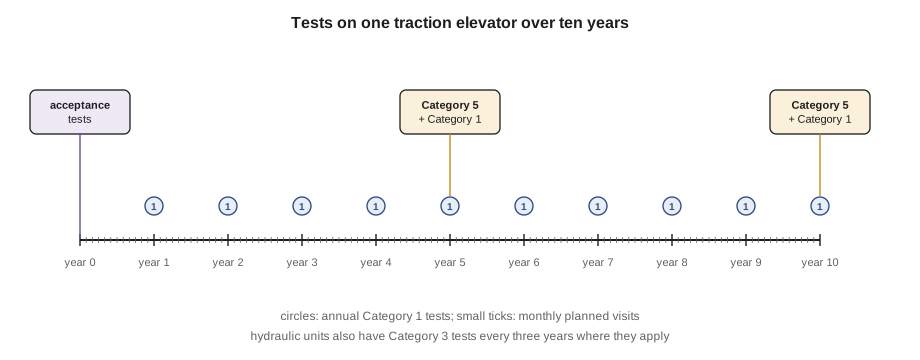
The annual tests on a traction elevator check that the safety devices still operate, mostly without load and at low speed. They include operating the governor and its overspeed switch, and tripping the car safeties from the governor at slow speed with no load in the car to confirm that the safeties set and stop the car; checking oil buffers for oil level and plunger return; running the car onto the normal and final terminal stopping devices; testing firefighters' emergency operation and standby or emergency power operation; checking the power door system and door protection; and testing the emergency terminal speed limiting or stopping devices where fitted. Recent editions of the code have added annual checks of the braking system and of the ascending car overspeed and unintended movement protection, because so many newer machines use the brake for those functions. Which items apply to a particular car depends on its equipment and on the edition that governs it, and the program and the inspection guide list them for that unit.
Most annual tests can be done by one mechanic, but Northcrest's practice was to do them with two people whenever a safety was to be tripped or a car run onto a final limit, one at the controller or the inspection station and one watching the equipment. Every annual test day began with the same briefing: which tests, in what order, who was where, how they would talk, and how the car would be checked out at the end.
| Annual test | What it shows | Typical method |
|---|---|---|
| Governor and overspeed switch | the governor turns freely, its switch opens | operate the switch by hand or trip by the maker's method |
| No-load safety test | safeties set and stop the car | trip from the governor at inspection speed, empty car |
| Oil buffers | oil level and plunger return | check level; compress and watch return as the guide describes |
| Normal and final terminal devices | car stops at each terminal; final limit opens | run the car through the terminals on inspection |
| Firefighters' operation and standby power | recall, Phase II and power transfer work | operate as the guide and building plan describe |
| Door system and protection | close time, force and reopening | measure and operate each device |
| Braking system, overspeed and movement protection | brake holds; protection devices act | maker's procedure and the edition in force |
Category 5 tests on traction elevators
The five-year tests check the safety devices under the conditions they were designed for, with load and at speed. The car safeties are tested with rated load in the car, and for most types at rated speed, tripped by the governor, with the stopping distance measured and compared with the code's limits. The governor's tripping speed is measured, and the force it exerts on its rope when it trips, the pull-through or rope pull, is checked. Oil buffers are tested as the inspection guide describes, which commonly means striking them with the car or counterweight and measuring the return. The brake is tested under load, and the emergency stopping performance, the traction and the ascending car overspeed and unintended movement protection are tested by the methods in the code and the maker's procedures. Lessons 7 and 8 cover these tests in detail; ELV-320 lesson 12 followed one five-year test day at Quayside.
Some modern elevators allow, and some makers require, alternative test methods for five-year tests, because loading a car with test weights and driving it into its safeties at full speed wears the rails, the safeties and the machine. An alternative method might test the brake with the drive measuring torque instead of carrying weights, or test safeties with reduced load and calculate the result for rated load. The code permits such methods where the maker's procedure is followed and the results are recorded, and Washington's test form has its own entries for alternative Category 5 methods. The mechanic must have the maker's procedure for the exact equipment, the tools it calls for and, often, training on that product.
Who does the tests, and who watches
Periodic tests are done by the contractor's mechanics, and the authority may witness them. In Seattle, the SDCI inspector may witness tests, and the results are reviewed at the annual inspection; outside Seattle, L&I's rules and inspectors apply in the same way, and L&I licenses the mechanics everywhere in the state. Whether or not anyone is watching, the test is done the same way and recorded the same way: the code requirement, the date, the people, the method and every value measured.
Owners sometimes ask why tests cost what they do. The answer is mostly people and time: a five-year test on a geared car can take two mechanics most of a day, plus the test weights and their handling, plus the building's lost service. Ray's way of explaining it to the Pemberton's owner was to show her the test record from five years earlier and point to the safety stopping distance and the brake hold result. “These numbers are the reason your insurer and the authority let your tenants ride.”
Keeping track of what is due
With fourteen units, three categories and dates spread through the year, missing a test is easy unless the tracking is systematic. Northcrest's software did it for the whole company, but Ray kept his own sheet, and Hugh asked Tamsin to write the logic out so that she could check the software. A test is due one interval after the last one was done, and is overdue on the day after that. The program can always do a test earlier; doing one later is a finding.
# Periodic test tracker for Route 7 as of 12 April 2027 (dates of the last completed test in each category)
from datetime import date

def add_years(d, n):
    try:
        return d.replace(year=d.year + n)
    except ValueError:                      # 29 February
        return d.replace(year=d.year + n, day=28)

TODAY = date(2027, 4, 12)
INTERVAL = {"Cat 1": 1, "Cat 3": 3, "Cat 5": 5}
last = {
    "Tillicum 1":   {"Cat 1": date(2026, 5, 6),   "Cat 5": date(2022, 5, 10)},
    "Tillicum 2":   {"Cat 1": date(2026, 9, 14),  "Cat 5": date(2025, 9, 15)},
    "Larchmont 1":  {"Cat 1": date(2026, 4, 20),  "Cat 5": date(2025, 3, 3)},
    "Pemberton 1":  {"Cat 1": date(2026, 3, 30),  "Cat 5": date(2023, 3, 28)},
    "Seaview 1":    {"Cat 1": date(2026, 6, 2),   "Cat 5": date(2022, 6, 1)},
    "Birchwood 1":  {"Cat 1": date(2026, 4, 25),  "Cat 3": date(2024, 4, 24), "Cat 5": date(2023, 4, 26)},
    "Holloway 2":   {"Cat 1": date(2026, 4, 15),  "Cat 5": date(2024, 2, 9)},
}
rows = []
for unit, tests in last.items():
    for cat, done in tests.items():
        due = add_years(done, INTERVAL[cat])
        days = (due - TODAY).days
        status = "OVERDUE" if days < 0 else ("due within 30 days" if days <= 30 else ("due within 90 days" if days <= 90 else "ok"))
        rows.append((days, unit, cat, due, status))
for days, unit, cat, due, status in sorted(rows):
    if status != "ok":
print(f"{unit:12s} {cat}: due {due} ({days:+d} days) {status}")Pemberton 1 Cat 1: due 2027-03-30 (-13 days) OVERDUE Holloway 2 Cat 1: due 2027-04-15 (+3 days) due within 30 days Larchmont 1 Cat 1: due 2027-04-20 (+8 days) due within 30 days Birchwood 1 Cat 3: due 2027-04-24 (+12 days) due within 30 days Birchwood 1 Cat 1: due 2027-04-25 (+13 days) due within 30 days Tillicum 1 Cat 1: due 2027-05-06 (+24 days) due within 30 days Tillicum 1 Cat 5: due 2027-05-10 (+28 days) due within 30 days Seaview 1 Cat 5: due 2027-06-01 (+50 days) due within 90 days Seaview 1 Cat 1: due 2027-06-02 (+51 days) due within 90 days
The list showed one problem at once: Pemberton car 1's annual test, last done at the end of March 2026, had slipped past its due date by thirteen days, because the March visit had been taken up with a callback for flood water in the pit. Ray had the test done that week and recorded the reason for the delay. The rest of the list was the month's plan: Holloway, Larchmont, Birchwood car 1 with its three-year test, and Tillicum car 1, whose five-year test was coming due in May at the same time as its modernization. Lena decided to do the five-year test as planned rather than wait for the new equipment, because the old equipment would be carrying passengers for months yet; the modernization would bring its own acceptance tests in ELV-430.
Planning a test day
A good test day is planned like a small project. The program's test procedures are read in advance, along with the maker's procedures for any alternative methods. The building is told when the car will be out of service and for how long, and in a single-car building the owner decides when that can happen. Test weights are booked and their delivery and handling planned, which lesson 7 covers. The instruments are checked: a calibrated tachometer for governor and car speeds, a calibrated pressure gauge where needed, a tape and marking materials for stopping distances, a stopwatch, and, for many modern cars, the maker's service tool. The authority is told if it wants to witness. And the crew agrees how the car will be checked out at the end, because a test day leaves more jumpers, temporary connections and changed settings behind than any other work.
When a test fails
Not every test passes. A governor that trips above its allowed speed, safeties that slide too far or not at all, a brake that will not hold its load, or a terminal device that lets the car run past it are all failures, and the rule is the same for each: the car stays out of service until the cause is found, the device is repaired or replaced, and the test is repeated and passed. The failure, the cause, the repair and the repeat test are all recorded, including the failed values, because the record of a failure is as important as the record of a pass. It shows the authority that the test is real, and it shows the next mechanic what went wrong last time. Ray's one exception to doing things quickly was a failed test: “Never retest straight away hoping it passes the second time. Find out why it failed first.” If the cause is not found, the device is replaced rather than adjusted until it happens to pass.
A failure can also point to a problem in the program. A brake that fails its five-year test after five years of monthly examinations that recorded nothing wrong suggests that the examinations were not measuring the right things, and the program review that follows should change the brake tasks, not just the brake.
Worked problem
An overdue test found at audit
During a records check, Tamsin finds that Seaview car 2's last annual test record is fourteen months old, although the log shows monthly visits throughout. What should happen?
Show solution
- The test is overdue; the visits do not replace it.
- Tell Ray and the route supervisor, and arrange the annual test as soon as possible.
- Check whether the test was done but not recorded: if a record exists elsewhere, file it; if not, the test was not done.
- Record the finding, the reason and the corrective action, and check the tracker for any other gaps.
Answer: Do the test promptly, record why it was late, and check for other overdue tests; a test without a record counts as not done.
Common mistakes
MistakeTreating planned visits as a substitute for periodic tests.
InsteadPeriodic tests are separate requirements at their own intervals.
MistakeDoing five-year tests without the maker's procedure for alternative methods.
InsteadAlternative methods are allowed only as the maker's procedure describes, and must be recorded as such.
MistakeLetting a test slip because a callback took the visit.
InsteadReschedule the test at once and record the reason.
MistakeRecording only that a test passed.
InsteadRecord the method and every value measured.
MistakeLeaving the test day without a full checkout.
InsteadTest days leave the most temporary changes behind; follow the checkout procedure fully.
Summary and key terms
- Traction elevators have annual Category 1 tests, mostly without load at low speed, and five-year Category 5 tests with load and at speed.
- Annual tests cover governors and switches, no-load safety tests, buffers, terminal devices, firefighters' operation, standby power, doors and, in recent editions, brakes and movement protection.
- Five-year tests cover safeties with rated load, governor tripping speed and pull-through, buffers, brakes, emergency stopping and overspeed and movement protection.
- Alternative test methods follow the maker's procedures and are recorded as alternatives.
- A tracker computes each test's due date from the last completed test; late tests are findings.
- Test days are planned for procedures, people, weights, instruments, the building, the authority and checkout.
- Category 5 test
- A periodic test at intervals not exceeding five years, mostly of safety devices under load and at speed.
- No-load safety test
- An annual test in which the safeties are tripped from the governor at low speed with the car empty.
- Tripping speed
- The car speed at which the governor trips the safeties.
- Pull-through
- The force a tripped governor exerts on its rope, which must be enough to set the safeties.
- Alternative test method
- A maker-specified way of doing a periodic test without the full load or speed, permitted by the code and recorded as such.
- Witnessed test
- A test carried out with the authority present.
Practice problems
Work each problem on paper first, then reveal the answer to check.
What is the main difference between Category 1 and Category 5 tests on a traction elevator?
Show answer
Category 1 tests are mostly without load at low speed; Category 5 tests are with load and at speed.
Name four annual tests on a traction elevator.
Show answer
Governor and overspeed switch, no-load safety test, oil buffers, terminal stopping devices, firefighters' operation, standby power, door systems.
When is a test overdue?
Show answer
On the day after one interval from the last completed test.
What must be recorded when an alternative test method is used?
Show answer
That the alternative method was used, with the maker's procedure followed and all values recorded.
Why are five-year tests expensive?
Show answer
Two mechanics for much of a day, test weights and their handling, and lost service.
Lesson quiz · 5 questions
Score 60% or more to complete this lesson.
Create a free account to save your progress, take quizzes and earn a certificate.