
ELV-420 · Lesson 4 of 12 · 22 min
Lubrication, cleaning and wear measurement
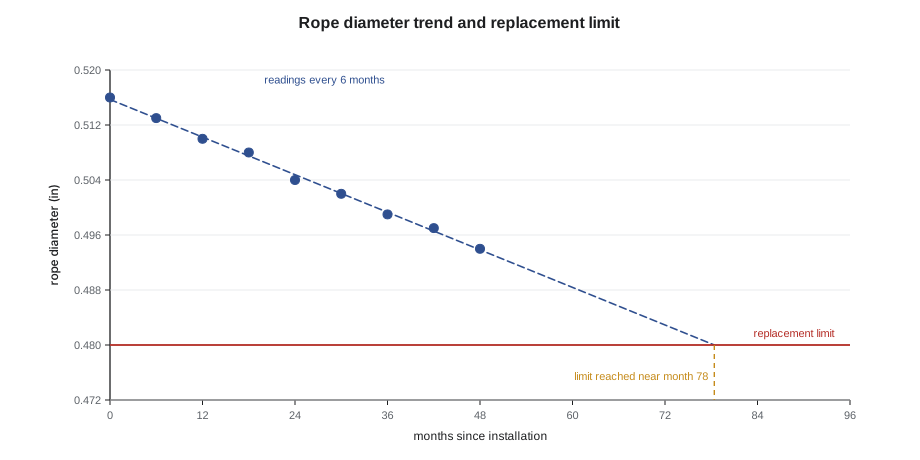
On the Seaview Medical visit in her third week, Tamsin found Ray on his knees in the machine room with a rope gauge, a notebook and a coffee going cold. He was measuring the diameter of each suspension rope on car 1 at three marked places, as he had done every six months for four years, and writing the numbers into a table that already filled two pages. “Ropes do not fail on the day you look at them,” he said. “They wear a little every month. If you measure the same place the same way every time, the numbers tell you when they will reach the limit, long before they get there. Then the owner gets a budget, not a surprise.” This lesson covers the three kinds of care that take up much of a planned visit: lubrication, cleaning and the measurement of wear, and how wear measurements are turned into a forecast.
Lubrication: the right amount in the right place
Lubrication reduces wear and heat where parts slide or roll against each other, but on an elevator it has to be done with care, because several parts depend on friction to work. The traction between ropes and sheave, the grip of safety jaws on rails, the hold of a brake and the clamping of a rope gripper all need surfaces that are not flooded with oil. Too little lubrication wears parts out; too much can cause loss of traction, slipping brakes or safeties that skid instead of gripping. The maker's procedures say what to lubricate, with what lubricant, how much and how often, and the program follows them.
Guide rails are the clearest example. Cars with sliding guide shoes usually run on lightly oiled rails, fed by lubricators on the car and counterweight that wipe a thin film onto the rail faces. Cars with roller guides run on dry rails, and oil on those rails makes the rollers skid and pick up dirt; the task there is to keep the rails clean and dry. Ray's first lesson at Seaview was a car that had been converted to roller guides years before, whose rail lubricators had never been removed from the counterweight: the counterweight side was oiled and the car side dry, and the oiled rail had collected a black paste of lint and dust that Tamsin spent an hour removing.
Suspension ropes are lubricated during manufacture, and over years the lubricant dries out or is worked out of the rope. A dry rope wears faster inside, where the strands rub against each other and the core. Some makers call for a light relubrication when the rope shows signs of drying, using a rope lubricant of the kind the rope maker specifies, applied sparingly so that the rope surface stays only slightly damp. Over-lubricating ropes is a known cause of lost traction, and on coated steel belts no lubricant is used at all. Worm gear machines such as Tillicum car 1 and the Pemberton car have gear cases whose oil level is checked every visit and whose oil is changed or analyzed at intervals set by the program; a sample showing bronze particles from the worm wheel, water or a change in viscosity is an early warning of gear trouble.
| Component | Usual care | Caution |
|---|---|---|
| Guide rails with sliding shoes | thin film from lubricators; top up and adjust felts | never oil rails that use roller guides |
| Suspension ropes | relubricate sparingly when the maker calls for it | excess oil reduces traction |
| Coated steel belts | clean only; no lubricant | lubricant can damage the coating |
| Worm gear case | check level every visit; change or analyze oil at set intervals | use the specified oil; watch for bronze, water |
| Machine and motor bearings | grease or oil as specified, or sealed for life | over-greasing can overheat bearings |
| Door hangers and tracks | clean; most rollers are sealed | oil on tracks collects dirt |
| Governor | as maker specifies; keep the rope groove clean | oil in the governor can affect tripping |
| Brake | pivot points only, as specified | no oil on linings or friction surfaces |
Cleaning
Cleaning sounds like the least skilled job on a visit, but it is one of the most important, and inspectors notice it immediately. Dirt in a door sill stops the door closing fully, which leads to door faults and callbacks. Dust on a controller's boards and in its fans makes components run hot and fail early. Oil and debris in a pit hide leaks, create a fire load and make the pit unsafe to work in. Debris on top of a car or in the hoistway can fall on someone or jam equipment. Lint and dust on oiled rails turn into the abrasive paste Tamsin removed at Seaview. The program sets intervals for cleaning each area, and the mechanic cleans what is found dirty on every visit whatever the schedule says.
Cleaning also lets the mechanic see. A clean pit floor shows a new oil spot at once; a clean machine shows a fresh leak; a clean controller shows a discolored terminal. Ray's view was that most of the value of cleaning was in the looking it forced: “You cannot clean something without examining it.”
What wears, and how it is measured
Many components wear slowly and predictably, and the program requires them to be measured at intervals so that their replacement can be planned. Measurements are only useful if they are repeatable: the same tool, at the same marked place, in the same conditions, recorded in the same units. Ray marked the rope measuring points on Seaview's ropes with paint, measured each rope across its widest diameter with a rope caliper whose jaws were wide enough to span two strands, and recorded all three readings for every rope.
| Component | What is measured | Why it matters |
|---|---|---|
| Suspension ropes | diameter at marked places; broken wires per lay; rouge (red dust) | replacement criteria in A17.6 and the program |
| Sheave grooves | groove depth and profile with a gauge; differences between grooves | uneven grooves load ropes unequally and wear ropes |
| Brake linings or pads | lining thickness; air gap; wear indicator | worn linings lose holding torque |
| Guide shoes and rollers | gib thickness; roller diameter and tire condition | worn guides let the car sway and wear rails |
| Door gibs, rollers and clutches | gib wear, roller diameter, clutch gap | worn gibs let panels leave the sill (ELV-320) |
| Coated belts | monitor readings; cover condition | the monitor triggers replacement |
| Hydraulic jack packing or seals | oil collected per month | a rising trend means seal wear |
Brake linings and pads are the second measurement Ray never skipped. On Seaview's gearless machines the disc brake pads have a minimum thickness set by the maker, and the brake's air gap grows as the pads wear; both were measured every three months. On Tillicum car 1's drum brake the lining thickness and the shoe clearance were measured, and the brake's holding was tested at the intervals in the program, which lesson 8 covers. A brake whose lining is near its limit is the one most likely to fail its next test.
Turning measurements into a forecast
A single reading says whether a part is within its limit today. A series of readings says how fast it is wearing and when it will reach the limit. The simplest forecast fits a straight line through the readings and projects it forward to the limit. Ray's Seaview rope readings, and the brake pad readings from the same car, were exactly that kind of series.
# Wear trend and projected replacement: least-squares straight line through repeat readings
def fit(xs, ys):
    n = len(xs); mx = sum(xs) / n; my = sum(ys) / n
    sxy = sum((x - mx) * (y - my) for x, y in zip(xs, ys)); sxx = sum((x - mx) ** 2 for x in xs)
    b = sxy / sxx
    return my - b * mx, b                     # intercept, slope per month

def project(name, months, values, limit, unit, now):
    a, b = fit(months, values)
    reach = (limit - a) / b                   # month at which the line reaches the limit
    print(f"{name}: wear {abs(b) * 12:.3f} {unit}/yr, latest {values[-1]:.3f} {unit}, limit {limit:.3f} {unit}, "
          f"projected to reach limit about {reach - now:.0f} months from now")

months = [0, 6, 12, 18, 24, 30, 36, 42, 48]           # months since the ropes were installed
rope = [0.516, 0.513, 0.510, 0.508, 0.504, 0.502, 0.499, 0.497, 0.494]                                        # worst rope, average of three marks
project("Seaview car 1 rope 3", months, rope, 0.48, "in", now=48)
pads = [0.315, 0.303, 0.295, 0.283, 0.272, 0.264, 0.252]                                        # brake pad thickness, readings every 3 months
project("Seaview car 1 brake pads", [0, 3, 6, 9, 12, 15, 18], pads, 0.157, "in", now=18)Seaview car 1 rope 3: wear 0.005 in/yr, latest 0.494 in, limit 0.480 in, projected to reach limit about 30 months from now Seaview car 1 brake pads: wear 0.041 in/yr, latest 0.252 in, limit 0.157 in, projected to reach limit about 28 months from now
The forecast gave the owner about 30 months' notice for the ropes and about 28 months for the brake pads, which let Lena propose doing both in one planned shutdown rather than two. A straight line is only a model. Ropes often wear slowly for years and then faster as the core dries and the strands begin to break, so Ray kept measuring at six months and would shorten the interval when the readings began to curve or when broken wires appeared. The forecast is also never a reason to leave a part in service past its criteria: if a rope shows the broken wires, rouge or other conditions that A17.6 and the program say mean replacement, it is replaced whatever its diameter says.
Sheave grooves and rope tension
On traction machines, the sheave grooves wear as well, and the wear is not always even. A groove that is deeper than its neighbors makes its rope run on a smaller effective diameter, so that rope carries more than its share of the load and wears faster, which deepens the groove further. ELV-230 showed how a deep groove on Tillicum car 1 was found and how the sheave was regrooved. On routine visits, groove depth is checked with a groove gauge or by measuring how far each rope sits below a straightedge across the sheave rim; differences beyond the maker's limit mean regrooving or replacement, usually at the next rope change. Rope tensions are checked at the same time and equalized when they differ by more than the program allows, commonly around ten percent from the average.
# Sheave groove check: how far each rope sits below a straightedge across the rim, Pemberton car
drops = {1: 0.161, 2: 0.169, 3: 0.22, 4: 0.165}      # rope number: depth below the straightedge, in
LIMIT = 0.04                                    # maker's limit on the difference between grooves, in (illustrative)
low, high = min(drops.values()), max(drops.values())
print(f"spread between grooves: {high - low:.3f} in (limit {LIMIT} in)")
for rope, d in drops.items():
    note = "deep groove, rope carries extra load" if d - low > LIMIT else ""
    print(f"rope {rope}: {d:.3f} in {note}")
print("action:", "plan regrooving at the next rope change and watch rope 3" if high - low > LIMIT else "none")spread between grooves: 0.059 in (limit 0.04 in) rope 1: 0.161 in rope 2: 0.169 in rope 3: 0.220 in deep groove, rope carries extra load rope 4: 0.165 in action: plan regrooving at the next rope change and watch rope 3
Rope 3 sat 0.06 in deeper than the shallowest groove, beyond the maker's limit, so Ray planned regrooving for the rope change already in the forecast and asked Tamsin to check rope 3's tension and condition more often until then. Units matter in wear records: the gauge, the maker's limit and the record must all use the same ones, and mixing them is a common source of mistakes.
Recording and reporting wear
Every wear reading goes into the record with the date, the tool and the place it was taken. When a forecast shows a replacement within the next year or two, the mechanic tells the route supervisor, and the supervisor tells the owner in writing with an estimate, so that the work can be budgeted and planned. When a reading reaches its limit, the part is replaced or the equipment is removed from service until it is. Hugh's audit in lesson 12 looks for exactly this chain: readings, trend, notice to the owner, planned replacement.
Worked problem
A reading that does not fit
Seaview car 2's rope diameters have fallen about 0.002 in each six months for three years. This visit, rope 5 measures 0.012 in smaller than last time at one mark, and the other ropes are unchanged. What should the mechanic do?
Show solution
- A sudden step on one rope at one place does not fit the trend and may mean local damage, a broken core or broken wires.
- Examine rope 5 closely along its length: broken wires, valley breaks, rouge, distortion or a flattened section.
- Re-measure at the mark and on either side of it to confirm the reading.
- If the rope meets any replacement condition, it is replaced; otherwise shorten its measuring interval and report the finding.
Answer: Treat the step as a possible local defect: examine and re-measure, replace if any criterion is met, and shorten the interval if not.
Common mistakes
MistakeOiling rails that run on roller guides.
InsteadRoller guides run on clean, dry rails; oil makes them skid and collect dirt.
MistakeOver-lubricating ropes.
InsteadExcess lubricant reduces traction; relubricate sparingly with the specified lubricant.
MistakeMeasuring wear at a different place each time.
InsteadMark the measuring points and use the same tool and method every time.
MistakeWaiting for a part to reach its limit before telling the owner.
InsteadForecast from the trend and give the owner notice to plan and budget.
MistakeKeeping a rope in service because its diameter is still within the limit.
InsteadAny replacement condition in A17.6 or the program means replacement, whatever the diameter.
Summary and key terms
- Lubricate where the maker specifies, with the specified lubricant and amount; friction surfaces such as traction grooves, brakes and safety rail faces must not be flooded.
- Sliding-shoe rails are lightly oiled; roller-guide rails are kept clean and dry; coated belts get no lubricant.
- Cleaning prevents faults and fires and lets the mechanic see leaks and damage.
- Wear is measured repeatably: same tool, same marked place, same units, every time.
- A straight-line fit through readings projects when a part reaches its limit and gives the owner notice.
- Groove depth differences and rope tensions are checked together; any replacement criterion overrides the forecast.
- Rail lubricator
- A device on the car or counterweight that applies a thin film of oil to the rail faces for sliding guide shoes.
- Rope caliper
- A caliper with wide jaws that spans at least two strands, used to measure rope diameter.
- Rouge
- Red-brown dust from internal rope wear, a sign that a rope needs close examination.
- Groove gauge
- A gauge for checking the depth and profile of sheave grooves.
- Wear trend
- A series of repeat measurements used to estimate how fast a part is wearing.
- Projected replacement
- The estimated date when a trend reaches the replacement limit.
Practice problems
Work each problem on paper first, then reveal the answer to check.
Why must traction grooves and brake linings stay free of excess oil?
Show answer
They rely on friction; oil can cause loss of traction or a slipping brake.
What is the care for rails used with roller guides?
Show answer
Keep them clean and dry; do not oil them.
How is a rope's diameter measured repeatably?
Show answer
With a rope caliper spanning at least two strands, at the same marked places each time.
What does a straight-line wear forecast give the owner?
Show answer
An estimated date for replacement, so the work can be planned and budgeted.
What does a deep groove do to its rope?
Show answer
It makes the rope carry more than its share of the load and wear faster.
Lesson quiz · 5 questions
Score 60% or more to complete this lesson.
Create a free account to save your progress, take quizzes and earn a certificate.