
ELV-420 · Lesson 3 of 12 · 22 min
Routine examinations and maintenance tasks
Ray let Tamsin lead her first full planned visit at the Pemberton Block, a seven-stop geared traction car in an old brick office building, with Ray standing back and saying nothing unless she was about to do something unsafe. She had done every individual task before, on other courses and other jobs. What she had not done was a whole visit: the order of the work, the safe transitions between the machine room, the car top and the pit, the decisions about what could wait and what could not, and the checkout before the car went back to the tenants. “Anyone can grease a rail,” Ray said afterwards. “The skill is doing forty small things in the right order, without missing one, without hurting yourself, and leaving the car better than you found it.” This lesson walks through a routine examination and maintenance visit by location, with the checks and the reasons behind them.
Before touching anything
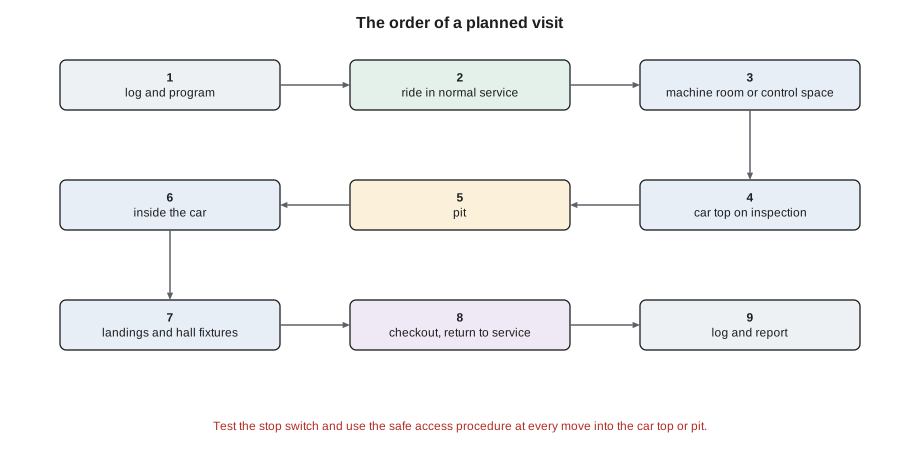
A visit starts at the log and the program. The mechanic reads the last entries, the open repair items, any callbacks since the last visit and the tasks due this month, and checks whether anything about the site has changed: a new tenant moving furniture, construction on a floor, a complaint from the owner. Then the mechanic rides the car in normal service from top to bottom and back, calling it from the hall and from the car, watching the doors, listening for noise from the machine and the hoistway, feeling the starts and stops, and checking that the car levels at each floor. Problems found on that ride are written down before any work begins, because once the car is on inspection operation the conditions that caused them may disappear.
The mechanic also confirms that the building is ready: that the machine room or control space is accessible, that the car can be taken out of service without trapping a resident who needs it, and that signs are in place at the main landing. In buildings with one car, such as the Pemberton Block, Ray always told the building manager how long the car would be out and checked whether anyone in the building needed it during that time. A tenant who uses a wheelchair is not a detail.
The machine room or control space
On a car with a machine room, most of the visit's examination work is there. The controller is examined for loose connections, heat discoloration, dust and the condition of contactors, relays and boards, and its fault log is read and cleared once the faults are understood. The drive's fault history is checked. The machine is examined for oil leaks, noise, vibration, the condition of the coupling and the oil level in the gear case. The brake is examined, its lining measured, its operation watched and its adjustment checked against the maker's values. The governor is examined, its rope checked where it passes over the sheave, its seals checked, and its switch tested if the program says so this month. The disconnects, lighting, ventilation and housekeeping of the room itself are checked too, because the code's requirements for the room continue to apply for the life of the equipment.
On a machine-room-less car such as Larchmont's, the same items are spread between the controller cabinet beside the top landing and the hoistway itself. The machine and brake are examined from the car top on inspection operation, with the car stopped and secured according to the maker's procedure, and the governor is examined in the hoistway. The visit takes longer, and more of it is spent in the hoistway, so the order of the work matters even more.
The car top
The car top gives access to the door operator, the car door and its contacts and hangers, the crosshead and the car's guide shoes or rollers, the suspension terminations, the landing system sensors, the car top inspection station, and the whole hoistway as the car moves through it. Moving from the landing to the car top, and back, is one of the most exposed moments of the visit, and the mechanic follows the safe access procedure from ELV-110 every time: test the hoistway door and car top stop switch, place the car on car top inspection, test the inspection direction buttons and the enabling button, and only then ride the car.
From the car top, the mechanic examines the door operator and its belts, linkages and lubrication; the car door gibs, rollers and clutch; the guide shoes or rollers for wear; and the ropes or belts at their terminations. Riding the car slowly through the hoistway on inspection, the mechanic examines the rails and brackets, the hoistway door interlocks and their engagement at each landing, the hall door hangers and closers, the landing system, the traveling cable and its hangers, the counterweight as it passes, and the hoistway itself for damage, debris or water. On Tillicum car 1 this was also where the rope condition was recorded each time, because those ropes were being watched against their replacement criteria.
The pit
Entering the pit follows its own procedure: the pit stop switch tested from the access door before climbing in, the car positioned and stopped, the lighting switched on, and the access ladder in good order. In the pit, the mechanic examines the buffers and their oil level if they are oil buffers, the compensation chains or ropes and their guides, the governor rope tension sheave and its switch, the bottom of the car and its safeties, the counterweight bottom and its runby, and the pit floor for water, oil or debris. On hydraulic cars, the pit is where the jack, its packing or seals, the pit oil and any scavenger pump are examined, and where the drip pan's contents tell the mechanic whether a seal is starting to leak. A dry, clean pit is the best evidence an inspector sees that a route is well run, and a wet or cluttered one suggests the opposite.
Inside the car and at the landings
Inside the car the mechanic checks the car lighting and the emergency light, the emergency communication by placing a call and confirming it reaches the monitoring point and identifies the car, the car operating panel buttons, indicators and key switches, the door reopening devices, the door closing force and time where due, the ventilation, and the condition of the cab. At each landing, the hall buttons and lanterns, the door gaps and alignment, the sills and the hall door unlocking device access are checked. The leveling of the car at each floor is measured, because poor leveling is a trip hazard and often the first sign of a problem in the landing system, the brake or, on a hydraulic car, the valve or a leak.
Firefighters' emergency operation is checked on the schedule the program and the jurisdiction set, with a record kept in the machine room or controller. On most visits the mechanic at least confirms that the Phase I key switch and the in-car switch are in place and that their keys are where the building's fire safety plan says they should be.
# Landing-by-landing check from a planned visit: level error and door close time (Pemberton car)
LIMIT_LEVEL = 0.5          # stopping accuracy limit, in
MIN_CLOSE = 3.2              # minimum door close time from the car's data plate, s
readings = {  # floor: (level error going up, level error going down, door close time)
    1: (0.08, -0.12, 3.4), 2: (0.16, -0.08, 3.5), 3: (0.24, -0.16, 3.4), 4: (0.20, -0.12, 3.1),
    5: (0.59, -0.08, 3.5), 6: (0.28, -0.20, 3.4), 7: (0.12, -0.08, 3.5),
}
problems = []
for floor, (up, down, close) in readings.items():
    flags = []
    if abs(up) > LIMIT_LEVEL or abs(down) > LIMIT_LEVEL:
        flags.append("level")
    if close < MIN_CLOSE:
        flags.append("closes too fast")
    print(f"floor {floor}: up {up:+5.2f} down {down:+5.2f} in, close {close:.1f} s  {'; '.join(flags) or 'ok'}")
    if flags:
        problems.append(floor)
print("floors to follow up:", problems)
ups = [v[0] for v in readings.values()]
print(f"average error going up: {sum(ups) / len(ups):+.2f} in (a consistent sign points to the stopping sequence, not one landing)")floor 1: up +0.08 down -0.12 in, close 3.4 s ok floor 2: up +0.16 down -0.08 in, close 3.5 s ok floor 3: up +0.24 down -0.16 in, close 3.4 s ok floor 4: up +0.20 down -0.12 in, close 3.1 s closes too fast floor 5: up +0.59 down -0.08 in, close 3.5 s level floor 6: up +0.28 down -0.20 in, close 3.4 s ok floor 7: up +0.12 down -0.08 in, close 3.5 s ok floors to follow up: [4, 5] average error going up: +0.24 in (a consistent sign points to the stopping sequence, not one landing)
Tamsin's readings showed floor 5 out of limit going up and floor 4's doors closing faster than the data plate allowed. Floor 5 turned out to be a landing vane that had been knocked on its bracket; floor 4 was a door operator speed setting that had drifted after the operator's controller board had been replaced the month before. Both were corrected and the readings repeated before the car went back in service. The small upward bias on every floor, she noticed, meant that the car tended to stop a little high going up, which was worth watching but within the limit.
Lubrication, cleaning and adjustment
Most visits include some lubrication and cleaning, which lesson 4 covers in detail, and some adjustment. The rule for adjustment is to adjust only what the measurements show needs it, to the maker's values, and to record the before and after values. A mechanic who adjusts a brake or a door operator by feel, without measuring, can make a car feel better and be less safe. Where an adjustment affects a safety function, such as a brake, a door closing force or a terminal device, the related test or check is repeated after the adjustment.
What can wait and what cannot
Every visit turns up findings. Some are fixed on the spot; some become planned repairs; and some mean the car cannot go back in service. The mechanic decides which is which, and the decision is part of the record. A worn but serviceable door roller can be ordered and replaced next visit. A hall door that can be opened with the car away from the landing, a brake that does not hold, a stop switch that does not stop, a safety circuit jumper left in place, or a suspension member past its replacement criteria cannot wait: the car is removed from service, the owner is told, and the car stays out until the hazard is fixed. Ray's rule was blunt: “If you would not put your own family in it, it does not go back in service.”
| Finding | Typical decision |
|---|---|
| Worn door roller, still running smoothly | order part, replace next visit, note in log |
| Noisy guide roller | plan replacement, examine others on the car |
| Car levels 3/4 in high at one floor | adjust and recheck before return to service |
| Hall door opens with car away | remove from service until repaired |
| Brake fails to hold | remove from service until repaired and tested |
| Rope past replacement criteria | remove from service until replaced |
| Jumper found on safety circuit | remove jumper, find why it was there, test the circuit |
Checkout and return to service
Before the car goes back in service, the mechanic follows the checkout procedure in the program. All jumpers and test connections are removed and accounted for, all covers and guards are replaced, the car is returned from inspection to normal operation, and the doors, door protection, emergency communication and stop switch are checked. The car is then run in normal service through several trips, called from the hall and the car, before the mechanic leaves. Finally the log is completed: tasks done, findings, readings, parts used and anything left open, with the mechanic's name and the date. Ray then told the building manager what had been done and what was planned, and left a note in the log for the next visit.
Worked problem
A finding at the end of the day
At 15:40, while checking out the Pemberton car, Tamsin notices that the car top stop switch does not open the safety circuit; the car still moves when the switch is pulled. What should she do?
Show solution
- A car top stop switch that does not stop the car is a hazard to anyone working on the car top.
- The car cannot go back in service with a defective stop switch.
- She should remove the car from service, tell Ray and the building manager, and find the fault (here, a switch with welded contacts).
- Replace the switch, test it, record the finding and the repair, then check out the car again.
Answer: Remove the car from service, repair and test the switch, record it, and only then return the car to service.
Common mistakes
MistakeStarting work before riding the car in normal service.
InsteadRide first; many faults disappear on inspection operation.
MistakeSkipping the stop switch test when entering the car top or pit.
InsteadTest the stop switch from the landing every time before entering.
MistakeAdjusting by feel.
InsteadMeasure, adjust to the maker's values, and record before and after values.
MistakeReturning a car to service with a known hazard to finish on time.
InsteadHazards keep the car out of service until fixed and tested.
MistakeLeaving without completing the log.
InsteadThe log is completed before leaving, with readings, findings and open items.
Summary and key terms
- A visit starts with the log and the program, then a ride in normal service before any work.
- Work is organized by location: machine room or control space, car top, pit, inside the car and the landings.
- Each move into the car top or pit follows the safe access procedure, with stop switches tested first.
- Measurements such as leveling and door close time are recorded and compared with limits.
- Findings are sorted into fix now, plan a repair, or remove from service; hazards keep the car out of service.
- The checkout procedure removes jumpers, restores normal operation, checks key functions and completes the log.
- Planned visit
- A scheduled maintenance visit following the tasks due in the program.
- Inspection operation
- Operation of the car at low speed from a car top or other inspection station, for maintenance and examination.
- Leveling accuracy
- How closely the car floor stops level with the landing; measured at each floor going up and down.
- Checkout procedure
- The steps in the program for confirming that equipment is safe before returning it to service.
- Removal from service
- Taking a unit out of use until a hazard is repaired and tested, with the owner informed.
Practice problems
Work each problem on paper first, then reveal the answer to check.
Why ride the car before starting work?
Show answer
To see faults that only appear in normal service.
What must be tested before entering the pit?
Show answer
The pit stop switch, from the access door, before climbing in.
Give two findings that mean a car cannot go back in service.
Show answer
A hall door that opens with the car away; a brake that does not hold; a suspension member past its criteria; a defective stop switch.
What is the rule for adjusting a safety-related device?
Show answer
Measure, adjust to the maker's values, record before and after, and repeat the related test.
What does a checkout procedure include?
Show answer
Removing jumpers and test connections, replacing covers, returning to normal operation, checking doors, protection, communication and stop switches, and running the car in service.
Lesson quiz · 5 questions
Score 60% or more to complete this lesson.
Create a free account to save your progress, take quizzes and earn a certificate.