
ELV-320 · Lesson 8 of 12 · 21 min
Car and counterweight safeties
The car safety is the mechanical device on the car frame that grips the guide rails and stops the car when the governor trips. It is the last line of defense against a falling or runaway car going down, and it is one of the oldest safety inventions in the trade: the famous demonstration in the 1850s, in which an inventor cut the only rope holding his platform in front of a crowd, was a demonstration of a safety. Modern safeties are far more refined, and the code requires them on every traction elevator car. This lesson explains the types, how a safety is operated by the governor, the stopping distance and deceleration the code allows, counterweight safeties, and how safeties are tested, reset and recorded. Lesson 12 carries out a full five-year test at Quayside.
Where safeties are and how they are operated
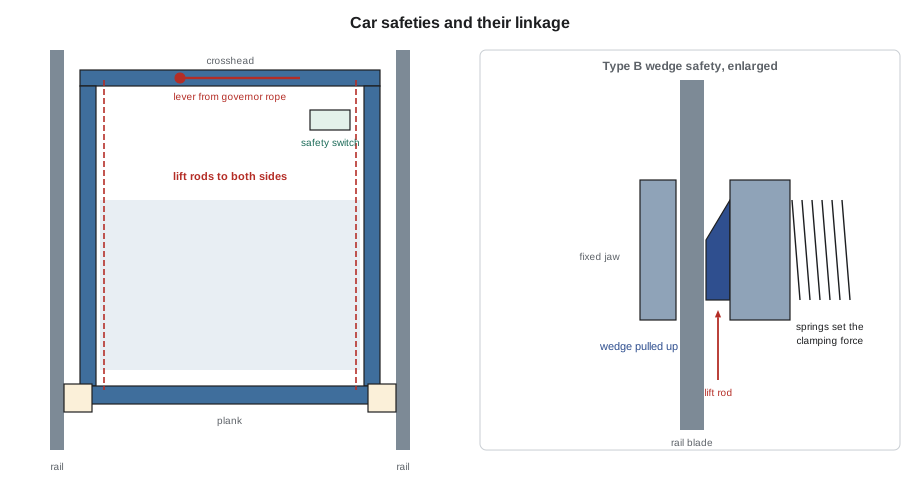
Safeties are mounted on the car frame, usually under the platform at the plank, one at each guide rail, so that each side grips its own rail. They are operated together through a linkage: the governor rope is attached to a safety operating lever on the crosshead, and lift rods run from the lever down the car frame stiles to the safety jaws on both sides. When the governor jaws grip the governor rope, the car's continued downward motion pulls the lever, the lift rods raise the safety wedges or jaws against the rails on both sides at once, and the safeties begin to grip. The linkage must apply both sides together, so that the car is not twisted, and it must reset when the car is raised. A safety-operated switch on the car opens the safety circuit as soon as the safety begins to apply, cutting power to the machine so that the drive does not fight the safety.
Types of safeties
The code recognizes three types. Type A safeties, called instantaneous safeties, grip the rail with a rapidly increasing force as the car moves; the stopping distance is very short and the deceleration high, so they are allowed only on slow cars, below a rated speed the code sets. Type B safeties apply a limited force to the rail, set by springs, so the car slides to a stop over a distance that depends on its speed and mass; these are the progressive safeties used on almost all passenger and modern freight cars. Type C safeties combine an instantaneous safety with oil buffers carried on the car, so the buffer stroke provides the stopping distance; they are rare. Within Type B, older designs include the flexible guide clamp, a pair of spring-loaded jaws closed by a wedge, and the wedge clamp safety driven by a drum and wire rope, which Tillicum car 1 has. Modern progressive safeties usually use a tapered wedge or roller pulled up between the rail and a spring-loaded block.
| Type | How it stops the car | Typical use |
|---|---|---|
| Type A (instantaneous) | grips with rapidly increasing force; very short stop | slow cars only, below the code's speed limit |
| Type B (progressive) | spring-limited clamping force; car slides to a controlled stop | most passenger and freight cars |
| Type C | instantaneous grip with stopping by oil buffers on the car | rare |
Stopping distance and deceleration
A Type B safety must stop the car with its rated load within limits the code sets. If the car stops too abruptly, passengers can be injured; if it stops too gently, it may not stop at all before the pit, or the stopping distance may be too long for the overtravel available. The code gives a table of maximum and minimum stopping distances for each governor tripping speed, and in practice the average deceleration of a correctly set Type B safety with rated load is a fraction of the acceleration of gravity, and never more than 1 g. The maker sets the springs to give a stopping distance within the table for the car's mass, and the test proves it.
# Five-year safety test: stopping distance to average deceleration
g = 32.2
tests = {"Quayside car 2, rated load, rated speed": (10.0, 4.0),
         "Tillicum car 1, rated load, rated speed": (4.47, 1.0)}
for name, (v, s) in tests.items():
    a = v * v / (2 * s)
print(f"{name}: tripped at {v} ft/s, stopped in {s} ft -> average {a:.1f} ft/s2 = {a / g:.2f} g")Quayside car 2, rated load, rated speed: tripped at 10.0 ft/s, stopped in 4.0 ft -> average 12.5 ft/s2 = 0.39 g Tillicum car 1, rated load, rated speed: tripped at 4.47 ft/s, stopped in 1.0 ft -> average 10.0 ft/s2 = 0.31 g
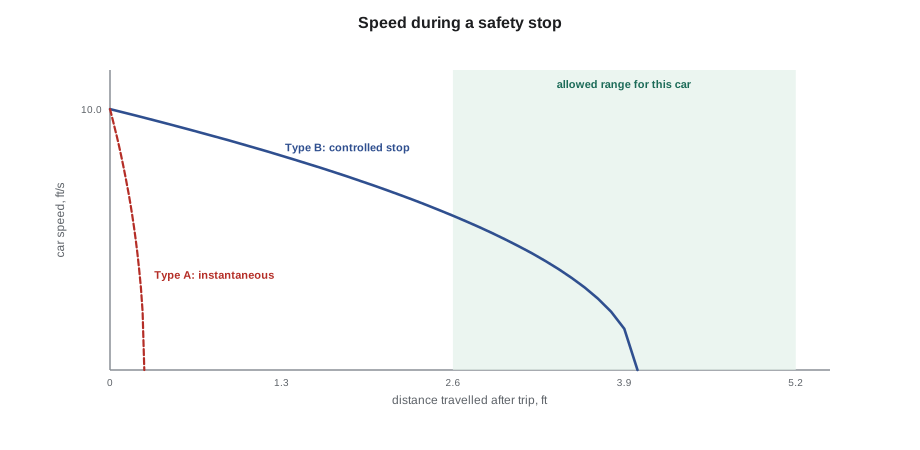
The speeds used are the governor tripping speeds measured in lesson 7, because the safety begins to apply at the moment the governor trips. Both stops are well under 1 g. Tillicum car 1 stops in a much shorter distance because it is going much more slowly; its deceleration is similar.
Stopping distance depends on the condition of the rails as well as the safety. Rails with heavy oil or grease on their blades give longer, less predictable stops, which is why the maker specifies what rail lubrication, if any, is allowed. Roller guide cars run on dry rails; cars with slide guides may use a light rail lubricator, and the safety is set and tested in that condition.
How much energy a safety absorbs
A safety stops a car by friction, turning the car's kinetic energy, and the potential energy it loses as it slides down, into heat in the safety blocks and rail. The larger the car and the faster it is going, the more energy the safety must absorb, and the maker's rating for a safety is a combination of the mass it can stop and the tripping speed. A safety fitted to a car that has been made heavier, by a new cab or added equipment, may no longer be rated for it, which is one reason a cab change is an alteration that must be checked.
# Energy absorbed and average braking force in a safety stop
g = 32.2
m = 6800               # car plus rated load, lb
v = 10.0               # tripping speed, ft/s
s = 4.0               # stopping distance, ft
ke = 0.5 * m * v * v / g
pe = m * g * s / g
force = (ke + pe) / s
print(f"kinetic energy {ke:,.0f} ft-lbf + potential energy {pe:,.0f} ft-lbf = {ke + pe:,.0f} ft-lbf")
print(f"average retarding force at the rails {force:,.0f} lbf, shared between two safeties")kinetic energy 10,559 ft-lbf + potential energy 27,200 ft-lbf = 37,759 ft-lbf average retarding force at the rails 9,440 lbf, shared between two safeties
Quayside car 2 with its rated load has a mass of about 6,800 lb. The safeties absorb tens of thousands of foot-pounds in a stop of little more than four feet, which is why the blocks and rails show bright marks after a test and the rails must be dressed afterward. On the US calculation, dividing by g converts pounds of weight to mass so that the energy comes out in foot-pounds and the force in pounds-force.
Counterweight safeties
A counterweight normally has no safeties: if it falls, it lands on its buffer in the pit. But where there is an occupied space below the hoistway, such as a parking garage, a storage room or a corridor under the pit, the code requires either counterweight safeties or a pit floor and foundation strong enough to stop a falling counterweight, so that a falling counterweight cannot break through. Quayside's lowest landing is above a basement storage room, and its counterweights have safeties operated by their own governors, which trip at a slightly higher speed than the car governors so that the car safeties set first in an overspeed that affects both. Counterweight safeties are tested on the same schedule as the car's.
Testing, resetting and recording
Each year, the safeties are tested without load: the car is run down at a slow speed, usually inspection speed, and the governor is tripped by hand; the safeties must set, stop the car and hold it, and the safety switch must open. Every five years, the full test is done: the car is loaded with its rated load, run down at rated speed, and the governor tripped, either by hand at the governor or by the test method the maker allows. The stopping distance is measured from the marks on the rails, the car platform is checked for tilt, because uneven setting on the two sides tilts the car, and the stopping distance is compared with the maker's range and the code table. On machine-room-less cars and some others, the test is done by a procedure from the maker using the controller's test functions.
# Platform tilt after the safety test: compare the two skid marks
left, right = 4.0, 3.85          # length of rail marks on each side, ft
width = 6.25                      # distance between the rails, ft
diff = abs(left - right)
tilt = diff / width * 100
print(f"marks {left} and {right} ft, difference {diff:.2f} ft over {width} ft between rails -> tilt about {tilt:.1f} %")
print("check the maker's and the code's tilt limit; unequal marks mean one side set late or weak")marks 4.0 and 3.85 ft, difference 0.15 ft over 6.25 ft between rails -> tilt about 2.4 % check the maker's and the code's tilt limit; unequal marks mean one side set late or weak
After the test, the car is raised off the safeties on inspection, which releases the wedges, and the safety switch is reset by hand on the car. The rail blades are dressed with a file or stone to remove the marks and any raised metal, because a burr will chatter the guides and may make the next stop uneven. The test, the load used, the speed, the stopping distance, the tilt and the condition of the rails are recorded, and in Washington the five-year test is witnessed or reported as the jurisdiction requires.
Worked problem
A safety that sets on one side only
During Tillicum car 1's annual no-load test, the car stops but tilts noticeably and the marks are on the left rail only. What could be wrong and what must be done?
Show solution
- A safety that sets on one side only means the linkage did not lift both sides together, or one side's jaws did not reach the rail.
- Check the lift rods and linkage for binding, bent rods, worn pins and seized pivots; check the right side's jaw clearance to the rail and the drum and wire rope on this older wedge clamp design.
- Check the right rail for heavy oil, which can let the jaw slip without marking.
- Repair, lubricate pivots as the maker specifies, set the jaw clearances, then repeat the test until both sides set together. The car stays out of service until it passes.
Answer: One-sided setting is a linkage or clearance fault; the car stays out of service until both sides set together on retest.
Safeties on roped hydraulic cars
Safeties are not only for traction cars. A roped hydraulic car, like Dunmore Square's 2:1 car from ELV-220, hangs from ropes running over a sheave on the jack, so it can fall if the ropes fail, and the code requires it to have car safeties. They may be operated by a governor, as on a traction car, or on some designs by a slack-rope device that applies the safeties when the ropes go slack. Direct-acting hydraulic cars, whose platform sits on the plunger, do not have safeties; they rely instead on the rupture valve and the other hydraulic protection described in ELV-220. Dunmore Square's safeties are tested on the same yearly and five-year schedule as Quayside's.
Common mistakes
MistakeLeaving the rails marked after a safety test.
InsteadDress the rail blades to remove marks and raised metal.
MistakeForgetting to reset the safety switch.
InsteadThe car cannot run until it is reset by hand; check it after every test.
MistakeAdding mass to a car without checking the safety rating.
InsteadA heavier cab can exceed the safety's rated mass for its tripping speed.
MistakeOiling rails on a car whose safety was not set for it.
InsteadFollow the maker's rail lubrication rules; oil lengthens stops.
MistakeAccepting a test with the car tilted.
InsteadTilt means uneven setting; find the cause and retest.
Summary and key terms
- Car safeties grip the guide rails to stop the car when the governor trips, operated through the lever and lift rods.
- Type A safeties stop instantly and are limited to slow cars; Type B safeties use spring-limited force for controlled stops; Type C use oil buffers.
- A Type B stop's average deceleration is a fraction of g and never above 1 g, within the code table's distances.
- Safeties absorb the car's kinetic and potential energy as heat; a heavier car may exceed the rating.
- Counterweight safeties are needed where there is an occupied space below the hoistway.
- Safeties are tested yearly without load and every five years with rated load at rated speed, then reset, rails dressed and results recorded.
- Car safety
- A mechanical device on the car frame that grips the guide rails to stop the car.
- Type B safety
- A progressive safety that applies a spring-limited force so the car slides to a controlled stop.
- Lift rods
- Rods linking the safety operating lever to the safety jaws on both sides of the car.
- Safety-operated switch
- A switch on the car that opens the safety circuit when the safety applies.
- Counterweight safety
- A safety on the counterweight, required where there is occupied space below the hoistway.
- Rail dressing
- Filing or stoning rail blades to remove marks after a safety test.
Practice problems
Work each problem on paper first, then reveal the answer to check.
What operates the car safeties when the governor trips?
Show answer
The governor rope pulls the safety operating lever, and lift rods raise the jaws on both sides.
Why are Type A safeties limited to slow cars?
Show answer
They stop the car almost instantly, with a deceleration too high for faster cars.
A car trips at 10.0 ft/s and stops in 4.0 ft. What is its average deceleration?
Show answer
About 12.5 ft/s2, or 0.39 g.
When are counterweight safeties required?
Show answer
When there is an occupied space below the hoistway, unless the pit is built to stop a falling counterweight.
What is done after a safety test?
Show answer
Raise the car off the safeties, reset the safety switch, dress the rails, and record the results.
Lesson quiz · 5 questions
Score 60% or more to complete this lesson.
Create a free account to save your progress, take quizzes and earn a certificate.