
ELV-320 · Lesson 7 of 12 · 21 min
Governors and governor ropes
A car that is going too fast must be stopped, whatever the cause: a failed brake, a broken shaft or gear, a drive that has lost control, or in the worst case broken suspension. The speed governor is the device that detects overspeed and starts the stop. It does two things in sequence. At a speed a little above rated speed, it opens an electric switch that cuts power to the machine and sets the brake. If the car keeps accelerating, it grips its own rope, and the rope, tied to the car, pulls the lift rods that apply the car's safeties to the guide rails. Ray took Tamsin up to Tillicum car 1's machine room to see a flyball governor that had been doing this job, unneeded, since 1962. "It has never tripped in anger," he said. "That is the point. We test it so that we know it would."
How a governor detects speed
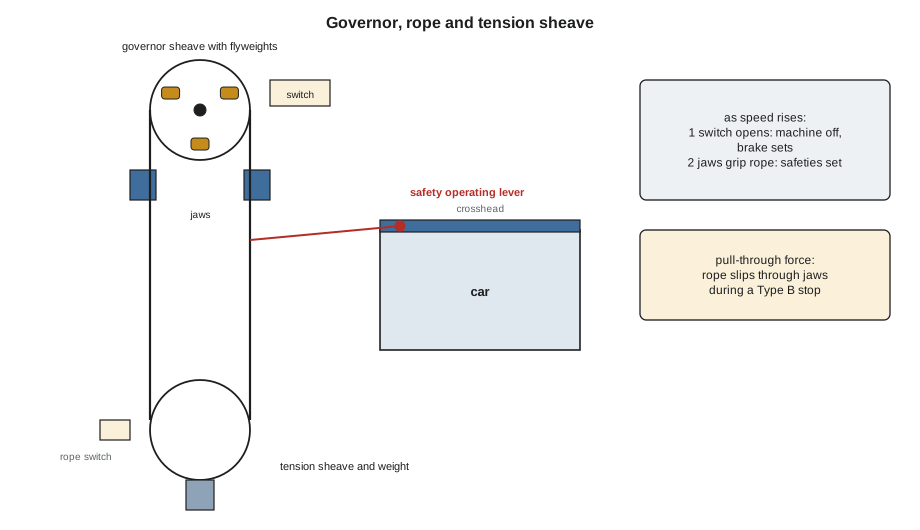
A governor is driven by its own rope, which runs from an attachment on the car, up over the governor sheave, down to a weighted tension sheave in the pit, and back up to the car, so the rope and sheave move exactly with the car. The governor senses the sheave's speed mechanically. On a flyball governor, the older vertical-shaft type on Tillicum car 1, two weighted balls on arms spin with the shaft and swing outward as speed rises, lifting a collar against a spring; at the switch speed the collar operates the overspeed switch, and at the tripping speed it releases a latch that drops the jaws onto the rope. On the horizontal-shaft governors common today, like Quayside's, flyweights pivoted on the sheave itself swing outward against springs as the sheave turns faster, and at the set speeds they strike the switch and then a trip latch. Some machine-room-less cars use governors mounted on the car that run on a fixed rope, and newer designs use electronic speed measurement for the switch, but the purpose and tests are the same.
Switch speed and tripping speed
The code sets two speeds. The tripping speed, at which the governor grips its rope and sets the safeties, must be at least 115 % of rated speed, so that normal running variations never trip it, and no higher than a maximum that depends on rated speed and is given in a code table. The overspeed switch must open before the jaws grip, at or below a maximum the table also gives, so that the machine is shut off and the brake set first; on many cars that alone stops the car and the safeties are never needed. On slow cars the code does not require a separate overspeed switch on the car governor, because the tripping speed is low. Governors on counterweights, where counterweight safeties are fitted, trip a little higher than the car's.
| Rated speed | Maximum governor tripping speed | Maximum overspeed switch speed (down) |
|---|---|---|
| 125 ft/min or less | 175 ft/min | switch not required on car governor |
| 200 ft/min | 280 ft/min | 252 ft/min |
| 300 ft/min | 395 ft/min | 355 ft/min |
| 500 ft/min | 625 ft/min | 563 ft/min |
| 1,000 ft/min | 1,200 ft/min | 1,140 ft/min |
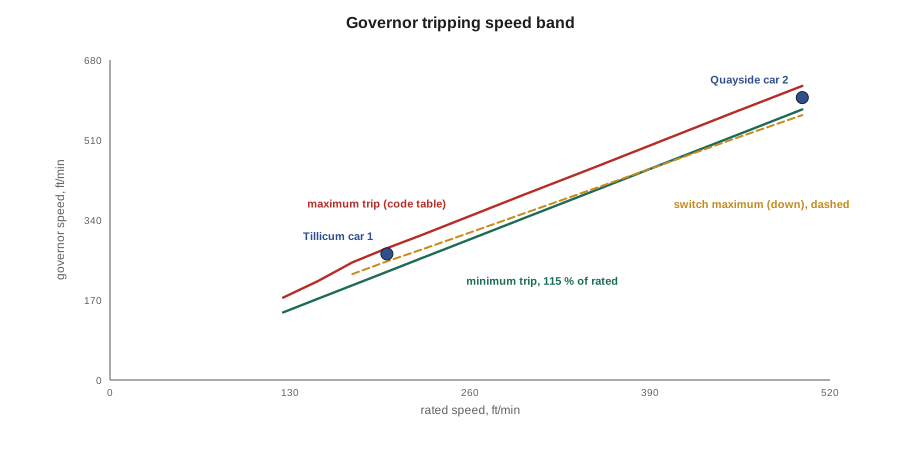
# Governor test results against the code table (Tillicum car 1 and Quayside car 2)
cars = {
    "Tillicum car 1": dict(rated=200, trip_max=280, switch_max=252, trip=268, switch=244),
    "Quayside car 2": dict(rated=500, trip_max=625, switch_max=563, trip=600, switch=575),
}
for name, c in cars.items():
    trip_min = 1.15 * c["rated"]
    ok_trip = trip_min <= c["trip"] <= c["trip_max"]
    ok_sw = c["switch"] <= c["switch_max"] and c["switch"] < c["trip"]
    print(f"{name}: trip {c['trip']} ft/min (allowed {trip_min:.0f} to {c['trip_max']}) -> {'ok' if ok_trip else 'OUT OF RANGE'}")
print(f"{'':16}switch {c['switch']} ft/min (max {c['switch_max']}, must open before trip) -> {'ok' if ok_sw else 'OUT OF RANGE'}")Tillicum car 1: trip 268 ft/min (allowed 230 to 280) -> ok
switch 244 ft/min (max 252, must open before trip) -> ok
Quayside car 2: trip 600 ft/min (allowed 575 to 625) -> ok
switch 575 ft/min (max 563, must open before trip) -> OUT OF RANGETillicum car 1's governor is within limits. Quayside car 2's tripping speed is fine, but its overspeed switch opened above the table maximum during the five-year test. The switch had been reset during an earlier repair without being checked. Priya adjusted it by the maker's procedure, retested, and sealed it.
The governor rope and tension sheave
The governor rope is a wire rope of smaller size than the hoist ropes, with a minimum diameter set by the code and a construction suited to the governor sheave, commonly 3/8 in on cars of Tillicum's age. It must be of the size, construction and material shown on the governor's marking plate, because the jaws and the pull-through setting are designed for that rope. It must be replaced when it is worn, stretched, kinked or has broken wires beyond the limits in the inspection guide, and a stretched rope that lets the tension sheave drop too far will eventually open the tension sheave switch. That switch, on the tension sheave frame in the pit, opens the safety circuit if the rope breaks or stretches excessively, because a governor with a slack or broken rope cannot set the safeties. Northcrest records the tension sheave's position at each maintenance visit so that stretch shows up as a trend.
The rope is attached to the car's safety operating mechanism, usually a lever on the crosshead, so that when the governor jaws grip the rope, the car's continued motion pulls the lever and applies the safeties. The attachment must be strong enough for the pull-through force with a large margin, and the rope ends are made up with fittings the code allows, not clips.
Pull-through force
When the jaws grip, they must hold the rope hard enough to set the safeties, but on the progressive Type B safeties used on most passenger cars, they must then let the rope slip through so that the rope is not broken as the car decelerates over its stopping distance. The force at which the rope slips through the jaws is the pull-through force. The code limits it to no more than one-fifth of the rope's rated breaking strength, and the maker sets a range high enough to apply the safeties reliably. The setting is shown on the governor's marking plate and checked during the five-year test with a dynamometer: the jaws are tripped onto the rope by hand, the rope is pulled through with a come-along or the car on inspection and the dynamometer reads the force.
# Governor rope pull-through check
breaking = 6100                 # rated breaking strength of the governor rope, lbf
code_max = breaking / 5          # code limit: no more than one-fifth
maker_low, maker_high = 500, 650  # maker's range on the marking plate, lbf
readings = [550, 565, 560]      # three pulls with the dynamometer
avg = sum(readings) / len(readings)
print(f"code maximum {code_max:.0f} lbf; maker's range {maker_low} to {maker_high} lbf")
print(f"measured average {avg:.0f} lbf -> " + ("ok" if maker_low <= avg <= min(maker_high, code_max) else "adjust jaw springs and retest"))code maximum 1220 lbf; maker's range 500 to 650 lbf measured average 558 lbf -> ok
The figures are illustrative but in proportion: the pull-through force is a small fraction of the rope's strength, so the rope is never in danger when it slips, and the maker's range sits well inside the code's limit. A jaw spring that has weakened shows up as a low reading, which would mean the safeties might not apply firmly.
Testing governors
Governors are tested on the same yearly and five-year schedule as the safeties they operate. Each year the governor is examined, its parts checked for wear, free movement and lubrication where the maker calls for it, the overspeed switch operated by hand to prove it stops the car, and the governor tripped, usually by hand at the governor with the car moving slowly on inspection, to prove that the jaws grip and the safeties set. Every five years, the tripping speed and switch speed are measured by running the governor up to speed, either by driving the sheave with a variable-speed test tool with the rope removed or by other means the maker allows, and the pull-through force is measured. After the test, the governor's adjustments are sealed, so that any later change is visible. A broken seal is a reason to retest.
# Flyball governor: shaft speed to car speed at the moment of trip
import math
sheave_d = 1.0           # governor sheave pitch diameter, ft
gear = 3.0                # shaft revolutions per sheave revolution (bevel gear ratio)
trip_rpm = 260          # flyball shaft speed at which the latch released on the test stand
car_speed = trip_rpm / gear * math.pi * sheave_d
print(f"trip at {trip_rpm} rpm on the flyball shaft -> car speed {car_speed:.0f} ft/min")trip at 260 rpm on the flyball shaft -> car speed 272 ft/min
Tillicum's flyball governor is tested on a stand by driving its sheave and reading the shaft speed at trip; the calculation turns that into car speed. Ray keeps a card in the machine room with the results of every test since he took over the route, and the trip speed has not moved in twenty years.
Worked problem
A governor that tripped on a normal run
Larchmont's car stops on a governor overspeed switch fault while running down at rated speed with a light load, and the remote governor reset is used to restore it. Two days later it happens again. What should Priya check?
Show solution
- A governor switch opening at rated speed means either the switch is set too close to rated speed or the car really is overspeeding briefly.
- Check the drive's speed records: a brief overspeed on starting down with a light car can come from the drive's tuning or from the brake dragging and releasing late.
- Check the governor itself: switch setting against the marking plate, flyweight springs, and whether a worn rope or a groove problem makes the rope slip and jerk on the sheave.
- Correct the cause, test the switch speed, reseal, and record. Do not adjust the switch upward just to stop the trips.
Answer: Find whether the car is truly overspeeding or the governor is set low; adjusting the switch to cure nuisance trips without that is not acceptable.
Governors on machine-room-less cars
Larchmont's car has no machine room, so its governor is mounted at the top of the hoistway beside the machine, with the tension sheave in the pit as usual. Two features make it workable. The governor has an electrical tripping actuator, a solenoid that can drop the jaws on command, so that the safety test can be started from the controller cabinet at the top landing instead of by reaching the governor by hand, and so that the safety board can trip it for the unintended movement function. And it has a remote reset: after the overspeed switch has opened or the jaws have tripped, a reset coil, again operated from the controller cabinet, resets the governor without anyone climbing onto the car top. Both features are covered by the governor's certification and the maker's instructions, and both must be tested at the intervals the maintenance control program sets.
Remote reset is a convenience, not a cure. A governor that trips must be investigated before it is reset, as the example below shows, and Priya's rule is that a second trip in a week means a site visit, not another remote reset. A governor in the hoistway also needs a safe way for the mechanic to reach it for its yearly examination and its five-year test, usually from the car top on inspection with the car stopped at a marked position and the car top barricade raised; that access is part of the job hazard analysis for every governor visit at Larchmont.
Common mistakes
MistakeFitting a governor rope of a different size or construction.
InsteadUse the rope shown on the governor's marking plate.
MistakeIgnoring a dropping tension sheave.
InsteadRecord its position; a stretched rope will open the tension switch and must be replaced.
MistakeAdjusting a governor switch upward to stop nuisance trips.
InsteadFind whether the car is overspeeding or the governor is set wrong.
MistakeReturning a governor to service with a broken seal and no retest.
InsteadA broken seal means the setting may have changed; test and reseal.
MistakeMaking up a governor rope end with rope clips.
InsteadUse the fittings the code and maker allow.
Summary and key terms
- The governor detects overspeed, first opening the overspeed switch, then gripping its rope to set the car safeties.
- Tripping speed must be at least 115 % of rated speed and no more than the code table maximum; the switch opens first.
- Flyball governors and sheave-mounted flyweight governors both sense rope speed mechanically.
- The governor rope must match the marking plate; the tension sheave switch opens if the rope breaks or stretches too far.
- Pull-through force on Type B safeties is limited to one-fifth of the rope's breaking strength and set by the maker.
- Governors are examined and tripped yearly, speed- and pull-through-tested every five years, and sealed.
- Speed governor
- The device that detects car overspeed, opens the overspeed switch and trips the safeties.
- Tripping speed
- The speed at which the governor grips its rope to set the safeties.
- Overspeed switch
- The governor switch that removes power from the machine and sets the brake before the jaws trip.
- Tension sheave
- The weighted pit sheave that keeps the governor rope taut, with a switch for a broken or stretched rope.
- Pull-through force
- The force at which the governor rope slips through the gripping jaws.
- Marking plate
- The plate on the governor stating its speeds, rope and pull-through settings.
Practice problems
Work each problem on paper first, then reveal the answer to check.
What are the two actions of a governor, in order?
Show answer
Open the overspeed switch to cut power and set the brake, then grip the rope to set the safeties.
What is the minimum tripping speed?
Show answer
115 % of rated speed.
For a car rated at 500 ft/min, what are the maximum tripping and switch speeds in the code table?
Show answer
625 ft/min to trip and 563 ft/min for the switch.
Why must a Type B governor let the rope slip through?
Show answer
So the rope is not broken while the car decelerates over the safety's stopping distance.
What does the tension sheave switch detect?
Show answer
A broken or excessively stretched governor rope.
Lesson quiz · 5 questions
Score 60% or more to complete this lesson.
Create a free account to save your progress, take quizzes and earn a certificate.