
ELV-230 · Lesson 9 of 12 · 21 min
Coated steel belts and suspension monitoring
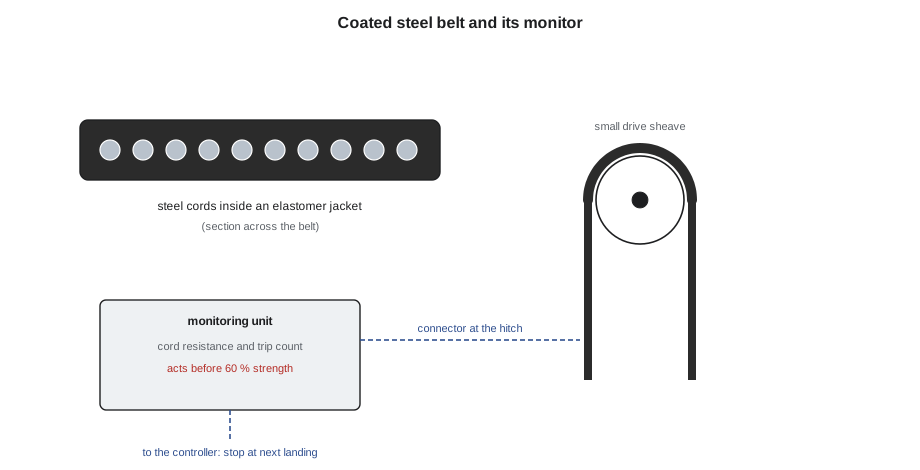
Larchmont Residences is the newest building on Route 7: an eight-story rental building with a single machine-room-less car that opened last year. Tamsin's first visit there was a surprise. When she brought the car to the top on inspection and looked across at the machine, she saw no ropes at all. Three flat black bands, two or three inches wide, ran from a hitch at the top of the hoistway down under the car, up over a small drive sheave hardly bigger than a dinner plate, and down to the counterweight. "Coated steel belts," Priya said. "Steel cords inside, polyurethane outside. You can't count broken wires on them, because you can't see a single wire. So the car watches them for you, and you watch the thing that watches." This lesson is about coated steel belts and the devices that monitor them and other suspension means.
What a coated steel belt is
A coated steel belt is a flat suspension member made of several small steel wire cords lying side by side, encased in a polyurethane or similar elastomer jacket. Each cord is a tiny wire rope, a small fraction of an inch in diameter. Because the cords are small, the belt bends easily over a small sheave without high bending stress in the wires. The jacket protects the cords, grips the sheave and makes the belt quiet. Belts were introduced on low- and mid-rise MRL elevators around 2000 and are now used by several makers, each with its own design. Other non-traditional suspension means include ropes with a polymer cover and, on very high-rise cars, ropes with a carbon fiber core, each with its own rules from its maker.
Belts bring three main advantages. The small sheave means a small, low-torque machine, so the machine can be compact enough to mount in the hoistway on a light car. Belts need no lubrication; the jacket keeps the cords clean and lubricant would harm the jacket and the traction. And belts are quiet and give a smooth ride. Their main disadvantage is that the condition of the steel inside cannot be seen. A wire rope wears and breaks from the outside first, where a mechanic can count the breaks; a belt's cords are hidden, so their condition must be measured another way.
Rules for belts
Because belts are not wire ropes, the codes treat them as their own kind of suspension means. ASME A17.1 requires belts and their terminations to meet ASME A17.6 whose part on noncircular elastomeric-coated steel suspension members sets their design, testing and replacement criteria. The machine maker's instructions give the details for each belt type, and those instructions are part of the maintenance control program. The key requirements are these.
- Monitoring. Every car with coated steel belts must have a device that detects the loss of residual strength in the belts and acts before any belt falls to 60 percent of its rated breaking force. When it acts, it stops the car at the next available landing and prevents normal operation; only inspection or hoistway access operation is then possible, and the device stays latched until it is reset by hand.
- Replacement criteria. A belt must be replaced when its jacket is worn through so that the cords show, when steel strands protrude through the jacket, when red rouge appears, when the load-carrying cords are damaged, for example by something in the hoistway, or when the residual strength reaches the replacement point. Damage to the jacket alone does not always require replacement if the cords are intact, but it must be assessed under the maker's instructions.
- Testing. The residual strength detection device and any broken suspension member device must be tested regularly, at least yearly, by simulating each condition it is meant to detect.
- Never defeat the monitor. A residual strength device is never disabled or bypassed, and a trip or cycle counter is never reset without replacing the belts it counts.
Makers also give belts a service life, often expressed as a number of years or a number of trips or bending cycles, whichever comes first, after which the belts are replaced even if the monitor has not acted. A typical figure in the industry is about fifteen years or a few million trips, but the values for each belt type are the maker's, and they depend on the sheave size and the number of bends per trip.
How belts are monitored
Several methods are used, depending on the maker. The most common measures the electrical resistance of the steel cords. A small current is passed through the cords from one end of the belt to the other, through connectors at the hitch, and the resistance is measured continuously or at intervals. As wires in a cord break or corrode, the cord's resistance rises, and a broken cord shows as an open circuit. The monitoring unit compares the resistance with its value when new and with limits that correspond to the residual strength criterion. Other methods count the bending cycles each part of the belt has made, from the car's trip record and the sheave geometry, and compare the count with the belt's tested life; some systems combine both.
Priya's monitoring check at Larchmont has three parts. First, she reads the monitoring unit's status and history from the controller: the current condition of each belt, any warnings, the trip or cycle count and any events since the last visit. Second, she tests the device as the maker requires, by simulating a broken belt and a belt at the replacement point, usually by opening or adding resistance in the monitoring circuit with the maker's test tool, and confirms that the car stops at the next landing and will not run normally until reset. Third, she inspects the belts themselves along their whole length from the car top at slow speed, looking at the jacket for wear, cuts, cracks, contamination and any sign of the cords showing, and at the hitches and connectors for security and damage.
# Larchmont belts: trend the monitoring readings and the trip count against the replacement points
readings = [  # year, residual strength index from the monitor for each belt (100 = new; illustrative)
    (2025.0, [100, 100, 100]),
    (2025.5, [99, 99, 98]),
    (2026.0, [98, 97, 96]),
    (2026.5, [97, 96, 93]),
]
replace_at = 60                     # the device must act before 60 % of rated breaking force
for b in range(3):
    t0, v0 = readings[0][0], readings[0][1][b]
    t1, v1 = readings[-1][0], readings[-1][1][b]
    rate = (v0 - v1) / (t1 - t0)    # index points lost per year
    years = (v1 - replace_at) / rate if rate > 0 else float("inf")
    print(f"belt {b + 1}: index {v1}, losing {rate:.1f} per year, about {years:.0f} years to the replacement point")
trips_per_year = 160000
trips = 1.5 * trips_per_year
trip_life = 3000000                 # maker's trip limit for this belt (illustrative)
print(f"trips so far {trips:,.0f}: about {(trip_life - trips) / trips_per_year:.0f} years left on the maker's trip limit")belt 1: index 97, losing 2.0 per year, about 18 years to the replacement point belt 2: index 96, losing 2.7 per year, about 14 years to the replacement point belt 3: index 93, losing 4.7 per year, about 7 years to the replacement point trips so far 240,000: about 17 years left on the maker's trip limit
The trend shows two belts wearing slowly and alike, and belt 3 losing strength faster than the others: in absolute terms the readings are fine, but the difference is worth investigating. Uneven wear between belts often means uneven tension, a tracking problem on the sheave or a contaminated belt. Priya found that belt 3's tension spring at the top hitch was compressed noticeably more than the others, so belt 3 was carrying more than its share of the load. She equalized the tensions following the maker's procedure, which uses spring length and a measured frequency of vibration, and noted the reading so that the next visits would show whether the faster wear had stopped.
When the monitor acts
Larchmont's monitor has acted once, in the car's first winter. The car stopped at the fifth floor in the evening, opened its doors, let the passengers out and refused to run. The controller's log showed the residual strength device had latched with a broken suspension member signal on belt 2. Northcrest's on-call mechanic treated it as real until proved otherwise: the car stayed out of service, and the building was told it would stay out until the belts had been examined. The next morning, Priya and a second mechanic inspected belt 2 along its full length from the car top and found nothing wrong with the jacket. The monitor's own diagnostics then showed the open circuit was at the connector on the hitch end of belt 2, where a cable clip had worked loose and let the connector pull partly out of its socket. Priya measured the cord circuit with the connector reseated and found it matched the other belts and the commissioning value, replaced the clip, tested the device by simulating both conditions as the maker requires, and only then reset it and returned the car to service.
The lesson she drew for Tamsin was about order. A monitor trip is first a possible failure of the suspension, and the car does not run until the belts are proved sound. Only after that is a connector or wiring fault accepted as the cause, and even then the device is tested before it is reset. Every trip, real or not, is recorded, because a pattern of nuisance trips on one belt can itself point to a developing problem.
Handling and installing belts
Belts are robust in service but easy to damage when they are handled. The maker's instructions for Larchmont's belts, which Tamsin read before helping on a belt inspection, list the rules that apply to most belt types.
- Keep belts on their reels until they are installed, and unreel them without twisting. A belt installed with a twist will not track on the sheave and will wear its edges.
- Never bend a belt sharply, kink it, step on it or drag it over sharp edges. A crease can break the cords inside without visible damage to the jacket.
- Keep oils, greases, solvents and cleaning chemicals away from belts and sheaves. Many solvents attack the jacket, and lubricant on a belt destroys its traction. Clean belts only as the maker says, usually with a dry cloth.
- Install and terminate belts only with the maker's terminations, tools and procedure, with the electrical connectors for the monitor fitted to the right cords.
- Set and equalize belt tensions as the maker specifies, then check tracking on the sheave at slow speed in both directions.
- Protect belts from welding spatter, grinding sparks and heat when other work goes on in the hoistway.
Belts are also more sensitive than ropes to things in the hoistway. A loose cable tie, a protruding bolt or a damaged guard that touches a moving belt can cut the jacket and damage cords in a few trips. Part of every belt inspection is looking at what is near the belts' path.
Monitoring wire ropes
Monitoring is not only for belts. Some new traction machines with small ropes have rope monitoring devices too, and electromagnetic rope testing is used on high-rise cars and in some inspection programs. In electromagnetic testing, the rope passes through a magnetizing head, and sensors detect the magnetic flux leakage caused by broken wires and loss of steel cross-section, inside the rope as well as outside. The result is a trace along the rope that shows broken wire clusters and loss of metallic area that a visual inspection cannot find, especially in steel-core ropes on small sheaves. Electromagnetic testing does not replace visual inspection, and it needs a trained operator and calibration, but on a car with rouge or a history of internal breaks it can show whether a rope is failing from within.
| Suspension means | Main inspection method | Monitoring | Typical replacement trigger |
|---|---|---|---|
| Steel wire rope | visual: diameter, broken wires per lay, rouge | electromagnetic testing on some cars | broken wire and diameter criteria |
| Coated steel belt | visual of jacket and terminations | residual strength device, required | monitor at replacement point, jacket worn through, maker's life |
| Polymer-covered or special ropes | maker's instructions | maker's device | maker's criteria |
Worked problem
Bending cycles per trip
Larchmont's belts run 2:1, passing under two car sheaves, over the drive sheave and under a counterweight sheave on each trip. The busiest part of each belt bends over all four sheaves on a typical trip. How many bending cycles does it make in a year of 160,000 trips?
Show solution
- Bends per trip: four, one at each sheave.
- Cycles per year: 4 × 160,000 = 640,000.
- If the belt's tested life were, for example, 12 million cycles at that sheave size, that part would reach it in about 19 years.
Answer: About 640,000 bending cycles a year; the maker's limits are applied to whichever of trips, cycles or years comes first.
Common mistakes
MistakeLubricating belts or the sheave.
InsteadBelts are never lubricated; lubricant destroys traction and harms the jacket.
MistakeTreating a clean belt as sound.
InsteadThe cords cannot be seen; the monitor and its test show their condition.
MistakeResetting a trip counter after a repair.
InsteadNever reset counters without replacing the belts they count.
MistakeBypassing a monitor that trips repeatedly.
InsteadFind the cause: a real loss of strength, a connector fault or a tension problem.
MistakeLeaving welding or grinding near unprotected belts.
InsteadSpatter and sparks damage the jacket; protect the belts.
Summary and key terms
- Coated steel belts are small steel cords in an elastomer jacket, allowing small sheaves and quiet running.
- Their cords cannot be seen, so a residual strength device must stop the car before any belt reaches 60 percent of its breaking force.
- Belts are replaced on monitor action, jacket wear through to the cords, rouge, cord damage or the maker's life.
- Monitors usually measure cord resistance or count bending cycles, and must be tested at least yearly.
- Belts must not be twisted, kinked, lubricated or exposed to solvents, sparks or sharp edges.
- Electromagnetic testing can show internal damage in wire ropes that visual inspection misses.
- Coated steel belt
- A flat suspension member of steel cords in an elastomer jacket.
- Residual strength
- The breaking strength a suspension member still has after wear.
- Residual strength detection device
- The required monitor that stops the car before a belt reaches its replacement strength.
- Bending cycle
- One bend and straightening of a suspension member over a sheave.
- Tracking
- How a belt runs across the face of its sheave.
- Electromagnetic rope testing
- Testing a rope by detecting magnetic flux leakage from broken wires and lost steel.
Practice problems
Work each problem on paper first, then reveal the answer to check.
Why can belts run on smaller sheaves than wire ropes?
Show answer
Their cords are very small, so bending stress over a small sheave is low.
What must happen when the residual strength device acts?
Show answer
The car stops at the next available landing and normal operation is prevented until a manual reset.
A belt's jacket is cut but the cords are intact. Must it be replaced?
Show answer
Not necessarily; it is assessed under the maker's instructions.
Why might one belt wear faster than the others?
Show answer
Uneven tension, poor tracking or contamination.
How often must the belt monitoring device be tested?
Show answer
At least yearly, by simulating each condition it detects.
Lesson quiz · 5 questions
Score 60% or more to complete this lesson.
Create a free account to save your progress, take quizzes and earn a certificate.