
ELV-230 · Lesson 2 of 12 · 22 min
Traction principles and the capstan equation
On her second day at Tillicum, Ray had Tamsin stand on the machine room floor with the car parked at the lobby and put her hand on the five ropes where they came off the drive sheave on the car side, then on the counterweight side. Both sets were tight, but the car side felt like steel bars and the counterweight side felt a little softer. "The car side's heavier right now," Ray said. "Empty car at the bottom, all that rope hanging under the sheave on the car side. The grooves are holding the difference. If the difference ever gets bigger than the grooves can hold, the ropes slide and the car goes where gravity wants it to." This lesson is about how big that difference can be before the ropes slide, and what a mechanic can change to make it larger or smaller.
Tension on each side of the sheave
A traction sheave has two rope tensions acting on it, one on the car side and one on the counterweight side. Each tension is the weight hanging on that side: on the car side, the car, its load, the ropes hanging below the sheave and any compensation hanging from the car; on the counterweight side, the counterweight, its ropes and its share of compensation. When the car is at rest, each tension equals the weight on that side. The heavier side is called the tight side and its tension T1; the lighter side is the slack side, T2, although on an elevator neither side is ever slack in the everyday sense. The ratio T1 / T2 is the number that matters for traction.
When the car accelerates or decelerates, the tensions change. If the car side is accelerating upward, its rope must also supply the force to accelerate the car, so the tension rises above the weight; the counterweight side, accelerating downward, carries less than its weight. Written as an equation, a side accelerating upward at a has tension W(g + a) and a side accelerating downward has W(g − a), where W is the mass on that side. A deceleration is simply an acceleration in the other direction, so a car going down and stopping hard behaves like a car going up and starting hard: its side carries more than its weight.
These changes are small in normal service, because normal accelerations are a tenth of g or less, but they grow in an emergency stop, when the brake drops at speed, and they are why traction is checked for emergency stops as well as for a car standing still.
The capstan equation
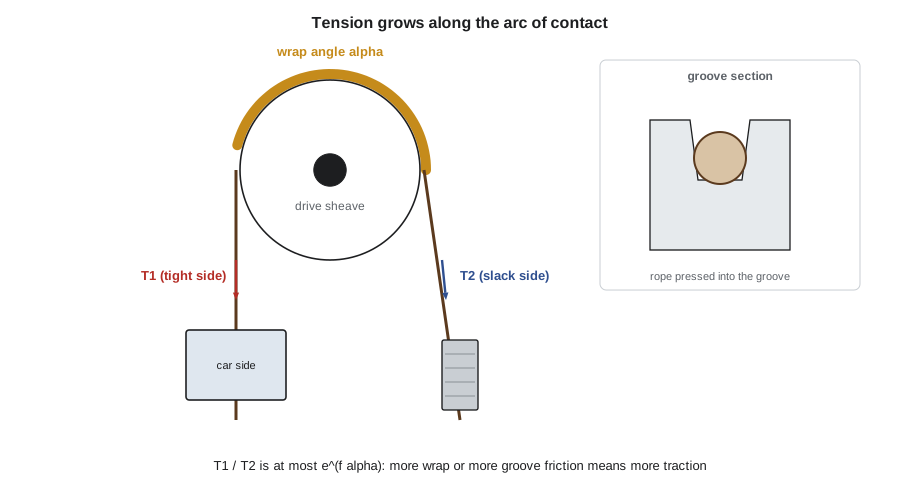
A rope wrapped around a fixed drum or a turning sheave can carry a larger tension on one side than the other, held by friction along the arc of contact. In the eighteenth century Leonhard Euler worked out how much larger. Each small piece of the arc adds friction in proportion to the pressure of the rope on the groove, and that pressure is itself in proportion to the tension, so the tension grows exponentially along the arc. The result is called the capstan equation, or the Euler-Eytelwein equation.
Here e is the base of natural logarithms, about 2.718, α is the angle of wrap, the angle in radians over which the rope touches the sheave, and f is the effective coefficient of friction between the rope and the groove. As long as the actual tension ratio stays below e^(fα), the rope grips; if the ratio rises above it, the rope slides. The equation has two levers: the wrap angle and the effective friction. A mechanic cannot change the wrap angle on an existing machine, but the friction depends on the groove shape, the groove wear, the rope's lubrication and the materials, and all of those change during the life of a car.
The wrap angle is about 180 degrees, π radians, when the ropes leave the sheave vertically on both sides. A deflector sheave that pulls the counterweight ropes away from the car to clear it reduces the wrap, often to between 150 and 170 degrees; Tillicum car 1's is 165 degrees. A double-wrap machine passes the ropes around the sheave twice, so the wrap is close to 360 degrees and e^(fα) is about the square of the single-wrap value. That is why high-speed gearless machines with gentle round grooves are double-wrapped.
Groove shape and the effective friction
The friction coefficient between a steel rope and a cast iron or steel groove is low, about 0.1 with a normally lubricated rope, and on its own it would give very little traction. The groove shape multiplies it. A rope in a groove is pressed into the groove by its tension, and the shape of the groove decides how hard the sides of the groove grip it.
- Round or U-groove. The groove is a semicircle a little larger than the rope, and the rope sits in it like a finger in a glove. The pressure is spread over a wide arc, the rope wears little, and the effective friction is only a little more than the material friction, about 4μ/π. Round grooves give low traction and are used on double-wrap machines, where the wrap makes up for it.
- Undercut U-groove. A U-groove with a narrow slot cut in its bottom. The rope cannot sit in the bottom of the slot, so it bears on the two edges of the undercut, which grips harder. The effective friction depends on the undercut angle: the wider the undercut, the more traction and the higher the pressure on the rope. Most single-wrap geared and gearless machines, including Tillicum's, use undercut grooves.
- V-groove. A wedge-shaped groove that pinches the rope between its sides, like a V-belt. It gives the most traction, about μ/sin(γ/2) for a groove angle γ, but the pressure is high and both the rope and groove wear quickly; as the groove wears, it deepens and the traction falls toward that of a U-groove. V-grooves are now found on older and some small machines.
The undercut groove formula is longer, because it depends on both the undercut angle and the groove angle, and the code below uses the form common in design work. All three show the same pattern: more traction means more pressure on the rope and faster wear. Groove design is a compromise between traction and rope life, and a groove that wears out of its designed shape changes the traction, the subject of Lesson 11.
| Groove | Typical effective friction (μ = 0.09) | Rope wear | Where used |
|---|---|---|---|
| Round (U) | about 0.11 | lowest | double-wrap gearless machines |
| Undercut U, 90 to 105 degree undercut | about 0.16 to 0.20 | moderate | single-wrap geared and gearless machines |
| V, 40 degree | about 0.26 | highest | older and small machines |
The conditions a traction design must meet
The codes require traction to do three things, and a designer checks each with the capstan equation using suitable friction values. First, the ropes must not slip when the car is loaded at the bottom landing, where the car side has its greatest weight, including the extra load allowed for loading and testing: the test uses 125 percent of the rated load on passenger cars. Second, the car must stop safely when the brake drops in an emergency, at any load, without the ropes sliding so far that the stop becomes uncontrolled. Third, if the car or the counterweight lands on its buffer and the machine keeps turning, the ropes must slip, so that the machine cannot drag the other side up into the overhead. The third condition is the reverse of the first two: the traction must be enough, but not too much.
Design methods use different friction values for each condition. A common European method takes μ = 0.1 for a car standing still at a landing, a smaller value that falls with speed for emergency stops, because a sliding rope has less friction than a gripping one, and μ = 0.2 for the stalled case, so that the check that the ropes will slip is made with a pessimistic, high friction. North American codes leave the method to the designer but require the result to be proved by test at acceptance and after alterations, which is why traction tests are part of Lesson 12.
# Traction check for Tillicum car 1 (single wrap, undercut U-groove; illustrative friction values)
import math
g = 32.2
car, rated, cwt = 2750, 2500, 3750     # lb
rope_long, rope_short = 200, 13          # rope hanging on the long and short side, lb
alpha = math.radians(165)                   # wrap angle with the deflector sheave
beta, gamma = math.radians(100), math.radians(30)   # undercut angle and groove angle
def f_groove(mu):
    return mu * 4 * (math.cos(gamma / 2) - math.sin(beta / 2)) / (math.pi - beta - gamma - math.sin(beta) + math.sin(gamma))
a = 2.0                                     # emergency stop deceleration, ft/s2
mu_stop = 0.10 / (1 + 1.0 / 10)             # sliding friction falls with speed (method uses the rated speed, here 1.0)
cases = [
    ("125 % load held at bottom landing", car + 1.25 * rated + rope_long, cwt + rope_short, 0.0, 0.10, "grip"),
    ("full car, emergency stop going down", car + rated + rope_long, cwt + rope_short, a, mu_stop, "grip"),
    ("empty car, emergency stop going up", cwt + rope_long, car + rope_short, a, mu_stop, "grip"),
    ("counterweight on buffer, machine turning", car + rope_short, rope_long, 0.0, 0.20, "slip"),
]
for name, w1, w2, acc, mu, want in cases:
    ratio = w1 * (g + acc) / (w2 * (g - acc))
    limit = math.exp(f_groove(mu) * alpha)
    ok = ratio <= limit if want == "grip" else ratio > limit
print(f"{name:<42} T1/T2 {ratio:5.2f} limit {limit:4.2f} must {want}: {'yes' if ok else 'NO'}")125 % load held at bottom landing T1/T2 1.61 limit 1.81 must grip: yes full car, emergency stop going down T1/T2 1.64 limit 1.72 must grip: yes empty car, emergency stop going up T1/T2 1.62 limit 1.72 must grip: yes counterweight on buffer, machine turning T1/T2 13.81 limit 3.28 must slip: yes
All four conditions pass, but the margins are not large: the full car stopping hard going down comes closest to the limit. That is normal for a single-wrap car and is why emergency stops on Tillicum's cars are tested at the bottom of the hoistway with the car loaded, where any slip is most likely and most easily seen. It also shows why a change that lowers the friction, such as over-lubricated ropes, or a change that raises the tension ratio, such as removing filler weights from the counterweight, can turn a working car into one that slides on an emergency stop.
What changes traction during a car's life
Ray listed the things he had seen change the traction on a car over thirty years, and every one of them can be read off the capstan equation.
- Rope lubrication. Ropes are made with lubricant in the core and strands, and some ropes need small amounts of field lubrication. Too much lubricant, or the wrong kind, lowers μ and the traction with it. Too little lets the ropes dry out and wear from the inside. Rope lubrication follows the rope maker's instructions, never habit.
- Groove wear. As grooves wear, an undercut groove loses its undercut and becomes a plain U-groove, and a V-groove deepens until the rope bottoms. Both lower the effective friction. Uneven wear between grooves makes some ropes travel faster than others and overload some ropes.
- Counterweight changes. Adding a heavier cab, flooring or a new door operator without adding counterweight raises the tension ratio with an empty car going up and changes the balance. The counterweight must be rebalanced after any change to the car's weight.
- Compensation and rope weight. On tall cars, the weight of the hoist ropes moves from one side to the other as the car travels; without compensation, the tension ratio at the top and bottom is much larger than at the middle. Lesson 4 returns to this.
- New ropes. New ropes stretch, settle into their grooves and lose some of their initial lubricant in the first weeks; their traction and tensions change and they must be equalized and checked again after running in.
Worked problem
Wrap angle and traction
A single-wrap machine with an effective groove friction of 0.17 has a wrap angle of 180 degrees. A new deflector sheave position would reduce the wrap to 150 degrees. By how much does the traction limit e^(fα) fall?
Show solution
- At 180 degrees, α = π = 3.142 rad, and e^(0.17 × 3.142) = e^(0.534) = 1.71.
- At 150 degrees, α = 2.618 rad, and e^(0.17 × 2.618) = e^(0.445) = 1.56.
- The limit falls from 1.71 to 1.56, about 9 percent.
Answer: The traction limit falls by about 9 percent, enough to turn a marginal car into one that slips on an emergency stop.
Slip and creep
Even when a rope grips, it does not move exactly with the groove. Along the arc of contact, the rope stretches a little as its tension changes from T2 to T1, and that stretch makes the rope creep slowly relative to the groove, a small fraction of an inch per trip. Creep is normal and wears both rope and groove a little. Slip is different: the whole rope slides over the groove because the tension ratio has exceeded the traction limit. Slip makes a noise, polishes the grooves, heats the ropes and, in the worst case, lets the car run away from the machine. A traction mechanic watches for signs of slip: bright, polished grooves; ropes with flattened, shiny crowns; a car that overshoots or stops short after an emergency stop; and mismatched position readings between a sheave-mounted encoder and a car-mounted position system.
Common mistakes
MistakeThinking a tighter rope grips with less effort.
InsteadTraction depends on the ratio of tensions, not on how tight the ropes are.
MistakeAssuming more lubricant always helps the ropes.
InsteadExcess lubricant lowers the friction and the traction; follow the rope maker's instructions.
MistakeChecking traction only with the car at rest.
InsteadEmergency stops change the tensions and must be checked too, usually at the bottom with load.
MistakeWanting the most traction possible.
InsteadIf the counterweight or car lands on its buffer, the ropes must slip; too much traction is unsafe.
MistakeIgnoring weight added to the car.
InsteadA heavier cab without more counterweight changes both balance and traction.
Summary and key terms
- Each side of the sheave carries the weight hanging on it, increased or decreased by acceleration.
- The capstan equation limits the tension ratio to e^(fα), set by the wrap angle and effective friction.
- Groove shape multiplies the material friction: V-grooves grip most, round grooves least.
- Traction must hold a loaded car and an emergency stop, but must slip if the other side lands on its buffer.
- Lubrication, groove wear, counterweight changes, rope weight and new ropes all change traction.
- Creep is normal; slip is a fault that polishes grooves and ropes and can let the car run away.
- Tight side
- The side of the sheave with the higher rope tension, T1.
- Capstan equation
- T1 / T2 ≤ e^(fα): the most a rope can hold by friction over a wrap angle α.
- Wrap angle
- The angle over which the ropes touch the drive sheave.
- Effective friction
- The friction coefficient of the rope in its groove, including the effect of the groove shape.
- Undercut groove
- A U-groove with a slot in its bottom so the rope bears on its edges and grips harder.
- Double wrap
- Roping that passes twice around the drive sheave, nearly doubling the wrap angle.
- Creep
- The small, normal relative movement of a rope along the groove as its tension changes.
Practice problems
Work each problem on paper first, then reveal the answer to check.
The car side carries 5,500 lb and the counterweight side 3,750 lb at rest. What is T1 / T2?
Show answer
5,500 / 3,750 = 1.47.
What is e^(fα) for f = 0.11 and a double wrap of 330 degrees?
Show answer
α = 5.76 rad; e^(0.11 × 5.76) = e^(0.634) = 1.88.
Why does a V-groove lose traction as it wears?
Show answer
It deepens until the rope sits in the bottom and is no longer pinched by the sides, so it acts like a U-groove.
Which emergency stop case usually comes closest to the traction limit on a single-wrap car?
Show answer
A loaded car stopping going down near the bottom landing.
Why must traction fail when the counterweight lands on its buffer?
Show answer
So the machine cannot keep lifting the car into the overhead.
Lesson quiz · 5 questions
Score 60% or more to complete this lesson.
Create a free account to save your progress, take quizzes and earn a certificate.