
ELV-230 · Lesson 5 of 12 · 22 min
Geared traction machines
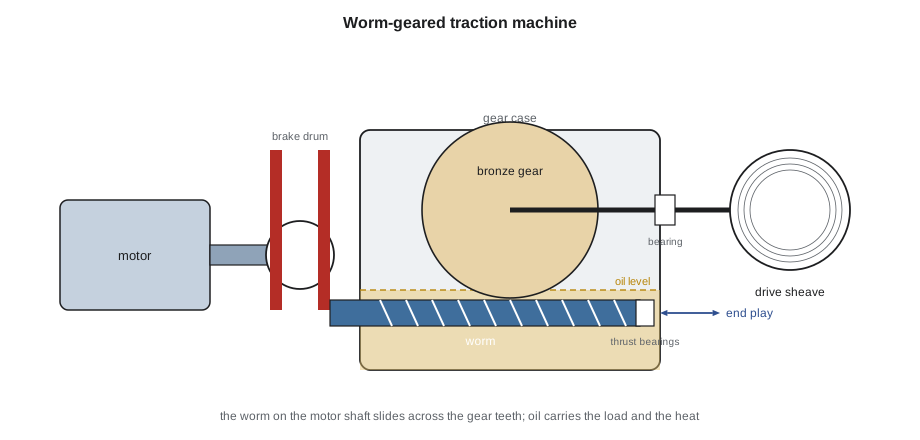
Tillicum car 1's machine has been turning since 1962. It sits on a cast iron bedplate on steel beams in the penthouse: a DC motor on the left, a brake drum on the motor shaft, a long cast iron gear case in the middle with a worm inside it, and the drive sheave on the right on a shaft that runs out of the side of the gear case. Across the room, the motor-generator set that feeds it hums whenever the car is in service. Tamsin had greased bearings and checked oil levels on machines like it in her first year without thinking much about what was inside the gear case. This term, with the machine due for its five-yearly inspection of the gearing, Ray had her open the inspection cover with him. "Most of what can go wrong with a geared machine starts with oil," he said, "and most of what you can measure from outside tells you about the worm." This lesson is about geared traction machines: how the gear works, how it is sized, how it loses energy and how a mechanic keeps it running.
Why a gear?
A traction sheave on a mid-rise car turns slowly. Lesson 3 showed that Tillicum's 30 in sheave turns at about 25 rpm at rated speed. Electric motors are small, cheap and efficient at high speeds, typically 1,000 to 1,800 rpm, and large and expensive at low speeds. A gear between the two lets a small fast motor drive a slow sheave. For most of the twentieth century, that made the geared machine the standard for cars from about 100 to 400 ft/min. Above that, the gear became noisy and the losses large, and gearless machines took over. Since about 2000, compact permanent-magnet gearless machines have taken most of the new mid-rise market too, but geared machines remain in tens of thousands of existing buildings and in many freight and low-speed applications, and a traction mechanic works on them every week.
The gear ratio i is the motor speed divided by the sheave speed. The motor torque is the sheave torque divided by the ratio and by the gear efficiency η. A 46 to 1 ratio means the motor turns 46 times for each turn of the sheave and needs only about a forty-sixth of the sheave torque, divided by the efficiency.
The worm and gear
Most elevator geared machines use a worm gear. The worm is a short steel screw on the motor shaft, with one or more spiral threads, called starts. It meshes with a large gear wheel, usually with a bronze rim on a cast iron center, mounted on the sheave shaft at right angles to the worm. Each turn of a single-start worm advances the gear by one tooth, so a gear with 46 teeth gives a ratio of 46 to 1; a two-start worm with 92 teeth gives the same ratio. The worm is usually below the gear, so that it runs in the oil bath and carries oil up into the mesh, although some machines have the worm on top.
The worm's threads slide across the gear teeth rather than rolling on them, so a worm gear depends completely on a film of oil between the steel and the bronze. The sliding makes worm gears quiet and smooth, which suits elevators, but it also wastes energy as heat and wears the bronze slowly. The worm's thrust, the force pushing it along its own axis, reverses each time the car changes from lifting to holding back, and it is carried by thrust bearings at one end of the worm shaft. The gear is held on the sheave shaft by keys or a press fit, and the sheave shaft runs in two large bearings, one in the gear case and one outboard of the sheave on many machines.
Efficiency and backdriving
The efficiency of a worm gear depends on the lead angle of the worm thread, the angle of the thread to a plane square to the worm's axis, and on the friction between worm and gear. A small lead angle, as on a single-start worm with a high ratio, means more sliding for each tooth moved and lower efficiency. The friction falls as the sliding speed rises and depends strongly on the oil, so a cold machine in winter is less efficient than a warm one.
Here λ is the lead angle and φ is the friction angle, the angle whose tangent is the friction coefficient. The first equation gives the efficiency when the worm drives the gear, as it does when the motor lifts the heavier side. The second gives the efficiency when the gear drives the worm, as it does when the heavier side runs down and the motor holds it back. Backdriving efficiency is always lower. If the friction angle were larger than the lead angle, the gear could not drive the worm at all and the machine would be self-locking. Some old texts describe worm-geared elevators as self-locking, but no elevator code relies on that: friction changes with oil, temperature and vibration, and the brake, not the gear, must hold the car.
# Tillicum car 1: worm gear efficiency and the motor torque and power for a full car going up
import math
lead = math.radians(5.0)                 # worm lead angle (illustrative)
mu = 0.04                                # friction at running speed, warm oil (illustrative)
phi = math.atan(mu)
eta_fwd = math.tan(lead) / math.tan(lead + phi)
eta_back = math.tan(lead - phi) / math.tan(lead)
print(f"forward efficiency {eta_fwd:.2f}, backdriving efficiency {eta_back:.2f}")
g = 1
rated, ob = 2500, 0.40
radius = 15 / 12                           # sheave pitch radius, ft
ratio = 46
motor_rpm = 1150
unbalance = (1 - ob) * rated             # full car going up, lb
t_sheave = unbalance * g * radius        # lb-ft
t_motor = t_sheave / (ratio * eta_fwd)
power = t_motor * motor_rpm / 5252
print(f"sheave torque {t_sheave:,.0f} lb-ft, motor torque {t_motor:,.0f} lb-ft, motor output about {power:.1f} hp")
print(f"sheave speed {motor_rpm / ratio:.1f} rpm")forward efficiency 0.68, backdriving efficiency 0.54 sheave torque 1,875 lb-ft, motor torque 60 lb-ft, motor output about 13.1 hp sheave speed 25.0 rpm
The worm gear loses about a third of the energy at the mesh, and the bearings, the oil churning and the motor lose more. On a car with a motor-generator set, the generator and the driving motor of the set add their own losses, so a geared Ward-Leonard car like Tillicum's may use two or three times the energy of a modern gearless car for the same work. That is one reason the owner is planning to modernize car 1, and the reason car 2's new gearless machine was installed last term.
Helical geared machines, with parallel shafts and helical or planetary gears, appeared in later designs. Their teeth roll more than they slide, so they are more efficient, often above 90 percent, but they are noisier and less tolerant of misalignment. A mechanic who meets one follows the manufacturer's instructions for oil, backlash and bearing checks; the principles in this lesson still apply.
Gear oil
The oil in a worm gear does more than lubricate. It carries heat away from the mesh, protects the bronze from corrosion and cushions the teeth from shock when the brake sets. Worm gears usually need a heavy oil, often a compounded or synthetic gear oil of the grade and type the machine maker specifies. Additives that suit steel gears can attack bronze, so a gear oil is never chosen by its viscosity alone. Ray's rules for gear oil were the ones in Northcrest's maintenance control program for Tillicum:
- Check the level at every visit with the machine stopped and the oil settled, at the sight glass or dipstick, and keep it between the marks. Too low starves the mesh; too high churns the oil, heats it and pushes it past the seals.
- Look at the oil. Bronze-colored glitter means bronze wear; a milky color means water; dark, burnt-smelling oil means overheating. Take a sample at the interval in the program and have it analyzed for wear metals, water and viscosity.
- Feel or measure the gear case temperature after a busy period. A sudden rise compared with the record means a problem with the oil, the mesh or a bearing.
- Change the oil at the interval the maker specifies or when analysis shows it is needed, flushing the case and cleaning the magnetic drain plug, and record the oil type and quantity.
- Fix leaks at the worm shaft seal and the sheave shaft seal promptly. A leaking seal on the sheave side can let oil reach the sheave grooves and ropes, which lowers traction.
End play, backlash and wear
Two measurements tell a mechanic most of what is happening inside a worm gear without taking it apart. The first is end play: how far the worm shaft can move along its axis. It shows the condition of the thrust bearings. With the car parked and the ropes loaded, the shaft is pushed one way and then the other, using the car's own unbalance or a bar, while a dial indicator on the end of the shaft reads the movement. Growing end play means the thrust bearings are wearing, and if it goes far enough, the car will jerk each time the load reverses as the worm slides from one bearing face to the other. The second is backlash: the free play between the worm and the gear teeth, measured as how far the sheave can turn back and forth with the worm held still. It grows as the bronze teeth wear.
Both are compared with the maker's limits and with the machine's own history. A single reading means little; a steady trend over years is normal wear, while a sudden jump means something has changed. Tamsin's five-yearly inspection at Tillicum also included looking at the teeth through the inspection cover with a light and mirror. Normal worm gear teeth have a smooth, polished contact pattern centered on the tooth; pitting, scoring, a contact pattern running off one end of the teeth or flakes of bronze in the oil are signs for an engineering assessment.
# Tillicum car 1 gear inspection history: compare readings with the limits and the trend
limit_end_play = 0.016        # in, maker's limit (illustrative)
limit_backlash = 0.10        # in at the sheave rim, maker's limit (illustrative)
history = [
    # year, worm end play, backlash at the sheave rim
    (2011, 0.004, 0.047),
    (2016, 0.005, 0.055),
    (2021, 0.007, 0.063),
    (2026, 0.012, 0.071),
]
prev = None
for year, ep, bl in history:
    note = ""
    if prev:
        rate = (ep - prev[1]) / (year - prev[0])
        note = f"  end play growing {rate:.4f} in per year"
    flags = []
    if ep > limit_end_play: flags.append("end play over limit")
    if bl > limit_backlash: flags.append("backlash over limit")
    print(f"{year}: end play {ep:.3f}, backlash {bl:.3f} in{note}  {', '.join(flags) or 'within limits'}")
prev = (year, ep)2011: end play 0.004, backlash 0.047 in within limits 2016: end play 0.005, backlash 0.055 in end play growing 0.0002 in per year within limits 2021: end play 0.007, backlash 0.063 in end play growing 0.0004 in per year within limits 2026: end play 0.012, backlash 0.071 in end play growing 0.0010 in per year within limits
The backlash had grown slowly and steadily for fifteen years, which is normal bronze wear. The end play had been steady too, until the last five years, when it nearly doubled. It was still within the limit, but the jump was the kind of change Ray had told her to look for. They found the cause the following week: one of the thrust bearing races showed spalling, small flakes of metal breaking out of the surface. The bearing was replaced with the car out of service for a day, with the machine blocked and the ropes supported as the maker's procedure required, and the end play returned to its earlier value.
Bearings, couplings and the bedplate
The other moving parts of a geared machine need the same steady attention. The motor bearings, the worm shaft bearings and the sheave shaft bearings are greased or oiled at the intervals in the program, with the right lubricant and the right amount: over-greasing a ball or roller bearing makes it run hot. Bearing temperatures and noises are checked by touch, by an infrared thermometer and by listening with a mechanic's stethoscope or a screwdriver held to the housing. The coupling between motor and worm, which on many machines is also the brake drum, is checked for wear in its pins or rubber elements and for the alignment of the two shafts. The machine is fastened to its bedplate and the bedplate to the building with bolts that must stay tight; a machine that moves on its bedplate changes the alignment of the sheave and the ropes and can loosen its own bolts further.
Worked problem
Choosing a gear ratio
A machine for a car of 350 ft/min on 1:1 roping has a sheave of 25 in pitch diameter and a motor of 1,750 rpm at rated speed. What gear ratio is needed?
Show solution
- Sheave speed n = 350 / (π × 25 / 12) = 53.5 rpm.
- Ratio i = 1,750 / 53.5 = 32.7.
- The nearest standard ratio, perhaps 33 to 1, would be chosen and the motor speed or sheave diameter adjusted to give exact rated speed.
Answer: About 33 to 1.
Common mistakes
MistakeRelying on the worm gear to hold the car.
InsteadWorm gears are not reliably self-locking; the brake holds the car.
MistakeChoosing gear oil by viscosity only.
InsteadSome additives attack bronze; use the type the maker specifies.
MistakeOverfilling the gear case.
InsteadToo much oil churns, overheats and leaks; keep it between the marks.
MistakeReading end play once and moving on.
InsteadCompare with the history; a sudden jump means wear or damage in the thrust bearings.
MistakeIgnoring a sheave shaft seal leak.
InsteadOil on the sheave and ropes lowers traction.
Summary and key terms
- A gear lets a small fast motor drive a slow sheave; the ratio is motor speed over sheave speed.
- Worm gears slide, so they are quiet but lose energy as heat and depend completely on their oil.
- Forward efficiency is tan λ / tan(λ + φ); backdriving efficiency is lower, and the brake, not the gear, holds the car.
- Gear oil level, condition, temperature and leaks are checked at every visit; oil is analyzed at intervals.
- End play shows thrust bearing wear; backlash shows tooth wear; both are compared with limits and their trends.
- Bearings, couplings and bedplate fastenings complete the machine inspection.
- Worm
- The screw on the motor shaft that drives the gear.
- Gear ratio
- Motor speed divided by sheave speed.
- Lead angle
- The angle of the worm thread to a plane square to the worm axis.
- Backdriving
- The gear driving the worm, as when the motor holds back an overhauling load.
- End play
- Axial movement of the worm shaft, governed by the thrust bearings.
- Backlash
- Free play between worm and gear teeth.
- Spalling
- Flakes breaking out of a bearing or gear surface through fatigue.
Practice problems
Work each problem on paper first, then reveal the answer to check.
A motor turns at 1,150 rpm and the sheave at 23 rpm. What is the gear ratio?
Show answer
50 to 1.
With λ = 6 degrees and μ = 0.05, what is the forward efficiency?
Show answer
φ = 2.86 degrees; tan 6 / tan 8.86 = 0.105 / 0.156 = 0.67.
Why is backdriving efficiency lower than forward efficiency?
Show answer
Friction subtracts from the lead angle when the gear drives the worm, so more of the input is lost.
What does milky gear oil indicate?
Show answer
Water in the oil.
End play has been steady for ten years and then doubles in two. What should happen?
Show answer
Investigate the thrust bearings even if the reading is within the limit.
Lesson quiz · 5 questions
Score 60% or more to complete this lesson.
Create a free account to save your progress, take quizzes and earn a certificate.