
ELV-230 · Lesson 4 of 12 · 20 min
Counterweight balance and compensation
Last year the Tillicum Building's owner renovated the lobby and both elevator cabs. Car 1 received new stone flooring, stainless steel wall panels and a new ceiling with LED lighting, all much heavier than the plywood and plastic laminate they replaced. Nobody at the time added weight to the counterweight. A year later, the car had begun to feel sluggish with a full load going up, its motor-generator set ran hotter on busy afternoons, and on the last two inspections the emergency stop with an empty car going up had stopped the car a little longer than before. Ray's first question when Tamsin described it was, "What did the cab weigh before and after?" This lesson is about the balance between the car and the counterweight, why it matters for energy, traction and stopping, how it is measured and corrected, and how compensation keeps the balance as the ropes move from one side of the machine to the other.
How heavy should the counterweight be?
The counterweight balances the weight of the empty car and part of the rated load. The part of the load it balances is called the overbalance, and it is usually between 40 and 50 percent of the rated load. A passenger car spends most of its time with a part load, so balancing about half the rated load keeps the average unbalance, and with it the average energy use and the size of the machine, as small as possible.
Here W_cw is the counterweight, W_car is the complete empty car, including its frame, platform, cab, doors, operator, car-top equipment and the part of the traveling cable it carries, k is the overbalance fraction and Q is the rated load. For Tillicum car 1, as designed, the car weighed 2,750 lb, the rated load is 2,500 lb and the overbalance was 40 percent, so the counterweight was 2,750 + 0.40 × 2,500 = 3,750 lb. Quayside car 2's car weighs 3,300 lb, its rated load is 3,500 lb and its overbalance 45 percent, so its counterweight is 4,875 lb, the value Tamsin's crew built up in stages with filler weights during installation.
The choice of overbalance is a compromise. A higher overbalance favors a car that usually travels full going up, such as a lobby car in an office in the morning; a lower one favors a car that travels full going down, or a freight elevator that is often empty. Freight elevators often have lower overbalance because their load is uncertain and they run empty much of the time. Whatever the choice, it is a design value, and the counterweight must be kept at it as the car changes over its life.
What unbalance does
The unbalance is the difference between the car side and the counterweight side. With a load L in the car, the unbalance is L − kQ: positive when the car side is heavier, negative when the counterweight is heavier. The machine must lift a positive unbalance going up and hold it back going down; with a negative unbalance, the roles reverse. The biggest unbalances are with a full car, where the car side is (1 − k)Q heavier, and with an empty car, where the counterweight side is kQ heavier.
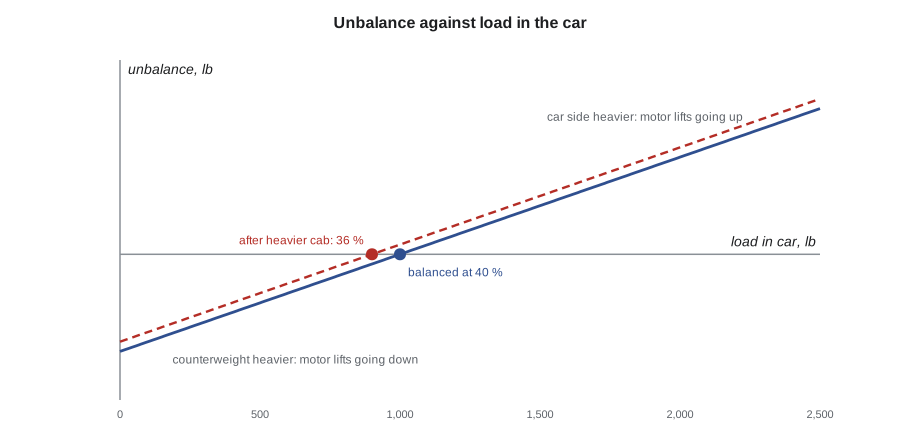
A car out of balance does several kinds of harm. If the car has become heavier, the full car going up needs more torque and current than the machine was sized for, so the motor runs hot and the car may slow down. The unbalance on an empty car going up becomes smaller, so that case looks better, but the full-car-down emergency stop, the most critical traction case in Lesson 2, gets worse, and the brake must hold more on a full car. If the counterweight has become relatively heavier, perhaps because someone added fillers to cure a different complaint, the empty-car-up stop gets worse and the car may rise when the brake is released with an empty car. Either way, energy use rises, because the average unbalance grows.
Measuring the balance
A counterweight cannot be weighed in place, and the car's weight after years of changes is rarely known exactly. Balance is measured instead by running the car. When the load in the car equals the overbalance, the two sides balance and the machine needs the same effort going up as going down, apart from friction, which acts the same way in both directions. The traditional test, often called a balance or current test, runs the car through the middle of the hoistway, where the ropes on each side are about equal, with several known test loads, and records the motor current going up and going down at full speed. The load at which the two currents are equal is the load the counterweight balances.
On a DC car like Tillicum's, the armature current is read with a clamp meter or a shunt; on a car with a modern drive, the drive's own torque or current display is used, and some controllers have a balance test built into their service menu. In each case the readings are taken at constant speed, past the acceleration, in the same part of the hoistway each run.
# Balance test on Tillicum car 1: find the load at which up and down currents are equal
rated = 2500                          # lb
loads = [0.0, 0.25, 0.50]               # test loads as a fraction of rated load
up = [118.0, 148.0, 178.0]              # armature current at full speed, mid-hoistway, going up (A)
down = [196.0, 170.0, 150.0]            # the same, going down (A)
diff = [u - d for u, d in zip(up, down)]
balance = None
for i in range(len(loads) - 1):
    if diff[i] <= 0 <= diff[i + 1]:
        balance = loads[i] - diff[i] * (loads[i + 1] - loads[i]) / (diff[i + 1] - diff[i])
design = 0.40
print(f"counterweight balances {100 * balance:.0f} % of rated load (design {100 * design:.0f} %)")
short = (design - balance) * rated
filler = 66                        # one full filler weight, lb
print(f"counterweight light by about {short:.0f} lb: about {short / filler:.1f} filler weights to add")counterweight balances 36 % of rated load (design 40 %) counterweight light by about 100 lb: about 1.5 filler weights to add
The test showed that the counterweight now balanced only 36 percent of the rated load instead of 40. The new cab had added roughly 100 lb net to the car that the counterweight did not match. Ray and Tamsin added one full and one half filler, fastened them under the tie rods with the filler retainers, and ran the test again; the balance came back to 40 percent. They recorded the new counterweight weight, the fillers added and the test readings in the maintenance control program, and added a note to the owner's file that any future cab change needs a balance check.
Worked problem
Adding fillers
After a door operator upgrade, a car's balance test gives 43 percent instead of the design 45 percent. The rated load is 3,500 lb and each filler weighs 66 lb. How many fillers should be added?
Show solution
- The counterweight is light by 0.02 × 3,500 = 70 lb.
- That is 70 / 66 = 1.06 fillers.
- Add one full filler and retest; the result should be within about one percent of the design value.
Answer: One filler, then retest.
Rope weight and why tall cars need compensation
The car and counterweight are not the only weights hanging on the sheave. The ropes themselves are heavy, and their weight moves from one side to the other as the car travels. With the car at the bottom landing, nearly all the rope hangs on the car side; with the car at the top, nearly all of it hangs on the counterweight side. For each rope, the tension at the drive sheave changes by the weight of a length of rope equal to the rise on each side, so the difference between the two sides swings by twice that over the full travel, on 1:1 and 2:1 roping alike.
Here n is the number of ropes, w the rope's weight per unit length and H the rise. At Tillicum, with five 1/2 in ropes at about 0.42 lb/ft and a rise of 100 ft, the swing is 2 × 5 × 0.42 × 100 = 420 lb at the sheave, against a load unbalance that runs from about −1,000 lb with an empty car to +1,500 lb with a full one. That is large but manageable, and Tillicum, like most low-rise cars, has no compensation. At Quayside, the rise is 285 ft, and although the ropes are smaller, six of them at about 0.17 lb/ft give a swing of about 580 lb, against a load unbalance at the sheave of only half the car-side value because of the 2:1 roping. Without compensation, a full car at the bottom would see a very different tension ratio from a full car at the top, the traction and the motor torque would vary through the run, and the drive would have to work much harder at the ends of the hoistway.
Compensation chains and ropes
Compensation hangs a chain or ropes from the bottom of the car, down into the pit and up to the bottom of the counterweight. As the car rises, more compensation hangs below the car and less below the counterweight, adding weight to the car side just as the hoist ropes take weight off it. If the compensation weighs the right amount per unit length, the two effects cancel and the balance is the same at every position. For compensation hung directly between car and counterweight, the right weight per unit length is the hoist ropes' weight per unit length multiplied by the number of ropes and by the roping ratio, because on 2:1 roping a given length of car travel moves twice as much hoist rope over the sheave.
# Compensation needed to balance the hoist rope weight
cars = [
    # name, roping ratio, number of ropes, rope weight per unit length, rise
    ("Tillicum car 1", 1, 5, 0.42, 100),
    ("Quayside car 2", 2, 6, 0.17, 285),
]
for name, r, n, w, rise in cars:
    swing = 2 * n * w * rise
    comp = r * n * w
print(f"{name:<15} rope weight swing at the sheave {swing:6.0f} lb; full compensation {comp:4.2f} lb/ft")Tillicum car 1 rope weight swing at the sheave 420 lb; full compensation 2.10 lb/ft Quayside car 2 rope weight swing at the sheave 581 lb; full compensation 2.04 lb/ft
Quayside's compensation is a sound-deadened chain, a steel chain with a plastic filler threaded through its links so that it does not rattle, hung in a loop from the car to the counterweight, with a guide in the pit to stop it swinging into the equipment there. Faster cars use compensation ropes running under a tensioning sheave in the pit, because a chain at high speed can sway, and at the highest speeds the tensioning sheave is held down by a tie-down device so that the car and counterweight cannot jump on an emergency stop. Compensation is attached to the car and counterweight frames with shackles or hangers that are inspected like rope terminations: a compensation chain that falls into the pit is a dangerous load to drop and changes the balance of a car in service instantly.
Inspecting the counterweight
The counterweight is often out of sight, and that is why it gets less attention than it deserves. On a maintenance visit, from the car top with the car at slow speed, Tamsin's checklist covers: the frame and its bolts; the filler weights, which must be held by tie rods and retainers so that they cannot shift or fall; the guide shoes or rollers and their wear; the counterweight sheave on 2:1 roping; the rope hitches or shackles; the compensation hangers; the counterweight guard in the pit; the runby and the buffer. A loose filler weight can fall more than 280 feet down a high-rise hoistway, so the retainers are checked at every visit, and any work that adds or removes fillers is recorded with the new total weight.
Common mistakes
MistakeChanging the cab and forgetting the counterweight.
InsteadAny change in car weight changes the balance; check and correct it.
MistakeAdding fillers to cure a slow full-load run without a balance test.
InsteadMeasure the balance first; the cause may be elsewhere and extra fillers create a new unbalance.
MistakeTaking balance readings during acceleration or near the ends.
InsteadRead at constant speed in the middle of the hoistway, where the ropes are about equal.
MistakeAssuming rope weight is negligible.
InsteadOn tall cars it swings the balance by hundreds of kilograms or pounds; compensation is needed.
MistakeLeaving filler retainers unchecked.
InsteadLoose fillers can fall the length of the hoistway.
Summary and key terms
- The counterweight equals the empty car plus an overbalance of usually 40 to 50 percent of rated load.
- Unbalance is the load in the car minus the overbalance; it sets the motor effort, the brake load and traction.
- A heavier car without more counterweight lowers the balance point and worsens full-load cases.
- Balance is measured by comparing up and down motor current at constant speed with known loads.
- Rope weight swings the balance by 2nwH over the rise; compensation of weight r n w per unit length cancels it.
- Counterweight frame, fillers, retainers, guides, hitches and compensation hangers are inspected regularly.
- Overbalance
- The fraction of rated load, besides the car, that the counterweight balances.
- Unbalance
- The difference in weight between the car side and the counterweight side.
- Balance test
- A test comparing motor current or torque up and down with known loads to find the balance point.
- Filler weight
- A steel or cast iron plate stacked in the counterweight frame to set its weight.
- Compensation
- Chain or ropes hung between car and counterweight to balance the weight of the hoist ropes.
- Sound-deadened chain
- Compensation chain with a filler threaded through its links to stop noise.
- Tie-down
- A device holding the compensation sheave down so car and counterweight cannot jump on a hard stop.
Practice problems
Work each problem on paper first, then reveal the answer to check.
A car weighs 4,000 lb with a rated load of 3,000 lb and 45 percent overbalance. What should the counterweight weigh?
Show answer
4,000 + 1,350 = 5,350 lb.
In a balance test, up and down currents are equal at 47 percent of rated load. The design is 45 percent. Is the counterweight heavy or light?
Show answer
Heavy: it balances more load than designed.
What is the rope weight swing for four ropes of 0.27 lb/ft over a rise of 130 ft?
Show answer
2 × 4 × 0.27 × 130 = 281 lb.
Why do very fast cars use compensation ropes with a tie-down instead of chain?
Show answer
Chain sways at high speed, and the tie-down stops the car and counterweight jumping on a hard stop.
Why are balance readings taken in the middle of the hoistway?
Show answer
There the rope weight on each side is about equal, so it does not distort the result.
Lesson quiz · 5 questions
Score 60% or more to complete this lesson.
Create a free account to save your progress, take quizzes and earn a certificate.