
ELV-230 · Lesson 12 of 12 · 21 min
Capstone: a rope replacement and traction test
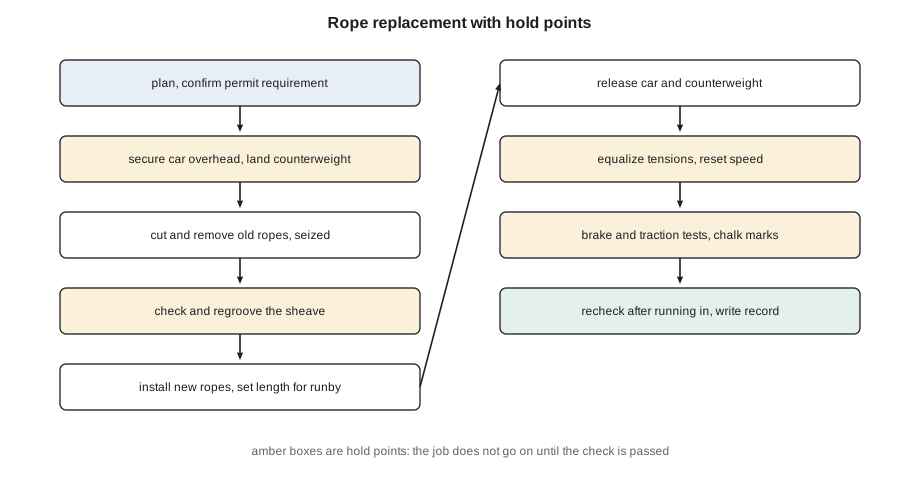
The last three weeks of Tamsin's traction term were spent on one job: replacing all five suspension ropes on Tillicum car 1, regrooving its drive sheave, and proving by test that the car was safe to return to service. The rope record from Lesson 8 had condemned two ropes and shown the others close behind; the straightedge check in Lesson 11 had shown a deep groove under rope 4 that explained the uneven wear. Ray ran the job, with Tamsin as his partner and a grooving contractor for two days in the middle. Lena wrote the plan with them, and Priya came for the tests. This capstone follows the job from planning to the record, using the knowledge from every lesson in the course.
Part 1: planning
Lena's plan began with the questions every major job on an elevator starts with: what work is being done, what permits and notices it needs, how the building will manage without the car, how the car and counterweight will be secured, who does each step, and how the work will be proved. Replacing suspension ropes with ropes of the same size, construction and number is treated as maintenance or repair in many jurisdictions and recorded in the maintenance control program, while a change in the size, type or number of ropes, or in the sheave, is an alteration that needs a permit and an inspection. Lena confirmed the requirement with the L&I Elevator Program before ordering ropes: the new ropes matched the old in diameter, construction and number, the regrooving restored the sheave's original profile, and the work would be documented with the test results in the program and reported as required.
The building's property manager agreed to a six-day outage of car 1, with car 2 carrying the traffic and a notice in the lobby. The ropes were ordered to the specification on the rope record: five ropes of 1/2 in eight-strand traction steel with a fiber core, from the same rope maker, cut as one production length so they would stretch alike, with the maker's certificate showing their breaking force. New wedge-socket terminations of the type approved for the car replaced the old babbitted sockets, with new shackle rods, springs and nuts.
- Hazard assessment: work at the top of the hoistway and in the machine room; loads suspended during rope changes; the counterweight landed on cribbing in the pit; rope ends under tension when cut; moving machinery during regrooving; sharp wire ends; noise and swarf from the grooving tool.
- Securing the car and counterweight: the car brought to the top landing and held from the machine room beams by two rated slings and a chain hoist, independent of the ropes; the counterweight landed on rated cribbing on the pit floor beside its buffer, sized from its weight of 3,750 lb plus the fillers added in Lesson 4.
- Lockout: main line disconnect and motor-generator set locked, with the machine run only under the grooving contractor's control or for tests, by the person in charge.
- Proof: rope lengths set for the correct counterweight runby, tensions equalized, the brake and traction tests in Part 4, then a recheck of tensions and runby after the ropes had run in.
Part 2: removing the old ropes and regrooving
On the first morning, Ray and Tamsin ran the car to the top landing, measured and recorded the counterweight runby and the old ropes' positions, and secured the car from the beams. In the pit, they built the crib under the counterweight and lowered the counterweight onto it by running the car up an inch or two on inspection with the slings slack, then let the slings take the car. With both sides supported independently of the ropes, the ropes went slack. They cut the old ropes one at a time at the car and counterweight ends, using seizing on each side of every cut so the wires could not unlay and spring, and pulled them off over the sheave and deflector into the machine room for disposal, keeping a sample of rope 4 for the rope record.
With the ropes off, the grooving contractor mounted the grooving tool on the machine bedplate and machined the five grooves to the profile for the new rope over two days, removing about 0.03 in from the deepest groove and the same from the others so that all five finished at the same depth. Ray checked each groove with the groove gauge for the new rope size and a straightedge across a set of short rope samples laid in the grooves; the heights now matched within about a thousandth of an inch. The new effective diameter was recorded; it was slightly smaller than before, so the car would run a little slower for the same motor speed until Priya reset it.
Part 3: installing the new ropes
The new ropes came on a single reel. Ray mounted it on a stand in the machine room so it could turn freely, and paid each rope off the reel without twisting it, lowering the end down the hoistway to the counterweight first, then up over the deflector and the sheave to the car. Each rope was measured and cut to length with seizing on both sides of the cut, and fitted with its wedge socket at the counterweight and the car crosshead, following the termination maker's instructions for the wedge, the tail length and the tail clip that keeps the wedge from loosening.
The rope length was the critical number. Too long, and the counterweight runby with the car at the top would be too small after the ropes stretched; too short, and the runby would be too large and the car's overtravel at the top too small. New ropes stretch in their first weeks as the strands bed into the core, and keep stretching slowly afterward. Ray cut them so that the initial runby was near the top of the allowed range, leaving room for the initial stretch.
# Tillicum car 1 new ropes: cut length and the counterweight runby before and after initial stretch
import math
d_sheave, d_defl = 30 / 12, 24 / 12                     # ft
segments = {
    "car hitch to drive sheave, car at top": 10.2,
    "wrap on drive sheave (165 degrees)": math.pi * d_sheave * 165 / 360,
    "drive sheave to deflector": 3.1,
    "wrap on deflector": math.pi * d_defl * 165 / 360,
    "deflector to counterweight hitch, car at top": 109.6,
}
for name, length in segments.items():
    print(f"{name:<46} {length:6.2f} ft")
rope = sum(segments.values())
allowance = 1.5                                 # termination tail at each end, ft
print(f"rope length between terminations {rope:.2f} ft; cut length {rope + 2 * allowance:.2f} ft")
runby_new = 20.5                                   # set at installation, in
for stretch_pct in (0.25, 0.50):
    loss = rope * stretch_pct / 100 * 12
print(f"initial stretch {stretch_pct:.2f} %: runby falls by {loss:.0f} in to {runby_new - loss:.0f} in (limits 6 to 24 in)")car hitch to drive sheave, car at top 10.20 ft wrap on drive sheave (165 degrees) 3.60 ft drive sheave to deflector 3.10 ft wrap on deflector 2.88 ft deflector to counterweight hitch, car at top 109.60 ft rope length between terminations 129.38 ft; cut length 132.38 ft initial stretch 0.25 %: runby falls by 4 in to 17 in (limits 6 to 24 in) initial stretch 0.50 %: runby falls by 8 in to 13 in (limits 6 to 24 in)
With the ropes terminated, Ray took the chain hoist's load off the car slowly until the car hung on the new ropes, then ran the car down a little on inspection so the counterweight lifted off its crib. The slings and crib were removed. With the car level at the top landing, the counterweight runby measured 20.3 in, close to the target, and well above the minimum even after the expected stretch.
Then the tensions. With the car near the top so that the free length between the car hitch and the sheave was short and the same for every rope, Tamsin measured each rope's vibration frequency with the meter from Lesson 11. The first readings were within about 6 percent, inside the limit, but Ray wanted a new set closer than that; rope 3, the lowest, was tightened a little at its shackle rod and the set remeasured.
# Tillicum car 1 new rope tensions after installation and after one adjustment
m, length = 0.42 / 32.2, 10.0                    # rope mass per unit length (slug/ft), free length (ft)
rounds = {
    "as installed": [10.9, 11.0, 10.6, 11.1, 10.9],
    "after tightening rope 3": [10.9, 10.9, 10.8, 11.0, 10.9],
}
for label, freqs in rounds.items():
    t = [4 * m * length ** 2 * f ** 2 for f in freqs]
    avg = sum(t) / len(t)
    worst = max(abs(x - avg) / avg for x in t)
print(f"{label}: worst rope {100 * worst:.1f} % from average: {'within' if worst <= 0.10 else 'outside'} the 10 % limit")as installed: worst rope 5.5 % from average: within the 10 % limit after tightening rope 3: worst rope 1.8 % from average: within the 10 % limit
After the adjustment, the worst rope was within about 2 percent of the average. Ray ran the car on inspection the full length of the hoistway, watching the ropes run onto the sheave and deflector, then at slow and full speed with the car empty. Priya measured the car's speed with a hand tachometer on the governor rope and, because the regrooved sheave was slightly smaller, adjusted the motor-generator set's generator field to bring the car back to its rated speed, then rechecked the slowdown and stopping at each floor.
Part 4: the tests
Priya's test plan put the tests in an order that kept the car safe at each step: first the running checks and the brake with an empty car, then the full-load tests, then the traction tests at the limits, and last the recheck of the safety circuits disturbed during the work. The test weights, 3,125 lb of steel blocks for 125 percent of the rated load, were brought in on car 2 at night and loaded into car 1 at the lobby a cart at a time.
- Running: the car ran smoothly through the full rise at rated speed empty, half loaded and fully loaded, with no rope noise, no rope running on the side of its groove, and the leveling within limits at every floor. The balance test from Lesson 4 was repeated and still showed 40 percent.
- Brake, holding: with 125 percent of rated load in the car at the lobby, the brake held the car with the hoist motor de-energized, with no movement of the sheave and no creep of the ropes on the sheave, checked with chalk marks across the ropes and grooves.
- Brake, stopping: with the car loaded to rated load and running down at rated speed near the bottom, the safety circuit was opened; the car stopped in about 2 ft, close to the earlier results, smoothly, with no visible slip of the ropes against the chalk marks.
- Emergency stop, empty car up: the empty car, running up at rated speed near the top, was stopped by opening the safety circuit; it stopped within the expected distance with no slip.
- Traction limit: with the counterweight resting on its buffer, compressed as the test procedure required, the machine was run in the up direction on inspection with the car empty; the ropes slipped on the sheave and the car was not lifted, proving that the machine cannot drag the car into the overhead.
- Final checks: terminations and tail clips, shackle nuts and cotter pins, the counterweight runby and the car's top clearance, the final limit and the governor rope position after the work, and all safety circuit devices disturbed during the job.
Tamsin recorded every result on the test sheet as it was taken, and Priya checked each against its limit before the next test began. Ray checked the chalk marks after every stop; on a car with new ropes on newly cut grooves, those marks were the simplest and most reliable evidence that the ropes were gripping.
# Tillicum car 1 test results checked against limits
tests = [
    # name, result, low limit, high limit, unit
    ("balance after rope change", 40, 38, 42, "% of rated"),
    ("rope tension spread, worst rope", 1.8, 0, 10, "% from average"),
    ("125 % load, sheave movement on brake", 0, 0, 0.04, "in"),
    ("rated load down, stopping distance", 2.0, 1.3, 3.0, "ft"),
    ("rope slip on chalk marks, any stop", 0, 0, 0, "in"),
    ("counterweight runby, car level at top", 20.3, 6, 24, "in"),
]
fails = 0
for name, value, lo, hi, unit in tests:
    ok = lo <= value <= hi
    fails += not ok
    print(f"{name:<40} {value:>6} {unit:<16} {'pass' if ok else 'FAIL'}")
print("traction limit test: car not lifted with counterweight on its buffer -> pass")
print("ready to return to service" if fails == 0 else f"{fails} result(s) outside limits: correct and retest")balance after rope change 40 % of rated pass rope tension spread, worst rope 1.8 % from average pass 125 % load, sheave movement on brake 0 in pass rated load down, stopping distance 2.0 ft pass rope slip on chalk marks, any stop 0 in pass counterweight runby, car level at top 20.3 in pass traction limit test: car not lifted with counterweight on its buffer -> pass ready to return to service
Part 5: running in and the record
Car 1 returned to service on the sixth day. Ray had arranged a return visit after three weeks of service, when the new ropes would have done most of their initial stretch. At that visit, the counterweight runby had fallen to 16.5 in, a stretch of about 0.25 percent, as expected; the rope tensions were remeasured and one rope adjusted to bring it back within the limit; the chalk marks, renewed at the return to service, showed no slip; and the grooves showed an even, dull contact track on all five ropes, with no bright polishing. The ropes' lubrication was checked against the rope maker's instructions, which called for no field lubrication in the first year.
Tamsin wrote the record. It went into the maintenance control program for car 1 and was sent to the owner, and it followed the form Lena required for every major repair:
- What was done and why: the replacement of all five suspension ropes after two met the replacement criteria and the others were near them, and the regrooving of the drive sheave after the height check showed one groove 0.049 in deeper than the others.
- What was installed: the rope maker, construction, diameter, breaking force and certificate number; the terminations; the new groove profile and effective diameter; the speed adjustment made.
- How it was proved: the test sheet with every result, the chalk mark checks, the balance test, the tension readings before and after adjustment, and the runby at installation and after running in.
- What comes next: tension and runby checks at the next two maintenance visits, a full rope inspection at the next examination with the new baseline diameters, and the rope record started for the new set.
Ray read it through before it went out. He changed one word and added a line at the end recommending that the owner plan the modernization of car 1's machine within five years, before its end play and gear wear became the next job. Then he handed it back. "That's a traction mechanic's record," he said. "Anyone who comes after us can see what we did, why we did it and how we know it's right."
Looking back over the course
The job used every lesson. The capstan equation, from Lesson 2, explained why the deep groove and over-tensioned rope wore faster and why traction is tested at the limits. Roping geometry and the wrap angle from Lesson 3 set the rope length. The balance from Lesson 4 was checked again after the change. The geared machine and its brake from Lessons 5 and 10 were run and tested under load. The machine-room-less and gearless lessons, 6 and 7, gave the comparison with the cars Tamsin will spend most of her career on, and the belt lesson, 9, the other suspension means she will meet. The rope inspection criteria of Lesson 8 and the groove and tension work of Lesson 11 decided what was done and proved that it was done right.
Common mistakes
MistakeCutting ropes without seizing both sides of the cut.
InsteadSeize first, so the wires cannot unlay or spring.
MistakeRemoving ropes before the car and counterweight are secured independently.
InsteadSupport both sides from independent rated points before the ropes go slack.
MistakeTwisting new ropes off the reel.
InsteadMount the reel to turn freely and pay ropes off without twisting.
MistakeSetting the runby at the minimum with new ropes.
InsteadSet it near the top of the range; new ropes stretch.
MistakeSkipping the return visit.
InsteadRecheck tensions and runby after running in, and record them.
Summary and key terms
- A rope replacement starts with a plan: permit requirement, outage, hazards, securing car and counterweight, and proof.
- Car and counterweight are supported independently of the ropes before the old ropes are cut.
- Worn grooves are corrected before new ropes go on, and the car's speed is reset for the new effective diameter.
- New ropes are paid off without twisting, cut and terminated to give the runby needed for stretch, and equalized.
- Tests cover running, balance, brake holding and stopping with load, emergency stops and the traction limit.
- Tensions and runby are rechecked after running in, and the record shows what was done, why and how it was proved.
- Seizing
- Binding wrapped tightly around a rope on each side of a cut to stop it unlaying.
- Wedge socket
- A termination in which the rope loops around a wedge drawn into a tapered body by the load.
- Initial stretch
- The stretch of new ropes in their first weeks as the strands bed into the core.
- Traction limit test
- A test proving the ropes slip and the car is not lifted when the counterweight is on its buffer.
- Chalk marks
- Marks across the ropes and grooves used to show any slip during tests.
- Hold point
- A step in a job that may not proceed until a check has been passed.
Practice problems
Work each problem on paper first, then reveal the answer to check.
Why are the five new ropes ordered as one production length?
Show answer
So they have the same properties and stretch alike.
Ropes of 122 ft stretch 0.4 percent. How much does the counterweight runby fall?
Show answer
5.9 in.
What does the traction limit test prove?
Show answer
That the machine cannot lift the car with the counterweight on its buffer; the ropes slip.
Why is the brake holding test done with 125 percent of rated load?
Show answer
That is the load the code requires the brake to hold.
Why must the car's speed be checked after the sheave is regrooved?
Show answer
The effective diameter is smaller, so the car runs slightly slower for the same motor speed until it is reset.
Lesson quiz · 5 questions
Score 60% or more to complete this lesson.
Create a free account to save your progress, take quizzes and earn a certificate.