
ELV-230 · Lesson 11 of 12 · 20 min
Sheaves, grooves and traction problems
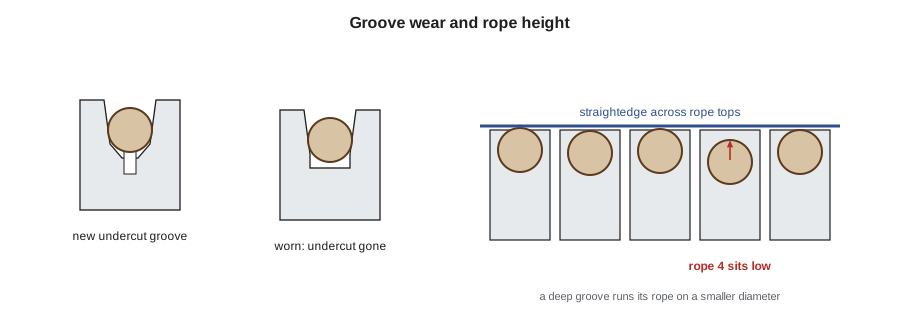
Before Tillicum car 1's ropes could be replaced, Ray wanted to know whether the drive sheave was fit to receive them. "New ropes on worn grooves is money thrown down the hoistway," he said. "The grooves will chew the new ropes to the old shape in a year." So on the visit before the replacement, with the car parked and locked out, he laid a steel straightedge across the tops of the five ropes where they sat in the drive sheave's grooves, and had Tamsin measure the gap under the straightedge above each rope with feeler gauges. Four ropes sat almost level. The fourth sat nearly fifty thousandths of an inch lower. This lesson is about sheaves and their grooves, how they wear, how uneven wear and uneven rope tensions cause traction problems, and how a mechanic finds and corrects them.
How grooves wear
Every trip, each rope creeps a little along its groove as its tension changes from one side of the sheave to the other, as Lesson 2 described. That creep, under the pressure of the rope, slowly wears both the rope and the groove. Over years, a groove that started as a precise undercut U-shape wears deeper and wider, the undercut disappears and the groove takes the shape of the worn rope. As long as all the grooves wear alike and the ropes are matched to them, a worn sheave can still work, but its traction is lower than when it was new, and new ropes will not fit its grooves properly.
Grooves rarely wear alike. A rope that carries more than its share of the load presses harder in its groove and wears it faster. A rope with a slightly larger diameter, or one that has stretched differently, sits differently. A sheave or deflector out of alignment makes the ropes rub on one side. Once one groove is deeper than the others, its rope sits lower, on a smaller effective diameter, and travels a shorter distance for each turn of the sheave. Since all the ropes are fastened to the same car and counterweight, they must all move the same distance; the rope in the deep groove must slip or stretch to keep up, and it does so on every trip. The slip polishes and deepens its groove further. Uneven groove wear therefore feeds itself.
Measuring groove wear
There are three common ways to check grooves. The first is the straightedge check Ray used: with the ropes in place, a straightedge across the rope tops shows whether every rope sits at the same height, and feeler gauges measure the differences. The second uses a groove gauge, a profile plate cut to the shape of a new groove for the rope size, held in each groove with the ropes removed or lifted out to show how much the groove has worn and whether the undercut is still there. The third, on machines whose makers give one, is a direct measurement of groove depth or of the rope's position against a reference on the sheave. The maker's limits, or Northcrest's procedure where there are none, decide when a sheave must be regrooved or replaced. A height difference of a few thousandths of an inch between grooves is common; a difference approaching forty thousandths of an inch or more on a car like Tillicum's means the grooves need attention before new ropes go on.
Here Δh is how much lower one rope sits than the others, so its effective diameter is 2Δh smaller and it travels 2πΔh less per revolution, N_rev is the number of sheave revolutions in a trip of length H on a 1:1 car, and Δs is the difference in rope travel over the trip that the low rope must make up by slipping or stretching.
# Tillicum car 1 drive sheave: rope heights under a straightedge and the travel difference they cause
import math
d = 30 / 12                          # sheave pitch diameter, ft
rise = 100.0                       # full trip, ft
gaps = [0.002, 0.012, 0.004, 0.049, 0.008]   # gap above each rope under the straightedge, in
rev = rise / (math.pi * d)
base = min(gaps)
for i, gap in enumerate(gaps, 1):
    dh = (gap - base) / 12        # how much lower than the highest rope, ft
    ds = 2 * math.pi * dh * rev * 12
    print(f"rope {i}: sits {gap - base:.3f} in low, travels {ds:.1f} in less per full trip than the highest rope")
print(f"{rev:.1f} sheave revolutions per full trip")rope 1: sits 0.000 in low, travels 0.0 in less per full trip than the highest rope rope 2: sits 0.010 in low, travels 0.8 in less per full trip than the highest rope rope 3: sits 0.002 in low, travels 0.2 in less per full trip than the highest rope rope 4: sits 0.047 in low, travels 3.8 in less per full trip than the highest rope rope 5: sits 0.006 in low, travels 0.5 in less per full trip than the highest rope 12.7 sheave revolutions per full trip
Rope 4 must slip or stretch nearly four inches relative to the others on every full trip. That explains why rope 4 had the most broken wires and the worst rouge in Lesson 8: it has been dragged through its groove on every run. It also explains why Ray would not put new ropes on the sheave as it was. The grooves had to be made even first.
Regrooving or replacing a sheave
A worn sheave can sometimes be regrooved: the grooves are machined back to the correct profile, all to the same depth, either in place with a portable grooving tool mounted on the machine or in a shop with the sheave removed. Regrooving removes metal, so the sheave's diameter gets smaller each time; the maker or the sheave's original design sets how much can be removed before the sheave is too small for its ropes or its rim too thin. Some sheaves, particularly hardened ones on newer gearless machines, cannot be regrooved and must be replaced. Regrooving also changes the effective diameter, which changes the car speed slightly for a given motor speed; on a car with a modern drive, the drive's sheave diameter setting is updated so its speed and position calculations remain correct.
For Tillicum car 1, the sheave had been regrooved once in the 1990s and its rim still had enough material for one more. Ray arranged for a grooving contractor to regroove it in place during the rope replacement, with the old ropes removed and the sheave turned slowly by the machine under the contractor's control. The new grooves would be cut to the profile for the new ropes, an undercut U-groove matching the rope diameter, and checked with the groove gauge before the new ropes went on.
Rope tension equalization
Even on a perfect sheave, the ropes of a set never carry exactly equal loads unless they are adjusted to. Ropes are cut to slightly different lengths, stretch at slightly different rates and settle into their terminations differently. A rope carrying more than its share wears its groove and itself faster, as rope 4 at Tillicum did, and in the worst case carries enough of the load that its own factor of safety is far below the design. Equalizing the tensions is part of installing new ropes and of maintenance. The maker or the program sets how closely the ropes must match; a common requirement is that each rope be within about 10 percent of the average.
Tension is measured in one of several ways. Some terminations have springs whose compressed length shows the load, but spring lengths alone are not reliable, because springs differ. A rope tension gauge clamps on the rope and measures the force to deflect it by a set amount. The vibration method, used with a handheld meter or a phone app made for it, plucks the rope and measures its natural frequency: a tighter rope vibrates faster. For a rope of mass per unit length m with a free length L between two fixed points, the frequency f and tension T are related like a guitar string.
# Tillicum car 1 rope tensions from vibration frequency (car near the top, free length from hitch to sheave)
m = 0.42 / 32.2                   # rope mass per unit length, slug/ft
length = 10.0              # free length, ft
freqs = [10.6, 10.9, 10.8, 11.6, 10.4]      # measured, Hz
k_spring = 860.0            # termination spring rate, lbf per in
tensions = [4 * m * length ** 2 * f ** 2 for f in freqs]
avg = sum(tensions) / len(tensions)
for i, t in enumerate(tensions, 1):
    dev = 100 * (t - avg) / avg
    action = ""
    if abs(dev) > 10:
        turn = (avg - t) / k_spring
        action = f"  adjust: {'tighten' if turn > 0 else 'slacken'} about {abs(turn):.2f} in of spring"
print(f"rope {i}: {t:6.0f} lbf ({dev:+5.1f} % from average){action}")rope 1: 586 lbf ( -4.9 % from average) rope 2: 620 lbf ( +0.6 % from average) rope 3: 609 lbf ( -1.2 % from average) rope 4: 702 lbf (+13.9 % from average) adjust: slacken about 0.10 in of spring rope 5: 564 lbf ( -8.4 % from average)
Rope 4 carried nearly 14 percent more than the average, and rope 5 just within the limit at the low side. On the old ropes Ray did not bother adjusting; they were coming off within the month. On the new ropes, the same measurement would be made after installation and again after the ropes had run in for a few weeks, because new ropes stretch unevenly at first. Adjustment is made at the terminations, by turning the nuts on the shackle rods to shorten or lengthen a rope, a little at a time, with the car at the same position for every measurement and the measurements repeated after each adjustment, since changing one rope's tension changes the others.
Traction problems and their causes
When a traction car slips, or shows signs that it is slipping, the cause is usually one of a short list, and each one can be traced to a term in the capstan equation or to uneven sharing of the load. Priya's list for diagnosing traction complaints, which she taught in the evening class, is the one Tamsin copied into her log.
| Symptom | Likely cause | Check |
|---|---|---|
| Car overshoots or slides after emergency stops | grooves worn, ropes over-lubricated, counterweight too light | groove profile, rope lubrication, balance test |
| Polished, shiny grooves; ropes with flattened bright crowns | slip in service | straightedge and gauge; rope tensions; balance |
| One rope wears much faster than the others | deep groove or high tension on that rope | rope heights; tension measurement |
| Position error between sheave encoder and car position system | rope slip or creep greater than normal | groove wear; tensions; drive records |
| Squeal or chatter from the sheave | slip, or ropes rubbing groove sides | alignment, fleet angle, groove shape |
| Traction lost after new ropes installed | new ropes on worn grooves, or excess factory lubricant | groove profile; rope maker's instructions |
On cars with a modern controller, the drive records give early warning. The drive counts sheave revolutions through its encoder, and the controller knows the car's real position from its landing system. If the ropes are slipping or creeping more than normal, the two disagree increasingly over a trip, and the controller has to correct its position at each floor. A growing correction is one of the first signs of a traction problem, often long before anyone can see polished grooves. Priya checks that correction value at Quayside and Larchmont on every visit.
Worked problem
Is a rope over the limit?
The tensions in a set of six ropes measure 920, 970, 900, 1,100, 940 and 920 lbf. Using a 10 percent limit, which ropes need adjustment?
Show solution
- Average = 5,750 / 6 = 958 lbf.
- Allowed range 958 × 0.90 = 862 to 958 × 1.10 = 1,054 lbf.
- Only the rope at 1,100 lbf is outside the range.
Answer: The fourth rope, about 15 percent above the average, must be slackened and the set rechecked.
Common mistakes
MistakePutting new ropes on worn grooves.
InsteadCheck and regroove or replace the sheave first, or the new ropes wear to the old shape.
MistakeJudging rope tension by spring length alone.
InsteadSprings differ; measure tension with a gauge or the vibration method.
MistakeAdjusting one rope and not remeasuring the others.
InsteadChanging one tension changes all; remeasure after each adjustment.
MistakeForgetting the drive's sheave setting after regrooving.
InsteadUpdate the effective diameter so speed and position stay correct.
MistakeTreating polished grooves as normal.
InsteadPolish means slip; find the cause.
Summary and key terms
- Rope creep wears grooves; uneven wear makes one rope run on a smaller diameter and slip every trip.
- Groove wear is checked with a straightedge across the rope tops, a groove gauge, or the maker's method.
- Worn sheaves are regrooved within their material limit or replaced; hardened sheaves are replaced.
- Rope tensions are equalized, often to within about 10 percent of the average, after installation and after running in.
- Tension can be measured with a gauge or from vibration frequency, T = 4 m L² f².
- Traction problems trace to grooves, lubrication, balance, tension sharing and alignment.
- Groove gauge
- A profile plate matching the correct groove shape, used to check wear.
- Regrooving
- Machining worn sheave grooves back to the correct profile.
- Effective diameter
- The diameter at which a rope actually runs in its groove.
- Tension equalization
- Adjusting the ropes of a set so they share the load evenly.
- Vibration method
- Finding rope tension from the frequency at which the rope vibrates.
- Shackle rod
- The threaded rod at a rope termination used to adjust rope length and tension.
Practice problems
Work each problem on paper first, then reveal the answer to check.
Why does a rope in a deeper groove slip on every trip?
Show answer
It runs on a smaller diameter, so it travels less per revolution than the other ropes fastened to the same car.
A rope sits 0.02 in lower than the others on a 25 in sheave. How much less does it travel per revolution?
Show answer
2π × 0.02 = 0.13 in.
What is the tension of a rope with m = 0.27 lb/ft, L = 10 ft and f = 12 Hz?
Show answer
4 × (0.27 / 32.2) × 100 × 144 = 483 lbf.
Why are rope tensions remeasured a few weeks after new ropes are installed?
Show answer
New ropes stretch unevenly as they run in.
What drive record can show a developing traction problem?
Show answer
A growing position correction between the encoder count and the car's actual position.
Lesson quiz · 5 questions
Score 60% or more to complete this lesson.
Create a free account to save your progress, take quizzes and earn a certificate.