
ELV-230 · Lesson 1 of 12 · 22 min
Traction elevator systems and layouts
Tamsin Iwasaki finished her hydraulic term with the Holloway acceptance test, and Lena Ostrander moved her to traction work for the rest of her second year. "Hydraulics push," Ray Abernethy told her on the first morning, standing in the Tillicum Building's penthouse machine room beside a geared machine older than he was. "Everything else in the city hangs." A traction elevator hangs its car on steel ropes or coated steel belts that run over a grooved sheave on the machine and down to a counterweight on the other side. Nothing pushes the car up: the machine turns the sheave, friction between the sheave grooves and the ropes drags the ropes along, and the car rises as the counterweight falls. This course follows Tamsin through the machines, ropes, belts and brakes of Northcrest's traction cars, from the 1962 geared cars at Tillicum to the machine-room-less gearless cars at Quayside Tower, and ends with a full rope replacement and traction test.
The idea is old and simple. A rope wrapped part of the way around a turning drum or sheave can carry a much heavier load on one side than on the other before it slips, as long as the rope stays tight on both sides. A sailor holding a heavy line with a few turns around a bollard uses the same effect. In a traction elevator the counterweight keeps the slack side tight, and the friction in the grooves lets the machine move the much heavier car side. Because the car and counterweight largely balance each other, the machine only has to lift the difference between them, plus friction and the force needed to accelerate. That is why traction elevators can serve the tallest buildings in the world with motors smaller than the pump motor of a four-stop hospital hydraulic.
From drum machines to traction
The first electric elevators wound their ropes onto a drum, like a winch. A drum machine needs a drum long enough to hold all the rope for the full rise, so tall buildings needed impossibly large drums, and if the controls failed the drum could keep winding and pull the car into the overhead. Drum machines were limited by code to low rises and slow speeds and are now rare. Traction drives, which appeared at the start of the twentieth century, removed both problems: the rope does not have to be stored anywhere, so the rise is limited only by the weight of the rope, and if the counterweight lands on its buffer at the bottom the ropes go slack on the counterweight side and the sheave slips instead of lifting the car into the overhead. That built-in limit is part of what the traction test in Lesson 12 proves.
Early traction machines were geared: a fast electric motor drove the sheave through a worm gear that reduced the speed. Gearless machines, in which the sheave is mounted directly on the shaft of a large slow-speed motor, followed for high-rise, high-speed buildings. For most of the twentieth century, geared machines served the mid-rise market and gearless machines the high-rise. Two changes since about 2000 have reshaped that picture. Permanent-magnet synchronous motors made gearless machines compact enough to fit inside the hoistway, which made machine-room-less elevators practical; and small-diameter ropes and coated steel belts allowed smaller sheaves, which made the motors smaller still. Today most new traction elevators in mid-rise buildings are gearless and many are machine-room-less.
The main layouts
Every traction elevator on Northcrest's routes is one of a few layouts. The layout decides where the machine sits, how the ropes run, how many sheaves the ropes pass over and where a mechanic stands to work on each part.
- Overhead machine room, 1:1 roping. The machine sits in a room above the hoistway. Ropes run from the car crosshead up over the drive sheave and down to the counterweight, often over a deflector sheave that spreads the car and counterweight apart. Car speed equals rope speed. Tillicum car 1 is this layout, with a geared machine and a deflector sheave.
- Overhead machine room, double wrap. On high-speed gearless machines, the ropes pass over the drive sheave, down around a secondary sheave and back over the drive sheave again, so they wrap the sheave twice and the traction is much greater. The grooves can then be gentler round grooves that wear the ropes less.
- Overhead machine room, 2:1 roping. The ropes are dead-ended at the top of the hoistway, run down under sheaves on the car and the counterweight, and up over the machine. The car moves at half the rope speed and each rope carries half the load, so a smaller, faster machine can be used. Many freight elevators and most machine-room-less elevators use 2:1 roping.
- Basement or side machine. Older buildings sometimes put the machine at the bottom of the hoistway or beside it, with the ropes led up over overhead sheaves and back down. These layouts need more sheaves and longer ropes, and every extra sheave bends the ropes once more on every trip.
- Machine-room-less (MRL). The machine is mounted inside the hoistway, usually at the top on the rails or on a beam, with the controller in a cabinet at a landing or in a small control room. Quayside Tower's four passenger cars and the new building at Larchmont Residences on Route 7 are MRL cars.
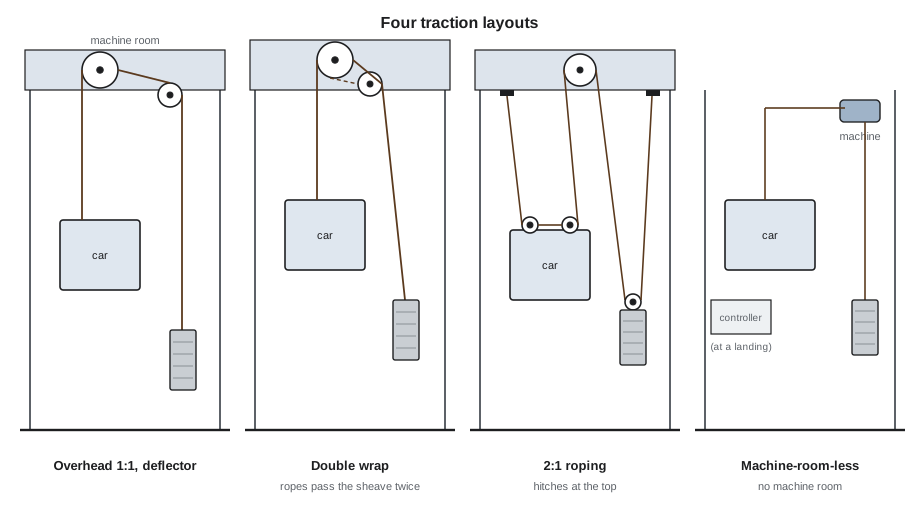
The parts of a traction elevator
Whatever the layout, a traction elevator has the same chain of parts, and this course takes them in order. The machine turns the drive sheave. On a geared machine it has a motor, a brake, a worm and gear in an oil-filled gear case, and the sheave on the gear shaft; on a gearless machine the sheave, brake and motor are on one shaft. The suspension means are the ropes or belts that carry the car and counterweight, with their terminations, called shackles or hitches, at each end. The counterweight is a steel frame filled with weights that balances the car plus part of the rated load. On taller cars, compensation chains or ropes hang from the bottom of the car to the bottom of the counterweight, to balance the weight of the hoist ropes as they move from one side of the sheave to the other. The brake holds the car at rest and stops it in an emergency. The governor and safety gear, covered in ELV-320, stop the car if it overspeeds. The controller and drive, covered in ELV-310 and in ELV-210's drive lessons, decide when and how fast the machine turns.
Ray put it differently on Tamsin's first day at Tillicum. "The ropes hold the car, the counterweight makes it easy to move, the grooves make it move, and the brake makes it stop. If you ever find one of those four not doing its job, you've found your problem." She wrote that on the first page of her traction log, under the hydraulic summary from the term before.
Why traction cars use less energy
Lesson 1 of ELV-220 showed that a hydraulic car lifts its whole weight every up trip and turns that energy into heat on the way down. A traction car with a counterweight lifts only the difference between the car side and the counterweight side. The counterweight is usually set to the weight of the empty car plus 40 to 50 percent of the rated load; Quayside's is set to 45 percent. With half a load in the car, the two sides almost balance and the machine has little more than friction to overcome. With a full car going up, or an empty car going down, the machine lifts the unbalance, which is about half the rated load. With an empty car going up, the counterweight is heavier and pulls the car up; the machine holds back and, on a regenerative drive like Quayside's, returns energy to the building.
# Hoist power for a full car going up: the machine lifts only the unbalance
g = 1
cars = [
    # name, rated load, overbalance fraction, rated speed, machine and roping efficiency
    ("Quayside car 2 (gearless, 2:1)", 3500, 0.45, 500, 0.85),
    ("Tillicum car 1 (geared, 1:1)", 2500, 0.40, 200, 0.55),
]
for name, rated, ob, v, eta in cars:
    unbalance = (1 - ob) * rated            # full car up: load minus the part the counterweight balances
    p = unbalance * g * v / eta / 33000
print(f"{name:<32} unbalance {unbalance:6,.0f} lb, power at rated speed about {p:5.1f} hp")Quayside car 2 (gearless, 2:1) unbalance 1,925 lb, power at rated speed about 34.3 hp Tillicum car 1 (geared, 1:1) unbalance 1,500 lb, power at rated speed about 16.5 hp
The power is small for the size of the cars because only the unbalance is lifted. The geared Tillicum car needs a relatively large motor for its speed because its worm gear and its old motor-generator set waste much of the energy as heat, a point Lesson 5 returns to. Quayside's gearless machine, with a regenerative drive, uses less energy per passenger than almost anything else in the building.
Here P is the power needed at rated speed, k is the overbalance fraction, Q is the rated load, g is the acceleration of gravity, v is the rated speed and η is the overall efficiency of the machine and roping. The equation ignores acceleration, rope weight and the friction of the guides, which a full calculation includes.
Tamsin's traction cars
Lena gave Tamsin a sheet listing the traction cars she would work on during the term, with the numbers the course will use again and again.
| Car | Machine | Roping | Speed | Car / rated load |
|---|---|---|---|---|
| Quayside car 2 | permanent-magnet gearless, in the hoistway (MRL) | 2:1, six 5/16 in ropes | 500 ft/min | 3,300 / 3,500 lb |
| Tillicum car 1 (1962) | geared worm machine, DC motor on a motor-generator set | 1:1 single wrap, five 1/2 in ropes | 200 ft/min | 2,750 / 2,500 lb |
| Tillicum car 2 | new gearless machine set last term | 1:1 single wrap, five 1/2 in ropes | 200 ft/min | 2,750 / 2,500 lb |
| Larchmont Residences | gearless MRL with coated steel belts | 2:1, three belts | 200 ft/min | 2,300 / 2,500 lb |
Quayside car 2 is the car Tamsin helped rig and install in her first year: the machine was hoisted into the top of the hoistway, the car frame built on the bottom landing and the counterweight filled in stages. It is now finished, and Northcrest maintains it while the building's warranty period runs. Tillicum car 1 is the last car on Route 7 with its original 1962 geared machine; car 2 had its machine replaced last term, lifted out through the penthouse roof by a mobile crane. Larchmont Residences is new to Tamsin: an eight-story rental building that opened last year, with a single MRL car hung on coated steel belts. Between them, the cars cover nearly every traction arrangement a mechanic meets in a modern city.
Worked problem
Rise and floors at Quayside
Quayside car 2 serves 30 floors with a floor-to-floor height of 10 ft. At rated speed of 500 ft/min, how long does an express run from the lobby to the top take, if acceleration and slowdown add about 4 s to the time at full speed?
Show solution
- The rise is 29 floor heights: 29 × 10 = 290 ft (the job uses 285 ft from the survey).
- At full speed the run would take 285 / 500 × 60 = 34.2 s.
- Adding about 4 s for acceleration and slowdown gives about 39 s from start to stop.
Answer: About 39 s, compared with about 27 s for the four-stop Holloway hydraulic traveling one-seventh of the distance.
Codes, regulators and the traction mechanic
Traction elevators are covered by ASME A17.1, the Safety Code for Elevators and Escalators, harmonized with CSA B44 and adopted in Washington under chapter 70.87 RCW and chapter 296-96 WAC. The code's part on electric elevators covers machines, sheaves and their diameters, brakes, suspension means and their factors of safety, terminations, counterweights, compensation, and protection against overspeed and unintended movement. A companion standard, ASME A17.6, sets requirements for steel wire ropes and for noncircular elastomeric-coated suspension members such as coated steel belts, and A17.1 refers to it. Maintenance and inspection are covered by the code's maintenance part and by the L&I Elevator Program, or inside Seattle the Seattle Department of Construction and Inspections, which issues operating permits and decides when an alteration, such as a rope replacement or a machine replacement, needs a permit and an inspection.
Several of the rules in this course arrived in the codes in the last 25 years, so the cars on Route 7 are built to different editions. Tillicum car 1, installed in 1962, has a single brake and no protection against an empty car rising too fast or a car moving away from a floor with the doors open; newer cars must have both, and many jurisdictions now require older cars to be upgraded when they are altered. Part of a traction mechanic's skill is knowing which edition a car was built to, what the current code would require if it were altered, and what the maintenance part requires of every car regardless of age.
How the course is organized
Lessons 2 to 4 cover the physics that every traction car depends on: the capstan equation that sets how much traction the grooves give, the geometry of roping and sheaves, and the balance between car and counterweight. Lessons 5 to 7 cover the machines: geared, gearless and machine-room-less. Lessons 8 and 9 cover the suspension means, ropes and belts, and how to tell when they must be replaced. Lesson 10 covers brakes, Lesson 11 the sheaves and grooves and the traction problems that come from wear, and Lesson 12 brings everything together in a full rope replacement and traction test at Tillicum.
Common mistakes
MistakeThinking the machine lifts the whole car.
InsteadIt lifts only the unbalance between the car side and the counterweight side, plus friction and acceleration.
MistakeAssuming the ropes are fixed to the sheave.
InsteadThe ropes are driven by friction in the grooves; they can slip if the traction is not enough.
MistakeTreating car speed and rope speed as always equal.
InsteadOn 2:1 roping the rope moves twice as fast as the car.
MistakeAssuming every traction car meets current code.
InsteadEach car was built to the code of its day; current rules apply when it is altered and through maintenance requirements.
MistakeThinking a machine-room-less car has no machine space.
InsteadThe machine is in the hoistway, and working on it needs the same planning as any machine room, plus access precautions.
Summary and key terms
- A traction elevator hangs the car on ropes or belts that run over a grooved drive sheave to a counterweight.
- Friction in the grooves moves the ropes; the counterweight keeps the slack side tight.
- The machine lifts only the unbalance between car and counterweight, so traction cars use little energy.
- Layouts include overhead 1:1, double wrap, 2:1, basement and machine-room-less.
- The machine, suspension means, counterweight, compensation, brake and governor form one system.
- Cars are built to the code of their day; current requirements apply through alterations and maintenance.
- Traction
- Driving the ropes by friction between the ropes and the grooves of the drive sheave.
- Drive sheave
- The grooved wheel on the machine that drives the ropes or belts.
- Counterweight
- The weighted frame on the other side of the sheave that balances the car and part of the load.
- Overbalance
- The part of the rated load, usually 40 to 50 percent, that the counterweight balances in addition to the car.
- Roping ratio
- The ratio of rope speed to car speed, such as 1:1 or 2:1.
- Machine-room-less (MRL)
- An elevator with its machine inside the hoistway instead of in a machine room.
- Suspension means
- The ropes or belts that carry the car and counterweight.
Practice problems
Work each problem on paper first, then reveal the answer to check.
Why does a traction elevator not need a drum to store rope?
Show answer
The ropes run over the sheave from car to counterweight; their length does not change with the car's position.
With a 45 percent overbalance, what load in the car makes the two sides balance?
Show answer
45 percent of rated load.
Why do most MRL cars use 2:1 roping?
Show answer
It halves the load on each rope and doubles the sheave speed, so a smaller machine can drive the car.
Quayside car 2 travels 285 ft at 200 ft/min on a slow test run. How long does the full rise take at that speed?
Show answer
285 / 200 × 60 = 85.5 s.
Name the four jobs in Ray's summary of a traction elevator.
Show answer
The ropes hold the car, the counterweight makes it easy to move, the grooves make it move, and the brake makes it stop.
Lesson quiz · 5 questions
Score 60% or more to complete this lesson.
Create a free account to save your progress, take quizzes and earn a certificate.