
ELV-220 · Lesson 7 of 12 · 21 min
Holeless, telescopic and roped hydraulics
Route 7 gained two buildings this year, and both had hydraulics with no hole under the pit. The Ashgrove Clinic is a two-story medical building with a small passenger car lifted by two telescopic jacks standing in the pit, one on each side of the car. Dunmore Square is a four-story office building with a roped hydraulic: a single jack in the corner of the hoistway, a sheave on top of its plunger and steel ropes running over the sheave from a hitch in the pit to the car. Ray took Tamsin to both on the first service visit. "These avoid the buried cylinder," he said, "but each brings its own parts to check. Know which kind you are on before you go into the pit."
Why avoid the hole
A buried cylinder needs a drilling rig, a hole as deep as the travel, a liner and casing, and a site where drilling is possible. Rock, a high water table, contaminated soil, an underground parkade or a building that cannot have a rig brought in can each make drilling impractical or expensive. A buried cylinder can also leak into the soil and corrode out of sight. Holeless and roped arrangements put the whole jack in the hoistway, where it can be seen, inspected and replaced without drilling, and where a leak drips into the pit rather than the ground.
The price is in the travel. A jack standing in the pit must be shorter than the space between the pit floor and the car's underside with the car at the bottom, plus the pit depth. A single-stage holeless jack therefore gives a rise of only one or two floors. Telescopic jacks and roped arrangements are the two ways to get more travel from a short jack.
Holeless direct-acting jacks
In the simplest holeless arrangement, one or two single-stage jacks stand on the pit floor beside the car and push up on the car sling, usually at the top crosshead or on brackets on the sling's stiles. With two jacks, one on each side, the load is shared and the car is pushed up evenly, like a car lifted at both ends. The two jacks are piped from a common line so they see the same pressure, and their plungers are tied to the car so they move together. A single jack beside the car, the cantilever or side-post arrangement, puts an overturning moment on the car and rails and suits only light cars.
With the jack beside the car instead of under it, the plunger is in tension at its top connection and the car is guided by the rails against the side loads. The jack bases sit on the pit floor, which must carry the full load of car and plunger, and the jacks are anchored and braced to the rails or hoistway wall. Because each jack carries half the load, the pressure in a twin-jack system is the total load divided by the combined area of both plungers.
Telescopic jacks
A telescopic jack has two or three nested plungers. The largest stage slides out of the cylinder, the next stage slides out of the largest, and so on. Collapsed, the jack is only a little longer than one stage; extended, it reaches nearly the sum of the stage lengths. The Ashgrove's jacks are two-stage, giving the car's full travel of 14 ft from jacks that stand only about 8.5 ft tall when collapsed.
If all stages simply connected to the same oil, the stage with the largest area would extend first, because it needs the least pressure to move the load, and then the smaller ones in turn. The car would change speed and the pressure would jump as each stage took over. Elevator telescopic jacks are synchronized so that all stages extend together at fixed proportions. In hydraulic synchronization, the stages are designed with internal passages and annular chambers so that oil displaced from one stage drives the next, and the stages move in a fixed ratio. Some designs use external synchronizing cables or chains instead. Either way, the car moves smoothly, but the synchronization must be maintained: a hydraulically synchronized jack can lose its synchronization if oil leaks between chambers, and the manufacturer specifies a resynchronizing procedure, usually running the jack to its fully collapsed or fully extended position so the stages bottom out together and the chambers refill.
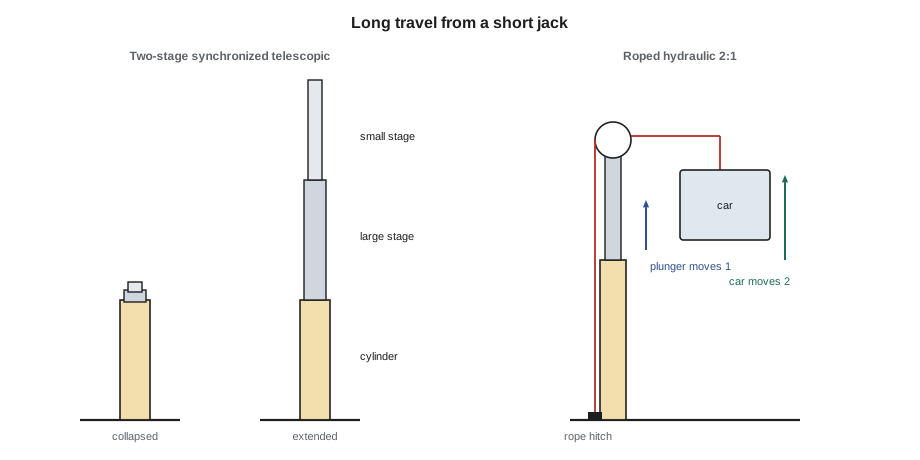
Telescopic jacks have more seals than a single-stage jack, one at each stage, and each is a place for wear and leaks. The stage surfaces must be protected just like a single plunger. Resynchronizing and bleeding a telescopic jack takes longer, because air can be trapped in each stage and in the synchronizing chambers.
# Stage areas, pressure and speed for a twin-post synchronized telescopic jack (Ashgrove Clinic, illustrative)
import math
stages = [5.5, 4.0]          # plunger outside diameters, largest first, in
jacks = 2
car_total = 2400                # car, sling and both jacks' moving stages, lb
rated = 2500                    # rated load, lb
v_car = 50                    # car speed, ft/min
areas = [math.pi * d ** 2 / 4 for d in stages]
# In a hydraulically synchronized jack the pressure acts on an effective area; for a simple estimate
# use the smallest stage area, which carries the full load in the final stage.
eff = areas[-1]
for name, load in (("empty", 0.0), ("rated load", rated)):
    force_per_jack = (car_total + load) * 1 / jacks
    p = force_per_jack / eff
    print(f"{name:<10} force per jack {force_per_jack:,.0f} lb, pressure about {p :.0f} psi")
# In a synchronized two-stage jack each stage moves at half the car speed relative to the stage below
print(f"each stage extends at {v_car / len(stages):.0f} ft/min relative to the stage that holds it")
# power balance: p Q = F v, so the oil flow is the effective area times the car speed
flow = eff * v_car * jacks * 12 / 231
print(f"oil flow for both jacks about {flow:.0f} gpm")empty force per jack 1,200 lb, pressure about 95 psi rated load force per jack 2,450 lb, pressure about 195 psi each stage extends at 25 ft/min relative to the stage that holds it oil flow for both jacks about 65 gpm
The estimate shows why telescopic jacks run at higher pressures than single-stage jacks for the same car: the smallest stage must carry the load, and its area is small. That higher pressure is part of the design, and the relief valve, hoses and fittings are rated for it. The exact pressure depends on the synchronizing design, and the manufacturer's data gives the working pressure to use for settings and tests.
Roped hydraulics
A roped hydraulic, sometimes called a hole-less roped or indirect hydraulic, uses a jack in the hoistway with a sheave on the top of its plunger. Wire ropes are fixed at one end to a hitch on the pit floor or the jack base, pass up over the sheave and down to the car's crosshead or a bottom hitch on the car. When the plunger rises, the ropes on the car side are pulled up twice as far, so the car moves at twice the plunger speed and travels twice the plunger stroke. This is 2:1 roping, and it lets a jack about half the travel serve the full rise, with no hole.
The 2:1 arrangement doubles the force on the plunger. The ropes on both sides of the sheave carry the car's weight, so the sheave pushes down on the plunger with twice the weight of the car and load, plus the weight of the plunger, sheave and its guides. The jack therefore needs about twice the area, or twice the pressure, of a direct jack for the same car, but only half the stroke. The oil flow is the same as for a direct jack of the same car speed: half the speed times twice the area.
Here W is the weight of the car and load hanging on the ropes, W the weight of the plunger, sheave and sheave guides, and v the speeds of the plunger and the car. Because the car hangs on ropes, a roped hydraulic has the hazards of a rope-suspended car: the ropes could fail or the car could overspeed in the down direction. The code therefore requires car safety gear operated by a governor, as on a traction elevator, or another approved means, and a slack rope device that stops the pump and the car if the ropes go slack, for example if the car is held up by its safeties while the plunger keeps going down.
# Dunmore Square roped hydraulic: plunger force, pressure, stroke and flow (illustrative)
import math
car = 3000                    # car and sling, lb
rated = 3000                    # lb
sheave_and_plunger = 1400      # plunger, sheave and sheave guides, lb
d = 8.0                        # plunger diameter, in
travel = 36.0                   # car travel, ft
v_car = 100                    # ft/min
area = math.pi * d ** 2 / 4
for name, load in (("empty", 0.0), ("rated load", rated)):
    force = (2 * (car + load) + sheave_and_plunger) * 1
    print(f"{name:<10} plunger force {force:,.0f} lb, pressure {force / area :.0f} psi")
print(f"plunger stroke {travel / 2:.1f} ft for {travel} ft of car travel")
flow = area * v_car / 2 * 12 / 231
print(f"plunger speed {v_car / 2:.0f} ft/min, oil flow {flow:.0f} gpm")empty plunger force 7,400 lb, pressure 147 psi rated load plunger force 13,400 lb, pressure 267 psi plunger stroke 18.0 ft for 36.0 ft of car travel plunger speed 50 ft/min, oil flow 131 gpm
What to check on holeless and roped units
Each arrangement adds items to the maintenance checklist. On twin-post holeless cars, both jacks must move together; a car that tilts or rides unevenly, or whose guide shoes wear on one side, may have one jack leaking or out of synchronization. On telescopic jacks, each stage's seal is checked for leakage, the stages for scoring, and the synchronization by watching the stages on a full run, or by the manufacturer's resynchronizing procedure when needed. On roped hydraulics, the ropes, rope hitches and sheave are inspected like those of a traction elevator: rope wear, broken wires, rust, rope tension equal across the set and the sheave grooves. The safety gear, governor and slack rope device are tested as the code requires, and the slack rope device is part of the annual tests described in Lesson 10.
Holeless jacks stand in the pit, so the pit is crowded. The refuge space, pit ladder, pit stop switch and lighting must all be reachable, and mechanics must plan their position so they are never under the car or beside a moving plunger without the car stopped and the pit stop switch open. At the Ashgrove, the jacks stand close to the pit ladder, and Ray showed Tamsin the one safe path to the stop switch before she stepped off the ladder.
Inverted jacks and other arrangements
Some holeless and roped designs mount the jack upside down, with the cylinder moving and the plunger fixed, or put the cylinder up the hoistway with its plunger pushing on the car frame. Others place the jack behind the car on a cantilevered frame. The principles are the same: the load on the moving part sets the pressure, the area and speed set the flow, and the roping ratio links the jack's motion to the car's. When Tamsin meets an unfamiliar arrangement, the first thing she does is trace the load path from the car to the jack and the oil path from the power unit to the jack, and find the manufacturer's manual.
Worked problem
Comparing a direct jack and a roped jack for the same car
Dunmore Square's car (car and sling 3,000 lb, rated load 3,000 lb) could have been served by an in-ground direct jack with a 5 in plunger. Compare the stroke, force and pressure of that jack with the roped jack's 8 in plunger, taking the direct plunger's own weight as 1,000 lb and the roped plunger with sheave as 1,400 lb, both with rated load.
Show solution
- Direct jack: stroke equal to car travel, 36 ft; force 3,000 + 3,000 + 1,000 = 7,000 lb; area 19.6 in²; pressure 357 psi.
- Roped jack: stroke half the travel, 18 ft; force 2 × 6,000 + 1,400 = 13,400 lb; area 50.3 in²; pressure 267 psi.
- The roped jack carries almost twice the force, but its larger plunger keeps the pressure lower, and it needs no hole.
Answer: The roped jack is half the length with about twice the force; the hole is avoided at the cost of ropes, a sheave, safeties and a governor.
Common mistakes
MistakeTreating a roped hydraulic like an in-ground car.
InsteadIt needs rope inspection, safety gear, a governor and a slack rope device.
MistakeIgnoring a tilting car on a twin-post holeless.
InsteadUneven jacks or leakage on one side load the guides and rails; investigate.
MistakeExpecting a telescopic jack to resynchronize itself.
InsteadFollow the manufacturer's resynchronizing procedure.
MistakeUsing a single-stage jack pressure for a telescopic jack.
InsteadThe smallest stage carries the load; use the manufacturer's working pressure.
MistakeEntering a crowded holeless pit without planning a path to the stop switch.
InsteadIdentify the safe path and the refuge space first.
Summary and key terms
- Holeless and roped hydraulics avoid drilling and buried cylinders by putting the jack in the hoistway.
- Single-stage holeless jacks give one or two floors of travel; twin jacks share the load evenly.
- Synchronized telescopic jacks extend their stages together, giving long travel from a short jack at higher pressure.
- Roped hydraulics use 2:1 roping: half the stroke and speed at the plunger, twice the force.
- Rope-suspended hydraulic cars need safety gear, a governor and a slack rope device.
- Each arrangement adds its own inspection items, and holeless pits need careful planning for safe access.
- Holeless hydraulic
- A hydraulic elevator with its jacks standing in the pit rather than buried.
- Telescopic jack
- A jack with nested stages that extend in turn or together.
- Synchronization
- The arrangement that makes the stages of a telescopic jack extend together in fixed proportion.
- Roped hydraulic
- A hydraulic elevator with a sheave on the plunger and 2:1 roping to the car.
- Slack rope device
- A switch that stops the car and pump if the ropes of a roped hydraulic go slack.
- Twin-post
- An arrangement with one jack on each side of the car.
- Resynchronizing
- The procedure that restores a telescopic jack's stages to their correct relative positions.
Practice problems
Work each problem on paper first, then reveal the answer to check.
Why does a 2:1 roped hydraulic need twice the plunger force of a direct jack?
Show answer
The ropes on both sides of the sheave carry the car's weight, so the sheave pushes down with twice that weight.
A roped hydraulic car travels 33 ft. What is the plunger stroke?
Show answer
Half the travel: 16.5 ft.
What does a slack rope device protect against?
Show answer
The plunger continuing down while the car is held by its safeties or stuck, leaving the ropes slack.
Why do telescopic jacks run at higher pressure than single-stage jacks for the same car?
Show answer
The smallest stage, with the smallest area, carries the load.
Give two reasons an owner might choose a holeless or roped hydraulic.
Show answer
Drilling is impractical or costly, and there is no buried cylinder to corrode or leak into the soil.
Lesson quiz · 5 questions
Score 60% or more to complete this lesson.
Create a free account to save your progress, take quizzes and earn a certificate.