
ELV-220 · Lesson 5 of 12 · 21 min
Control valves and valve adjustment
"The valve is the elevator," Priya told the evening class. "The pump is just a source of oil, the jack is just a cylinder. Everything the passenger feels, the start, the speed, the slowdown and the stop, comes from the valve." She handed round a cutaway of an old mechanical valve, a heavy aluminum block drilled with passages and fitted with spools, springs, needle valves and three solenoid coils. Then she showed a photograph of the new valve for Holloway car 2: a smaller block with two proportional solenoids, a pressure transducer, a temperature sensor and a cable to the controller. Different as they look, both do the same jobs, and a mechanic who understands those jobs can adjust either.
The jobs of a control valve
A hydraulic elevator control valve controls the oil between the pump, the tank and the jack. It must do six things:
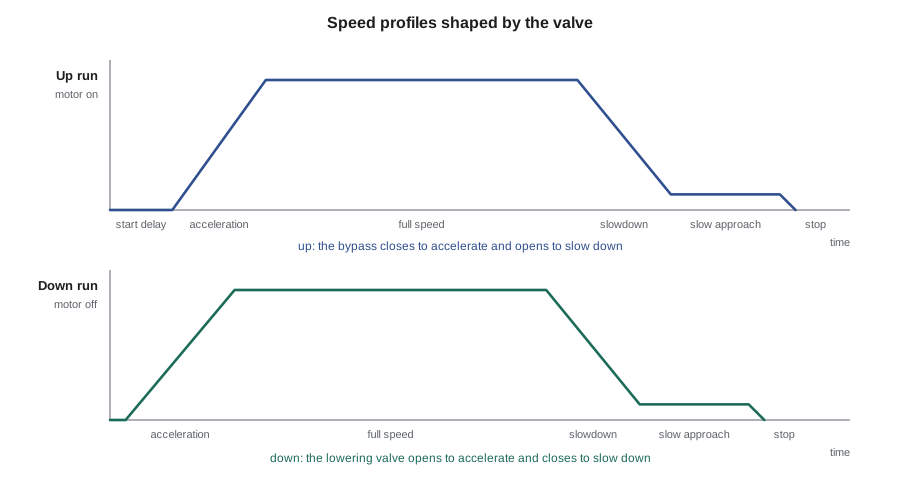
- Up start: when the motor starts, send the pump's flow back to the tank through a bypass, so the motor accelerates unloaded and the car does not move.
- Up acceleration and full speed: close the bypass gradually so that more and more flow goes to the jack, giving a smooth start, then send all the flow to the jack for full speed.
- Up slowdown, leveling and stop: as the car approaches its floor, open the bypass partly to divert flow back to the tank, slowing the car to a low leveling speed, then fully, so the car stops at the floor. The motor then stops.
- Hold: with the car stopped, hold the oil in the jack with a check valve so the car does not sink.
- Down start, speed, slowdown and stop: open a lowering path from the jack to the tank gradually for a smooth start, fully for full speed, partly for leveling, then close it to stop. The pump does not run.
- Protect: limit the pressure with the relief valve, and, on many valves, allow manual lowering with a hand-operated screw or button.
How a mechanical valve works
A conventional mechanical valve uses pilot-operated spools. A small pilot flow, controlled by solenoid valves and needle valves, moves a larger main spool, and the main spool controls the large flow to and from the jack. On an up run, the controller energizes the motor and, after a short delay, the up solenoid. The up solenoid closes a pilot passage, and the main bypass spool begins to close at a rate set by a needle valve: that is the up acceleration adjustment. Fully closed, the bypass sends all flow to the jack. When the car reaches the slowdown point, the controller de-energizes the up fast solenoid; the bypass opens part way, to a position set by the leveling speed adjustment, at a rate set by the up deceleration adjustment. At the floor, the controller drops the up leveling solenoid, the bypass opens fully, the check valve closes and holds the car, and the motor stops.
Down travel uses the lowering spool. The controller energizes the down solenoids; the lowering spool opens at a rate set by the down acceleration adjustment, to a position that sets the down speed. At the slowdown point, one solenoid drops and the spool closes to the down leveling position at a rate set by the down deceleration adjustment. At the floor, the last solenoid drops, the lowering spool closes and the car stops. Because the car is pushing the oil out, the down speed depends on the pressure, and so on the load: a heavy car pushes oil through a given opening faster than a light one. Mechanical valves use pressure-compensating spools to reduce this effect, but cannot remove it completely, nor the effect of oil temperature.
Each valve has its own names for its adjustments, often numbered screws, and its own order of adjustment. The manufacturer's adjusting instructions are the authority. The typical set includes: up start or bypass, up acceleration, up leveling speed, up stop, down acceleration, down speed, down leveling speed, down stop, relief pressure and sometimes manual lowering speed.
Electronic valves
Electronic, or proportional, valves replace the needle valves with solenoids whose force is proportional to their current. A valve control board, built into the controller or mounted on the valve, varies the solenoid current to shape the speed profile. Many electronic valves measure car speed through an encoder or the valve's own flow sensing, and correct the solenoid currents during the run so that the car follows the same profile whatever the load and the oil temperature. This is closed-loop control. The adjustments become parameters on a service tool or keypad: acceleration time, leveling speed, leveling distance and so on. Holloway car 2's new valve is of this type, with an oil temperature sensor and a pressure transducer built in.
Electronic valves make adjustment faster and the ride more consistent, and they record faults: a solenoid open circuit, a speed error or a pressure out of range. But they still have mechanical spools and seats that can stick or wear, and they still depend on the oil being clean and in its temperature range. The relief valve remains a purely mechanical device, set by a spring, because it must protect the system even if the electronics fail.
Leveling and stopping accuracy
A hydraulic car stops accurately because it slows to a low leveling speed before the stop. The controller starts the slowdown at a fixed distance before the floor, given by the landing system. The car decelerates to leveling speed and runs at that speed into the leveling zone, then stops when the landing system signals that the car is at floor level. The stopping accuracy depends on the leveling speed and on how quickly the valve can stop the car once the stop signal comes: a lower leveling speed gives a more accurate stop but a longer trip.
The first equation gives the distance needed to slow from full speed v to leveling speed at a deceleration a. The second estimates the stopping error: the leveling speed times the valve's response time, the time between the stop signal and the car actually stopping. If the slowdown distance is too short for the deceleration the valve can give, the car arrives at the floor still faster than leveling speed and overshoots; if too long, it spends many seconds creeping in at leveling speed.
# Up run profile for a hydraulic car: slowdown distance, leveling time and stopping error
v = 100                 # full speed, ft/min
v_lev = 10            # leveling speed, ft/min
a = 1.6                 # deceleration the valve gives, ft/s2
t_resp = 0.10           # valve response from stop signal to stop, s
slowdown_set = 16     # slowdown point set before the floor, in
v_si, vl_si, a_si = v * 0.00508, v_lev * 0.00508, a * 0.3048
s_needed = (v_si ** 2 - vl_si ** 2) / (2 * a_si)                 # m
s_set = slowdown_set * 0.0254
lev_dist = s_set - s_needed
print(f"distance needed to reach leveling speed: {s_needed / 0.0254:.1f} in")
if lev_dist <= 0:
    print("slowdown point too close: the car reaches the floor above leveling speed and overshoots")
else:
    print(f"distance run at leveling speed: {lev_dist / 0.0254:.1f} in, taking {lev_dist / vl_si:.1f} s")
error = vl_si * t_resp
print(f"stopping error from valve response: about {error / 0.0254:.2f} in")distance needed to reach leveling speed: 10.3 in distance run at leveling speed: 5.7 in, taking 2.8 s stopping error from valve response: about 0.20 in
With these settings, the car slows to leveling speed with room to spare and spends about three seconds at leveling speed before it stops, and the stopping error from the valve's response is only about 0.2 in. Shorten the leveling run too much, or let hot oil slow the valve's response and raise the leveling speed, and the stopping accuracy suffers. Owners and specifications usually expect a stopping accuracy within about 1/4 to 1/2 in, and the controller re-levels the car if it drifts beyond a set limit, as Lesson 10 shows.
Adjusting a valve
Valve adjustment is skilled work, done by or under the direction of a qualified mechanic and always to the manufacturer's procedure. The general order Priya teaches is:
- Prepare: install an accurate gauge on the valve's gauge port, bring the oil into its normal temperature range by running the car, and check the oil level. Read the existing settings and note them before changing anything.
- Set the relief valve first, with the manual shut-off valve closed, to the value in the manufacturer's data and within the code limits described in Lesson 10. Everything else depends on the system being protected.
- Adjust the up direction with an empty car: the bypass or start so the car does not jump when the motor starts, the acceleration for a smooth start, the leveling speed and the stop.
- Adjust the down direction with an empty car: acceleration, full speed, deceleration, leveling speed and stop.
- Check with rated load: run the car loaded in both directions, check speeds and stops, and adjust if necessary. On a mechanical valve, a compromise between empty and loaded is often needed.
- Check at different temperatures where possible, record the final settings and seal the relief valve adjustment.
Small changes, one adjustment at a time, are the rule. Each adjustment interacts with others: speeding up the up acceleration shortens the time to full speed but may make the start harsh; lowering the leveling speed improves the stop but lengthens the trip. Tamsin's log from the Holloway car 2 adjustment lists every change Priya made, the reason and the result.
Common valve problems
| Symptom | Likely cause | First check |
|---|---|---|
| Car jumps or bumps on up start | Bypass closing too fast, or up start setting wrong | Up start and acceleration adjustments |
| Car will not go up, motor runs | Bypass not closing: up solenoid not energized or spool stuck | Coil voltage, then spool |
| Car stops short of floor going up | Up leveling speed too low or stop too early | Leveling speed, landing system |
| Car overshoots and settles back | Slowdown too late, oil hot or leveling speed too high | Oil temperature, slowdown point |
| Car will not go down | Down solenoid not energized, lowering spool stuck, or shut-off valve closed | Coil voltage, shut-off valve |
| Car drifts down when parked | Check valve or lowering spool leaking, or jack packing leaking externally | Leak-down test (Lesson 10) |
| Ride varies through the day | Oil temperature changing beyond what the valve compensates for | Oil temperature, cooler |
Many valve faults are electrical rather than hydraulic. Before touching an adjustment, Ray checks that the solenoid is getting voltage when it should, using the controller's indicators or a meter at the coil, and that the coil's resistance is normal. A solenoid with an open coil, a broken lead or a burned controller output behaves exactly like a stuck spool. Debris in the oil is the next most common cause, lodging under a seat or in a small pilot orifice; it is why Lesson 3 put so much emphasis on clean oil.
Worked problem
An overshoot at the top floor
After the Marlowe's oil was cooled back into range, the car still overshot the top floor by about 3/4 in and settled back, but stopped accurately at the other floors. The top floor's slowdown vane was moved recently during a door job. What is the likely cause and fix?
Show solution
- Only one floor is affected and the oil is in range, so the valve adjustments are probably fine; they would affect every floor.
- A slowdown point that is too close to the floor gives too little distance to reach leveling speed, so the car arrives fast and overshoots.
- Tamsin measures the slowdown distance at the top floor against the other floors and finds it 6 in short.
- With Ray's agreement, she resets the vane to the same distance as the other floors and test runs the car up to the top floor several times, empty and loaded.
Answer: The landing system, not the valve, caused the overshoot; restoring the correct slowdown distance cured it.
Common mistakes
MistakeAdjusting a valve with cold or overheated oil.
InsteadBring the oil to its normal range first.
MistakeChanging several adjustments at once.
InsteadChange one at a time and record each change.
MistakeLeaving the relief valve until last.
InsteadSet and verify the relief valve first; the system must be protected.
MistakeBlaming the valve for a fault at one floor only.
InsteadCheck the landing system and slowdown point for that floor.
MistakeAssuming an electronic valve never sticks.
InsteadIt still has spools and seats that dirt can jam.
Summary and key terms
- The control valve shapes the start, speed, slowdown and stop in both directions, holds the car and limits pressure.
- Mechanical valves use pilot-operated spools with needle-valve adjustments; electronic valves use proportional solenoids and often closed-loop speed control.
- Accurate stops come from slowing to a low leveling speed before the floor; slowdown distance, leveling speed and valve response set the accuracy.
- Adjustment follows the manufacturer's order: prepare, relief valve first, up, down, loaded checks, record and seal.
- Many valve problems are electrical or caused by dirt or oil temperature; check those first.
- Bypass
- The valve path that returns pump flow to the tank, used for starting and stopping up runs.
- Check valve
- A one-way valve that holds the oil in the jack when the car is stopped.
- Lowering valve
- The valve that meters oil from the jack to the tank for down travel.
- Leveling speed
- The low speed at which the car approaches the floor before stopping.
- Proportional solenoid
- A solenoid whose force varies with its current, used in electronic valves.
- Closed-loop control
- Control that measures the result, such as car speed, and corrects the output.
- Slowdown point
- The position before a floor where the controller starts the slowdown.
Practice problems
Work each problem on paper first, then reveal the answer to check.
Why does the motor start with the bypass open?
Show answer
So it reaches speed unloaded before flow goes to the jack.
Why does a loaded car tend to go down faster than an empty car through a mechanical valve?
Show answer
Higher pressure pushes more oil through the same opening.
How far does a car need to slow from 100 to 10 ft/min at 1.6 ft/s²?
Show answer
About 0.86 ft, or 10 in.
A car will not go down; the controller shows the down command. What two things does Ray check first?
Show answer
Voltage at the down solenoid and the position of the manual shut-off valve.
Why is the relief valve set and sealed by spring rather than electronically?
Show answer
It must protect the system even if the electronics fail.
Lesson quiz · 5 questions
Score 60% or more to complete this lesson.
Create a free account to save your progress, take quizzes and earn a certificate.