
ELV-220 · Lesson 3 of 12 · 22 min
Hydraulic oil, temperature and contamination
The first service call of Tamsin's second year that was hers to explain came from the Marlowe Apartments on a hot July afternoon. The building manager reported that the elevator was "tired": it crawled up from the lobby, overshot the top floor and then sank back to the landing. In the morning, residents said, it was fine. Ray let Tamsin lead. She checked the oil temperature first, because Priya had told the class that almost every hydraulic complaint that changes with the time of day is an oil temperature complaint. The thermometer on the tank read 145 °F. The oil was thin, the valve could not control it, and the pump was slipping more of it back to the tank. This lesson is about the oil itself: what it is, how temperature changes it, what contaminates it and how a mechanic keeps it fit for service.
What hydraulic oil does
The oil in a hydraulic elevator does several jobs at once. It transmits the force from the pump to the plunger, which needs a liquid that hardly compresses. It lubricates the pump, the valve spools and the plunger packing, which needs a film strong enough to keep metal parts apart. It carries heat from the pump and valve to the tank walls and the cooler. And it protects the steel inside the system from rust. Elevator oils are mineral oils refined from petroleum, with additives for wear protection, rust and oxidation resistance, and foam control. They are usually sold by their viscosity grade, most often ISO VG 32 or ISO VG 46, and the power unit manufacturer specifies which one to use.
Some buildings use fire-resistant or biodegradable fluids, such as synthetic esters or vegetable-based oils, where a leak into the soil or a fire would be especially serious. These fluids work in elevator systems designed or approved for them, but they are not all compatible with the seals, hoses and paints used with mineral oil, and they should never be mixed with mineral oil without the manufacturers' agreement. The rule Ray gave Tamsin was simple: top up only with the oil named on the power unit's data plate or in the maintenance records, and if you do not know what is in the tank, find out before adding anything.
Viscosity and temperature
Viscosity is a liquid's resistance to flow, its thickness. It is the most important property of a hydraulic oil, and it changes strongly with temperature. A grade 46 oil has a kinematic viscosity of about 46 centistokes at 104 °F, the reference temperature for the grade. Cold, at 50 °F, it is several times thicker; hot, at 150 °F, it is less than half as thick. The viscosity index, a number on the oil's data sheet, describes how much the viscosity changes with temperature: the higher the index, the smaller the change.
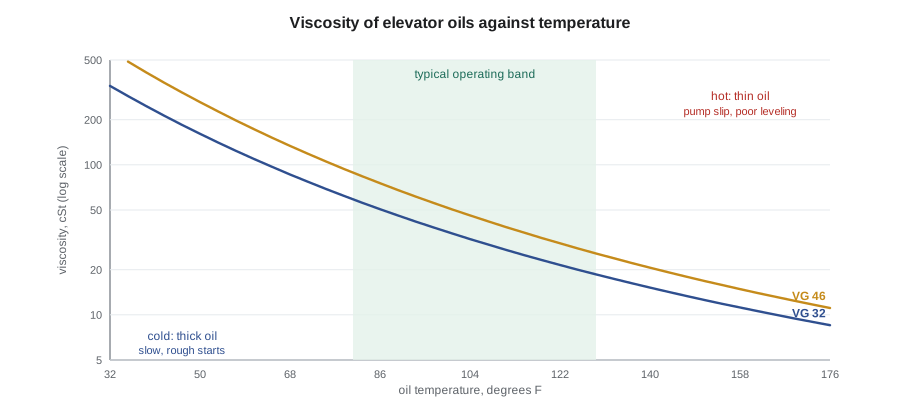
Valve and pump manufacturers design their equipment for a range of oil viscosity, and so for a range of temperatures. Typical recommendations are to keep the oil between about 80 and 130 °F in service, with exact limits given by each manufacturer. When the oil is too cold, it is thick: the car may start roughly, run slowly in the down direction because the thick oil passes through the valve more slowly, and level erratically. When it is too hot, it is thin: the pump's internal leakage rises and up speed falls, the valve meters less precisely, so the car overshoots or undershoots floors, and the oil oxidizes faster, forming sludge and varnish that shorten its life. Seals and hoses also age quickly at high temperatures.
Valve designers try to make the car's speed independent of temperature. Many electronic valves measure the oil temperature or the car speed and correct for it, and some mechanical valves have temperature-compensating adjustments. But compensation has limits. At the Marlowe the old valve had none, and the oil at 145 °F was outside any range it could handle.
Why the oil heats up
Lesson 1 showed that every descent of a hydraulic car turns the potential energy of the car, plunger and load into heat in the oil, as the valve throttles the returning flow. On the way up, the losses in the pump, motor, valve and pipes also end up as heat; on a submersible power unit, where the motor sits in the oil, even the motor's losses heat the oil. The more trips per hour and the heavier the loads, the more heat. The tank loses heat through its walls to the machine room air, but only slowly, and only if the air around it is cooler than the oil.
The temperature of the oil is therefore a balance between the heat generated, which depends on traffic, and the heat removed, which depends on the machine room. A quiet apartment building in a cool basement may never get warm; a busy hospital car or a car in a small, unventilated machine room on a summer afternoon can overheat. At the Marlowe, a new tenant had stored furniture against the machine room's only louver, and the room had reached 100 °F.
# Heat added to the oil per hour and how far the temperature would rise without a cooler (illustrative)
g = 1
travel = 40.0                     # ft
car_and_plunger = 6500           # lb
avg_load = 1800                # average load per trip, lb
eta_up = 0.60                    # share of the up-run input that does useful lifting
trips_per_hour = 40
mass = car_and_plunger + avg_load
lift = mass * g * travel / 778    # useful work per up trip, Btu (= heat on the way down)
heat_up = lift * (1 / eta_up - 1)
heat_down = lift
q_hour = trips_per_hour * (heat_up + heat_down)       # Btu per hour
oil_mass = 730                # lb of oil in the tank
c_oil = 0.45                   # specific heat of oil, Btu/(lb F)
steel_mass, c_steel = 660, 0.11 # tank, pump and motor steel
cap = oil_mass * c_oil + steel_mass * c_steel
loss = 32 * 36               # natural loss from the tank at the stated temperature difference
print(f"heat per round trip {(heat_up + heat_down) :,.0f} Btu, per hour {q_hour :,.0f} Btu")
print(f"natural loss from the tank about {loss :,.0f} Btu per hour")
rise = (q_hour - loss) / cap
print(f"net temperature rise without a cooler about {rise:.0f} F per hour of this traffic")
print(f"cooler needed to hold the temperature: about {(q_hour - loss) :,.0f} Btu/h")heat per round trip 711 Btu, per hour 28,449 Btu natural loss from the tank about 1,152 Btu per hour net temperature rise without a cooler about 68 F per hour of this traffic cooler needed to hold the temperature: about 27,297 Btu/h
The calculation is rough, but it shows why busy hydraulics need coolers. Forty round trips an hour add tens of megajoules of heat, far more than a tank can lose to still air. Without a cooler, the oil would climb steadily until the heat lost by the hotter tank matched the heat generated, which might be well above the valve's range. The heat capacity uses Btu per pound per °F for the oil and steel; the loss term assumes about 32 Btu per hour per °F of difference between the tank and the room, with the work of lifting converted to heat at 778 ft-lb per Btu.
Heaters and coolers
A power unit may have an oil heater, an oil cooler or both, each switched by a thermostat. Heaters are immersion elements in the tank, used where the machine room can get cold, such as an unheated parkade or an outbuilding; they keep the oil above the lower limit so that the first trip of the morning is smooth. Coolers are of two kinds. An air-to-oil cooler pumps oil from the tank through a finned radiator with a fan, and dumps the heat into the machine room, which must then be ventilated well enough to carry it away. A water-to-oil cooler uses building water or a closed loop and puts the heat outside the room; it needs a reliable water supply and protection against leaks into the oil. The thermostat for the cooler is set a few degrees below the upper limit, so the cooler starts before the oil is too hot.
At Holloway, the new power unit for car 2 includes an air-to-oil cooler, because the emergency department car runs almost continuously during the day and the machine room is small. The mechanical contractor upgraded the room's exhaust fan as part of the job, after Lena pointed out that a cooler only moves heat from the oil to the room. Code and the manufacturer's instructions also set the machine room temperature range; most power units are designed for rooms between about 40 and 104 °F.
Contamination: water, air and dirt
Clean, dry oil lasts many years. Contaminated oil wears pumps and valves, sticks valve spools and changes the ride. The three main contaminants are water, air and solid particles.
- Water enters as condensation when warm, humid air breathes into a tank that cools at night, or through a leaking cooler, a flooded pit, or a cylinder hole with groundwater. Small amounts dissolve; more makes the oil look milky. Water causes rust, breaks down additives and, with heat, forms acids and sludge.
- Air enters through a low oil level that lets the pump suck air, a leaking pump suction, or oil returning to the tank above the oil surface and splashing. Foamy or aerated oil compresses, so the car feels spongy, bounces when it stops and levels poorly, and the pump becomes noisy.
- Particles come from wear of the pump and valve, from new pipes and fittings that were not flushed, from the packing and from dirt brought in when the tank is topped up from an open container. They score valve spools and seats, block small orifices in pilot circuits and wear the pump.
Most power units have a suction strainer on the pump inlet and many have a filter in the return line. Oil cleanliness is described by ISO 4406 codes, which count the particles larger than 4, 6 and 14 micrometers in a milliliter of oil; a lower code means cleaner oil. A laboratory oil analysis also reports water content, viscosity and the acid number, which rises as the oil oxidizes. Northcrest sends a sample from each hydraulic on Route 7 for analysis every few years, and from any car with a valve or pump complaint. The sample is taken from the middle of the tank with a clean pump and bottle, not from the bottom, where water and sludge settle.
Topping up and filling are where much contamination starts. Ray fills tanks through a filter cart, a small pump with a fine filter that pulls oil from a sealed drum, and he keeps the drum's bung closed and the drum indoors. When a power unit is replaced, as at Holloway, the new system is flushed before it is put in service, and the old oil is not reused unless analysis shows it is fit.
Oil as a hazard
Hydraulic oil is a combustible liquid with a flash point well above room temperature, so it does not ignite easily, but a fine spray from a burst hose can ignite on a hot surface, and oil-soaked rags can heat up and catch fire on their own. Machine rooms are kept clean of oily waste, and rags go in a closed metal container. Oil on a pit floor or machine room floor is a slip hazard. Skin contact over long periods causes dermatitis, so mechanics wear nitrile gloves when handling oil and wash before eating. The safety data sheet required under the Hazard Communication Standard describes the specific oil's hazards and first aid, and Lena expects every apprentice to have read the one for the oil used on their route.
Used oil is a controlled waste. It goes to a licensed recycler, never down a drain or into the general garbage, and spills are cleaned up with absorbent, which is itself disposed of as oily waste. Lesson 11 covers leaks and spills from buried cylinders, which are an environmental problem as well as a mechanical one.
Worked problem
The Marlowe overheating call
At the Marlowe, Tamsin finds the oil at 145 °F, the machine room at 100 °F and the louver blocked by stored furniture. The power unit has no cooler. The manufacturer's oil range is 80 to 130 °F. What does she do?
Show solution
- Make the immediate problem safe: with the car at the lobby and doors closed, she and Ray explain the problem to the manager and ask for the furniture to be moved at once.
- Restore airflow: once the louver is clear and the room door is propped open with a sign and a person nearby, the room temperature begins to fall.
- Let the oil cool before judging the valve: she leaves the car out of service for an hour, then checks the oil temperature and makes test runs.
- With the oil back to 113 °F, the car runs at normal speed and levels within tolerance, so the valve itself is not at fault.
- Prevent a repeat: she writes up the cause, recommends a permanent sign on the louver and a cooler or exhaust fan quotation if the building's traffic increases, and notes it in the maintenance record.
Answer: The car was fine; the oil was too hot because the machine room could not lose heat. The fix was ventilation, and the follow-up was a written recommendation.
Common mistakes
MistakeTopping up with whatever oil is in the van.
InsteadUse only the oil specified for the power unit; mixing types can damage seals and change the ride.
MistakeAdjusting the valve on a car whose oil is too hot or too cold.
InsteadBring the oil into its operating range first, then judge the adjustment.
MistakeThinking a cooler solves the heat problem by itself.
InsteadAn air cooler moves heat into the room; the room must be ventilated.
MistakeSampling oil from the drain at the bottom of the tank.
InsteadSample from the middle of the tank; the bottom holds settled water and sludge.
MistakeLeaving oily rags in an open pile.
InsteadOil-soaked rags can heat and ignite; keep them in a closed metal container.
Summary and key terms
- Hydraulic oil transmits force, lubricates, carries heat and protects against rust.
- Viscosity falls steeply with temperature; equipment is designed for a limited temperature range.
- Cold oil gives slow, rough runs; hot oil gives low up speed, poor leveling and short oil life.
- Heat comes from every descent and from pump and valve losses; busy cars need coolers and ventilated machine rooms.
- Water, air and particles are the main contaminants; strainers, filters, careful filling and oil analysis control them.
- Oil is a combustible, slippery and controlled material; handle, store and dispose of it accordingly.
- Viscosity
- A liquid's resistance to flow.
- ISO viscosity grade
- The viscosity class of an oil, such as VG 32 or VG 46, named for its viscosity in centistokes at 104 °F.
- Viscosity index
- A number describing how much an oil's viscosity changes with temperature.
- Aeration
- Air bubbles carried in the oil, making it compressible.
- Oil cooler
- A heat exchanger that removes heat from the oil to air or water.
- ISO 4406 code
- A cleanliness code based on particle counts at three sizes.
- Acid number
- A measure of acids in the oil, rising as it oxidizes.
Practice problems
Work each problem on paper first, then reveal the answer to check.
Why does a car often run slowly down on a cold morning?
Show answer
Cold oil is thick and passes through the down valve more slowly.
Name three effects of oil that is too hot.
Show answer
Lower up speed from pump slip, poor leveling from imprecise valve control, faster oxidation and seal aging.
What does milky oil indicate?
Show answer
Water contamination.
Why must an air-to-oil cooler be paired with machine room ventilation?
Show answer
It transfers the oil's heat into the room air, which must be carried away.
A car feels spongy and bounces when it stops; the tank level is low. What is the likely cause?
Show answer
Air drawn in by the pump, aerating the oil.
Lesson quiz · 5 questions
Score 60% or more to complete this lesson.
Create a free account to save your progress, take quizzes and earn a certificate.