
ELV-220 · Lesson 2 of 12 · 21 min
Hydraulic principles: pressure, flow and force
Priya Sandhu, Northcrest's senior adjuster, ran the evening block for second-year apprentices again this term, and she opened it with a pressure gauge on the classroom table. "Every hydraulic elevator you will ever adjust obeys three rules," she said. "Pressure is force divided by area. Flow is area times speed. Power is pressure times flow. If you can do those three calculations in your head, you can tell from a gauge reading whether a car is overloaded, whether a pump is worn and whether a valve is set right." This lesson works through those rules with the numbers from Holloway car 2, and adds the losses that turn some of the pump's work into heat on the way to the jack.
Pressure in a liquid
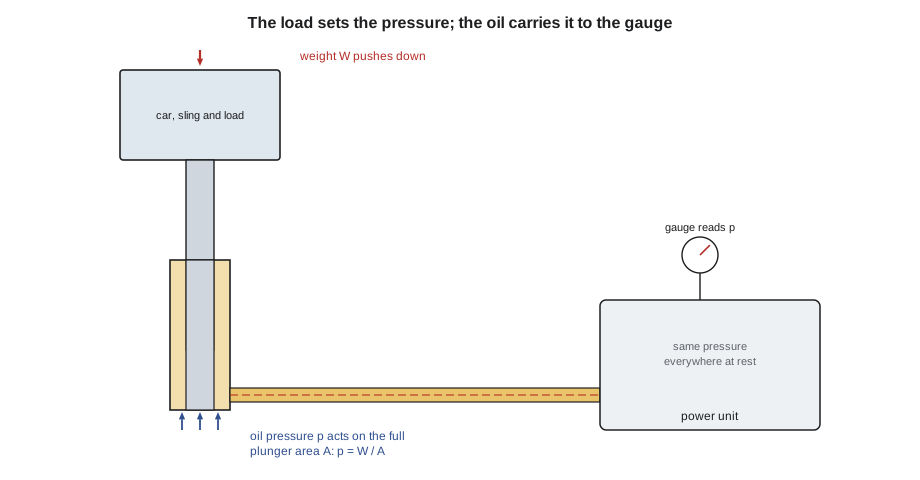
Pressure is force spread over an area. A liquid in a closed system passes pressure equally in all directions, a principle named after Blaise Pascal, who described it in the seventeenth century. If a pump pushes oil into a pipe connected to a jack, the pressure in the pipe, the valve block and the cylinder is the same everywhere, apart from small differences caused by flow and by the height of the oil. The pressure that develops is whatever is needed to hold up the load on the plunger. The pump does not decide the pressure; the load does. With no load, the pressure would be almost zero; with the car full, it rises.
Here p is the pressure, F the force on the plunger and A the area of the plunger. The area that matters is the area of the plunger's full outside diameter, because the oil presses on the plunger's whole cross-section, even if the plunger is a hollow tube. For Holloway car 2, the plunger is 6 in in diameter, so its area is 28.27 in².
The force on the plunger is the weight of everything it carries: the car and sling, the plunger itself, because a direct-acting plunger is lifted with the car, and the load in the car. With the car empty, the plunger carries 5,000 + 1,500 = 6,500 lb. With the full rated load of 4,500 lb it carries 11,000 lb.
# Jack pressure for Holloway car 2, empty and with rated load
import math
d = 6.0                      # plunger diameter, in
area = math.pi * d ** 2 / 4  # in2
car_sling = 5000            # lb
plunger = 1500
rated = 4500
for name, load in (("empty car", 0.0), ("half load", rated / 2), ("rated load", rated), ("125 % load", 1.25 * rated)):
    force = (car_sling + plunger + load) * 1      # lb
    p = force / area
print(f"{name:<11} force {force:>9,.0f} lb pressure {p / 1:6.0f} psi")empty car force 6,500 lb pressure 230 psi half load force 8,750 lb pressure 309 psi rated load force 11,000 lb pressure 389 psi 125 % load force 12,125 lb pressure 429 psi
The results are the static pressures, the pressures with the car standing still. The empty car needs about 230 psi and the fully loaded car about 389 psi. The code calls the full-load static pressure the working pressure, and many other numbers are set from it: the setting of the pressure relief valve, the test pressures for the cylinder and piping, and the rating of the hose. Ray keeps the empty-car and full-load pressures for every hydraulic on Route 7 in his notebook, because a gauge reading that does not match the expected value is often the first clue to a problem.
Several pressure units are in use. In the United States, gauges, valve data and code values for hydraulic elevators are usually given in pounds per square inch, psi. Some imported equipment uses the bar, about 14.5 psi, or the megapascal, about 145 psi. Gauges read gauge pressure, the pressure above atmospheric pressure, sometimes written psig. A gauge reads the pressure above atmospheric pressure, which is what matters for the forces on a jack.
Flow and speed
Flow is the volume of oil moving per unit of time. To raise the plunger at a given speed, the pump must fill the space the plunger leaves behind at the same rate. The volume of that space per second is the plunger area times its speed. The relation between flow and speed is the second of Priya's rules.
For Holloway car 2, with a plunger area of 28.27 in² and a rated speed of 100 ft/min, the flow at rated speed is 28.27 × 1,200 = 33,900 in³/min, and since a US gallon is 231 in³, about 147 gpm. The power unit's pump is chosen to deliver at least that flow at the working pressure, and the valve's flow rating must match.
The relation also works the other way. If the car runs slower than rated speed on an up run, either the pump is delivering less flow than it should or some of the flow is escaping somewhere else, usually back to the tank through a valve that is not closing fully. A worn pump delivers less flow at high pressure than at low pressure, because more oil slips past its internal clearances, so a car that runs normal speed empty but slows down when loaded points to the pump. A timed run with a stopwatch, empty and loaded, is one of the simplest tests a mechanic can make.
On a direct-acting jack, the car moves at the plunger's speed. On a roped hydraulic, with 2:1 roping, the car moves at twice the plunger speed, but the plunger carries twice the load. The flow and pressure for the same car are therefore the same as for a direct-acting jack of twice the stroke, apart from the extra friction of the sheave and ropes, which is why a roped hydraulic's jack is larger in diameter than a direct jack for the same car.
Power and energy
Hydraulic power is the rate at which the oil does work. It equals the pressure times the flow, Priya's third rule, and it is the power the pump must deliver to the oil. The motor must supply more than this, because the pump and motor are not perfectly efficient.
With the car fully loaded going up, the hydraulic power for Holloway car 2 is 389 psi × 147 gpm. In US units the hydraulic power in horsepower is psi × gpm / 1,714, so the power is 389 × 147 / 1,714 = 33.3 hp. With a pump and motor efficiency of about 80 percent, the motor needs about 42 hp, and the new power unit's motor is rated 40 hp, which is enough because hydraulic elevator motors are rated for the short, intermittent runs of elevator service rather than continuous running.
# Pump flow, hydraulic power and motor power for Holloway car 2
import math
area = math.pi * 6.0 ** 2 / 4        # in2
speed = 100                          # rated speed, ft/min
flow = area * speed * 12 / 231          # gpm
eta = 0.80                           # pump and motor together
for name, p in (("empty car", 230), ("rated load", 389)):
    hyd = p * flow / 1714
    print(f"{name:<10} flow {flow:5.0f} gpm  hydraulic power {hyd:5.1f} hp  motor input {hyd / eta:5.1f} hp")
# energy delivered to the oil in one full-load up trip
travel = 40.0
t_run = travel / speed * 60
print(f"one full-load up trip takes about {t_run:.0f} s at rated speed")empty car flow 147 gpm hydraulic power 19.7 hp motor input 24.6 hp rated load flow 147 gpm hydraulic power 33.3 hp motor input 41.7 hp one full-load up trip takes about 24 s at rated speed
The pump's flow depends very little on pressure, because a positive-displacement pump pushes a fixed volume of oil each revolution. The motor current, in contrast, rises with pressure, because the power the motor delivers is proportional to the pressure. That gives the mechanic two easy readings on an up run: the car speed, which shows the flow, and the motor current, which shows the pressure. A car that runs at rated speed with the motor current above the nameplate is overloaded or has a high back-pressure; a car that runs slow with normal current has lost flow.
Losses: friction in pipes and valves
Oil moving through pipes, fittings, valves and hoses loses pressure to friction. When the car is going up, the pump must produce the static pressure needed to hold the load plus the pressure lost on the way to the jack, so the gauge on the power unit reads higher while the car is running up than when it is standing. Going down, the losses work the other way: the pressure at the power unit is lower than in the cylinder. These differences are called the running pressures, and the difference between running and static pressure is a measure of the losses.
The pressure lost in a pipe rises with the square of the oil velocity, so the pipe size matters. A rule of thumb used by many manufacturers is to keep the oil velocity in the main line at no more than about 13 to 16 ft/s. Above that, the losses, noise and heating grow quickly and the valve's control becomes rougher. The velocity in the pipe is the flow divided by the pipe's inside area.
This is the Darcy-Weisbach equation. The pressure drop depends on a friction factor f, the length of pipe L, its inside diameter D, the oil density ρ and the velocity v. The friction factor in turn depends on whether the flow is smooth and layered, called laminar, or turbulent. A dimensionless number, the Reynolds number, decides which: below about 2,000 the flow is laminar, above about 4,000 it is turbulent. Hydraulic oil is much more viscous than water, so elevator pipe flows are often near the boundary.
# Oil velocity and friction loss in the main line to the jack (illustrative)
import math
flow = 147                 # gpm
d_in = 2.469                   # inside diameter of the pipe, in (2-1/2 in schedule 40)
length = 60.0                  # pipe length, power unit to jack, ft
nu = 46e-6                    # kinematic viscosity, m2/s (an ISO VG 46 oil at 40 C)
rho = 870.0                   # kg/m3
q = flow * 3.785e-3 / 60                # m3/s
d = d_in * 0.0254                # m
v = q / (math.pi * d ** 2 / 4)
re = v * d / nu
f = 64 / re if re < 2000 else 0.316 / re ** 0.25
dp = f * (length * 0.3048) / d * rho * v ** 2 / 2       # Pa
print(f"velocity {v / 0.3048:.2f} ft/s, Reynolds number {re:,.0f}")
print(f"friction factor {f:.3f}, pressure loss in the straight pipe {dp / 6895:.1f} psi")
print("fittings, the valve and the jack inlet add more; the total is found from the running pressure")velocity 9.85 ft/s, Reynolds number 4,093 friction factor 0.040, pressure loss in the straight pipe 6.6 psi fittings, the valve and the jack inlet add more; the total is found from the running pressure
The friction loss in the straight pipe at Holloway is small compared with the working pressure, which is the aim. The valve itself takes the biggest share of the losses, especially on the down run, where the valve deliberately throttles the flow to control the speed. Every loss turns pressure into heat in the oil.
Head pressure and the height of the oil
A column of liquid exerts a pressure at its base proportional to its height and density. For hydraulic oil, a column 1 ft high exerts about 0.38 psi. The difference is small compared with the working pressure, but it matters in two places. When a power unit is on a floor above the pit, as at Dunmore Square, the gauge at the power unit reads a little less than the pressure at the cylinder because of the oil column in the pipe. And when a mechanic opens a fitting at the bottom of a system, the column of oil above it keeps pushing oil out even with the pump stopped and the car landed on its stops, so isolation must include closing the shut-off valve and draining or lowering the pressure.
Worked problem
Checking a car for overload from a gauge reading
At Holloway, a porter calls the car to the basement with a heavy bed and a portable imaging unit. With the car standing at the floor, the gauge on the power unit reads 440 psi. The car and sling plus plunger weigh 6,500 lb and the plunger area is 28.27 in². Is the car overloaded?
Show solution
- The total force on the plunger is pressure times area: 440 × 28.27 = 12,440 lb.
- Subtracting the car, sling and plunger leaves a load of 12,440 − 6,500 = 5,940 lb.
- The rated load is 4,500 lb, so the car carries about 132 percent of rated load.
Answer: Yes. The reading shows a load well over rated load; the car should not run until the load is reduced, and the incident should be reported to facilities.
Common mistakes
MistakeThinking the pump sets the pressure.
InsteadThe load on the plunger sets the pressure; the pump sets the flow.
MistakeUsing the plunger's wall area for pressure calculations.
InsteadThe oil acts on the plunger's full cross-section.
MistakeForgetting the plunger's own weight.
InsteadA direct-acting plunger is lifted with the car and is part of the load.
MistakeComparing a running gauge reading with the static working pressure.
InsteadRunning up, the gauge also shows the pipe and valve losses; compare static with static.
MistakeMixing pressure units.
InsteadOne megapascal is about 145 psi; one bar is about 14.5 psi.
Summary and key terms
- Pressure is force divided by plunger area; the load on the plunger sets it.
- The working pressure is the static pressure with rated load, and other settings are based on it.
- Flow equals plunger area times speed; the pump's flow sets the car's up speed.
- Hydraulic power equals pressure times flow; the motor supplies that power divided by the efficiency.
- Friction in pipes and valves lowers the pressure along the path and turns it into heat.
- Car speed and motor current are simple field readings of flow and pressure.
- Pressure
- Force per unit area, measured in pascals or psi.
- Working pressure
- The static pressure in the jack with the car at rated load.
- Flow
- The volume of oil moving per unit of time.
- Positive-displacement pump
- A pump that delivers a fixed volume per revolution, almost independent of pressure.
- Running pressure
- The pressure at the power unit while the car is moving, including losses.
- Reynolds number
- A dimensionless number that indicates whether a flow is laminar or turbulent.
- Gauge pressure
- Pressure measured above atmospheric pressure.
Practice problems
Work each problem on paper first, then reveal the answer to check.
A jack has a plunger of 4 in diameter carrying a total of 4,000 lb. What is the static pressure?
Show answer
Area 12.57 in²; 4,000 / 12.57 = 318 psi.
The same jack must move at 80 ft/min. What flow is needed?
Show answer
12.57 × 80 × 12 / 231 = 52 gpm.
A car runs at rated speed empty but slows down when loaded. What is the likely cause?
Show answer
Internal leakage in a worn pump, which increases with pressure.
Why does the gauge read higher while the car runs up than when it stands still?
Show answer
The pump must also overcome friction losses in the pipe and valve.
How much pressure does a 6 ft column of hydraulic oil exert?
Show answer
About 6 × 0.38 = 2.3 psi.
Lesson quiz · 5 questions
Score 60% or more to complete this lesson.
Create a free account to save your progress, take quizzes and earn a certificate.