
ELV-220 · Lesson 12 of 12 · 21 min
Capstone: troubleshooting and testing a hydraulic elevator
The last two weeks of Tamsin's hydraulic term brought the two kinds of work that make up most of a hydraulic mechanic's year. The first was the acceptance test of Holloway car 2, the end of the modernization she had worked on since the first lesson. The second was a service call at Dunmore Square, where the roped hydraulic had started stopping short of the top floor. Ray told her she would write the records for both. This capstone follows both jobs from start to finish, using the knowledge from every lesson in the course: pressure and flow, oil, the power unit, the valve, the jack, the controls and the safety devices.
Part 1: the acceptance test at Holloway
By the Thursday before the inspection, car 2's new equipment was installed: the protected cylinder and plunger, the rupture valve on the cylinder inlet, the new line and hose, the power unit with its soft starter and cooler, the electronic valve and the new controller. Priya had adjusted the valve over two evenings, with the oil at its normal temperature, first empty and then with test weights. Before the inspector came, Northcrest ran its own full set of acceptance tests, so that nothing would be found for the first time in front of the inspector.
Lena's test plan listed the tests in an order that kept the car safe at each step: safety circuits and door locks first, so that every later test was done on a car that would stop if something went wrong; then the hydraulic system's pressure tests; then the overspeed and lowering devices; then the running tests with load; and finally the operating features, such as fire service, battery lowering and the pump run timer. The test weights, 4,500 lb of steel blocks on wheeled carts, were brought up from the dock on car 1 at night, a few carts at a time.
- Relief valve: with the shut-off valve closed, the pump was run against it and the relief valve passed full flow at 525 psi, 135 percent of the working pressure of 389 psi, inside the permitted range. The test was repeated with the jack in the circuit as the procedure required.
- System pressure test: the new jack, line and hose were held at the test pressure for the required time with the car on its stop, with no loss of pressure beyond what the temperature change explained, and no leaks at any fitting.
- Rupture valve: with the specified load in the car and nobody in it, the car was run down and the down flow raised above the trip setting using the test method in the valve manufacturer's instructions. The valve closed and the car stopped within the limits, then was reset and lowered normally.
- Anti-creep: with the car at a floor, the manual lowering valve was opened slowly; the re-leveling held the car within limits.
- Running tests: speeds empty and with rated load in both directions, stopping accuracy at every floor, motor current on a loaded up run and the oil temperature were recorded. The loaded down speed with warm oil was checked against the rupture valve's trip with a comfortable margin.
- Protections and features: pump run timer, motor thermal input, phase reversal, low oil, battery lowering, fire service recall and in-car operation, and the emergency lighting and communication in the car.
Tamsin recorded every reading on the test sheet as it was taken, and Priya checked each against its limit. The code below does the same check on the recorded values, the kind of check the controller's service tool or a spreadsheet can do once the readings are typed in.
# Holloway car 2 acceptance test readings checked against limits
working = 389
tests = [
    # name, reading, low limit, high limit, unit
    ("relief, shut-off closed", 525, 1.10 * working, 1.50 * working, "psi"),
    ("relief, jack in circuit", 530, 1.10 * working, 1.50 * working, "psi"),
    ("up speed, rated load", 98, 0.90 * 100, 1.10 * 100, "ft/min"),
    ("down speed, rated load, warm oil", 108, 0.90 * 100, 1.15 * 100, "ft/min"),
    ("rupture valve trip speed", 152, 1.00 * 100, 160, "ft/min"),
    ("anti-creep drift held within", 0.3, 0.0, 1.0, "in"),
    ("stopping accuracy, worst floor", 0.25, 0.0, 0.40, "in"),
    ("motor current, rated load up", 45.0, 0.0, 1.00 * 47.0, "A"),
    ("oil temperature at end of tests", 111, 80, 130, "F"),
]
fails = 0
for name, value, lo, hi, unit in tests:
    ok = lo <= value <= hi
    fails += not ok
    print(f"{name:<34} {value:>7} {unit:<7} limits {lo:.2f} to {hi:.2f}  {'pass' if ok else 'FAIL'}")
print("all tests passed: ready for the inspector" if fails == 0 else f"{fails} reading(s) outside limits: correct and retest")relief, shut-off closed 525 psi limits 427.90 to 583.50 pass relief, jack in circuit 530 psi limits 427.90 to 583.50 pass up speed, rated load 98 ft/min limits 90.00 to 110.00 pass down speed, rated load, warm oil 108 ft/min limits 90.00 to 115.00 pass rupture valve trip speed 152 ft/min limits 100.00 to 160.00 pass anti-creep drift held within 0.3 in limits 0.00 to 1.00 pass stopping accuracy, worst floor 0.25 in limits 0.00 to 0.40 pass motor current, rated load up 45.0 A limits 0.00 to 47.00 pass oil temperature at end of tests 111 F limits 80.00 to 130.00 pass all tests passed: ready for the inspector
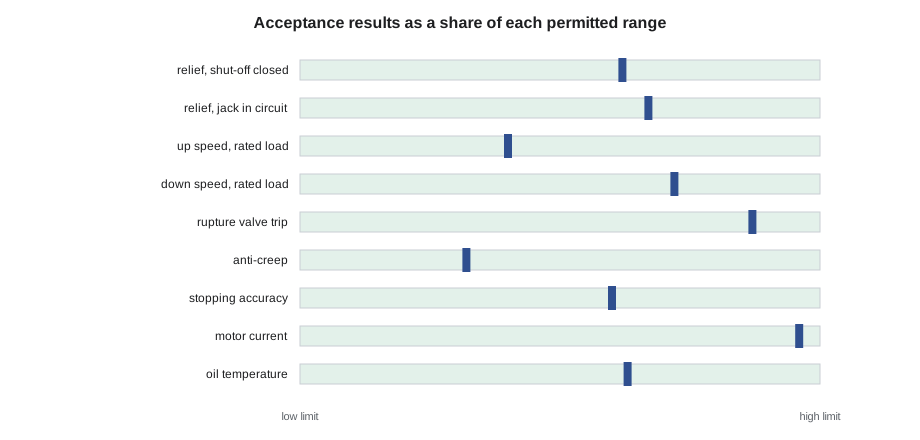
On the Monday, the inspector witnessed the tests. She chose which tests to see repeated, read the test sheet, checked the maintenance control program for the new equipment, looked at the liner monitoring pipe and the drawings of the protected cylinder, and asked Tamsin how the rupture valve was reset. She found one deficiency: the new machine room door closer did not latch the door reliably. Northcrest's carpenter adjusted it that afternoon, and the car returned to service under a new operating permit two days later. The hospital's facilities manager rode it first, with a stretcher from the emergency department.
Part 2: the Dunmore Square call
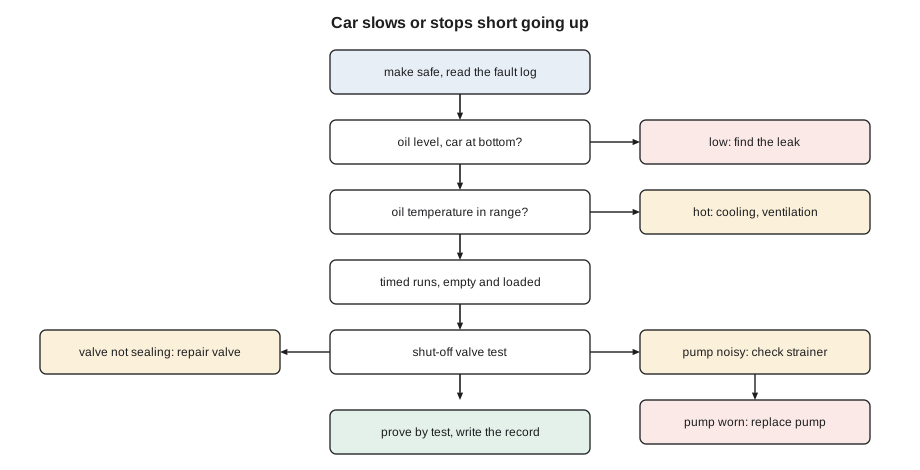
Two days later, Dunmore Square's property manager called. The roped hydraulic had stopped below the top floor twice that morning with a full car and then gone down to the lobby by itself and opened its doors. People were taking the stairs. Ray sent Tamsin with a second-year apprentice from another route and stayed on the phone. Tamsin used the method Priya taught in every evening class: make it safe, gather information, form hypotheses, test them one at a time with measurements, repair, prove the repair by test and write it up.
- Make it safe: she confirmed the car was empty at the lobby and out of service, put signs at the lobby and fourth floor, and told the property manager what she was doing.
- Gather information: the controller's event log showed two pump run timer trips that morning, both on up runs to the fourth floor with high car load. The building manager said the car had been "a bit noisy" for a week. The previous visit's record showed a repacking of the jack a month earlier.
- Observe: she ran the car empty to the top floor on inspection from the machine room. It arrived, but the pump sounded rough, with a crackling noise, and the car speed was low near the top. Oil temperature was 106 °F, normal. Oil level, with the car at the bottom landing, was at the normal mark.
The pump run timer had done what it should: the car had taken too long to arrive, so the controller assumed low oil, lowered the car and took it out of service. But the oil level was normal. So the pump was running and not delivering full flow, especially at high pressure, and the crackling noise suggested cavitation, the pump starving at its inlet so that bubbles form and collapse inside it.
# Dunmore Square: is the pump delivering its flow? Timed runs compared with the commissioning record
import math
area = math.pi * 8.0 ** 2 / 4              # plunger area, in2
stroke = 13.0 * 12                               # plunger travel in the timed section, in
commissioning = {"empty": 16.2, "loaded": 16.8}   # seconds for the timed section when new
today = {"empty": 17.4, "loaded": 22.6}
for k in ("empty", "loaded"):
    q_new = area * stroke / commissioning[k] * 60 / 231
    q_now = area * stroke / today[k] * 60 / 231
    print(f"{k:<7} flow when new {q_new:5.0f} gpm, today {q_now:5.0f} gpm, loss {100 * (1 - q_now / q_new):4.1f} %")
print("loss much larger loaded than empty, with noise at the pump: suspect inlet restriction or worn pump")empty flow when new 126 gpm, today 117 gpm, loss 6.9 % loaded flow when new 121 gpm, today 90 gpm, loss 25.7 % loss much larger loaded than empty, with noise at the pump: suspect inlet restriction or worn pump
Her hypotheses, in order of likelihood and ease of checking, were: a restricted pump inlet, from a clogged suction strainer; air entering the suction; a worn pump; and a valve bypass not closing fully under pressure. The shut-off valve test from Lesson 4 would separate pump from valve: with the shut-off valve closed, the pump should build the relief pressure promptly and pass full flow. It did reach the relief pressure, but the pump's noise got worse and the pressure gauge needle shook. A valve leak would not cause that noise; a starved pump would.
That left the inlet. With the car landed on its buffer, the controller locked out and the shut-off valve closed, Tamsin and her partner pumped the oil from the tank into clean drums through the filter cart, opened the tank and found the suction strainer on the pump inlet half covered with black fibers and shreds of rubber: pieces of the old packing removed a month before, which had been flushed into the tank by the scavenger pump and drawn onto the strainer. The strainer was cleaned, the tank wiped out, the scavenger pump's own filter checked and the oil returned through the filter cart. An oil sample went to the lab.
Proof by test came next: the car ran up empty and loaded, timed in the same section as the commissioning record, and both times were back within a second of the original. The pump was quiet, the gauge steady, the motor current normal. She tested the pump run timer by simulating a long run as the controller manual describes, and it tripped as it should. The car went back into service before noon, and she rode it with the first full load.
Writing it up
The service record is the last step and, as Ray reminded her, the one the next mechanic will read. Tamsin's record for Dunmore Square said:
- Complaint: car stopped below the top floor twice with full load, lowered to lobby; noisy for about a week.
- Findings: two pump run timer trips in the event log; oil level and temperature normal; flow loss about 26 percent loaded and 7 percent empty against the commissioning times; pump cavitation noise; relief pressure reached against the closed shut-off valve with pump noise and gauge vibration; suction strainer half blocked with packing debris from last month's repacking.
- Work done: tank drained through filter cart, strainer and tank cleaned, scavenger pump filter checked, oil returned through filter, oil sample sent for analysis.
- Tests: timed runs empty and loaded within one second of commissioning; pump quiet, motor current normal; pump run timer tested; car returned to service.
- Recommendations: after any repacking, clean the drip ring and check the strainer at the next visit; add this to the maintenance control program; review the oil analysis when it returns.
Lena added the recommendation to the program for every hydraulic on Route 7 with a scavenger pump. It was a small change, and exactly the kind of change that a good record makes possible.
What the two jobs have in common
The acceptance test and the service call look different, but they rest on the same understanding. Pressure comes from the load, flow from the pump, and the valve directs the oil. The oil must be clean, at the right temperature and in the right quantity. The safety devices must work at the right settings, and the only way to know is to test them. Every reading is compared with a known value, a limit, a commissioning record or a previous visit. And the work is not finished until the car has been proved by test and the record written. That is the job of a hydraulic elevator mechanic, and it is the foundation for the traction machines, controllers and doors in the next courses.
Worked problem
Choosing the next check at Dunmore Square
Suppose that at Dunmore Square the oil level had been low, with the car at the bottom landing, and the pump quiet. What would the likely cause of the run timer trips have been, and what would Tamsin do next?
Show solution
- Low oil means the pump could not supply enough oil to extend the plunger to the top; the run timer trips because the car does not arrive.
- The oil went somewhere. On a roped hydraulic with the jack in the hoistway, a leak should be visible: at the packing after the recent repacking, a fitting, the hose or the valve.
- She would clean and check the packing head first, because it was the most recent work, then the line and the power unit.
- After repairing the leak, she would top up the oil through the filter cart, record the amount in the oil log, and test the car and the run timer.
Answer: A low level points to a leak; the recent repacking would be the first place to look, and the oil added would be recorded.
Common mistakes
MistakeResetting a pump run timer trip because the oil level looks normal.
InsteadA normal level with a timer trip means the pump is not delivering; find out why.
MistakeJudging pump flow without a reference.
InsteadCompare timed runs with the commissioning record or previous visits.
MistakeDoing acceptance tests in any order.
InsteadTest the safety circuits first, so every later test is done on a car that can stop.
MistakeReturning a car to service without proving the repair.
InsteadRun the tests that showed the fault and confirm they now pass.
MistakeWriting a record that says only 'fixed'.
InsteadRecord complaint, findings, work, tests and recommendations.
Summary and key terms
- Acceptance tests follow a plan: safety circuits first, then pressure tests, overspeed devices, loaded runs and operating features.
- Each reading is checked against its limit and recorded; the inspector witnesses and reviews.
- Troubleshooting follows a method: make safe, gather information, form hypotheses, test them, repair, prove and record.
- Timed runs against commissioning values and the shut-off valve test separate pump, valve and oil problems.
- Debris from earlier work can starve a pump; good records lead to better maintenance programs.
- Acceptance test
- The full set of tests that proves a new or altered installation before it carries passengers.
- Cavitation
- Formation and collapse of vapor bubbles in a pump starved at its inlet, causing noise and damage.
- Suction strainer
- A screen on the pump inlet that stops large debris entering the pump.
- Commissioning record
- The readings taken when equipment was new, used as the reference for later checks.
- Proof by test
- Repeating the tests that showed a fault to confirm a repair.
- Service record
- The written account of a call: complaint, findings, work, tests and recommendations.
Practice problems
Work each problem on paper first, then reveal the answer to check.
Why does the acceptance test plan put safety circuits first?
Show answer
So every later test is done on a car whose safety circuits will stop it if something goes wrong.
What two observations at Dunmore Square pointed to the pump inlet rather than the valve?
Show answer
Cavitation noise that got worse at high pressure, and a shaking gauge, with the relief pressure still reached.
A timed loaded run takes 22.6 s against 16.8 s when new. What percentage of flow has been lost?
Show answer
1 − 16.8 / 22.6 = 26 percent.
What should a service record include?
Show answer
The complaint, findings with readings, work done, tests that prove the repair and recommendations.
What change to the maintenance program came out of the Dunmore Square call?
Show answer
Check the drip ring and suction strainer at the visit after any repacking.
Lesson quiz · 5 questions
Score 60% or more to complete this lesson.
Create a free account to save your progress, take quizzes and earn a certificate.