
ELV-220 · Lesson 11 of 12 · 21 min
Maintenance, leaks and oil management
Every hydraulic on Route 7 has a binder in its machine room, and since last year a matching record in Northcrest's online maintenance system. Lena reviews them every month, and one line she always reads is oil added. "Oil does not evaporate," she told Tamsin, showing her the record for the Marlowe. "Every liter you pour into that tank went somewhere. If you can see where, fix it. If you can't, it may be in the ground." The Marlowe's record showed oil added three times in the past year, a total of about 5 gal, with no visible leak noted. That made it the first hydraulic on Route 7 Tamsin was asked to investigate on her own.
The maintenance control program
The code requires the owner of every elevator to have a maintenance control program, usually prepared and carried out by the elevator contractor. The program lists the maintenance tasks and examinations for each piece of equipment, the interval for each, the procedures to follow, and the records to keep. It must be specific to the installation, available on site to the mechanic and the inspector, and updated when equipment changes. The L&I Elevator Program and the inspector review the records at each periodic inspection, and missing or incomplete records are a common finding. For a hydraulic elevator, the program typically includes:
| Interval | Typical hydraulic tasks |
|---|---|
| Each visit | Check oil level with the car at a known position and record it; check oil temperature; look for oil at the power unit, valve, line, packing and pit; listen to the pump and motor; ride the car and check starts, stops and leveling |
| Monthly to quarterly | Clean the drip ring and check the scavenger pump; inspect hoses and fittings; check the plunger surface; check motor current on a loaded up run; check controller indicators and fault log; test the battery lowering device and emergency light |
| Semi-annually | Check valve adjustments and stopping accuracy; check the starter, contacts and overloads; check the pump run timer; check the cooler and heater thermostats; check the liner monitoring pipe |
| Annually | Category 1 tests: relief valve, hose and fitting hold, anti-creep, slack rope, gripper or overspeed devices, low oil protection; inspect and clean the strainer; record results |
| At longer intervals | Oil analysis; tests of safeties on roped cars; cylinder leak tests where required; packing replacement as needed |
The intervals depend on the equipment's age, use and condition, the manufacturer's recommendations and the code. A busy hospital car gets visits more often than a quiet two-stop clinic. Northcrest's program for Holloway car 2 was rewritten when the new equipment went in, with the new valve's and soft starter's own checks added.
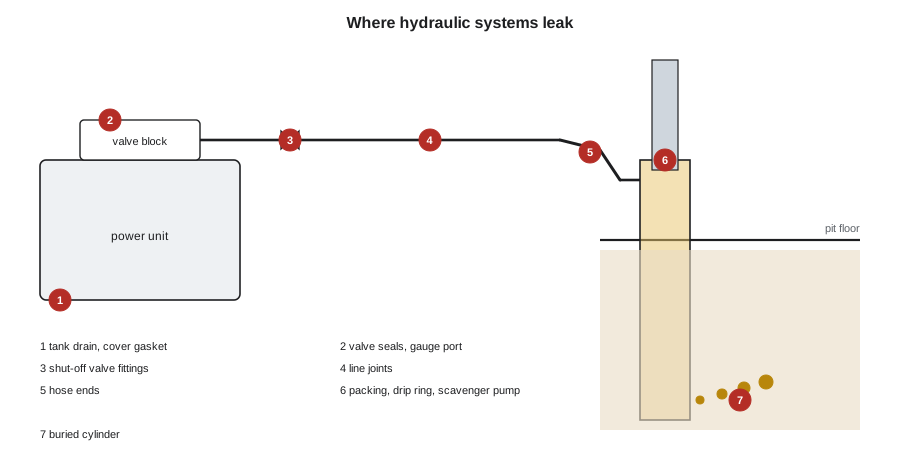
Where hydraulic systems leak
Leaks are the most common hydraulic maintenance problem. Knowing the usual places saves time.
- The packing at the cylinder head. Some seepage is normal and is caught by the drip ring. More than the scavenger pump can handle, oil running down the cylinder, or oil thrown on the pit walls means worn seals or a damaged plunger.
- Fittings and joints in the line: threaded fittings that have loosened with vibration, O-ring fittings with damaged O-rings, flanges with failed gaskets and welded joints with cracks.
- Hoses, at the crimped ends or through cracked covers.
- The valve block: seals on spools, solenoid tubes and adjustment screws, and the gauge port.
- The tank: the drain plug, the cover gasket, the motor lead seal and, on dry units, the pump shaft seal.
- The cooler, if it has one, and its hoses.
- The buried cylinder and any buried piping, where the leak cannot be seen.
Finding a leak starts with cleaning. Oil spreads and collects dust, so an old leak and a new one look alike. Ray degreases the suspect area, dries it, and checks it again after a few runs. A white powder spray, sold for the purpose, shows fresh oil as a dark stain. For a slow drip at a fitting, a clean paper towel held under it and checked after a few minutes tells the story. Fittings are tightened only to the manufacturer's values; overtightening cracks fittings and crushes O-rings. Many leaks need the joint remade with new seals, with the system isolated at the shut-off valve, the car landed on blocking or its buffer, and the pressure relieved.
Repacking a jack
Replacing the packing at the cylinder head is a regular job on older cars. The car is run to the bottom and landed on timber blocking or the pit buffers so that the plunger carries no load, or held by approved rigging; the manual shut-off valve is closed; the system pressure at the head is relieved through the bleeder; and the controller is locked out. The packing head is opened, the old seals removed without scratching the plunger, the plunger surface inspected and cleaned, and new seals and wiper fitted in the orientation the manufacturer shows. After the head is closed, the shut-off valve is reopened, air is bled from the head, and the car is run slowly while the head is watched for leaks. A damaged plunger will tear new seals quickly, so pits and scratches found during repacking are reported; the cure for a badly scored plunger is a new plunger, not repeated repacking.
Tracking oil: the oil log
The simplest leak detector is a record. Each time oil is added, the mechanic records the date, the amount, the oil type and the car's position when the level was read. Over months, the log shows whether the system is losing oil and how fast. Visible leaks are usually found and fixed. But oil lost with no visible leak, after the power unit, line and packing have been checked, is a sign of a buried cylinder or buried pipe leak, which the code and regulators treat seriously: the cylinder may be corroding through, and the oil is going into the ground.
# Oil added to the Marlowe power unit over a year: total, rate and what it means
log = [  # (month, oil added gal, visible leak found and repaired?)
    (2, 1.5, False),
    (6, 2.0, False),
    (11, 1.5, False),
]
total = sum(v for _, v, _ in log)
months = 12
rate_day = total / (months * 30.4)
print(f"oil added in {months} months: {total} gal, about {rate_day * 128:.1f} fl oz per day")
unexplained = sum(v for _, v, seen in log if not seen)
print(f"oil added with no visible leak found: {unexplained} gal")
threshold = 1.0    # company action level for unexplained loss per year, gal
if unexplained >= threshold:
    print("action: inspect and clean the power unit, line and packing; test the cylinder for leakage;")
    print("        report to the owner and the regulator as the rules require")
else:
print("keep monitoring at each visit")oil added in 12 months: 5.0 gal, about 1.8 fl oz per day
oil added with no visible leak found: 5.0 gal
action: inspect and clean the power unit, line and packing; test the cylinder for leakage;
report to the owner and the regulator as the rules requireAt the Marlowe, Tamsin found no oil on the power unit, line or packing after cleaning and checking, and no drop in the tank over a weekend when the car stood at the bottom landing with the shut-off valve closed. With the shut-off valve open and the car at the top landing, however, the level fell slowly. The oil was going from the line or the cylinder, and there was no visible leak on the exposed line. Ray reported it to Lena, who arranged a cylinder leak test with the owner.
Testing a buried cylinder
A cylinder leak test measures whether the cylinder and the buried line hold oil. A common method is to isolate the jack, hold the car at a fixed position on blocking or with the plunger at the bottom of its travel against a stop, and watch the pressure or the oil volume over time with the temperature recorded. Another is to measure the car's drift with the shut-off valve closed, as Lesson 10 described, while confirming there is no leak at the packing. The test method, duration and pass criteria depend on the regulator and the code. At the Marlowe, the test confirmed a slow leak below ground. The owner chose to replace the jack with a new protected cylinder, like Holloway's, rather than repair the old one, and the old cylinder came out with the contaminated soil around it.
Oil in the environment
Hydraulic oil that leaks into the soil can reach groundwater, and oil pumped from a pit sump can reach the storm or sanitary sewer. Both are pollution. Mechanics have three responsibilities: prevent spills, contain the ones that happen, and report what the rules require. Every service van carries a spill kit with absorbent pads, socks and granules, and bags for the used absorbent. Pit sumps on hydraulic cars should not pump oil away; many have oil-sensing controls or are kept clean so that the sump pump does not discharge oil. Oil on a pit floor is cleaned up promptly, and its source is found.
A spill that reaches the ground or water, or a buried cylinder leak, may have to be reported. In Washington, the Department of Ecology must be told of oil spills to water or that threaten water, and other spills to the environment may need reporting depending on the amount and where they go; federal rules also require reporting of oil that reaches navigable waters. The owner is usually responsible for reporting and cleanup, but the mechanic who finds the leak is responsible for telling the owner promptly and in writing. Northcrest's procedure is for the mechanic to make the area safe, contain the oil, photograph it, and call the supervisor, who contacts the owner.
Used oil and oily waste go to a licensed recycler, with the records kept. When the old Marlowe cylinder was removed, its oil, the contaminated soil and the absorbents were each handled by the environmental contractor the owner hired, and the disposal records were added to the elevator file.
Changing and conditioning oil
Hydraulic oil does not need changing on a fixed schedule if it stays clean, dry and cool. Its condition is judged from the oil analysis: viscosity still within the grade, low water content, a low acid number and an acceptable cleanliness code. Oil that has darkened, smells burnt, is milky or has failed analysis is changed. Changing oil means pumping the tank empty with the car at the bottom, cleaning the tank and strainer, refilling with new oil through a filter cart, bleeding the system and recording the volume. Between changes, a filter cart can be run on the tank, a process called kidney-loop filtration, to clean oil that has collected particles.
Records that tell the story
Good records make the next mechanic's job easier and protect the company and the owner. Each visit's record should give the date, the mechanic, the tasks done, readings taken such as oil level and temperature, motor current, pressures and run times, any defects found and what was done, oil added and parts replaced. Test results go on the forms the regulator requires. When Tamsin investigated the Marlowe leak, the most useful records were Ray's readings from previous visits: the oil level with the car at the bottom landing had fallen slowly, visit after visit, long before anyone added oil.
Worked problem
Estimating how much oil a buried leak lost
The Marlowe's oil log shows 5 gal added over 12 months with no visible leak, and Ray's readings show the level had been falling for about two years before the first top-up, by about the same amount again. Roughly how much oil may have gone into the soil?
Show solution
- Oil added in the last year: 5 gal.
- Before that, the level fell by about the same amount without being topped up: another 5 gal.
- Total: about 10 gal, a rough estimate because the readings were not taken under identical conditions.
Answer: In the order of 10 gal; the estimate goes in the report to the owner, who decides with the environmental contractor how much soil to test and remove.
Common mistakes
MistakeTopping up oil without recording it.
InsteadRecord every addition; the oil log is the best leak detector.
MistakeTightening a weeping fitting as hard as possible.
InsteadTighten to the manufacturer's value; remake the joint with new seals if needed.
MistakeLetting a pit sump pump oil into the drain.
InsteadKeep pits clean and prevent oil discharge; find the oil's source.
MistakeRepacking a scored plunger again and again.
InsteadReport the damage; a badly scored plunger needs replacing.
MistakeAssuming the owner already knows about a buried leak.
InsteadTell the owner promptly in writing, through the supervisor.
Summary and key terms
- Every elevator has a maintenance control program setting tasks, intervals, procedures and records.
- Hydraulic leaks are common at packing, fittings, hoses, valve seals and tanks; buried cylinders leak out of sight.
- Clean, check and use the manufacturer's tightening values and seals to fix leaks; repack jacks with the plunger unloaded.
- The oil log reveals oil lost with no visible leak, a sign of a buried cylinder or line leak.
- Spills are prevented, contained and reported as the rules require; used oil goes to a licensed recycler.
- Oil is changed on condition, judged by analysis, and every reading and repair is recorded.
- Maintenance control program
- The written program of maintenance tasks, intervals, procedures and records for an elevator.
- Packing
- The seals at the cylinder head that stop oil escaping around the plunger.
- Oil log
- The record of oil added, with dates, amounts and car position.
- Spill kit
- Absorbents and bags for containing and cleaning up oil spills.
- Cylinder leak test
- A test to determine whether a buried cylinder and line hold oil.
- Kidney-loop filtration
- Cleaning oil by circulating it through an external filter.
- Repacking
- Replacing the seals at the cylinder head.
Practice problems
Work each problem on paper first, then reveal the answer to check.
Why does Lena read the oil added line first?
Show answer
Oil does not evaporate; oil added means oil lost somewhere.
What must be done to the car before opening the packing head?
Show answer
Land it on blocking or its buffers so the plunger is unloaded, close the shut-off valve, relieve the pressure and lock out the controller.
A tank loses oil only when the shut-off valve is open and the car is at the top, with no visible leak. Where is the oil going?
Show answer
From the buried line or the cylinder.
Who is usually responsible for reporting an oil spill to the environment, and what is the mechanic's duty?
Show answer
The owner; the mechanic must contain it and tell the owner promptly in writing through the supervisor.
When should hydraulic oil be changed?
Show answer
When analysis or condition shows it has degraded or is contaminated, not on a fixed schedule.
Lesson quiz · 5 questions
Score 60% or more to complete this lesson.
Create a free account to save your progress, take quizzes and earn a certificate.