
ELV-220 · Lesson 10 of 12 · 20 min
Leveling, re-leveling and pressure testing
The Ashgrove Clinic's receptionist had a complaint that sounded small. Every few minutes, she said, the elevator "made a noise by itself" even when nobody was using it: a short hum from the machine room and a slight bump as the car, parked at the lobby with its doors closed, moved. Tamsin recognized it from the evening class. The car was sinking below the floor, and the controller was re-leveling it, starting the pump for a second or two to bring it back up. A car that re-levels every few minutes is losing oil from its jack somewhere. This lesson covers leveling and re-leveling, how to measure a leak and find where it is, and the pressure tests that the code requires to prove a hydraulic system sound.
Leveling and the leveling zone
Leveling is the final, slow part of every stop: the car approaches the floor at leveling speed and stops at floor level, as Lesson 5 described. The leveling zone is a short distance above and below each floor within which the controller can move the car at leveling speed, and within which, under conditions the code sets, the car may move with its doors open. The landing system marks the zone, typically with magnets or vanes on a tape or in the hoistway read by sensors on the car, and gives the controller separate signals for up leveling, down leveling and door zone.
Hydraulic cars need leveling more than traction cars do, because their position changes while they are parked. Oil leaks slowly past the check valve, the lowering valve and the packing, so the car sinks. As the oil cools after a busy period, it contracts and the car sinks further. And the oil and hoses compress a little under load, so a heavy load wheeled onto the car presses it down, like a spring. A stretcher at Holloway with its attendants can drop the car a few millimeters as it rolls in.
Anti-creep and re-leveling
The code requires an anti-creep or re-leveling operation that keeps a hydraulic car at the floor. When the car sinks below floor level by more than a set distance, the controller starts the pump and runs the up leveling solenoid to bring it back; if the car rises above the floor, it opens the down leveling solenoid. The operation must work whether the doors are open or closed and must not be defeated by most of the car's safety devices, so that the car stays at the floor while people load and unload. In the annual test the mechanic opens the manual lowering valve slowly with the car at a floor and checks that re-leveling holds the car within the code's limit, about 1 in on current installations.
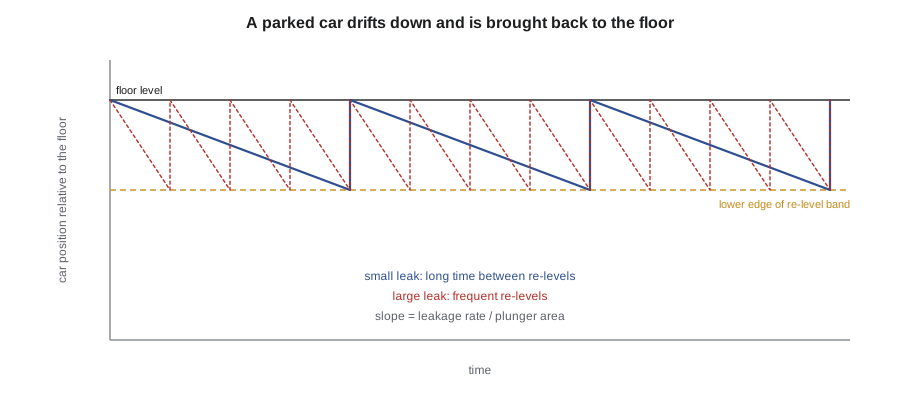
Occasional re-leveling is normal. Re-leveling every few minutes is a symptom of a leak. The time between re-levels depends on the leakage rate, the plunger area and the re-leveling band, the distance the car is allowed to drift before the controller acts.
Here v is the drift speed of the car, q the leakage rate, A the plunger area, b the re-leveling band and t the time between re-levels. A small leak makes a large drift on a small plunger: the telescopic jacks at the Ashgrove have a small final stage, so a few drops a minute move the car noticeably.
# Drift speed and time between re-levels from a leakage rate (illustrative)
import math
cars = [
    ("Holloway car 2 (single jack)", [6.0], 0.005),
    ("Ashgrove (two jacks, small stage)", [4.0, 4.0], 0.013),
]
band = 0.4          # re-leveling band, in
for name, dias, leak in cars:          # leak in gal/min for the whole system
    area = sum(math.pi * d ** 2 / 4 for d in dias)          # in2
    drift = leak * 231 / area                               # in per minute
    t = band / drift
print(f"{name:<34} leakage {leak} gal/min: drift {drift:.2f} in/min, re-level every {t:.0f} min")Holloway car 2 (single jack) leakage 0.005 gal/min: drift 0.04 in/min, re-level every 10 min Ashgrove (two jacks, small stage) leakage 0.013 gal/min: drift 0.12 in/min, re-level every 3 min
The calculation shows why the same leak can be a non-event on one car and a nuisance on another. It also gives a way to measure a leak: time how fast the car drifts, and the leakage rate is the drift speed times the plunger area.
Finding where the oil goes
Oil leaving the jack can go to one of two places: back to the tank through the valve, an internal leak, or out of the system, an external leak at the packing, a fitting, a hose or a buried cylinder. An internal leak wastes nothing but lets the car sink; an external leak also loses oil and may contaminate the pit or the ground. The standard method to tell them apart uses the manual shut-off valve.
- Park the car at the top landing, where the drift is easiest to see and measure, with the oil at normal temperature. Mark the car's position against the hoistway, for example with a piece of tape on the rail and a mark on the car's sill, or use a dial gauge or the controller's position display.
- Switch off re-leveling, as the controller manual describes, so that the drift is not hidden. Keep the car out of service and the hoistway doors closed.
- Watch the drift for a set time, for example 15 minutes, with the shut-off valve open. This gives the total leakage.
- Close the shut-off valve and repeat. If the drift stops, the leak is in the valve or power unit side; if it continues at the same rate, the oil is escaping between the shut-off valve and the jack, from the jack itself, its packing, the line or a buried cylinder.
- Account for temperature: oil cooling during the test causes some drift even with no leak, so the test is done with the oil at a steady temperature or the cooling is estimated.
If the drift continues with the shut-off valve closed and there is no oil at the packing, the fittings or the line, a buried cylinder is the suspect, and the next step is a cylinder leak test as the code and the regulator require, and a check of the liner monitoring pipe if the cylinder is protected. At the Ashgrove, the drift stopped when Tamsin closed the shut-off valve, and the leak was a worn seat in the lowering valve, which Priya replaced the next week.
Pressure tests
Pressure tests prove that the relief valve works at the right pressure and that the system holds that pressure without leaking or bursting. The code sets acceptance tests for new and altered installations and periodic tests for existing ones, and the test procedures are described in ASME A17.2, the guide for inspection of elevators, escalators and moving walks. The common periodic tests for a hydraulic elevator, done every year, include:
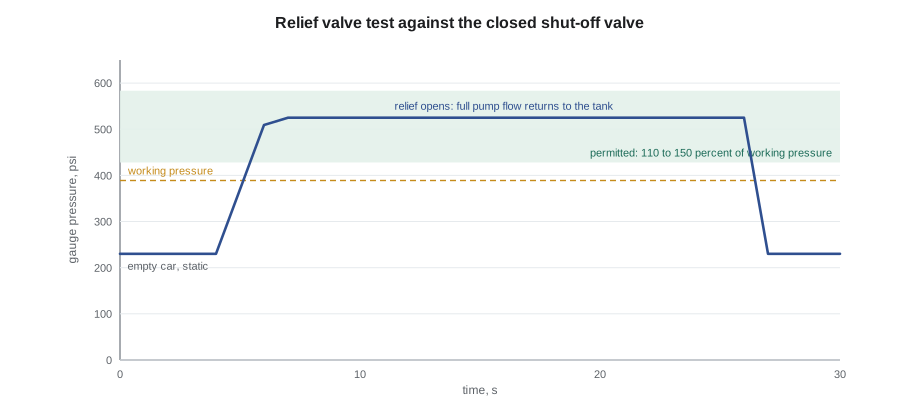
- Relief valve test. With the manual shut-off valve closed, the pump is run against it and the gauge shows the pressure at which the relief valve opens and passes the pump's full flow. The setting must be at least about 110 percent of working pressure, so the relief valve does not open in normal service, and not more than 150 percent of working pressure. Then, following the test procedure, the shut-off valve is opened, the system is pressurized again with the jack in the circuit, and the relief valve must again pass full flow without the pressure exceeding its setting.
- Pressure test of hoses and fittings. The system is held at relief pressure for about 30 seconds while the mechanic inspects every hose and fitting for leaks, bulging or distortion.
- Anti-creep test, as described above.
- Tests of the devices fitted: slack rope device on roped cars, plunger gripper, overspeed or rupture valve where the procedure calls for it, low oil protection and battery lowering.
Longer-interval tests, at intervals the code and the regulator set, include full-load tests of rupture valves and safeties and leak tests of buried cylinders. After any relief valve adjustment, the valve is resealed and a test tag records the date and pressure.
# Relief valve test check for Holloway car 2
working = 389             # static pressure with rated load, psi
readings = [525, 530]     # relief pressures read on the test gauge (shut-off closed, then against the car)
low, high = 1.10 * working, 1.50 * working
print(f"working pressure {working} psi: relief must be at least {low:.0f} and at most {high:.0f} psi")
for i, r in enumerate(readings, 1):
    status = "OK" if low <= r <= high else "out of range: adjust, reseal and retest"
    print(f"test {i}: relief opened at {r} psi ({100 * r / working:.0f} % of working) -> {status}")
hold = 525               # pressure during the 30 s hold on hoses and fittings
print(f"hose and fitting inspection held at {hold} psi for 30 s: inspect for leaks, bulges and distortion")working pressure 389 psi: relief must be at least 428 and at most 584 psi test 1: relief opened at 525 psi (135 % of working) -> OK test 2: relief opened at 530 psi (136 % of working) -> OK hose and fitting inspection held at 525 psi for 30 s: inspect for leaks, bulges and distortion
Doing pressure tests safely
A pressure test deliberately raises the system to its highest allowed pressure, so it is planned like any other hazardous task. The car is empty and out of service, with signs at the landings. The test gauge is a calibrated gauge with a range well above the relief setting, connected through the valve's gauge port and isolating valve. People stay clear of hoses and fittings while the pressure is high, and inspect them by eye and with a light, not with their hands, because a pinhole leak at that pressure can inject oil through the skin, an injury that needs emergency surgery even when it looks small. Pump run time against the relief valve is kept short, because all the pump's power is turning into heat in the oil.
Ray also checks that the person running the pump and the person reading the gauge can talk to each other, by radio if the jack and power unit are far apart, and that the shut-off valve is reopened and the car returned to normal service at the end of the test, with the result recorded.
Acceptance testing a new installation
Holloway car 2's new installation will be tested before it carries passengers. Northcrest's adjuster runs the acceptance tests, then the inspector witnesses them. For the hydraulic system, they include the relief valve test at the setting chosen for the new valve and working pressure, a pressure test of the new jack, piping and hose to the code's test pressure, a check of the rupture valve at its trip setting with the specified load, the anti-creep test, the pump run timer, the motor thermals and phase protection, battery lowering, and full-load runs in both directions with speeds and stopping accuracy recorded. The oil level is checked with the car at the bottom landing and recorded with the volume added. Lesson 12 follows the day of the test.
Worked problem
Measuring a leak at the Ashgrove
At the Ashgrove, with re-leveling disabled and the oil steady at 104 °F, the car drifts 1.9 in in 15 minutes with the shut-off valve open, and none with it closed. Each of the two jacks' final stage is 4 in in diameter. What is the leakage rate, and where is it?
Show solution
- Drift speed: 1.9 / 15 = 0.127 in/min.
- Total area of the two final stages: 2 × π × 4² / 4 = 25.1 in².
- Leakage: 0.127 × 25.1 = 3.2 in³/min, about 0.014 gal per minute.
- No drift with the shut-off valve closed means the jacks and line hold; the leak is in the valve or power unit.
Answer: About 3.2 in³ per minute, through the valve; the lowering valve seat was the cause.
Common mistakes
MistakeMeasuring drift with re-leveling switched on.
InsteadDisable re-leveling for the test, as the controller manual describes, and restore it afterwards.
MistakeMeasuring drift while the oil is cooling fast.
InsteadTest with the oil at a steady temperature, or the contraction looks like a leak.
MistakeRunning the pump against the relief valve for minutes.
InsteadKeep relief runs short; all the pump's power turns into heat.
MistakeFeeling along a pressurized hose for a leak.
InsteadInspect by eye and light; a high-pressure pinhole leak can inject oil through skin.
MistakeLeaving the shut-off valve closed after a test.
InsteadReopen it and check the car runs normally before returning it to service.
Summary and key terms
- Leveling brings the car to floor level at low speed; re-leveling keeps it there as oil leaks, cools and compresses.
- Drift speed equals leakage rate divided by plunger area; frequent re-leveling means a leak.
- Closing the shut-off valve separates leaks in the valve from leaks in the jack, line or cylinder.
- Annual tests include the relief valve, between about 110 and 150 percent of working pressure, a hold at relief pressure on hoses and fittings, anti-creep and installed safety devices.
- Pressure tests are planned hazardous work: empty car, calibrated gauge, hands off pressurized parts, short relief runs.
- New installations are acceptance tested by the contractor and witnessed by the inspector before service.
- Leveling zone
- The short distance above and below a floor in which the car moves at leveling speed.
- Re-leveling
- Automatic return of a drifting car to floor level.
- Anti-creep test
- A test that re-leveling holds the car within limits when oil is released through the manual lowering valve.
- Internal leak
- Leakage from the jack back to the tank through the valve.
- External leak
- Leakage out of the hydraulic system, at seals, fittings, hoses or the cylinder.
- Relief valve test
- Running the pump against the closed shut-off valve to confirm the relief setting.
- Working pressure
- The static pressure with rated load, the reference for relief and test settings.
Practice problems
Work each problem on paper first, then reveal the answer to check.
A car drifts 1/4 in in 10 minutes with re-leveling off. Its plunger area is 28.3 in². What is the leak?
Show answer
0.025 × 28.3 = 0.71 in³/min.
The drift continues at the same rate with the shut-off valve closed. Where is the leak?
Show answer
Between the shut-off valve and the jack: line, packing, jack or buried cylinder.
What is the permitted range for the relief setting in terms of working pressure?
Show answer
At least about 110 percent and not more than 150 percent.
Why is oil temperature controlled during a drift test?
Show answer
Cooling oil contracts and makes the car sink, which looks like a leak.
Why should no one feel along a hose at relief pressure?
Show answer
A pinhole leak can inject oil through the skin.
Lesson quiz · 5 questions
Score 60% or more to complete this lesson.
Create a free account to save your progress, take quizzes and earn a certificate.