
ELV-130 · Lesson 7 of 12 · 18 min
Rigging in the hoistway and temporary supports
A hoistway is a vertical tunnel with openings at every floor, and that shape decides how loads move through it. Material arrives at a landing, crosses the sill into the hoistway, goes up or down on a hoist, and leaves the hoistway at another landing or is set on a support inside it. At every stage the load is either hanging from rigging or resting on something temporary: a platform, timbers, cribbing, a jack or the pit floor. This lesson covers moving loads in and through the hoistway, the temporary supports that hold them, and the rules that keep the people working there out of the way.
Planning the route
Before anything heavy goes into a hoistway, the crew plans its route from where it is delivered to where it ends up, and the load's size, weight and center of gravity at each stage. At Quayside, the route for the car 2 parts starts at the general contractor's laydown area, goes up in the construction hoist on the outside of the building or by tower crane to a floor, across the floor on a pallet jack or dolly to the car 2 entrance, and into the hoistway. Every part has to fit through the construction hoist door, along the corridor and through the landing entrance, and the floor it crosses has to carry it.
The floor matters more than people expect. A building under construction has floors designed for their finished use, which in a residential tower is a fairly light live load, and some floors are not yet at full strength when the elevator crew needs them. A pallet of counterweight fillers or the machine on its dolly is a concentrated load. The general contractor sets limits for staging materials on each floor, and Lena gets those limits before the elevator deliveries are planned. Loads are spread on plywood or timber, staged near columns or walls rather than at mid-span, and not left at the edge of an open hoistway.
The route also includes where each load will stop and be supported. Car frame parts, for example, are lowered to the bottom of the hoistway, where the car is built, and they need a place to rest. The counterweight frame is set on blocking in the pit. The machine stops at the top. Each of those supports is planned before the lift.
Moving a load into the hoistway
The step from the landing into the hoistway is the awkward one. A load on a dolly at the landing is beside the hoistway, and the hoist above the hoistway is not above the load. Pulling the load into the hoistway with the hoist hook at an angle is exactly the side pull Lesson 5 warned against, and letting the load swing off the sill into the hoistway makes it a pendulum on a hook. The safe methods all keep the load supported or controlled during the transfer.
- For small loads, the load is moved onto the sill and the hoist hook is brought out to it with a tag line or a pole, so that the hoist takes the load almost vertically; the load is then eased into the hoistway with a tag line held from the landing.
- For larger loads, a second hoist, usually a lever hoist anchored to a rated point at the landing, holds the load back while the main hoist lifts it, and the two are worked together so that the load moves out over the hoistway under control. This is the two-hoist transfer used for the machine in Lesson 8.
- For long items such as rails, the item is lifted on end: the hoist picks up one end, the other end stays on a dolly or skid on the landing floor, and the item is walked in and stood up in the hoistway as the hoist lifts.
In all three, the people on the landing are tied off, stand to the side of the opening rather than in front of it, and keep their hands off the load as it swings free. The barricade hatch is open only while the transfer is happening and is closed again at once.
Lifting rails and long items
Rails are the longest items a mechanic lifts, 16 ft lengths that weigh well over 200 lb each for the Quayside car rails. They are lifted in the hoistway on end, from a rail lifting clamp or a shackle through the top fishplate holes where the manufacturer allows it, never from a choker around the rail blade, which can slip along the smooth machined surface. A tag line goes on the bottom end. As the rail goes up past the brackets, the person on the platform guides it with the tag line clear of the brackets and lifelines. ELV-120 covered rail setting; the rigging rules here apply to any long load in a hoistway, such as a hydraulic cylinder section, a long sill, or a run of conduit.
A long load hanging on end swings like a pendulum, slowly but with a great deal of energy, and the bottom end moves farthest. In a hoistway, a long load's bottom end can strike the rails, the wall or a person on the platform below. That is why the platform is clear when a long load passes it, and why long loads are moved slowly.
Temporary supports
A load that is not hanging from rigging rests on a temporary support: timber blocking, cribbing, a steel stand, a jack or the pit floor. A temporary support must carry the load without crushing, sliding, tipping or settling, and it must stay stable while people work around it. The rules are as strict as for rigging, because a support that fails drops the load just as surely as a broken sling, and the people near it are usually closer.
At Quayside, the car frame is built at the bottom landing on a car-building platform: heavy timbers spanning the pit on temporary steel supports that bear on the pit floor, at the height that puts the car floor level with the bottom landing. The design of this platform comes from the manufacturer's installation manual. The safety plank, the bottom member of the car frame, is set on it first, and the stiles, crosshead and platform are built up from there. The car is supported on this platform until the ropes are on and the car can hang from them, and the platform is removed only when the car is on its ropes or its safeties.
The counterweight frame is set in the pit on blocking of a planned height, chosen so that when the ropes are installed and the car is at the top landing, the counterweight is at the correct position for its runby. The blocking is a structural support in its own right: it carries the frame and every filler loaded into it until the ropes take the weight.
Cribbing
Cribbing is a stack of timbers laid in alternating layers at right angles, like a log cabin, used to support a load at a height. It is the standard support for loads that are jacked up a little at a time, such as an escalator truss end or a heavy machine being raised onto its base. Cribbing spreads a load over a wide area and is stable if it is built correctly, and it can be raised or lowered a layer at a time as a jack lifts or lowers the load.
A crib is built of sound, square-edged hardwood or dense softwood timbers of the same size, free of large knots, splits and rot. Each layer crosses the one below at right angles, with at least two timbers per layer and the ends overlapping by at least the width of a timber. The crib stands on a firm, level base, on steel plates or planks if the floor is soft or uneven. Its height is limited relative to its base: a common rule, and Northcrest's, is that a crib is no taller than twice the width of its smallest base dimension unless an engineer approves it. The load bears on the top layer through a plate or a timber cap spread across the timbers, never on a corner or a single timber end. And a crib is built to follow the load as it rises, never allowed to fall more than one layer behind a jacked load, so that a slipping jack drops the load only a short distance.
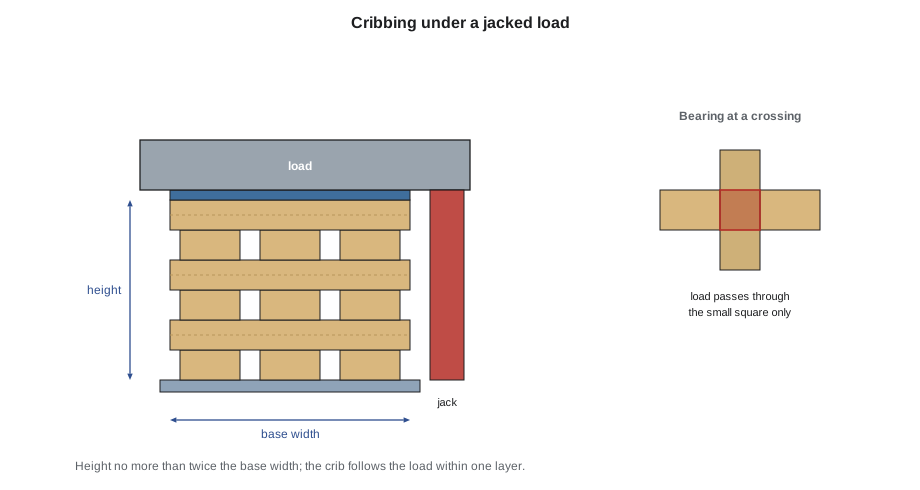
The weak point of a crib is where timbers cross. Wood is far weaker when pressed across its grain than along it, and in a crib every load passes through the small squares where one timber sits on another. The bearing stress at those crossings is the load divided by the total crossing area, and it must stay below the timber's allowable stress perpendicular to the grain. The code below checks a crib for the end of the Brackenridge escalator truss section used in Lesson 11, with the allowable stress and the timber size illustrative.
# Crib check: bearing at the timber crossings, height to base ratio, and floor pressure
load = 7000                # load on this crib (lb)
t = 6                      # timber width (in), square timbers
layers = 6                 # layers in the stack
per_layer = 3            # timbers in each layer
allow_perp = 360            # allowable compression across the grain (psi) - illustrative
base_len = 36              # length of each timber (in)
g = 1
force = load * g
crossings = per_layer * per_layer          # each timber in one layer crosses each in the next
area = crossings * t * t
stress = force / area
height = layers * t
ratio = height / base_len
floor = force / (base_len * base_len) * 144
print(f"bearing at the crossings: {stress:.1f} psi against an allowable of {allow_perp}")
print(f"stack height {height:.1f} in, height to base {ratio:.2f} (limit 2.0)")
print(f"pressure under the base: {floor:.1f} psf")
print("crib OK" if stress <= allow_perp and ratio <= 2.0 else "crib NOT OK")bearing at the crossings: 21.6 psi against an allowable of 360 stack height 36.0 in, height to base 1.00 (limit 2.0) pressure under the base: 777.8 psf crib OK
The crib passes on both counts. With three timbers a layer, there are nine crossings between each pair of layers, and the bearing stress is well under the allowable figure. Six layers of 6 in timber make a stack about as tall as its base is wide, well within the limit. The pressure under the base is a separate check, because the mall floor has its own capacity, and that number goes to the building's engineer with the move plan. If the crib had been built with two timbers a layer, the crossings would have dropped to four and the bearing stress would have more than doubled.
Wedges are used to take up the last small gap under a load, driven in pairs from opposite sides so that the top surface stays level. A single wedge tilts the load. Shims are used under a machine or a stand to level it, and they are full size under the bearing, not a pile of small scraps.
Jacks
Hydraulic jacks and screw jacks lift a load from below over short distances, and they are used on elevator jobs to raise a machine onto its bedplate, to lift an escalator truss end onto cribbing, or to take the weight of a car frame for adjustment. A jack is rated for its capacity and its stroke, sits on a firm, level base and under a solid lifting point on the load, and is loaded vertically. A load on a jack is never worked under: the jack is a lifting device, and once the load is at height it is transferred to cribbing or stands. Only one jack is operated at a time when a load is supported at several points, unless a jacking system is designed to lift them together, and each end of a long load is raised in small steps with the cribbing following.
Working below other work
The branch rule from ELV-110, no work below other work in the same hoistway, is most important during rigging. While a load is moving in a hoistway, nobody is in the hoistway below it. While a temporary support is being built or removed, nobody is under the load it carries. When a car is being built at the bottom landing, the hoistway above is closed to other work, because a tool dropped from a bracket row thirty floors up arrives in the pit at a speed that no hard hat will stop. At Quayside, the work schedule for car 2 separates the car-building days from the bracket and rail days for that reason, and the lifeline and hatch arrangements from ELV-120 apply throughout.
Common mistakes
MistakePulling a load off the landing into the hoistway with the hoist at an angle.
InsteadHold the load back with a second hoist or bring the hook out to it, and transfer under control.
MistakeLifting a rail with a choker around its blade.
InsteadUse a rail lifting clamp or the fishplate holes as the manufacturer allows.
MistakeBuilding a crib from mixed timber sizes, two per layer, taller than it is wide.
InsteadUse matched sound timbers, enough per layer, and stay within the height to base limit.
MistakeLeaving a jacked load on the jack while working near it.
InsteadTransfer it to cribbing or stands that follow the load.
MistakeDriving a single wedge under a load.
InsteadDrive wedges in pairs from opposite sides.
Summary and key terms
- Every load's route is planned from delivery to final position, including floor capacities on the way.
- Transfers from a landing into a hoistway keep the load supported or controlled, often with two hoists.
- Long loads are lifted on end from designed points, with a tag line, and moved slowly.
- Car-building platforms and counterweight blocking are planned temporary supports from the manual.
- Cribbing is built in crossing layers of sound matched timber, with limited height and full bearing, and follows a jacked load.
- Nobody works below a moving load or under a load on a jack.
- Cribbing
- Timbers stacked in alternating layers at right angles to support a load at a height.
- Car-building platform
- A temporary platform at the bottom of the hoistway on which the car frame is assembled.
- Counterweight blocking
- A temporary support of planned height on which the counterweight frame rests before roping.
- Bearing stress
- The force on a contact area divided by that area.
- Two-hoist transfer
- Moving a load from a landing into a hoistway with one hoist lifting and another holding it back.
- Wedge pair
- Two wedges driven from opposite sides to close a gap while keeping the load level.
Practice problems
Work each problem on paper first, then reveal the answer to check.
A crib has three timbers per layer. How many crossings carry the load between two layers?
Show answer
Nine.
Timbers are 6 in wide and the crib base is 36 in. What is the maximum height under a twice-the-base rule?
Show answer
72 in, or twelve layers of 6 in.
Why is a car built on a platform at the bottom landing?
Show answer
It puts the car floor level with the landing and supports the frame until it can hang from its ropes or safeties.
How far may cribbing fall behind a load being jacked up?
Show answer
No more than one layer.
Lesson quiz · 5 questions
Score 60% or more to complete this lesson.
Create a free account to save your progress, take quizzes and earn a certificate.