
ELV-130 · Lesson 4 of 12 · 19 min
Shackles, hooks, eyebolts and rigging hardware
Between the sling and the load, and between the sling and the hoist, there is hardware: shackles, hooks, eyebolts, swivel hoist rings, master links, turnbuckles, wire rope clips and beam clamps. Each piece has a working load limit, and like a sling, each piece is rated for a particular way of loading. A shackle is rated for a load along its center line, an eyebolt for a pull in line with its shank, a hook for a load seated in its bowl. Load them another way and their capacity drops, sometimes to a quarter of the rating. This lesson goes through the hardware in a Northcrest rigging kit, how each piece is meant to be loaded, how to reduce its rating when it is not, and how it is inspected.
Markings and grades
Every piece of rigging hardware must be marked with its manufacturer, its size or product identifier and its working load limit, or enough information to find the working load limit. Forged hardware made for lifting is marked on the body: a shackle shows its rating on the bow and its maker's name on the side, and the pin is marked too. Hardware without markings, such as a hardware-store eyebolt or a turnbuckle of unknown origin, is not used for lifting, however solid it looks. A forged alloy shackle and a cheap cast one can look alike; only the marking tells them apart.
Hardware is not mixed between makers when parts are interchangeable in appearance. A shackle pin from one manufacturer may fit the bow of another but have a different rating or a different heat treatment. At Northcrest, pins and bows are kept together, and a shackle with a lost pin is discarded rather than fitted with a pin from the spare-parts bin.
Shackles
A shackle is a U-shaped or bow-shaped body closed by a pin. The two common shapes are the chain shackle, or D-shackle, whose sides are parallel, and the anchor shackle, or bow shackle, whose body is rounded so that it can take more than one sling leg. Pins come in two kinds. A screw pin threads into one ear of the shackle and is used for lifts where the shackle is attached and removed often. A bolt-type pin passes through both ears and is held by a nut and a cotter pin; it cannot unscrew, so it is used where the shackle stays in place for a long time or where the pin could be turned by a moving sling.
ASME B30.26 and the manufacturers require a screw pin to be fully engaged, with the shoulder tight against the ear, and moused with wire or replaced by a bolt-type shackle where the pin could turn under a moving sling. A shackle pin is never replaced with a bolt, a rod or any other makeshift fitting, because a bolt is not made of the same material, has threads where it should have a smooth shank, and has no rating.
A shackle is rated for a load in line with its center line, from the middle of the pin to the middle of the bow. When a shackle is used to collect two sling legs, the legs go on the bow, not the pin, and the shackle's rating is reduced for the angle between them, because the legs pull the bow sideways as well as down. A shackle loaded across its body, so that the load pulls on the side of the bow, is side loaded, and most manufacturers reduce its capacity to about 70 percent at 45 degrees and 50 percent at 90 degrees. A shackle is never loaded on the tips of its pin or across its ears, and it is never allowed to pull at an angle against its pin such that the pin bends.
| Load direction on a shackle | Typical rating | Note |
|---|---|---|
| In line with the center line | 100 % | As rated |
| 45° from the center line | About 70 % | Check the manufacturer's table |
| 90° from the center line | About 50 % | Avoid where possible |
| On the pin tips or across the ears | Not permitted | Bends the pin or spreads the ears |
A shackle connected to a wire rope eye goes with the eye over the bow, not the pin, where possible, because the bow is larger and gives the rope a gentler bend. A shackle in a choker hitch goes with the pin on the eye side and the bow toward the running part of the sling, so that the moving sling cannot turn the pin out.
Hooks
Hooks on hoists, master links and sling legs are forged and rated for a load seated in the bottom of the bowl. Loaded at the tip, a hook acts as a long lever and can open or break at a small fraction of its rated load. A hook that is opening, twisted or cracked has been overloaded, and the evidence is permanent: forged steel stretches before it fails. That is why hooks are inspected for their throat opening, and many manufacturers forge two marks on the hook body a set distance apart so that a stretch can be measured.
ASME B30.10 requires a hook to be removed from service when its throat opening has increased beyond the limit set by the manufacturer or the standard, when it is twisted beyond a small angle from its plane, when it is worn or cracked, or when its latch is missing or does not close where a latch is required. Washington's rules require latches on hoist hooks except where the application makes one impractical and the hook is otherwise controlled. Northcrest removes hooks at any measurable opening or twist.
The safety latch is not a load-bearing part. It stops a slack sling from jumping out of the hook; it does nothing when the load is on. A latch that is bent, stuck open or missing is fixed before the hook is used, and a latch is never tied open to make rigging faster.
Two sling eyes in one hook are placed so that the angle between them is not more than the hook allows, typically up to 90 degrees included angle, and each sits in the bowl. If more legs or wider angles are needed, a master link or a shackle collects them and goes on the hook.
Eyebolts and swivel hoist rings
Eyebolts are screwed into tapped holes in the load, and many elevator parts are made with tapped holes for them: machine housings, sheaves, controller cabinets and some counterweight frames. Two kinds are used for lifting. A plain or shank eyebolt has no shoulder and is rated for vertical pulls only. A shoulder eyebolt has a collar that bears against the surface of the load, and it can take angular loads, but only with a large reduction, and only when the eye is in line with the pull. Angle is again the enemy: a shoulder eyebolt pulled at 45 degrees from its axis is typically rated at about 30 percent of its vertical capacity, and at 90 degrees about 25 percent.
For an eyebolt to carry its rating, the shoulder must be seated firmly against the load, flat and in full contact, with a washer only if the manufacturer allows it to bring the eye into line. The thread must be engaged to at least the depth the manufacturer requires, commonly at least one and a half thread diameters in steel and more in cast iron or aluminum. The eye must be turned so that the pull is in the plane of the eye, never across it. A shoulder eyebolt that cannot be seated with its eye in line is not shimmed to fit; a swivel hoist ring is used instead.
A swivel hoist ring bolts to the load and has a ring that pivots and rotates, so that it lines up with the pull automatically. Most are rated for their full working load limit at any angle within their range, which makes them the right fitting for angular pulls from tapped holes. They are installed with the bolt the manufacturer supplies, torqued to the value marked on the ring, and the bushing must bear flat on the load.
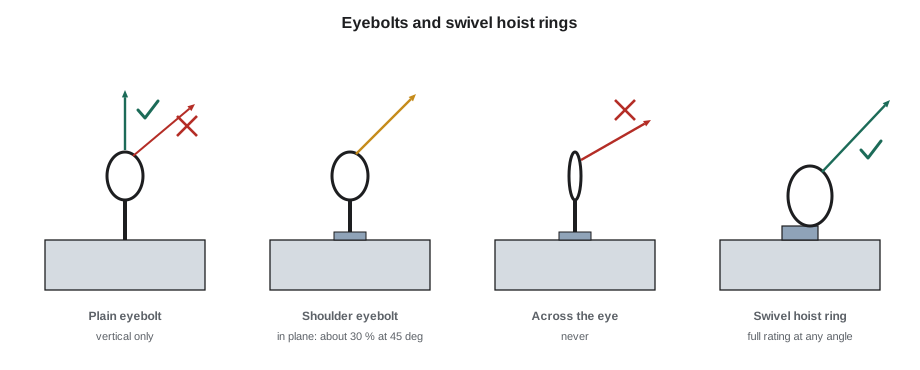
Checking each connection
When Tamsin plans a lift, she now lists every connection in the rigging from the hook to the load, writes down the load it carries and the direction of that load, and checks the rated capacity reduced for the way it is used. A connection that passes vertically can fail at an angle. The code below does the check for the Holloway Memorial Hospital power unit lift, where a new hydraulic power unit is lifted from a dolly at the machine room door onto its pad with a chain hoist on a beam trolley. The unit has four tapped holes for lifting, and the rigging uses swivel hoist rings on the near side and shoulder eyebolts that happened to be in the kit on the far side, which the check shows is a mistake.
# Connection check: rated capacity reduced for the direction of loading
import math
REDUCE = {   # fraction of the rated capacity at a given angle from the in-line direction
    "shoulder eyebolt": {0: 1.00, 45: 0.30, 90: 0.25},
    "swivel hoist ring": {0: 1.00, 45: 1.00, 90: 1.00},
    "shackle (side load)": {0: 1.00, 45: 0.70, 90: 0.50},
}
W = 1000                     # power unit, drained, with rigging (lb)
legs, from_vertical = 4, 45
t = W / (2 * math.cos(math.radians(from_vertical)))   # rigid load: two legs carry it
print(f"leg tension (two legs effective): {t:.0f} lb")
conns = [  # (connection, type, rated capacity lb, angle from in-line)
    ("near-left lifting point", "swivel hoist ring", 2300, 45),
    ("near-right lifting point", "swivel hoist ring", 2300, 45),
    ("far-left lifting point", "shoulder eyebolt", 2200, 45),
    ("far-right lifting point", "shoulder eyebolt", 2200, 45),
    ("master link shackle", "shackle (side load)", 4400, 0),
]
for name, kind, rated, ang in conns:
    cap = rated * REDUCE[kind][ang]
print(f"{name:<25} {kind:<20} capacity {cap:6.0f} lb {'ok' if cap >= t else 'NOT OK'}")leg tension (two legs effective): 707 lb near-left lifting point swivel hoist ring capacity 2300 lb ok near-right lifting point swivel hoist ring capacity 2300 lb ok far-left lifting point shoulder eyebolt capacity 660 lb NOT OK far-right lifting point shoulder eyebolt capacity 660 lb NOT OK master link shackle shackle (side load) capacity 4400 lb ok
The swivel hoist rings and the shackle are fine. The shoulder eyebolts, rated a little lower than the hoist rings in vertical, fall below the leg tension at 45 degrees, because the angle cuts their capacity to less than a third. The fix was to use four swivel hoist rings, which the branch sent over with the morning delivery. Ray pointed out that the same eyebolts, used with a spreader beam so that every pull was vertical, would have been perfectly adequate. The hardware was not wrong; the way it was being loaded was.
Master links, turnbuckles and wire rope clips
A master link is the large oblong link at the top of a bridle that goes on the hook. It is sized so that it seats in the hook bowl without being pinched and so that all the legs fit in it without crowding. A master link is never loaded at its narrow end by a hook point.
Turnbuckles adjust the length of a guy, a tie-back or a sling leg. For lifting they must be rated and marked, loaded in line only, with the end fittings fully engaged and the frame locked with lock nuts or wire so that it cannot turn. Hook-ended turnbuckles are not used for lifting, because the hooks can come out.
Wire rope clips are used to make temporary eyes in wire rope, for example to terminate a tag line or a guy, but a clipped eye is not used for an overhead lifting sling in place of a factory-made sling. Where clips are used, the U-bolt goes on the dead end, the short tail, and the saddle on the live end, which carries the load: the old rule is never saddle a dead horse. The number of clips, their spacing, the tail length and the nut torque come from the clip manufacturer's table for the rope size, the nuts are re-tightened after the first load is applied, and a properly made clipped eye still has less strength than the rope, typically about 80 percent.
Beam clamps and trolleys
Beam clamps grip the flange of a steel beam to provide an attachment point for a hoist. Each clamp is rated, and is made for a range of flange widths and thicknesses. It is installed square to the beam, fully tightened onto the flange, and loaded vertically below the beam, never at an angle along or across the beam unless the manufacturer rates it for that. A beam trolley runs on the bottom flange of an I-beam and lets a hoist travel along it; it is adjusted to the flange width with the spacers provided, and stops are fitted at the ends of the beam so that it cannot run off. Neither device rates the beam. The beam's own capacity is a separate question, covered in Lesson 6.
Inspecting hardware
Hardware is inspected before use on each shift along with the slings. The rigger looks for markings that are legible; cracks, nicks and gouges; wear, especially on pins and at bearing points; bending, twisting or elongation; spread ears on a shackle; pins that are bent or will not seat; damaged threads on eyebolts, hoist ring bolts and screw pins; heat damage such as discoloration or weld spatter; and latches that do not close. Any of these takes the item out of service. Hardware is never repaired by welding, heating or grinding, and it is never painted over in a way that would hide a crack or a marking.
Common mistakes
MistakeFitting a bolt in place of a lost shackle pin.
InsteadReplace the shackle; never substitute a bolt or rod.
MistakePulling a shoulder eyebolt sideways because it is rated for angular loads.
InsteadApply the angle reduction, keep the pull in the plane of the eye, or use a swivel hoist ring.
MistakeLoading a hook on its tip because the sling eye will not seat.
InsteadUse a master link or larger hook so the load sits in the bowl.
MistakePlacing the U-bolt of a wire rope clip on the live end.
InsteadU-bolt on the dead end, saddle on the live end, torque and re-torque.
MistakeAssuming a beam clamp's rating is the beam's capacity.
InsteadThe clamp and the beam are checked separately.
Summary and key terms
- All lifting hardware must be marked with its maker, size and working load limit; unmarked hardware is not used.
- Shackles are rated in line; side loading reduces capacity, and pins are never replaced with bolts.
- Hooks carry load in the bowl, have working latches, and are removed when opened, twisted or cracked.
- Shoulder eyebolts lose most of their capacity at an angle; swivel hoist rings keep their rating at any angle.
- Every connection is checked for its load and its direction of loading.
- Turnbuckles, wire rope clips and beam clamps have their own rules, and none of them rates the structure.
- Shackle
- A U-shaped or bow-shaped fitting closed by a removable pin.
- Side loading
- Loading a shackle at an angle to its center line, which reduces its capacity.
- Shoulder eyebolt
- An eyebolt with a collar that bears against the load, allowing reduced-capacity angular loads.
- Swivel hoist ring
- A bolted lifting point whose ring rotates and pivots to line up with the pull.
- Master link
- The large link at the top of a bridle that goes on the hook.
- Mousing
- Securing a hook or shackle pin with wire to stop it opening or turning.
Practice problems
Work each problem on paper first, then reveal the answer to check.
A shackle rated 4,400 lb is side loaded at 45 degrees. What is its approximate capacity?
Show answer
About 70 percent, or 3,080 lb.
A shoulder eyebolt rated 2,200 lb vertical is pulled at 45 degrees in the plane of its eye. What can it carry?
Show answer
About 30 percent, or 660 lb.
Which end of a wire rope gets the saddle of a clip?
Show answer
The live end, which carries the load.
What does a hook's safety latch do?
Show answer
It retains a slack sling; it carries no load.
Lesson quiz · 5 questions
Score 60% or more to complete this lesson.
Create a free account to save your progress, take quizzes and earn a certificate.