
ELV-130 · Lesson 5 of 12 · 19 min
Chain hoists, lever hoists and wire rope hoists
Cranes do some of the heavy lifting on an elevator job, but most loads are raised, lowered and positioned with hand-operated or small powered hoists that the crew carries: a hand chain hoist hung from the hoist beam, a lever hoist for pulling a load sideways or tensioning, a wire rope pulling and lifting hoist for long pulls, and on bigger jobs an electric chain hoist. These hoists are simple machines that let one person lift a load many times their own weight, and that same mechanical advantage means the operator gets very little feedback when something is wrong. This lesson covers how each hoist works, how to calculate the effort and the travel, how hoists are inspected, and the habits that keep a hoist from being overloaded.
Hand chain hoists
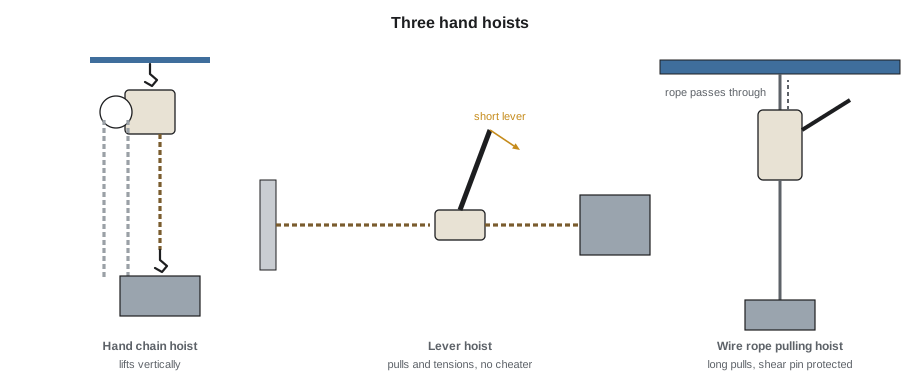
A hand chain hoist, often called a chain fall or chain block, hangs from its top hook and lifts a load on its bottom hook through a load chain. The operator pulls a continuous loop of hand chain that turns a wheel, and a gear train inside the hoist turns the load sheave slowly with great force. A friction brake, usually a load-operated Weston-type brake, holds the load whenever the operator stops pulling, and releases only when the hand chain is pulled in the lowering direction. That brake is why a chain hoist can hold a load indefinitely without anyone touching it, and why it must never be bypassed or adjusted in the field.
Chain hoists are rated by capacity, from 1/4 ton to 10 tons and more, with the rating cast or stamped on the body. The standards that cover them are ASME B30.16 for overhead hoists and, in Canada, CSA B167 where a hoist is part of a crane or monorail system. Many modern hoists include an overload limiter, a slip clutch that stops the hoist lifting when the load exceeds the rating by a set margin. A limiter is a backstop, not a scale: it is set above the rated load, so a hoist that lifts without slipping is not proven to be within its rating.
Inside the hoist, the load chain runs over a pocketed load sheave and, on higher-capacity hoists, through a bottom block with one or more falls of chain, which multiplies the force further. The load chain is a calibrated, hardened chain made for that hoist, and it is replaced only with the same chain from the manufacturer; it is not interchangeable with a sling chain.
Effort and hand chain travel
The work done by the operator equals the work done on the load, less what is lost to friction. If the operator pulls the hand chain a length L to raise the load a height h, then without friction the hand pull times L would equal the weight times h. Friction in the gears and brake means the operator must pull harder than that, by a factor of the hoist's efficiency, which for a hand chain hoist is typically between 0.6 and 0.8.
The useful figure from a manufacturer's catalog is the hand chain pull to lift the rated load and the hand chain overhaul, the length of hand chain pulled to raise the load one unit of height. A typical 1 ton chain hoist needs about 65 lb of pull at full load and has an overhaul of around 40 ft of hand chain per foot of lift. That ratio sets how long a lift takes. Raising the Quayside machine five stories with a chain hoist is not practical, which is why the machine goes up the hoistway in Lesson 8 by a different method and the chain hoist only lifts it the last short distance.
# Hand chain hoist: pull and hand chain length for a lift
capacity = 2000        # hoist rating (lb)
pull_full = 68      # hand chain pull at rated load, from the catalog (lb-force)
overhaul = 40         # hand chain pulled per unit of lift (ft per ft)
load = 1520           # load including rigging (lb)
lift = 5           # height to raise it (ft)
pull = pull_full * load / capacity
chain = overhaul * lift
print(f"hand pull about {pull:.0f} lb-force")
print(f"hand chain to pull: {chain:,.0f} ft")
print(f"at about 65 ft of hand chain a minute: {chain / 65:.0f} minutes of pulling")
eta = load * lift / (pull * chain)
print(f"implied efficiency {eta:.2f}")hand pull about 52 lb-force hand chain to pull: 200 ft at about 65 ft of hand chain a minute: 3 minutes of pulling implied efficiency 0.74
Lifting the machine 5 ft from the platform level to its support takes a few minutes of steady pulling, which is reasonable. The implied efficiency is the catalog's own figure worked backwards, and it shows why the hand pull at full load is several times what friction-free arithmetic would give. A hand pull that suddenly becomes much harder than the catalog figure for the load means something is wrong: the load is heavier than planned, it is caught on something, or the hoist is damaged. The operator stops and finds out why.
That is the most important habit with a chain hoist. Ray's rule is that one person pulls the hand chain, and if one person cannot pull it, nobody pulls it. A second person on the hand chain, or a bar through it, can overload the hoist by more than its whole design margin without anyone noticing. On a hoist with an overload limiter, the limiter will slip; on one without, the next thing to give may be the load chain, the hook or the beam.
Lever hoists
A lever hoist, also called a lever block or come-along, works on the same principle as a chain hoist, but the operator moves a short handle back and forth with a ratchet instead of pulling a hand chain. Lever hoists are compact, work in any direction, and are the tool for pulling a load sideways, holding it against a pull, tensioning a guy or making the fine adjustments at the end of a lift. In a hoistway they are used to pull a load in from the landing, to hold a load clear of a rail while a chain hoist lowers it, and to tension temporary ties. ASME B30.21 covers them.
A lever hoist's handle is sized so that a normal operator's pull on it gives the rated load. Extending the handle with a pipe, a cheater, multiplies the force and overloads the hoist, and it is prohibited by every manufacturer. If the handle cannot be moved by one person's normal effort, the hoist is too small or the load is caught. The free-chaining feature on many lever hoists, which lets the load chain be pulled through quickly with no load, is engaged only with no load on the hoist.
Lever hoists used horizontally have one more hazard: the load chain stores energy as it stretches. A lever hoist holding a load against a pull, such as a counterweight frame being pulled in from a landing, must be released in a controlled way, a click at a time, with nobody in line with the chain. The chain and hooks are always in line with each other; a lever hoist is never loaded around a corner or with its hook point bearing on something.
Wire rope pulling and lifting hoists
A wire rope pulling and lifting hoist, often known by a trade name, grips a wire rope between two pairs of jaws that move alternately as the operator works a lever. One set of jaws holds the rope while the other moves forward, so the rope is pulled through the hoist hand over hand. Because the rope passes through the hoist rather than winding onto a drum, the length of pull is limited only by the length of rope, which makes these hoists useful for long horizontal pulls, such as moving a load across a mall floor on skates, and for some vertical lifts where the hoist is anchored at the top. The hoist is anchored by its own hook or pin to a rated anchor through a sling, and the rope is the type and diameter the manufacturer specifies, with its fused and tapered end and its hook.
Most of these hoists have a shear pin in the lever mechanism that breaks if the hoist is overloaded, and spare shear pins of the correct type are carried with it. A shear pin is never replaced with a bolt or a nail, for the same reason a shackle pin is never replaced: the whole protection depends on it. They are not used to lift people unless the model is specifically designed and approved for that use.
Electric chain hoists
Electric chain hoists do the same job as hand chain hoists with a motor, a brake and a pendant control. They are faster, which matters on a long lift, and they remove the physical effort, which on a long day matters too. They also remove the feedback a hand pull gives, so they rely on an overload device, upper and lower limit switches that stop the hook before it runs into the hoist body or runs out of chain, and a pendant with constant-pressure buttons and an emergency stop. Electric hoists are classified by duty, which describes how many starts and how much running time per hour they are designed for; a hoist used for a few lifts a day has a lower duty class than one used continually on a production line.
On a construction site, an electric hoist needs a temporary power supply installed to the electrical code, with a ground fault protected circuit where required, and its cord must be protected from damage on the landing and in the hoistway. The hoist is inspected before use each shift, including the limit switches and the brake, which is tested by raising the load slightly and stopping. ASME B30.16 and the hoist manual set the inspection and testing requirements, and DOSH applies them on Washington sites.
At Quayside, the machines and the heavy car parts came up to the floors in the general contractor's construction hoist on the outside of the building, and an electric chain hoist on the hoist beam at the top of the car 2 hoistway brings parts up the hoistway from the landings. The hoist and its limits were tested when it was installed, and it is inspected at the start of each shift by the crew using it.
Hanging a hoist
A hoist is only as safe as the point it hangs from. Its top hook goes on a rated rigging point: a hook or lug on the hoist beam, a beam clamp or trolley on the beam's bottom flange, or a sling choked around a beam with softeners. The top hook seats in the bowl, the latch closes, and the hoist hangs freely so that it can line up with the load. A hoist is never hung from a rail bracket, a pipe, conduit, scaffold, the car top crosshead unless designed for it, or anything else not rated for the load. The rating of the hoist, the rating of the attachment and the capacity of the structure are three separate checks, and the lowest governs.
The hoist must also hang freely and be as nearly as possible above the load. A hoist whose body is held against a beam or a wall while it pulls at an angle drags its load chain across the edge of its body and bottom hook and can jump the chain off its sheave. A freely hanging hoist lines up with its chain, but an angled pull still puts a side load on the top hook and the attachment, which they may not be rated for. A load that has to move sideways is moved with a second hoist or a lever hoist pulling sideways while the first carries it, keeping the angle of each within what its attachment is rated for. That is the method used to bring the machine in from the landing in Lesson 8.
Inspecting and storing hoists
Before use each shift, the operator checks the hoist's hooks for opening, twist and working latches; the load chain for stretched, nicked, twisted or worn links and for correct lubrication; the hand chain for damage; the body for cracks; and the operation of the brake by lifting a light load a short distance and stopping. A chain wear gauge from the manufacturer is used to check load chain stretch over a set number of links. Periodic inspections by a designated person, at intervals set by the service, look inside the hoist at the brake and gears and are recorded. A hoist that has been dropped, overloaded, or used near welding, or whose brake slips, is tagged out and sent for repair by a qualified repairer.
Hoists are stored dry, hung up rather than thrown in the bottom of a gang box, with their chains coiled so that they are not twisted. A twisted load chain on a hoist with a bottom block, called a capsized block, is untwisted before use by turning the bottom block back through the chain, never by lifting a load to straighten it.
Common mistakes
MistakeTwo people pulling the hand chain to lift a stubborn load.
InsteadIf one person cannot pull it, stop and find out why.
MistakeExtending a lever hoist handle with a pipe.
InsteadNever use a cheater; use a larger hoist.
MistakeTreating an overload limiter as a scale.
InsteadKnow the weight; the limiter is set above the rating.
MistakePulling a load sideways with a chain hoist.
InsteadKeep the hoist above the load and use a second hoist for the side pull.
MistakeReplacing a wire rope hoist shear pin with a bolt.
InsteadUse only the manufacturer's shear pins.
Summary and key terms
- Hand chain hoists lift through a gear train and hold the load with a load-operated brake.
- The hand pull equals the weight times the lift divided by the hand chain length and the efficiency.
- A pull that is harder than expected means stop; one person pulls, and nobody adds a bar or a second pair of hands.
- Lever hoists pull and tension in any direction, never with a cheater, and are released slowly under load.
- Wire rope pulling hoists make long pulls through gripping jaws and are protected by shear pins.
- A hoist hangs from a rated point directly above the load and is inspected before each shift.
- Chain hoist
- A hand-operated hoist that lifts a load chain through a gear train.
- Load-operated brake
- A brake that uses the load itself to hold the hoist and releases only when the operator lowers.
- Hand chain overhaul
- The length of hand chain pulled to raise the load one unit of height.
- Lever hoist
- A ratcheting hoist operated by a short lever, used in any direction.
- Overload limiter
- A slip clutch that stops a hoist lifting a load well above its rating.
- Capsized block
- A bottom block that has turned over through its chain falls, twisting the chain.
Practice problems
Work each problem on paper first, then reveal the answer to check.
A 2,000 lb hoist needs 66 lb of pull at full load. About what pull is needed for a 1,200 lb load?
Show answer
About 40 lb.
The overhaul is 40 ft per foot of lift. How much hand chain is pulled for an 8 ft lift?
Show answer
320 ft.
Why is a second person on the hand chain dangerous?
Show answer
It can overload the hoist far beyond its rating without any warning.
Name three separate capacity checks when hanging a hoist.
Show answer
The hoist rating, the attachment rating and the capacity of the structure.
Lesson quiz · 5 questions
Score 60% or more to complete this lesson.
Create a free account to save your progress, take quizzes and earn a certificate.