
ELV-130 · Lesson 3 of 12 · 19 min
Slings, hitches and sling angles
A sling is the part of the rigging that wraps around or attaches to the load. It is also the part most often overloaded, because its capacity depends not only on its rating but on how it is used: the hitch, the angle of its legs, and what it bears against. A sling that is perfectly adequate in a vertical hitch can be overloaded in a choker or at a flat angle. This lesson covers the sling types an elevator crew carries, the three basic hitches, the effect of sling angle, and how slings are protected, inspected and removed from service.
Sling types
Northcrest's kits carry four kinds of sling, each with its own strengths. Wire rope slings are strong for their size, resist cutting and heat better than synthetics, and are the usual choice for steel loads with hard edges such as rails and counterweight frames. They are made with a mechanically spliced eye at each end, with a pressed sleeve, and are rated for the hitch printed on the tag. Their weakness is that they are stiff, can kink, and lose strength when bent sharply.
Alloy steel chain slings are tough, flexible enough to wrap around a load, tolerate heat and rough handling, and are easy to adjust in length with a grab hook or shortening clutch. Only alloy chain made and marked for overhead lifting is used, usually grade 80 or grade 100, and each sling carries a tag with its size, grade, working load limit, length and number of legs. Ordinary proof coil or transport chain is never used for lifting, and lifting chain is never welded, heated or repaired with mechanical links that are not rated for it.
Synthetic web slings, flat straps of nylon or polyester, and synthetic roundslings, endless loops of polyester yarn inside a protective cover, are light, soft and do not mark finished surfaces. They are the right choice for car panels, polished escalator parts and machine housings with painted surfaces. They are easily cut, however, and lose strength when exposed to heat, some chemicals and sunlight over time. Roundslings are color-coded by capacity, but the color is only a guide; the tag is the rating.
Metal mesh slings are used occasionally for hot or abrasive loads, and are rarely needed in elevator work.
| Sling | Strengths | Weaknesses | Typical elevator use |
|---|---|---|---|
| Wire rope | Strong, resists cuts and heat | Stiff, kinks, weakened by tight bends | Rails, counterweight frames, steel beams |
| Alloy chain | Tough, adjustable, tolerates heat | Heavy, can damage soft surfaces | Machines with lifting lugs, cribbing work, rough loads |
| Synthetic web | Light, flat, protects surfaces | Cuts easily, heat and chemical damage | Cab panels, escalator steps, finished parts |
| Roundsling | Soft, flexible, conforms to the load | Cuts easily, heat damage, hidden core | Machine housings, controller cabinets, sheaves |
The three hitches
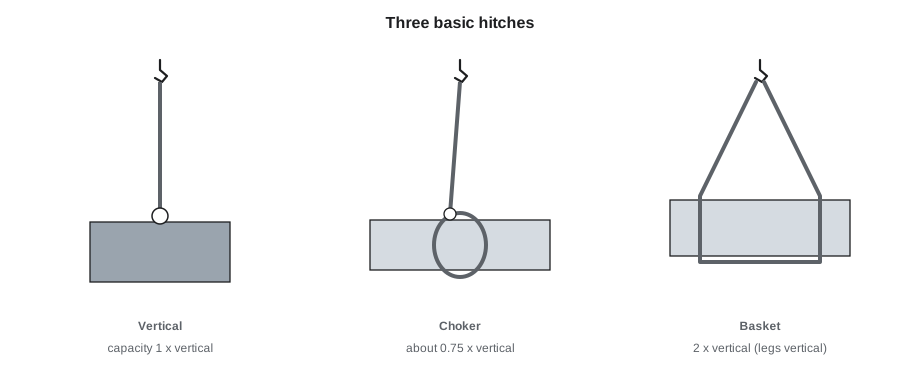
A vertical hitch is a single leg from the hook straight down to the load, with the load attached by a shackle or hook to one eye. The sling carries the whole load in tension, at its rated vertical capacity. A single vertical hitch gives no control of rotation, so it is used for loads with a single lifting point, such as a sheave with a lifting eye, and a tag line is attached.
A choker hitch passes one eye of the sling around the load and through the other eye, so that the sling tightens around the load as it is lifted. A choker grips, which makes it useful for bundles of rails or brackets and for loads with no lifting points. It also reduces the sling's capacity, because the sling is bent sharply at the choke point and the load is shared unevenly. A choker is typically rated at about three quarters of the vertical capacity, and less when the angle of choke is tighter than the sling manufacturer's reference angle. The choke is never forced down against the load with a hammer or a bar; it is allowed to form naturally as the sling takes the load.
A basket hitch passes the sling under the load with both eyes on the hook. With both legs vertical, the sling carries the load on two legs and its capacity is twice the vertical rating. A basket gives no grip, so the load must be balanced in it and cannot slide out; a basket under a smooth cylinder or a long load is dangerous unless the load is held from rolling, for example with a double wrap. Two baskets, one near each end of a long load, are the usual rigging for a load such as a car platform.
Sling angle
When two sling legs go from a hook to two points on a load, the legs lean inward toward the hook. Each leg must carry part of the weight vertically, but because it is leaning, it also pulls sideways toward the other leg. The tension in a leaning leg is therefore greater than its share of the weight, and the flatter the legs, the greater the tension. At a steep angle the increase is small. At a flat angle it is large, and as the legs approach horizontal the tension grows without limit.
Here W is the weight, n the number of legs carrying it, and θ the angle of each leg from the vertical. Rigging tables and standards express the same effect in different ways, and a rigger must know which convention a table uses. The ASME tables give rated loads for leg angles measured from the horizontal, at 60, 45 and 30 degrees, and the standard does not permit leg angles flatter than 30 degrees from horizontal without engineering approval.
Under the ASME tables used by OSHA and DOSH, a two-leg sling at 60 degrees from horizontal carries about 1.73 times the single-leg vertical rating, at 45 degrees about 1.41 times, and at 30 degrees only the single-leg rating, because each leg is then carrying the full weight. A rigger reading a manufacturer's chart checks whether its angles are measured from horizontal, as most US charts are, or from vertical.
| Angle from horizontal | Angle from vertical | Leg tension per unit of load, two legs | Comment |
|---|---|---|---|
| 90° | 0° | 0.50 | Legs vertical |
| 60° | 30° | 0.58 | Good practice |
| 45° | 45° | 0.71 | Acceptable |
| 30° | 60° | 1.00 | Each leg carries the full weight; minimum |
| Below 30° | Over 60° | Over 1.00 | Not permitted without engineering |
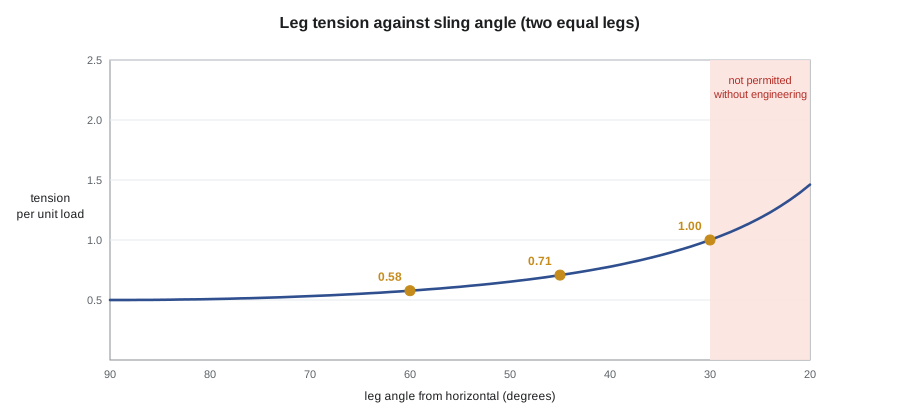
The practical rule follows from the table. Keep sling legs long enough that the angle between each leg and the horizontal is at least 45 degrees where possible and never less than 30. A leg length at least equal to the distance between the lifting points gives 60 degrees. In a hoistway, the overhead height limits how long the legs can be, which is why a spreader beam is often used: it takes the horizontal pull between the lifting points in compression and lets the slings hang vertically to the load.
# Two-leg bridle: leg tension against angle, checked against the sling WLL
import math
W = 3100               # load including rigging below the hook (lb)
wll_leg = 2200       # vertical rating of each leg (lb)
for from_horizontal in (90, 60, 45, 35, 30, 25):
    theta = math.radians(90 - from_horizontal)        # angle from vertical
    t = W / (2 * math.cos(theta))
    if from_horizontal < 30:
        verdict = "not permitted without engineering"
    else:
        verdict = "ok" if t <= wll_leg else "OVERLOADED"
print(f"{from_horizontal:>2} deg from horizontal: {t:7.0f} lb per leg {verdict}")90 deg from horizontal: 1550 lb per leg ok 60 deg from horizontal: 1790 lb per leg ok 45 deg from horizontal: 2192 lb per leg ok 35 deg from horizontal: 2702 lb per leg OVERLOADED 30 deg from horizontal: 3100 lb per leg OVERLOADED 25 deg from horizontal: 3668 lb per leg not permitted without engineering
The load is a bundle of four counterweight rails with their brackets, and each leg of the bridle is rated well above half the load. At steep angles the bridle is comfortable. At 45 degrees from horizontal the legs are just within their rating, and at 35 and 30 degrees they are overloaded even though the two legs together are rated for more than the load. Tamsin wrote the rule in her log in her own words: the sling does not know how much the load weighs, only how hard it is being pulled.
Unequal legs and three or four legs
When the hook is over the center of gravity of a load whose center of gravity is not midway between the lifting points, the legs have different lengths and angles. The shorter, steeper leg is on the side nearer the center of gravity, and it carries more load. The tensions are found from two balance conditions: the horizontal pulls of the two legs are equal and opposite, and their vertical components add up to the weight. The code below applies this to the Quayside machine from Lesson 2, lifted from its two lugs with the hook placed over the center of gravity at a chosen height.
# Unequal two-leg bridle with the hook over the center of gravity
import math
W = 1520                    # machine and bedplate (lb)
xa, xb, xg = 3.1, 36.2, 23.8   # lug A, lug B and center of gravity along the bedplate (in)
h = 27.5                    # hook height above the lugs (in)
la, lb = math.hypot(xg - xa, h), math.hypot(xb - xg, h)
sa, ca_ = (xg - xa) / la, h / la      # sine and cosine of leg A from vertical
sb, cb = (xb - xg) / lb, h / lb
# horizontal: TA*sa = TB*sb ; vertical: TA*ca_ + TB*cb = W
TA = W / (ca_ + sa * cb / sb)
TB = TA * sa / sb
for name, l, t, c in (("A", la, TA, ca_), ("B", lb, TB, cb)):
    ang = math.degrees(math.acos(c))
print(f"leg {name}: length {l:.1f} in, {90 - ang:.0f} deg from horizontal, tension {t:.0f} lb")leg A: length 34.4 in, 53 deg from horizontal, tension 713 lb leg B: length 30.2 in, 66 deg from horizontal, tension 1043 lb
Leg B, on the motor side, is shorter and steeper and carries the larger tension, as the moment balance predicted. Both legs are well within the sling rating chosen for the lift, and both are steeper than 45 degrees from horizontal. If the overhead were lower and the hook could not be raised so far above the lugs, the legs would flatten and both tensions would rise.
With three or four legs, the load is not shared equally unless the legs are exactly the right lengths and the load is perfectly rigid, which is never the case in practice. A four-leg bridle on a rigid load is effectively carried by two diagonally opposite legs, with the other two just steadying it. For that reason, the usual practice, which most standards and manufacturers follow, is to rate a three- or four-leg bridle on a rigid load as if only two legs carry the weight. The extra legs add stability, not capacity.
Edges, bends and softeners
A sling bent around a sharp edge is weakened where it bends and can be cut outright. Steel edges on a counterweight frame, a car frame channel or a bundle of brackets will cut a synthetic sling under load in seconds, and they damage wire rope too. Edge protection, called softeners or wear pads, goes between the sling and every hard edge: purpose-made sleeves and pads, split rubber hose, or a timber block. Synthetic slings get edge protection designed for cutting, because a simple fabric sleeve can be cut through as well.
A wire rope sling also loses strength when bent around a pin, a hook or the load itself, even if the surface is smooth. The loss depends on the ratio of the diameter of the bend, D, to the diameter of the rope, d. At a D/d ratio of 1, such as a rope bent around a pin of its own diameter, a rope retains only about half of its strength; at a ratio of 10 it retains roughly 85 percent, and at 25 or more, nearly all. The exact figures come from the sling manufacturer, and they are why a wire rope sling's eye should go over a shackle bow or a hook larger than the rope, and why a basket hitch is made around as large a diameter as the load allows.
Inspection and removal from service
Each sling is inspected by the user before use on each shift, with a more thorough periodic inspection by a designated person at intervals set by the service, at least yearly, recorded for chain slings and good practice for all. The things that remove a sling from service are specific to its type, and a sling with any of them is cut up so that it cannot be used again.
- Wire rope: broken wires beyond the limits, such as ten randomly distributed broken wires in one rope lay or five in one strand in one lay; kinking, crushing or birdcaging; corrosion; heat damage; and damaged or cracked end fittings or sleeves.
- Alloy chain: stretched links, bent or twisted links, nicks and gouges, excessive wear at the bearing points, cracks, heat damage, and a missing or illegible tag.
- Synthetic web and roundslings: cuts, holes, tears and snags; melted, charred or chemically damaged areas; broken or worn stitching in the load-bearing splices; exposed core yarns on a roundsling, or a warning yarn showing where the manufacturer provides one; knots; and a missing or illegible tag.
The same rule applies to all: if there is doubt, the sling is not used. Slings are also stored so that they stay in service: hung on a rack in the branch, out of sunlight and weather, away from chemicals and welding, and coiled or hung rather than left on a floor where they are driven over.
Common mistakes
MistakeReading a sling chart without checking whether its angles are from horizontal or vertical.
InsteadConfirm the convention before reading any table.
MistakeRating a four-leg bridle on four legs.
InsteadOn a rigid load, rate a three- or four-leg bridle on two legs.
MistakeHammering a choker down tight against the load.
InsteadLet the choke form naturally as the sling takes the strain.
MistakeUsing short legs to suit low headroom and ignoring the angle.
InsteadUse a spreader beam or longer legs; never go below 30 degrees from horizontal.
MistakePutting a synthetic sling over a steel edge without cut protection.
InsteadFit softeners designed for cutting at every hard edge.
Summary and key terms
- Wire rope, alloy chain, synthetic web and roundslings each have uses, strengths and weaknesses.
- A choker is rated at about three quarters of vertical, less for tight choke angles; a vertical basket at twice vertical.
- Leg tension is the weight divided by the number of legs and the cosine of the angle from vertical.
- Legs should be at least 45 degrees from horizontal where possible and never less than 30 without engineering.
- Three- and four-leg bridles on rigid loads are rated as two legs.
- Softeners protect slings at edges, the D/d ratio governs bending loss, and damaged slings are removed and destroyed.
- Sling
- A wire rope, chain or synthetic member that connects a load to a hook.
- Choker hitch
- A hitch in which the sling passes around the load and through its own eye, tightening as it is lifted.
- Basket hitch
- A hitch in which the sling passes under the load with both ends on the hook.
- Bridle
- A sling assembly with two or more legs attached to a single master link or hook.
- Sling angle
- The angle between a sling leg and the horizontal or the vertical, depending on the convention used.
- D/d ratio
- The diameter of the bend divided by the diameter of the wire rope bent around it.
- Softener
- A pad or sleeve placed between a sling and a hard edge to protect the sling.
Practice problems
Work each problem on paper first, then reveal the answer to check.
A 2,000 lb load is lifted on two equal legs at 45 degrees from horizontal. What is the tension in each leg?
Show answer
2,000 / (2 × 0.707) = 1,414 lb.
A web sling is rated 2,200 lb vertical. What is its approximate rating in a choker and in a vertical basket?
Show answer
About 1,650 lb in a choker and 4,400 lb in a vertical basket.
Why is a three-leg bridle on a rigid load rated as two legs?
Show answer
The legs never share equally; in practice two legs carry the load.
A wire rope sling shows five broken wires in one strand within one lay. What happens to it?
Show answer
It is removed from service and destroyed.
Lesson quiz · 5 questions
Score 60% or more to complete this lesson.
Create a free account to save your progress, take quizzes and earn a certificate.