
ELV-130 · Lesson 12 of 12 · 20 min
Capstone: lift plans and the critical lift
Every lift in this course has been planned, but most of the plans lived in the heads of the people doing them, or on a single line of a job hazard analysis. Some lifts need more: a written lift plan, reviewed and signed before the lift, with every number and every role on paper. This capstone covers what a written lift plan contains, which lifts Northcrest treats as critical, and then follows Tamsin as she prepares the plan for the biggest lift of her second year: the replacement of the car 2 machine at the Tillicum Building on Route 7, with a mobile crane lifting the old machine out of the penthouse and the new one in.
When a lift needs a written plan
Most companies, Northcrest among them, divide lifts into routine lifts, which are covered by the job hazard analysis and the five questions, and critical lifts, which need a written plan reviewed by a second qualified person and signed off before the lift. The criteria for a critical lift vary between companies and clients. Northcrest's branch policy, which Lena reviews each year, treats a lift as critical if any one of these is true.
- Any piece of the system, from the rigging to the structure, will carry more than 75 percent of its rated capacity.
- The lift uses a crane of any size, or more than one hoist on the same load.
- The load passes over people, an occupied area, a public street or sidewalk, or equipment that would be costly or dangerous to hit.
- The load's weight or center of gravity is estimated rather than documented, and the estimate is within the capacity margin.
- The lift uses an engineered rigging point, a temporary beam or building structure confirmed by an engineer, or a below-the-hook device built for the job.
- The operator cannot see the load for any part of the lift.
The machine lift at Quayside in Lesson 8 met two of these: it used two hoists, and the operator's view of the machine was partly blocked during the transfer. It had a written plan. The Tillicum lift meets nearly all of them.
What goes in a lift plan
A lift plan answers the five questions in writing, adds the people, the sequence and the conditions under which the lift stops, and is signed by the people responsible. Northcrest's form has these sections, and Tamsin filled in each one for Tillicum.
| Section | What it records |
|---|---|
| Load | Description, weight and its source, center of gravity, lifting points, condition |
| Rigging | Each sling, shackle, hook, spreader and hoist ring, with its rating, its hitch or angle, and the load it carries |
| Hoisting equipment | Hoist or crane, its rating or load chart capacity at the radius and configuration used, and its inspection status |
| Rigging points and structure | What the load hangs from or rests on, its rating, and the engineer's confirmation where needed |
| Utilization | The load on each component as a percentage of its capacity |
| Route and controlled zone | Path of the load, clearances, barricades, street or area closures |
| People and communication | Person in charge, rigger, operator, signal person, spotters; radio channel, signals, stop authority |
| Conditions and stops | Weather or wind limits, lighting, time window, and the conditions that stop the lift |
| Sequence | Step-by-step order of the work, including preparation and hold points |
| Sign-off | Prepared by, reviewed by, approved by, and the pre-lift meeting attendance |
The Tillicum machine replacement
The Tillicum Building is a 1962 office building with a penthouse machine room on its roof. Car 2's geared machine is being replaced with a new gearless machine as the first step of a modernization; the controller, ropes and governor follow in later phases. The old machine has no documented weight, so the plan uses Tamsin's estimate from Lesson 2, 8,100 lb, drained of oil and rounded up with a margin. The new machine weighs 4,100 lb on its nameplate, with its new bedplate. The penthouse has a removable roof hatch above the machine, which the building engineer's drawings confirm, and the crane will lift each machine vertically through the hatch.
The crane is a mobile crane set up on the street in front of the building under a street use permit, with its outriggers on cribbing mats. The crane company provided the crane, its certified operator and its load chart, and worked out the radius from the crane's center of rotation to the hatch, which with the building's setback comes to 72 ft. At that radius and with the boom length needed to clear the parapet, the load chart gives a gross capacity from which the crane company deducts the hook block and rigging allowance, as the chart instructs, to give the net capacity available for the load.
The street use permit closes the sidewalk and one lane under the boom for the morning of the lift, from 6:00 a.m. to 10:00 a.m. on a Sunday, when the building is empty. The building's tenants were told a week ahead, and the parking garage entrance is closed during the lift. The crane operator holds the certification required under the federal and Washington crane rules for that crane type, the rigger is qualified for this rigging as Washington's rule requires, and the signal person is a Northcrest mechanic qualified as a signal person.
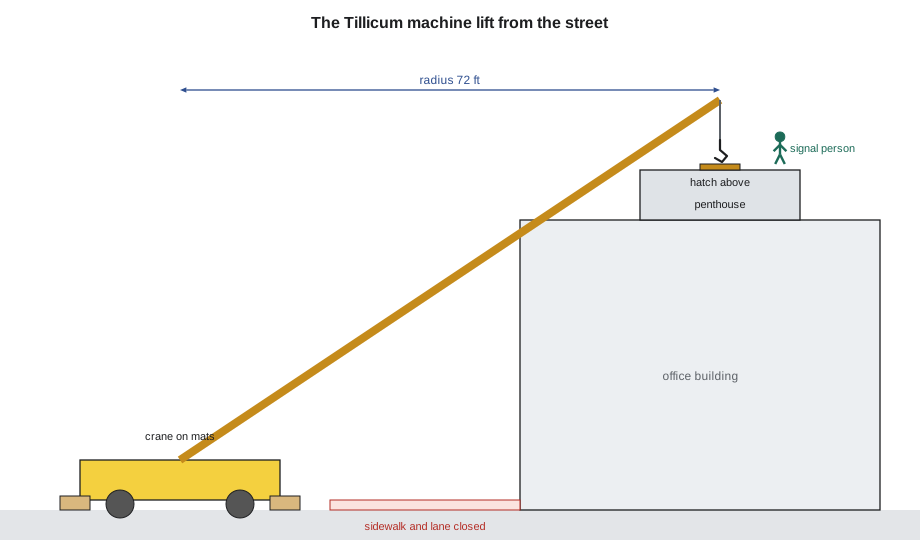
Preparation in the hoistway and machine room
Before the crane arrives, the old machine has to be free to lift. The week before, the crew lands the car and the counterweight on supports so that the ropes can be removed: the car is run to the top landing and set on its safeties, with blocking under the car frame on the top landing sill beams as a second support; the counterweight goes onto a crib on its buffer support in the pit, built to the height that puts it there with the car at the top, as Lesson 10 described. Only when both are confirmed resting on their supports, with the ropes visibly slack, are the ropes cut and removed. The machine is drained, the motor leads and brake wiring are disconnected and tagged, the machine's hold-down bolts are removed, and it is jacked off its beams and moved on skates to the position under the hatch, where it rests on cribbing with its lifting points clear for the crane rigging.
The roof is the other preparation. The hatch is unbolted the day before and left in place, weighted down against wind. The roof membrane around the hatch is protected with plywood, the parapet edge where the tag lines run is padded, and a guardrail is set around the open hatch for the people working beside it, who are also tied off to the roof anchors the building provides, not to the hatch frame.
The rigging and the numbers
The rigging for both machines is a spreader beam rated 11,000 lb below the crane hook, with two vertical wire rope slings from the spreader to shackles on the machine's lifting points, so that the slings hang vertically through the hatch opening without touching its edges. The old machine's lifting lugs were inspected and found sound; one was cracked at its weld on the old bedplate and has been replaced with a designed lifting attachment bolted through the bedplate, which the manufacturer's engineer approved. Each component's load is listed in the plan, and the code below computes the utilization of each one and the critical lift flags.
# Tillicum car 2: lift plan utilization and critical lift flags
old_machine, new_machine = 8100, 4100     # (lb) old is an estimate, new from the nameplate
rigging = 400          # spreader, slings and shackles (lb)
loads = {"old machine out": old_machine + rigging, "new machine in": new_machine + rigging}
xg_old = 0.55            # old machine center of gravity, fraction of lug spacing from lug A (estimated)
crane_net = 10400       # net capacity at 72 ft radius after the chart deductions (lb)
components = {            # name: rated capacity (lb)
    "crane, net at radius": crane_net,
    "spreader beam": 11000,
    "sling A (vertical)": 7000, "sling B (vertical)": 7000,
    "shackle A": 10500, "shackle B": 10500,
}
for lift, W in loads.items():
    share_b = xg_old if lift.startswith("old") else 0.5
    on = {"crane, net at radius": W, "spreader beam": W,
          "sling A (vertical)": W * (1 - share_b), "sling B (vertical)": W * share_b,
          "shackle A": W * (1 - share_b), "shackle B": W * share_b}
    print(f"{lift}: {W:,} lb")
    for name, cap in components.items():
        u = 100 * on[name] / cap
        flag = "OVER" if u > 100 else ("critical (> 75 %)" if u > 75 else "")
        print(f"   {name:<22} {on[name]:7,.0f} / {cap:7,} = {u:5.1f} %  {flag}")
criteria = {"crane used": True, "over a public street": True, "weight estimated": True,
            "operator cannot see the load": True, "component over 75 %": True}
print("critical lift:", ", ".join(k for k, v in criteria.items() if v))old machine out: 8,500 lb crane, net at radius 8,500 / 10,400 = 81.7 % critical (> 75 %) spreader beam 8,500 / 11,000 = 77.3 % critical (> 75 %) sling A (vertical) 3,825 / 7,000 = 54.6 % sling B (vertical) 4,675 / 7,000 = 66.8 % shackle A 3,825 / 10,500 = 36.4 % shackle B 4,675 / 10,500 = 44.5 % new machine in: 4,500 lb crane, net at radius 4,500 / 10,400 = 43.3 % spreader beam 4,500 / 11,000 = 40.9 % sling A (vertical) 2,250 / 7,000 = 32.1 % sling B (vertical) 2,250 / 7,000 = 32.1 % shackle A 2,250 / 10,500 = 21.4 % shackle B 2,250 / 10,500 = 21.4 % critical lift: crane used, over a public street, weight estimated, operator cannot see the load, component over 75 %
The old machine is the governing lift. The crane is at about four fifths of its net capacity at the planned radius, which puts it over the branch's 75 percent line and is one more reason the lift is critical; it is still inside the chart with a margin. The spreader beam is just over the line too, which Tamsin noted but did not change, because the lift was critical anyway. Of the slings, sling B, on the heavier side of the old machine, is the most loaded, at about two thirds of its rating. The new machine is a light lift by comparison. Because the old machine's weight is an estimate, the plan adds one more control: the crane's load indicator will be read when the old machine is lifted just clear of its cribbing, and if it reads more than the planned weight, the lift stops there, the machine is set back down, and the plan is reviewed. Ray reviewed the numbers and asked for one change, a second, smaller radius set-up position for the crane in case the indicator reading came in high, which the crane company confirmed was available.
Sequence and hold points
The plan's sequence is short, with hold points where nothing proceeds until the person in charge confirms a condition. On the morning, the pre-lift meeting is held on the sidewalk at 06:00 with everyone who has a role: the crane operator and oiler, Ray as person in charge, Tamsin as rigger, a Northcrest mechanic as signal person on the roof, two spotters at the street barricades, and the building engineer. The plan is read through, the radios are tested on the lift channel, and everyone signs the attendance sheet.
- Hold 1: street closed, barricades and spotters in place, crane set up on its mats and leveled, operator's pre-use inspection complete.
- Hold 2: rigging inspected and attached; spreader, slings and shackles as listed; hatch removed and guardrail in place; people on the roof tied off.
- Hold 3: trial lift of the old machine just clear of its cribbing; load indicator reading compared with the plan; machine level in the rigging.
- Hold 4: old machine landed on cribbing on the street truck bed in the closed lane and unrigged; rigging re-inspected.
- Hold 5: trial lift of the new machine; lowered through the hatch onto skates on cribbing in the machine room; unrigged.
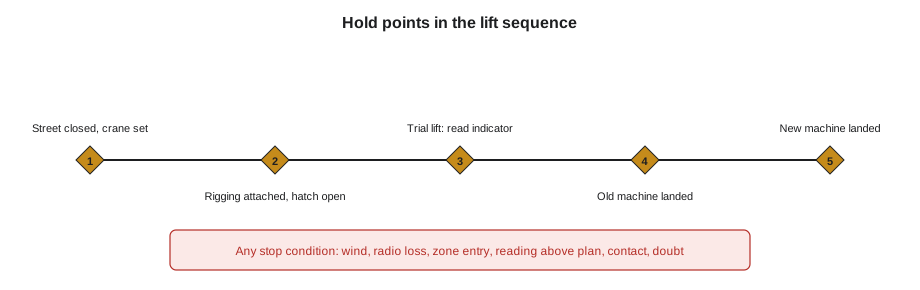
Stop conditions are stated in the plan: wind over the crane manufacturer's limit or gusts that make the load swing, loss of radio contact, anyone entering the controlled zone, an indicator reading above plan, any contact between the load or slings and the hatch edge, and any doubt from anyone on the team.
The lift
On the morning, the wind was light and the lift went to plan. At hold 3, the load indicator read about a tenth under the planned figure, about 7,400 lb, with the rigging included, which she wrote in her log next to the estimate: the margin had been a little generous, and the oil had been drained. The old machine came up through the hatch with the slings vertical and clear of the edges, swung out over the street on the signal person's directions under the operator's control, and was landed on the truck. The new machine went in by the reverse path. The crane was off the street by 09:15.
The machine room work that followed, skating the new machine to its position, jacking it onto the new beams, aligning it to the rope drop points and bolting it down, used the methods of Lessons 7 and 8. The ropes, the car and counterweight supports and the return to service belong to the later phases of the modernization and to ELV-230 and ELV-430.
The review
Northcrest reviews every critical lift after it is done, while the details are fresh. The Tillicum review was ten minutes at the branch on Monday morning, with the plan on the table. The things that worked were recorded as well as the things that did not: the estimate method had been sound and on the safe side; the spreader had kept the slings clear of the hatch exactly as planned; the second crane position had not been needed but was worth having. Two improvements went into the branch's lift plan template. A line was added for the roof membrane and parapet protection, which had been arranged by phone and nearly forgotten. And the street closure times were to be confirmed with the city the day before, because the permit's printed time had been an hour earlier than the one agreed by phone.
Tamsin's own note at the end of her second-year rigging section is a list of the five questions, with a line under each. What does it weigh? Know it, or estimate it high and check it. Where is its center of gravity? Find it before the load leaves the ground. What will it hang from? Only from something rated and marked for that load. How is it rigged? Every piece checked for its load and the way it is loaded. Where will each person be? Out of the zone, off the rigging, and able to call a stop.
Common mistakes
MistakeTreating a familiar lift as routine when it meets a critical lift criterion.
InsteadCheck the criteria for every lift; one is enough to require a written plan.
MistakeUsing the crane chart's gross capacity for the load.
InsteadUse the net capacity after the chart's deductions at the actual radius and configuration.
MistakeProceeding past a hold point because everything looks fine.
InsteadStop at each hold point until the person in charge confirms the condition.
MistakeRelying on an estimate without a check during the lift.
InsteadRead the load indicator at the trial lift and stop if it is above plan.
MistakeSkipping the review because the lift went well.
InsteadReview every critical lift and update the template.
Summary and key terms
- A critical lift needs a written plan, a second qualified reviewer and a sign-off before the lift.
- Northcrest's criteria include over 75 percent of any capacity, cranes or multiple hoists, lifts over people or streets, estimated weights, engineered points and blind lifts.
- A lift plan records the load, rigging, equipment, structure, utilization, route, people, stop conditions, sequence and sign-off.
- Utilization is the load on each component divided by its rated capacity, and the most loaded component governs.
- Hold points, trial lifts and stop conditions control a lift whose numbers include estimates.
- Every critical lift is reviewed afterwards, and what is learned goes into the template.
- Critical lift
- A lift that meets any of the criteria requiring a written, reviewed and signed lift plan.
- Lift plan
- A written plan of a lift covering the load, rigging, equipment, people, sequence and stop conditions.
- Utilization
- The load on a component as a percentage of its rated capacity.
- Net capacity
- The crane chart capacity after deducting the hook block and rigging as the chart requires.
- Hold point
- A step in a sequence at which work stops until a stated condition is confirmed.
- Blind lift
- A lift in which the operator cannot see the load for some or all of its path.
Practice problems
Work each problem on paper first, then reveal the answer to check.
A sling rated 7,000 lb carries 4,700 lb. What is its utilization, and is the lift critical on that basis?
Show answer
67 percent; not critical on that criterion alone.
Name four criteria that make a lift critical at Northcrest.
Show answer
Any component over 75 percent; a crane or more than one hoist; a load over people or a street; an estimated weight within the margin; an engineered rigging point; a blind lift.
What happens if the load indicator at the trial lift reads above the planned weight?
Show answer
The lift stops, the load is set back down, and the plan is reviewed.
Why are the car and counterweight landed before the old ropes are removed?
Show answer
So that neither can drop when the ropes no longer hold them.
Lesson quiz · 5 questions
Score 60% or more to complete this lesson.
Create a free account to save your progress, take quizzes and earn a certificate.