
ELV-120 · Lesson 11 of 12 · 18 min
Jump lifts and temporary construction elevators
A 30-story tower under construction moves thousands of people and tons of material up and down every day. For most of the job, that work is done by personnel hoists climbing masts on the outside of the building and by the tower crane. As the building rises and its envelope closes in, the external hoists get in the way of the cladding, and the trades inside want a faster, weatherproof way up. The answer on many high-rise jobs is to put one of the building's own elevators into service early, as a temporary construction elevator, and on taller buildings to have it climb with the building as a jump lift. At Quayside, the service car is that elevator. This lesson covers what a construction elevator is, the rules it runs under, how a jump lift works, how the jumps are planned, and the safety of running an elevator inside an unfinished building.
Construction elevators and personnel hoists
Two different kinds of equipment carry workers on a construction site, and they are covered by different standards. A personnel hoist, or construction hoist, is a rack-and-pinion car running on a mast, usually fixed to the outside of the building. It is temporary equipment and is removed when the job is done. A construction elevator is an elevator in the building's own hoistway, often one of the permanent elevators, used temporarily during construction to carry workers, tools and materials, and then finished and accepted as a permanent elevator.
In Washington, a construction elevator runs under a temporary construction-use operating permit from L&I, requested by the elevator contractor, under WAC 296-96-02415. The elevator must meet at least Section 5.10 of ASME A17.1/CSA B44, the code's section on elevators used for construction. The permit lasts 30 days, renewal is at the department's discretion and needs a reinspection, and an elevator whose temporary permit has expired may not be operated. Personnel hoists on the outside of the building are covered by a separate construction hoist standard, ANSI A10.4.
What a construction elevator must have
Section 5.10 of the code allows a construction elevator to be simpler than a finished passenger elevator, but not less safe. The car may have a plain, robust enclosure instead of the finished cab, and the hoistway entrances may have temporary doors. The essential safety systems must be in place and working: the safeties and governor, the buffers, the brake, the terminal stopping devices, the door locking, and the electrical protective devices. A construction elevator is not a hoist with an elevator's name on it; it is an elevator in temporary clothes.
Washington's rule sets the frame: the elevator meets Section 5.10 of the code, it carries only construction workers and construction materials, an operator runs it whenever it operates, and the operator has a way to contact people who can help in an emergency. Section 5.10 and the inspector's acceptance cover the rest: working safeties, governor, buffers, brake, terminal stopping and electrical protective devices, hoistway doors that lock, entrances that open only into areas closed to the public, and temporary wiring installed to the electrical code. The contractor maintains the unit throughout its construction use.
| Item | Construction elevator | Finished passenger elevator |
|---|---|---|
| Car enclosure | Plain, robust, protected; no glass or mirrors | Finished cab |
| Hoistway doors | Permanent or temporary, locked and with contacts | Permanent entrances |
| Operation | By a designated operator | By passengers |
| Users | Construction workers and materials only | Public |
| Safety systems | Safeties, governor, buffers, brake, terminal stopping, door locking, all working | Same, plus the finished fixtures and features |
| Permit | Temporary, for construction use | Operating permit after final acceptance |
The jump lift
On a tall building, a construction elevator installed in the lower part of the hoistway soon falls behind the work. A jump lift solves this by climbing with the building. The car runs in the completed lower part of the hoistway, with a temporary machine mounted on a machine platform at the top of the running section. Above the machine platform is a protection deck that shields the elevator from anything falling from the formwork and work above. As the concrete walls rise, the crew extends the rails and brackets in the new hoistway above the deck. Then, during a planned shutdown, the machine platform, the protection deck and everything with them are lifted up to a new position, the ropes are lengthened, and the elevator's travel grows by several floors. That move is the jump.
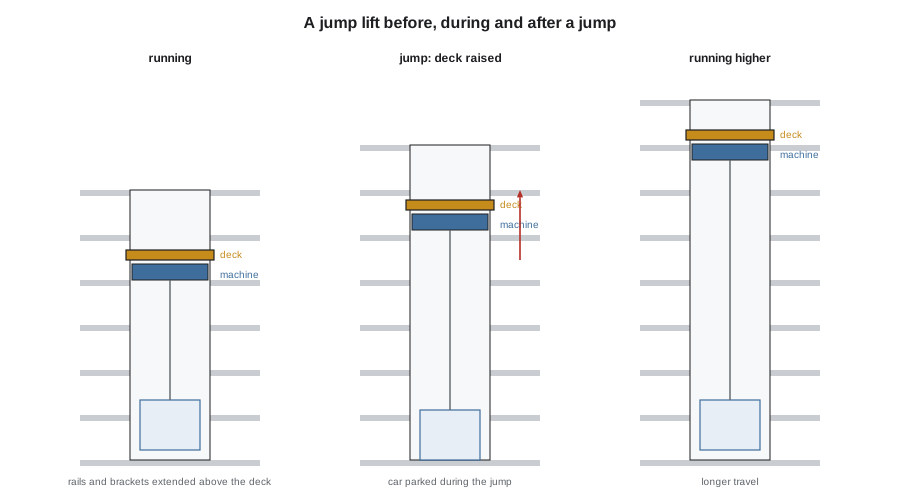
Several of the major elevator manufacturers offer jump lift systems, each with its own machine platform, climbing method and procedures. They share a few ideas. The permanent rails, brackets, entrances and pit equipment are installed as the building rises, so that the work done for the jump lift is the permanent elevator's work. The temporary parts, the machine platform and protection deck, are designed to be lifted and re-anchored quickly. The protection deck carries the overhead load from the work above and is never removed while anyone is in the hoistway below. And after each jump, the unit goes through checks and tests before it carries anyone again.
Quayside's service car
At Quayside, the service car was installed as a jump lift. Its hoistway, beside the four passenger cars, was among the first to be poured, and by the time Tamsin started, the car was running from the lobby to the 16th floor, with its machine platform at the 18th and the protection deck above it. The rail crew sets brackets and rails above the deck as the walls are poured, and the jump to the next running section is planned when enough hoistway is complete above the deck. A second crew from Northcrest handles the jumps themselves, and every jump is a planned shutdown of the building's main vertical transport, scheduled with the general contractor a week ahead.
The service car runs under a temporary construction-use permit with an operator on every trip. The permit is renewed every 30 days, and each renewal needs a reinspection, so Lena keeps the permit dates and the jump schedule on the same calendar. After each jump, the car stays out of service until the checks and tests in the manufacturer's procedure are done and the inspection requirements are met. When construction use ends, the car is finished as the permanent service elevator and goes through final acceptance.
Planning the jumps
A jump schedule follows the concrete schedule. If the building's walls rise one floor every few working days, the hoistway above the deck grows at the same rate, and the rail crew has to keep up with it. A jump is possible once the new section has its rails, brackets and entrances in and checked, with the walls cured enough to carry the deck's anchors. The calculation below sets out a jump plan for the service car with illustrative values for the concrete cycle and the jump size, and counts the days the car is out of service for jumps.
# Service car jump plan (illustrative concrete cycle and jump size)
floor_cycle = 5           # working days to pour one floor of the core
running_top = 16          # top floor the car serves now
deck_above = 2            # protection deck is this many floors above the top served floor
jump_size = 8             # floors added to the travel at each jump
lead = 2                  # floors of complete hoistway needed above the deck before a jump
jump_days = 3             # working days the car is out of service for each jump
poured = 22               # floors poured today (day 0)
top_floor = 30
permit_days = 30        # calendar days per temporary permit (None where not used)
day, jumps = 0, []
while running_top < top_floor:
    target = min(top_floor, running_top + jump_size)
    needed = target + deck_above + lead if target < top_floor else top_floor
    ready_day = max(day, (needed - poured) * floor_cycle)
    jumps.append((ready_day, running_top, target))
    day = ready_day + jump_days
    running_top = target
for d, a, b in jumps:
    note = f" (in {permit_days}-day permit period {d * 7 // 5 // permit_days + 1})" if permit_days else ""
    print(f"day {d:3d}: jump from floor {a} to floor {b}{note}")
print(f"{len(jumps)} jumps, {len(jumps) * jump_days} working days out of service for jumps")day 30: jump from floor 16 to floor 24 (in 30-day permit period 2) day 40: jump from floor 24 to floor 30 (in 30-day permit period 2) 2 jumps, 6 working days out of service for jumps
The plan shows two jumps over the rest of the structure: one to floor 24 once the core has been poured to floor 28, so that there is complete hoistway above the new deck position, and a final jump to the top once the core is complete. Each jump takes the car out of service for three working days. The real schedule changes every week with the weather and the concrete, so Lena updates it at the general contractor's coordination meeting. The service car being out of service for a jump also means the trades lose their elevator for those days, so jumps are planned for times when the external hoists can carry the load.
Running an elevator in an unfinished building
A construction elevator works hard in a rough environment. It carries heavy, awkward loads: drywall, piping, tool carts and occasionally things that should not go in an elevator at all. Its car is loaded by people who are not elevator users, and its hoistway doors are opened on floors still under construction. The hazards are a mix of elevator hazards and construction hazards.
- Overloading. The rated load is posted in the car, and the operator refuses loads that exceed it or that would strike the car enclosure or door. Long material such as rebar or pipe is not carried unless the car is designed for it.
- Door and landing damage. Carts and pallets strike hoistway doors and sills. The operator reports damage at once, and the car is taken out of service if a door lock or contact is affected.
- Water and debris. Rain, concrete wash water and debris find their way into the hoistway and pit. The pit is inspected and pumped as part of maintenance, and the protection deck is kept clean.
- Access to the hoistway. Only the elevator crew enters the hoistway, through the access log, and the construction elevator is locked out for any work on it. Other trades never ride the car top or open a hoistway door with a key.
- Work above. The protection deck is the only thing between the running elevator and the formwork above. Nothing is stored on it, and its condition is checked every shift.
DOSH's rules for the crew still apply in full: fall protection at the open hoistway above the deck, lockout for any work on the running elevator, and the no-work-below-other-work rule wherever the deck does not provide rated overhead protection.
The operator
The operator is the person who runs the construction elevator and controls who and what goes in it. The operator is trained on the controls, the rated load, the emergency procedures and how to call for help if the car stops between floors. At Quayside, the operators are employed by the general contractor, trained and signed off by Northcrest, and they keep a daily log of the car's use and any faults. A good operator is the elevator crew's best source of early warning: a door that drags, a strange noise at a particular floor, or water in the pit is reported by the operator long before it becomes a breakdown.
After construction use
When the building no longer needs a construction elevator, the service car's construction life ends, and it is turned into the finished permanent elevator. The temporary machine platform and protection deck come out, and the permanent machine and its supports are set in the top of the hoistway as described in Lesson 10. The plain construction enclosure is replaced by the finished cab, and temporary hoistway doors are replaced by the permanent entrances. Worn guides, damaged sills and door equipment are replaced, and the rails, which have carried two years of construction traffic, are checked against the alignment record and corrected where the building's shortening has moved them. Only then does the unit go through its final acceptance and receive its permanent operating permit.
Common mistakes
MistakeTreating the construction elevator as temporary equipment that can skip safety systems.
InsteadIt must meet the code's construction elevator section, with all its essential safety systems working.
MistakeLetting passengers run the car themselves.
InsteadA designated operator runs every trip.
MistakeStoring formwork or material on the protection deck.
InsteadKeep the deck clear and check it every shift.
MistakeCarrying a load over the rated capacity because the trip is short.
InsteadThe rated load is the limit for every trip.
MistakeRunning a jump lift on an expired or unrenewed authorization.
InsteadThe car does not run outside its acceptance or permit; plan inspections with the jump schedule.
Summary and key terms
- A construction elevator is an elevator in the building's hoistway used temporarily for construction; a personnel hoist runs on a mast and is covered by a different standard.
- Construction elevators must meet Section 5.10 of the elevator code and pass inspection before use.
- In Washington, temporary construction-use permits last 30 days and need a reinspection to renew.
- A jump lift climbs with the building: the machine platform and protection deck are raised at each jump.
- Jump plans follow the concrete schedule and the need for complete hoistway above the deck.
- Overloading, door damage, water and work above are the main operating hazards; the operator is the first line of control.
- Construction elevator
- An elevator used temporarily during construction to carry workers and materials.
- Personnel hoist
- A rack-and-pinion car on a mast used to carry workers on a construction site.
- Jump lift
- A construction elevator whose machine and protection deck are raised in stages as the building rises.
- Jump
- The planned move of a jump lift's machine platform and protection deck to a higher position.
- Protection deck
- A deck above a jump lift that shields it from falling objects.
- Operator
- The person who runs a construction elevator and controls its loading and use.
Practice problems
Work each problem on paper first, then reveal the answer to check.
What is the difference between a personnel hoist and a construction elevator?
Show answer
A personnel hoist runs on a mast outside the building; a construction elevator runs in the building's hoistway, usually becoming a permanent elevator.
Which section of the elevator code covers elevators used for construction?
Show answer
Section 5.10.
Why must the protection deck never be removed while anyone is in the hoistway below?
Show answer
It is the overhead protection against objects falling from the work above.
Name three things a construction elevator operator watches for.
Show answer
Overloads, door or sill damage, unusual noises, water in the pit, people trying to ride without the operator.
Lesson quiz · 5 questions
Score 60% or more to complete this lesson.
Create a free account to save your progress, take quizzes and earn a certificate.