
DCE-200 · Lesson 12 of 12 · 33 min
Running a data center: testing, operations and incidents
A data center is built in two or three years and then operated for twenty or more. Its reliability depends as much on how it is tested, operated and maintained as on how it was designed: industry surveys consistently find that a large share of serious outages involve human error or procedural failures, and that most could have been prevented with better management, training or processes. Lesson 11 introduced the commissioning levels and the main operating documents. This final lesson goes further: how integrated systems testing is planned and run, how a facility is staffed and operated day to day, the main maintenance strategies, how capacity is managed as load grows, how incidents are handled and learned from, and how facilities are eventually upgraded or retired.
Integrated systems testing in practice
Integrated systems testing (IST, commissioning Level 5) is the final exam for a new facility. With the building complete and before any customer equipment arrives, the commissioning team loads the data halls with load banks (portable resistive heaters that draw power and produce heat like servers) and runs scripted tests that simulate failures and maintenance events. A typical IST script includes:
- Utility failure: open the utility breakers and verify that UPS systems carry the load on battery, generators start and synchronize, transfer switches operate, the UPS walks in onto generator power, and cooling recovers without temperatures exceeding limits.
- Utility return: restore the utility and verify the retransfer sequence.
- Component failures: trip a UPS module, a generator, a chiller or a pump during operation and confirm that redundant equipment takes over.
- Maintenance scenarios: take each piece of equipment out of service using the written procedures to prove concurrent maintainability.
- Controls and monitoring: verify alarms, interlocks, building management and power monitoring responses.
- Pull-the-plug tests: some owners simulate the worst cases, such as losing a whole electrical or cooling path.
Each test has acceptance criteria (for example, rack inlet temperatures stay within the ASHRAE allowable range, no IT load is dropped, generator frequency stays within limits) and results are recorded, with deficiencies fixed and retested. IST often takes several weeks for a large facility and is followed by a period of burn-in operation.
Worked problem
Load banks for an IST
A data hall is designed for 6 MW of IT load at 415 V. Portable load banks are rated 250 kW each. How many are needed to test at full design load, and how much heat must the cooling system remove during the test?
Show solution
- Load banks: \(6000/250 = 24\).
- Heat: the full 6 MW, the same as the IT design load.
Answer: Twenty-four 250 kW load banks, distributed through the hall so that heat appears where racks will be. Some tests use rack-mounted or rack-shaped load banks that mimic server airflow, and liquid-cooled halls need liquid load banks connected to the CDU circuits so the liquid cooling system is tested at full load.
Worked problem
Temperature rise when cooling stops
During an IST, chillers restart 4 minutes after a utility failure. The 6 MW hall's air volume is 30,000 m³, and the chilled water loop holds thermal storage that absorbs heat for 3 minutes. If no other cooling is available after that, estimate how fast the air temperature rises in the remaining minute, ignoring the heat capacity of structure and equipment.
Show solution
- Air heat capacity: \(30000 \times 1.2 = 36{,}000\) kJ/K.
- Rate of rise: \(6000/36000 = 0.167\) K/s = 10 K per minute.
Answer: About 10 K in one minute, enough to push inlet temperatures beyond allowable limits. In reality, structure and equipment absorb some heat, but the calculation shows why cooling continuity (pumps and fans on UPS, thermal storage tanks, fast chiller restart) is tested carefully. High-density AI halls have even less margin.
Staffing and shifts
Most large data centers are staffed 24 hours a day, 7 days a week, by teams of critical facilities technicians and engineers, with specialists and vendors called in for complex work. A round-the-clock post requires about five full-time staff, because a year has 8,760 hours while each person works roughly 1,800 to 2,000 hours after vacation, training and sick time.
Worked problem
Staffing a site
A campus needs two technicians on site at all times plus a shift lead. If each person provides 1,850 productive hours a year, how many full-time staff are needed for shift coverage?
Show solution
- Posts: 3. Hours: \(3 \times 8760 = 26{,}280\).
- Staff: \(26280/1850 = 14.2\), so about 15.
Answer: About 15 people for shift coverage alone, plus managers, engineers, planners and security. Labor shortages of skilled electricians and mechanical technicians are a real constraint for the industry, which is one reason why remote monitoring, automation and training programs are growing.
Operations teams work from a network or facility operations center that monitors alarms and dashboards, coordinates with IT and customers, and manages work on site. Clear roles, shift handovers with written logs, and regular drills for emergencies (such as a utility failure at night) keep the team ready.
Procedures and change management
Critical facilities run on written procedures:
- Standard operating procedures (SOPs) for routine tasks such as rounds, readings and generator tests.
- Methods of procedure (MOPs) for every planned activity on critical equipment, with step-by-step actions, checks, the expected state after each step, risks, and back-out steps if something goes wrong. A MOP is reviewed and approved before work and followed line by line, often with two people reading and confirming each step.
- Emergency operating procedures (EOPs) for failures, giving technicians a tested sequence to stabilize the facility under pressure.
- Site configuration procedures and up-to-date single-line diagrams, labeling and lock-out/tag-out procedures.
Change management requires every change to critical systems, including software and control settings, to be described, assessed for risk, approved and scheduled, often during low-risk windows, with customers notified when appropriate.
Maintenance strategies
Maintenance keeps equipment reliable. Several strategies are combined:
- Reactive (run to failure): acceptable only for non-critical items with redundancy.
- Preventive (time-based): tasks at fixed intervals, such as annual breaker testing, generator oil changes and filter replacement.
- Predictive (condition-based): monitoring condition and acting when it changes, using infrared thermography of electrical connections, vibration analysis of pumps and fans, oil analysis, battery impedance testing and partial discharge monitoring of medium-voltage equipment.
- Reliability-centered maintenance (RCM): a structured analysis of each asset's failure modes and consequences to choose the most effective tasks.
Maintenance itself carries risk: each intervention can introduce errors, so concurrently maintainable designs (Lesson 8) and well-written MOPs are essential. Over-maintenance can cause failures as well as prevent them.
Worked problem
Availability from MTBF and MTTR
A UPS module has a mean time between failures (MTBF) of 250,000 hours and a mean time to repair (MTTR) of 8 hours with spares on site, or 72 hours if parts must be shipped. What is its availability in each case?
Show solution
- Availability \(= \frac{\text{MTBF}}{\text{MTBF} + \text{MTTR}}\).
- On-site spares: \(250000/250008 = 0.999968\).
- Shipped parts: \(250000/250072 = 0.999712\).
Answer: About 99.997% versus 99.971%: keeping spare parts on site reduces unavailability by a factor of 9. Repair time is often easier to improve than failure rate, through spares, trained staff, vendor agreements and clear procedures.
Monitoring and capacity management
Facilities generate huge amounts of data from the building management system (BMS) for mechanical equipment, the electrical power monitoring system (EPMS), environmental sensors, security systems and IT equipment. Data center infrastructure management (DCIM) software brings these together with an inventory of every rack, device and connection, so operators can see:
- Power: the load on every UPS, PDU and circuit, and whether redundancy is still intact (for example, that no 2N path is loaded above 50%).
- Cooling: temperatures, airflow and liquid cooling flows by zone.
- Space and connectivity: free rack units, ports and floor positions.
- Trends and forecasts: when capacity will run out at current growth.
Capacity management prevents a common failure: stranded or overcommitted capacity. Power may be available in one area but cooling in another, or a customer may reserve capacity they never use. Operators track each resource and plan expansions before limits are reached.
Worked problem
Is redundancy intact?
In a 2N system, each UPS side is rated 1,000 kW. Monitoring shows side A at 530 kW and side B at 490 kW. Is the facility still able to survive the loss of one side?
Show solution
- Total load: \(530 + 490 = 1020\) kW.
- If either side fails, the other must carry 1,020 kW, which exceeds its 1,000 kW rating.
Answer: No. The system is still running normally, but redundancy has been lost: a failure of either side would overload the other. Operators must stop adding load and rebalance or expand capacity. This silent erosion of redundancy is one of the most common findings in data center audits.
Incidents and learning
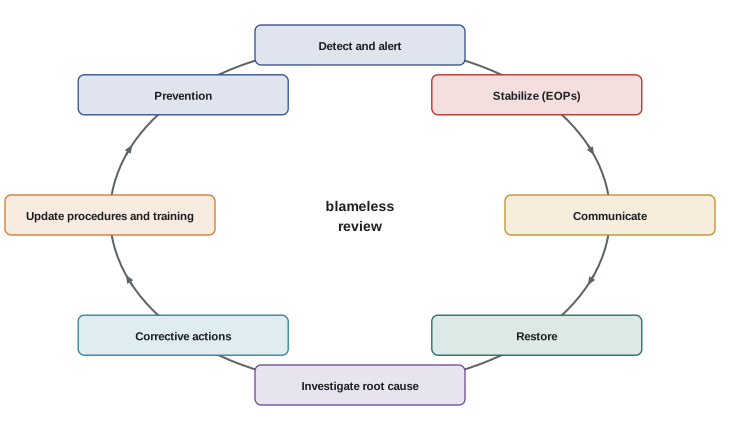
Despite all precautions, incidents happen. Good incident management follows a pattern: detect and alert quickly; stabilize the facility using EOPs; communicate with customers and management; restore normal operation; and then investigate. A root cause analysis (RCA) looks beyond the immediate cause (for example, a technician opened the wrong breaker) to the conditions that allowed it (unclear labeling, a missing step in the MOP, fatigue, time pressure, a confusing design) and recommends changes that prevent recurrence. Blameless post-incident reviews, borrowed from aviation and software operations, encourage people to report mistakes and near misses honestly.
Uptime Institute's annual outage analyses have found that power problems remain the most common cause of significant on-site outages, that a large majority of operators believe their most recent serious outage was preventable, and that failures to follow procedures and flawed procedures are leading contributors to human-error outages. The lesson is consistent: reliability comes from people, processes and culture as much as from equipment.
Upgrades, refreshes and end of life
Over its life, a facility will see several generations of IT equipment and at least one major refresh of electrical and mechanical systems: UPS modules and batteries are replaced every 10 to 15 years (lead-acid batteries every 4 to 8), generators may last 25 years or more, and chillers and cooling units 15 to 25 years. Upgrading equipment in a live facility is among the riskiest work in the industry and is planned with the same care as construction. Many existing facilities are now being retrofitted for liquid cooling and higher densities to host AI equipment, sometimes by converting a hall at a time.
At the end of life, decommissioning includes secure destruction of data-bearing media, recycling of IT equipment, batteries, copper and steel, safe disposal of refrigerants and fuel, and, where possible, reuse of the building and its power connection, which is often the most valuable asset of an old site.
Bringing the course together
A data center is a system in which every part affects every other: the IT equipment sets power and heat (Lesson 2); power flows through redundant electrical chains (Lessons 3 and 4); heat is removed by air and liquid (Lessons 5 and 6); networks connect it to the world (Lesson 7); reliability comes from redundancy and maintainability (Lesson 8); the building protects it (Lesson 9); sustainability shapes its acceptance (Lesson 10); a project brings it into being (Lesson 11); and operations keep it running (this lesson). The remaining courses in the program study each of these systems in depth.
Common mistakes
MistakeSkipping or shortening integrated systems testing to meet a deadline.
InsteadTest under full load with real failure scenarios before going live.
MistakeStaffing a 24/7 post with two or three people.
InsteadPlan about five full-time staff per round-the-clock post.
MistakeDoing critical work without a reviewed MOP.
InsteadScript, review and follow every step, with back-out plans.
MistakeAllowing load to grow until redundancy is silently lost.
InsteadMonitor each path against its redundant capacity.
MistakeEnding an incident review by blaming an individual.
InsteadFind the conditions that allowed the error and fix them.
Summary and key terms
- Integrated systems testing uses load banks and scripted failures to prove the facility before go-live.
- Cooling continuity matters: air alone heats up by degrees per minute at high density.
- Each 24/7 post needs about five full-time staff.
- SOPs, MOPs, EOPs and change management control risk in critical work.
- Maintenance combines preventive, predictive and reliability-centered strategies.
- Availability = MTBF/(MTBF + MTTR); shortening repair time is often easiest.
- DCIM and monitoring track capacity and reveal lost redundancy.
- Root cause analysis and blameless reviews turn incidents into lasting improvements.
- Integrated systems testing
- Commissioning tests of all systems together under load and failure scenarios.
- Load bank
- A device that draws power and produces heat to simulate IT load.
- Full-time equivalent (FTE)
- A unit of staffing equal to one full-time worker.
- Method of procedure (MOP)
- A step-by-step script for work on critical equipment.
- Emergency operating procedure (EOP)
- A tested sequence for responding to failures.
- Predictive maintenance
- Maintenance triggered by measured equipment condition.
- MTBF
- Mean time between failures.
- MTTR
- Mean time to repair.
- DCIM
- Data center infrastructure management software.
- Root cause analysis
- Investigation of the underlying causes of an incident.
Practice problems
Work each problem on paper first, then reveal the answer to check.
Name four scenarios tested in an IST.
Show answer
Utility failure, utility return, component failures, maintenance scenarios, controls.
Load banks of 200 kW for a 3.2 MW hall?
Show answer
16.
Air volume 20,000 m³ with 4 MW and no cooling. Temperature rise per minute?
Show answer
4000/24000 = 0.167 K/s = 10 K/min.
Staff for two 24/7 posts at 1,800 productive hours each?
Show answer
17,520/1,800 = 9.7, so 10.
What does a MOP contain?
Show answer
Steps, checks, expected states, risks and back-out steps.
Give two predictive maintenance techniques.
Show answer
Infrared thermography, vibration analysis, oil analysis, battery impedance testing.
MTBF 100,000 h, MTTR 10 h. Availability?
Show answer
0.9999 (99.99%).
2N sides of 800 kW each carry 450 and 420 kW. Is redundancy intact?
Show answer
No: 870 kW exceeds 800 kW.
What does a root cause analysis look for?
Show answer
The conditions that allowed the error, not just the immediate action.
What is often the most valuable asset of an old data center site?
Show answer
Its power connection.
Lesson quiz · 5 questions
Score 60% or more to complete this lesson.
Create a free account to save your progress, take quizzes and earn a certificate.