
DCE-200 · Lesson 10 of 12 · 35 min
Energy, water and sustainability
Data centers use a growing share of the world's electricity, and in some regions a noticeable share of water, while also enabling services that can save energy elsewhere. Their environmental footprint has become a major issue for communities, regulators, customers and investors, and it increasingly decides whether a project is approved. Lesson 1 introduced power usage effectiveness (PUE) and the scale of data center electricity demand. This lesson looks at the full environmental picture: the metrics used to measure performance, how to reduce energy use at each level, how carbon emissions are counted and reduced, how water is used and saved, how waste heat can be reused, and the embodied impacts of buildings and equipment.
The metrics family
PUE measures facility overhead, but it says nothing about where the energy comes from, how much water is used, or how useful the computing is. The Green Grid and ISO/IEC 30134 define a family of metrics:
- WUE (water usage effectiveness): liters of site water used per kWh of IT energy. Values range from near zero for dry-cooled or closed-loop facilities to about 1.8 L/kWh or more for heavily evaporative designs in hot climates.
- CUE (carbon usage effectiveness): kilograms of CO₂ equivalent emitted per kWh of IT energy, which equals PUE times the carbon intensity of the electricity used.
- ERF (energy reuse factor): the fraction of facility energy reused outside the data center, for example as district heating.
- REF (renewable energy factor): the share of energy from renewable sources.
Each metric captures one aspect; improving one can worsen another. Evaporative cooling lowers PUE but raises WUE; a dry-cooled facility saves water but may use more energy in hot weather.
Worked problem
Comparing two facilities
Facility A has PUE 1.15, WUE 1.6 L/kWh and buys grid power at 0.40 kg CO₂e/kWh. Facility B has PUE 1.30, WUE 0.05 L/kWh and grid power at 0.03 kg CO₂e/kWh. For 100 GWh of IT energy a year, compare total energy, water and emissions.
Show solution
- A: energy \(115\) GWh; water \(1.6 \times 10^8\) L = 160,000 m³; emissions \(115 \times 10^6 \times 0.40 = 46{,}000\) t CO₂e.
- B: energy \(130\) GWh; water \(5{,}000\) m³; emissions \(130 \times 10^6 \times 0.03 = 3{,}900\) t CO₂e.
Answer: Facility A uses 12% less energy, but Facility B uses 97% less water and emits over 90% less carbon because its grid is much cleaner. Location (grid carbon intensity and climate) often matters more than design efficiency. A complete assessment looks at all the metrics together.
Reducing energy at every level
Energy savings multiply through the chain, so savings in IT equipment are the most valuable: every watt saved at the server also saves the cooling and electrical losses attached to it. In order of leverage:
1. Useful work: run software efficiently, schedule workloads well, and avoid idle capacity. For AI, choose model sizes and inference methods appropriate to the task.
2. IT equipment: use efficient servers and accelerators, consolidate workloads through virtualization, retire unused "zombie" servers, and enable power management.
3. Power distribution: reduce conversion stages (Lesson 3), use high-efficiency UPS modes where risk allows, distribute at higher voltages and size transformers to operate near their best efficiency.
4. Cooling: manage airflow well (Lesson 6), raise supply temperatures within ASHRAE guidelines, maximize economizer hours, use liquid cooling with warm water, and use variable-speed fans and pumps.
5. Building: efficient lighting and controls, and good envelope design.
Worked problem
The value of a watt at the server
Retiring 500 unused servers drawing 200 W each saves how much energy a year in a facility with PUE 1.4, and what is it worth at $0.09/kWh?
Show solution
- IT power saved: \(500 \times 0.2 = 100\) kW. Facility power saved: \(100 \times 1.4 = 140\) kW.
- Annual energy: \(140 \times 8760 = 1{,}226{,}400\) kWh, about 1.23 GWh.
- Value: \(1{,}226{,}400 \times 0.09 = \$110{,}000\).
Answer: About 1.23 GWh and $110,000 a year, plus freed capacity for new equipment and avoided maintenance and licenses. Surveys have repeatedly found that a significant share of servers in enterprise data centers do little or no useful work, making this one of the cheapest savings available.
Carbon emissions
Greenhouse gas emissions are counted under the GHG Protocol in three scopes:
- Scope 1: direct emissions from sources the operator owns, mainly diesel burned in generators during testing and outages, and leaks of refrigerants, which can have very high global warming potentials.
- Scope 2: emissions from purchased electricity, usually by far the largest operational source for a data center.
- Scope 3: all other indirect emissions, including the manufacturing of servers and other equipment, construction materials and transport. For efficient facilities on clean grids, scope 3 embodied emissions can exceed operational emissions.
Scope 2 is reported in two ways. The location-based method uses the average carbon intensity of the local grid. The market-based method uses the emissions of electricity the company has contracted for, such as renewable power purchase agreements (PPAs) or renewable energy certificates. Companies increasingly aim for 24/7 carbon-free energy, matching consumption with clean generation every hour in the same grid region, which is more demanding but more meaningful than annual matching (DCE-420).
Grid carbon intensity varies widely across the US, from regions dominated by hydro, nuclear and wind (such as the Pacific Northwest) to regions still relying heavily on coal and gas. Siting and procurement therefore strongly affect a US data center's emissions, and large operators sign PPAs for new wind, solar, geothermal and nuclear capacity.
Worked problem
Generator emissions
A campus has 40 generators of 3 MW. Each is tested monthly for 1 hour at 50% load, burning about 0.27 L of diesel per kWh. Diesel emits about 2.7 kg CO₂ per liter. What are the annual testing emissions?
Show solution
- Energy per test: \(40 \times 3000 \times 0.5 \times 1 = 60{,}000\) kWh; per year \(\times 12 = 720{,}000\) kWh.
- Fuel: \(720{,}000 \times 0.27 = 194{,}400\) L. CO₂: \(194{,}400 \times 2.7 = 525\) t.
Answer: About 525 t of CO₂ a year from testing alone, small compared with scope 2 for a campus of this size but significant locally, along with nitrogen oxides and particulates that air permits limit. Operators reduce this with renewable diesel (hydrotreated vegetable oil), fewer or shorter tests where codes allow, and increasingly battery or gas-based alternatives.
Water
Data centers use water directly, mainly for evaporative cooling (cooling towers and adiabatic coolers), and indirectly, through the water used to generate their electricity. Two quantities should be distinguished: withdrawal (water taken from a source) and consumption (water evaporated or otherwise not returned). Evaporative systems consume roughly 1.5 to 2 liters of water per kWh of heat rejected by evaporation in practice, including blowdown (water drained to control mineral concentration).
Worked problem
Water for evaporative cooling
A 20 MW IT load rejects its heat through cooling towers for 2,000 hours a year, evaporating water. Estimate the water evaporated, and the total with blowdown at 25% of evaporation.
Show solution
- Evaporation rate: \(20{,}000/2400 = 8.3\) kg/s = 30 m³/h.
- Annual: \(30 \times 2000 = 60{,}000\) m³; with blowdown: \(75{,}000\) m³.
Answer: About 75,000 m³ a year, roughly the water use of several hundred households. In water-stressed regions, communities and regulators increasingly scrutinize such use, and many new designs use closed-loop or dry cooling, reclaimed (non-potable) water, or limit evaporation to the hottest hours. Using less water may increase electricity use, and power plants themselves consume water, so the overall balance depends on location.
Water strategies include: dry coolers or air-cooled chillers where climate allows; warm-water liquid cooling that rarely needs evaporation (Lesson 6); hybrid systems that evaporate only on hot days; reclaimed municipal wastewater or captured rainwater; and careful water treatment to reduce blowdown.
Heat reuse
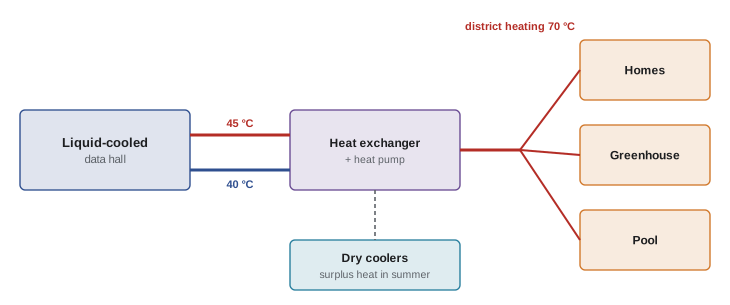
Almost all the energy a data center uses ends up as low-grade heat. Reusing it can displace fossil heating elsewhere. Air-cooled data centers produce heat at 25 °C to 40 °C, usually too cool for direct use without heat pumps; liquid-cooled systems return water at 40 °C to 60 °C, which suits low-temperature district heating, greenhouses, aquaculture or industrial preheating. Heat reuse is common in Nordic countries with district heating networks, and is beginning to appear in North America.
Worked problem
Homes heated by a data center
A 10 MW liquid-cooled data hall supplies 70% of its heat to a district heating network for 5,000 hours a year. A typical home needs about 15 MWh of heat a year. How many homes could be heated?
Show solution
- Heat supplied: \(10 \times 0.7 \times 5000 = 35{,}000\) MWh.
- Homes: \(35000/15 = 2333\).
Answer: About 2,300 homes, if a district heating network exists nearby, and possibly with heat pumps to raise the temperature. The main barriers are distance to heat users, the mismatch between steady data center heat and seasonal heat demand, and contracts between two different industries.
Embodied impacts and circularity
The buildings and equipment themselves carry environmental costs. Concrete and steel account for most of a building's embodied carbon; servers, especially their chips and memory, carry significant manufacturing emissions and use scarce materials. Strategies include:
- Lower-carbon concrete (supplementary cementitious materials such as slag and fly ash), recycled steel and efficient structural design.
- Longer service lives for buildings and infrastructure, designed for adaptation rather than replacement.
- Extending server life where efficiency gains from replacement are small, refurbishing and reusing components, and recycling e-waste responsibly.
- Choosing refrigerants with low global warming potential and preventing leaks.
Measuring and verifying
Metrics are only as good as the measurements behind them. A credible PUE requires metering of total facility energy at the utility connection and of IT energy as close to the IT equipment as practical: at UPS outputs (the simplest, but it counts PDU losses as IT), at PDU outputs, or at the rack or server (the most accurate). The Green Grid describes these as PUE categories of increasing rigor, and ISO/IEC 30134-2 requires the measurement point to be stated. Water metering should separate cooling make-up water, blowdown and domestic use. Annual values are reported, since seasonal variation is large, and trends are tracked monthly to spot problems such as failing economizer controls or leaks.
Worked problem
Where IT energy is measured
A facility measures 10,000 MWh at its utility meters. UPS outputs total 8,200 MWh, and PDU outputs total 7,950 MWh. Compute PUE both ways.
Show solution
- At UPS output: \(10000/8200 = 1.22\).
- At PDU output: \(10000/7950 = 1.26\).
Answer: A PUE of 1.22 or 1.26 for the same facility, depending only on the measurement point. Comparisons between facilities are meaningful only if they measure the same way, which is why reporting rules specify the method.
Reporting and regulation
Disclosure requirements are expanding. The European Union's Energy Efficiency Directive (2023) requires data centers of 500 kW and more to report energy, PUE, water, waste heat and renewable energy to a public database. Some jurisdictions restrict new data centers where grids or water are constrained, or require heat reuse.
In the US, there is no federal data center reporting requirement as of 2026, but states and utilities increasingly set conditions on large new loads, some states require disclosure of energy and water use for incentives, and local governments scrutinize water and noise during approvals.
Large technology companies publish sustainability reports with energy, water and emissions data, and many have committed to carbon-free or carbon-negative goals; independent analysts scrutinize these claims, especially as AI-driven growth has raised some companies' emissions.
Common mistakes
MistakeJudging sustainability by PUE alone.
InsteadConsider WUE, CUE, embodied carbon and heat reuse together.
MistakeFocusing on cooling while ignoring idle IT equipment.
InsteadSavings at the server multiply through PUE; retire zombie servers.
MistakeEquating annual renewable certificates with carbon-free operation.
InsteadHourly, local matching (24/7 CFE) better reflects real emissions.
MistakeAssuming dry cooling is always better.
InsteadWeigh water savings against energy use and local grid emissions.
MistakeIgnoring scope 3 emissions.
InsteadEmbodied emissions of equipment and buildings can dominate on clean grids.
Summary and key terms
- PUE, WUE, CUE, ERF and REF each measure one aspect of environmental performance.
- Energy savings at the IT level multiply through cooling and power losses.
- Emissions are counted in scopes 1, 2 and 3; location matters greatly through grid carbon intensity.
- 24/7 carbon-free energy matches clean supply hourly in the same region.
- Evaporative cooling consumes water; alternatives trade water for energy.
- Liquid cooling makes heat reuse practical for district heating and other users.
- Embodied carbon in buildings and equipment and disclosure rules are growing concerns.
- WUE
- Water usage effectiveness: liters of site water per kWh of IT energy.
- CUE
- Carbon usage effectiveness: kg CO₂e per kWh of IT energy.
- ERF
- Energy reuse factor: share of energy reused outside the facility.
- Scope 2 emissions
- Emissions from purchased electricity.
- Location-based method
- Scope 2 accounting using average local grid intensity.
- Market-based method
- Scope 2 accounting using contracted electricity sources.
- 24/7 carbon-free energy
- Matching consumption with clean generation every hour locally.
- Water consumption
- Water evaporated or not returned to its source.
- Blowdown
- Water drained from cooling towers to limit mineral concentration.
- Embodied carbon
- Emissions from producing materials and equipment.
Practice problems
Work each problem on paper first, then reveal the answer to check.
PUE 1.25 and grid intensity 0.5 kg/kWh. CUE?
Show answer
0.625 kg CO₂e per IT kWh.
WUE 1.2 L/kWh and 50 GWh of IT energy. Water?
Show answer
60,000 m³.
Why are savings at the server most valuable?
Show answer
They also save the cooling and power losses attached to each watt.
200 zombie servers at 150 W, PUE 1.5. Annual energy saved?
Show answer
45 kW × 8760 = 394 MWh.
Which scope covers generator diesel?
Show answer
Scope 1.
What does the market-based method use?
Show answer
Emissions of contracted electricity such as PPAs and certificates.
Evaporation rate to reject 5 MW?
Show answer
5000/2400 = 2.08 kg/s, about 7.5 m³/h.
Why does liquid cooling help heat reuse?
Show answer
It returns water at 40 °C to 60 °C, warm enough for district heating.
5 MW with 60% reuse for 4,000 h; homes at 12 MWh each?
Show answer
12,000 MWh / 12 = 1,000 homes.
Name two ways to reduce embodied carbon in data centers.
Show answer
Lower-carbon concrete, recycled steel, longer equipment life, refurbishing.
Lesson quiz · 5 questions
Score 60% or more to complete this lesson.
Create a free account to save your progress, take quizzes and earn a certificate.