
CRE-460 · Lesson 9 of 12 · 30 min
Payments, currency and payouts
International audiences and partners mean money moving across borders and between currencies. Platform payouts may be calculated in US dollars, sponsors may pay in euros or yen, members may pay in pesos or rupees, and every conversion and transfer can lose a slice to fees and exchange-rate spreads. Small percentages add up: a creator who loses 3 % on every conversion gives away a month's income every few years. This lesson explains how platform payouts work across borders, how currency conversion costs are hidden in exchange rates, how to choose between banks and specialist payment services, how to accept payments from international fans and customers, and what sanctions rules mean for creators. Provider features and fees change often; treat any figures as illustrative and check current terms.
How platform payouts work across borders
Platforms pay creators through their own payment systems, usually monthly once earnings pass a threshold. Many calculate earnings in US dollars and then pay in the creator's local currency, converting at an exchange rate the platform or its payment provider sets; others pay in US dollars and leave conversion to the creator's bank. Payment methods, thresholds and timing differ by platform and by the creator's country. The creator usually needs a bank account in their own name in their country of residence, verified identity and completed tax information, which lesson 10 covers. Views from abroad do not usually mean payments from abroad: the platform pays the creator in their home country, even when the audience is international.
| Revenue source | Who pays you | Typical currency issue |
|---|---|---|
| Platform ads and creator funds | The platform, in your country | Earnings often calculated in US dollars and converted at the platform's rate |
| Memberships and fan tips on platforms | The platform, after its share | Fans pay in their currency; the platform converts and pays you |
| Direct sponsorships | The brand or agency | Paid in the currency in the contract, often the brand's |
| Your own store, courses or memberships | Customers through your payment processor | Customers pay in their currency; the processor converts or settles in yours |
| Licensing and other deals | The licensee | Contract currency, possibly with withholding tax |
The hidden cost of currency conversion
Currency conversion has two costs. The visible one is an explicit fee, such as a flat wire fee or a percentage charge. The hidden one is the spread: the difference between the mid-market exchange rate, the midpoint between buying and selling rates that you see on financial news sites, and the rate the bank or service actually gives you. Traditional banks often build a spread of 2 % to 3 % or more into consumer conversions, while specialist money-transfer and multi-currency account services often charge a smaller explicit fee on a rate close to mid-market. Always compare the total amount received, not the advertised fee.
Worked problem
Comparing a bank with a specialist service
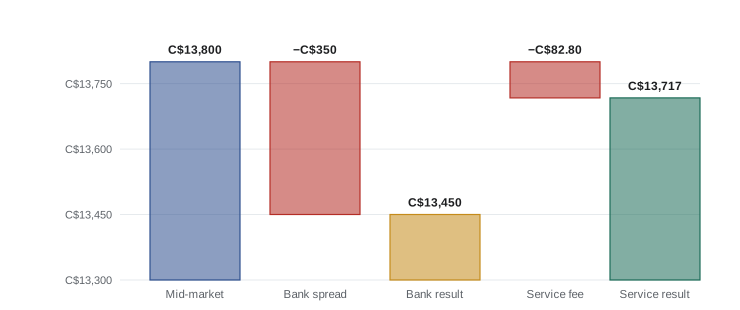
A creator converts US$10,000 when the mid-market rate is US$1 = C$1.38. Their bank offers C$1.345 with no explicit fee. A specialist service offers the mid-market rate with a 0.6 % fee. How much does each deliver, and what is the difference?
Show solution
- Bank: \( 10{,}000 \times 1.345 = \text{C}\$13{,}450 \).
- Specialist: \( 10{,}000 \times 1.38 = \text{C}\$13{,}800 \); fee \( 13{,}800 \times 0.006 = \text{C}\$82.80 \); delivered \( \text{C}\$13{,}717.20 \).
- Difference: \( 13{,}717.20 - 13{,}450 = \text{C}\$267.20 \).
- Bank's implied spread: \( 1 - 1.345 / 1.38 \approx 2.5 \% \).
Answer: The specialist service delivers about C$267 more on US$10,000. The bank charges no visible fee, but its rate hides a spread of about 2.5 %. Over a year of monthly conversions of this size, the difference would be about C$3,200.
Holding foreign currency
A creator who regularly earns and spends in another currency may not need to convert at all. A US-dollar account at a Canadian bank, or a multi-currency account at a specialist provider, lets a Canadian creator receive US dollars from platforms or sponsors and pay US-dollar expenses, such as software subscriptions, equipment from US suppliers or US contractors, without converting back and forth. Converting only the surplus, and choosing when to do so, reduces costs and gives some control over exchange-rate timing. US creators earning euros or pounds can do the same with multi-currency accounts.
For US creators, holding foreign currency is useful when they have regular income or expenses in euros, pounds or Canadian dollars. Keep in mind that for US tax purposes, income received in foreign currency must be reported in US dollars, generally at the exchange rate when received or an appropriate average, and large foreign accounts can trigger reporting requirements such as the FBAR. Lesson 10 and an accountant can help.
Worked problem
Natural hedging with a foreign-currency account
A Canadian creator earns US$4,000 a month and spends US$1,500 a month on US software, equipment and contractors. If they converted all income to Canadian dollars and then bought US dollars back for expenses, both conversions would lose about 2.5 %. How much a month does holding a US-dollar account save, converting only the surplus?
Show solution
- Without the account: convert US$4,000 (lose \( 4{,}000 \times 0.025 = \text{US}\$100 \)) and buy back US$1,500 (lose about \( 1{,}500 \times 0.025 = \text{US}\$37.50 \)). Total about US$137.50.
- With the account: convert only the surplus \( 4{,}000 - 1{,}500 = \text{US}\$2{,}500 \), losing \( 2{,}500 \times 0.025 = \text{US}\$62.50 \).
- Saving: \( 137.50 - 62.50 = \text{US}\$75 \) a month, about US$900 a year.
Answer: Holding US dollars saves about US$75 a month, or US$900 a year, before any further saving from a cheaper conversion service. Matching foreign income with foreign expenses is called natural hedging.
Accepting payments from international fans and customers
When creators sell their own products, courses, memberships or tickets, they need payment methods that work for international customers. Card payments through major processors work in most countries, but card use varies: in many markets, customers prefer local methods such as real-time bank payments, digital wallets or bank transfers. Examples include Pix in Brazil, UPI in India, iDEAL in the Netherlands, SEPA transfers across the euro area, and Alipay and WeChat Pay in China. Offering the methods your target market uses can raise conversion significantly; checkout pages that show prices in the customer's currency also help.
| Market | Common local payment methods | Note |
|---|---|---|
| Brazil | Pix instant payments, cards, boleto | Pix has become extremely widespread for everyday payments |
| India | UPI, cards, wallets | UPI dominates digital payments |
| Euro area | Cards, SEPA transfers, local methods such as iDEAL (Netherlands) | Strong customer authentication rules apply to many online card payments |
| China | Alipay, WeChat Pay | Foreign merchants usually need a partner or processor that supports them |
| Mexico | Cards, OXXO cash vouchers, bank transfers | Cash-based vouchers remain common for online purchases |
Payment processors charge fees that are often higher for international cards and currency conversion. A typical structure includes a percentage and fixed fee per transaction, an extra percentage for international cards, and another for converting currency. Prices also need to account for taxes in the customer's country, such as VAT on digital products sold to consumers in the EU or UK, which lesson 10 covers.
Worked problem
Processor fees on an international sale
A creator sells a digital course for US$100 to a customer in Germany. The processor charges (illustratively) 2.9 % plus US$0.30, an additional 1.5 % for international cards, and 1 % for currency conversion. What does the creator receive before taxes?
Show solution
- Percentage fees: \( 2.9 \% + 1.5 \% + 1 \% = 5.4 \% \) of US$100 = US$5.40.
- Fixed fee: US$0.30. Total fees: US$5.70.
- Received: \( 100 - 5.70 = \text{US}\$94.30 \).
Answer: The creator receives about US$94.30 before any VAT due, compared with about US$96.80 on a domestic card sale. International fees are worth knowing when setting prices and choosing processors.
Chargebacks, where a customer disputes a card payment through their bank, can be more common and harder to contest internationally. Clear product descriptions, receipts in the customer's language, and fast customer support reduce disputes. Some regions also have strong consumer rights for digital purchases, such as the EU's withdrawal rules, which lesson 11 mentions.
Sanctions and restricted countries
Sanctions are legal restrictions on dealing with certain countries, organizations and individuals. They can prohibit receiving payments from, sending payments to, or providing services to sanctioned parties, and banks and payment services screen transactions to comply. A creator who sells to customers or works with partners in sanctioned countries, or with sanctioned individuals, can face blocked payments, closed accounts and legal penalties.
In the US, sanctions are administered mainly by the Treasury Department's Office of Foreign Assets Control (OFAC), which maintains the Specially Designated Nationals list and country-based programs. US creators should check OFAC lists before entering deals with partners in higher-risk countries, and should expect payment providers to block transactions involving sanctioned parties.
Sanctions regimes change frequently and differ between countries; Russia, Iran, North Korea, Syria and certain regions of Ukraine have been subject to extensive measures, and lists of designated individuals change constantly. If a deal involves a higher-risk country, check the current government guidance and consider legal advice before agreeing.
Keeping records and choosing providers
Good records make taxes, disputes and planning easier. For every international payment, keep the contract or order, the invoice, the amount and currency, the date received, the exchange rate and fees, and any tax withheld. Most payment services provide statements; download and store them regularly. When choosing a bank or payment service, compare total costs on typical amounts, supported currencies, how quickly money arrives, whether you can hold balances, how the provider handles disputes, and whether it is properly regulated in your country.
Worked problem
Annual cost of conversion choices
A creator converts the equivalent of US$60,000 a year. Option A is a bank with a 2.5 % spread; option B is a specialist with a 0.6 % fee on the mid-market rate; option C holds US$20,000 of that income in a US-dollar account for US expenses and converts the remaining US$40,000 with option B. What does each cost a year?
Show solution
- A: \( 60{,}000 \times 0.025 = \text{US}\$1{,}500 \).
- B: \( 60{,}000 \times 0.006 = \text{US}\$360 \).
- C: \( 40{,}000 \times 0.006 = \text{US}\$240 \).
Answer: Costs fall from about US$1,500 a year with the bank, to US$360 with the specialist, to US$240 by also holding US dollars for US expenses. The choice of provider is one of the simplest ways to keep more of international income.
Common mistakes
MistakeComparing providers only on their advertised fee.
InsteadCompare the total amount received, including the spread hidden in the exchange rate.
MistakeConverting every foreign payment immediately and buying it back later.
InsteadHold foreign currency for foreign expenses and convert only the surplus.
MistakeOffering only card payments to every market.
InsteadAdd the local payment methods your target markets use.
MistakeIgnoring international processor fees when setting prices.
InsteadInclude international card and conversion fees, and taxes, in pricing.
MistakeDealing with partners in higher-risk countries without checks.
InsteadCheck current sanctions lists and guidance before agreeing.
Summary and key terms
- Platforms usually pay creators in their home country, often converting US-dollar earnings at their own rate.
- Conversion costs include visible fees and a hidden spread from the mid-market rate.
- Specialist services often deliver more than banks by charging a small fee on a near mid-market rate.
- Holding foreign currency for foreign expenses, natural hedging, reduces conversions.
- International customers often prefer local payment methods such as Pix, UPI, iDEAL, SEPA, Alipay and WeChat Pay.
- International card and currency fees reduce the amount received and should inform prices.
- Sanctions can block payments; check government lists before dealing with higher-risk countries.
- Mid-market rate
- The midpoint between buying and selling rates for a currency pair.
- Spread
- The difference between the mid-market rate and the rate a provider gives you.
- Multi-currency account
- An account that can hold balances in several currencies.
- Natural hedging
- Matching income and expenses in the same foreign currency to avoid conversions.
- Payout threshold
- The minimum balance a platform requires before paying.
- Payment processor
- A company that handles card and other payments for a seller.
- Chargeback
- A reversal of a card payment after a customer disputes it with their bank.
- Local payment method
- A payment method popular in a particular country, such as Pix or UPI.
- Sanctions
- Legal restrictions on dealing with certain countries, organizations or people.
- OFAC
- The US Treasury's Office of Foreign Assets Control, which administers US sanctions.
Practice problems
Work each problem on paper first, then reveal the answer to check.
Name the two costs of currency conversion.
Show answer
An explicit fee and the spread from the mid-market rate.
Mid-market 1.40, rate received 1.365. Implied spread?
Show answer
About 2.5 %.
US$5,000 at mid-market 1.38 with a 0.5 % fee. Delivered?
Show answer
C$6,865.50.
What is natural hedging?
Show answer
Matching foreign income with foreign expenses to avoid converting back and forth.
Name three local payment methods and their countries.
Show answer
Pix (Brazil), UPI (India), iDEAL (Netherlands); also Alipay and WeChat Pay (China).
US$50 sale with 4.4 % fees plus US$0.30. Received?
Show answer
US$47.50.
What is a chargeback?
Show answer
A reversal of a card payment after the customer disputes it with their bank.
Which US agency administers sanctions?
Show answer
OFAC, the Office of Foreign Assets Control.
Name four records to keep for each international payment.
Show answer
Contract or order, invoice, amount and currency, date, exchange rate and fees, tax withheld.
US$30,000 a year at a 2.5 % spread. Annual cost?
Show answer
US$750.
Lesson quiz · 5 questions
Score 60% or more to complete this lesson.
Create a free account to save your progress, take quizzes and earn a certificate.