
CRE-450 · Lesson 11 of 12 · 30 min
Working with brands on family and sensitive content
Sponsorships are central to many family, parenting and wellbeing channels, and brands in these categories are among the most cautious advertisers. They want to reach parents and families, but they also face strict advertising rules for children, scrutiny from regulators and parents, and reputational risk if a creator's content goes wrong. This lesson covers advertising rules for content aimed at children, brand safety and suitability for sensitive topics, child welfare in sponsored productions, contract terms that protect children and audiences, and how to negotiate with brands while keeping your standards. CRE-310 and CRE-340 covered brand partnerships in general, and CRE-320 covered disclosure law; this lesson focuses on the extra layer that applies when children or sensitive topics are involved.
Why children's advertising is treated differently
Research on child development suggests that younger children have difficulty recognizing advertising and understanding its persuasive intent. Children under about 7 or 8 often cannot reliably tell ads from content, and even older children find it hard to recognize advertising that is blended into entertainment, such as an influencer's unboxing video. For this reason, advertising rules and codes in both countries go further for children than for adults, and influencer content aimed at children gets particular scrutiny.
Advertising rules for child audiences
| Rule or code | Who it covers | Key points |
|---|---|---|
| FTC Act and Endorsement Guides (2023) | All advertising, including influencer content | Disclosures must be clear to the audience; the FTC has noted children may need simpler, more prominent disclosure |
| CARU Self-Regulatory Guidelines for Advertising | Advertising directed at children under 13 | Updated in 2022 with influencer guidance: clear disclosure children can understand, no blurring of ads and content, care with pressure and fantasy |
| COPPA | Data collection from children under 13 | Limits targeted advertising and requires parental consent for data collection |
| Platform ad and paid promotion policies | Paid content on each platform | Some platforms prohibit paid promotions in content made for kids |
In practice, the main requirements for sponsored content aimed at children are disclosure that children can actually understand, avoiding pressure tactics such as urging children to ask their parents, and following COPPA and platform rules. CARU, part of BBB National Programs, reviews complaints and publicizes cases, and the FTC can take action for unfair or deceptive practices.
Disclosure that children understand
A disclosure that works for adults may not work for children. A tiny "#ad" in a description, or a disclosure at the end of a video, will not be noticed or understood by a young viewer. Good practice for content children may watch includes saying aloud at the start, in simple words, that the video is paid for or that the product was given by the company, showing a clear on-screen label, using the platform's paid promotion tool and repeating the disclosure in longer videos. Words such as "This video is an ad" or "A company paid us to make this video" are clearer for children than "sponsored" or "in partnership with".
Worked problem
Checking disclosure timing in a long video
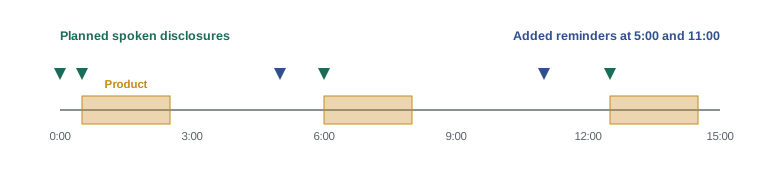
A 15-minute unboxing video, likely to be watched by children, is sponsored. The creator plans a spoken disclosure at the start and repeats it every time the product appears prominently. The product is featured at 0:30, 6:00 and 12:30. A guideline says a spoken disclosure should be repeated at least every 5 minutes while the product is featured. Does the plan meet it?
Show solution
- Spoken disclosures at the start (0:00) and at each featured segment: 0:30, 6:00, 12:30.
- Gaps between disclosures: 0:30 to 6:00 is 5.5 minutes; 6:00 to 12:30 is 6.5 minutes.
- Both gaps exceed 5 minutes, so add disclosures around 5:00 and 11:00, or keep an on-screen label visible throughout.
Answer: The plan falls short. Adding two spoken reminders or a persistent on-screen label meets the guideline. Clear, repeated disclosure matters more for children than adults.
Brand safety and suitability for sensitive topics
Brand safety refers to avoiding content that almost no advertiser would want to appear beside, such as hate speech or graphic violence. Brand suitability is more nuanced: whether content suits a particular brand's values and audience. Many advertisers use frameworks that classify sensitive topics, such as mental health, death, crime and disasters, by risk level. Content about these topics is not automatically unsuitable; thoughtful, educational content about mental health may suit a wellness brand well, while sensational content does not.
Creators who cover sensitive topics can help brands by being transparent: tagging sensitive videos clearly, offering brands the option to avoid them, and explaining their safe-messaging and editorial standards. Some creators keep sponsorships off their most sensitive content, such as a video about a personal loss, to avoid any impression of profiting from it.
Worked problem
Scoring brand suitability
A creator rates each video on three factors from 0 (low) to 2 (high): sensitivity of the topic, intensity of treatment, and likely share of young viewers. A family snack brand accepts videos scoring 2 or less in total. Which of these fit: (a) a cooking video with the kids (0, 0, 2), (b) a calm video about the creator's anxiety (2, 1, 0), (c) a video about a family pet dying (2, 2, 1)?
Show solution
- (a) Total 2: fits. Note: the high share of young viewers means the snack brand must follow children's advertising and food marketing rules.
- (b) Total 3: does not fit this brand; might suit a mental health app that follows safe-messaging standards.
- (c) Total 5: should not carry sponsorship.
Answer: Only (a) fits the snack brand's threshold, and even then children's advertising rules apply. Scoring makes suitability decisions transparent for both sides.
Children on sponsored sets
When a brand sponsors content featuring children, the production is work, and the welfare of the children should be part of planning, whether or not child performer laws strictly apply. Many responsible brands now ask creators to follow child welfare standards modeled on those in the entertainment industry.
- Limit working hours, schedule breaks and avoid filming during school hours or late at night.
- Have a parent or guardian present, and never leave children alone with crew they do not know.
- Get the child's assent and stop if the child is unwilling or distressed.
- Avoid scripts that pressure children to praise a product they do not like, which is also a truthfulness issue.
- Pay the required share into a Coogan or trust account where state law requires it, and set aside part voluntarily elsewhere.
Worked problem
Planning a child's hours on a sponsored shoot
A brand wants a sponsored shoot with a 9-year-old. The creator's policy, modeled on child performer rules, allows at most 4 hours on set per day for this age, including at least a 15-minute break every hour of work, with filming time counted inside the 4 hours. How much actual filming time is possible in one day?
Show solution
- 4 hours on set includes breaks: in each hour, 15 minutes is break, leaving 45 minutes of work.
- Working time: \( 4 \times 45 = 180 \) minutes, or 3 hours.
- If setup, wardrobe and rehearsal take a third of working time, filming time is about 2 hours.
Answer: About 2 hours of actual filming. A brand asking for a full-day shoot with a young child should expect the work to be split over several days.
Contract terms that protect children and audiences
Contracts for family and sensitive content should address responsibility explicitly, not leave it to goodwill.
| Clause | Purpose |
|---|---|
| Child welfare standards | Hours, breaks, supervision and the right to stop filming |
| Earnings set-aside | A share of fees attributable to the child goes to the child's account |
| Approval and editorial control | Creator keeps final say over how children are shown and over sensitive content |
| Disclosure obligations | Clear, child-appropriate disclosure using platform tools |
| Usage limits | Limits on how long and where the brand can use images of children |
| Removal rights | Right to take down content featuring a child if the child later objects |
| Sensitive content opt-out | Brand ads or mentions will not appear on specified sensitive videos |
Usage limits deserve particular attention. A brand that licenses images of a child for a short social campaign should not be able to use them in billboards or for years without further agreement. Short, specific licenses, as CRE-310 explained, protect the child as well as the creator's negotiating position.
Worked problem
Allocating a sponsorship fee to children
A family channel is paid $6,000 for a sponsored video. Analysis shows two children appear for 40 % and 20 % of the video's running time. The family follows the Illinois approach of setting aside half the percentage featured for each child. How much goes to each child?
Show solution
- Child A: half of 40 % = 20 %; \( 0.20 \times 6{,}000 = 1{,}200 \).
- Child B: half of 20 % = 10 %; \( 0.10 \times 6{,}000 = 600 \).
- Total set aside: $1,800, leaving $4,200 to the business.
Answer: $1,200 for child A and $600 for child B. Where a law applies, its exact rules for dividing between children govern; otherwise a consistent voluntary formula is good practice.
Saying no and negotiating standards
Creators with clear standards sometimes have to decline briefs that ask for content they consider harmful, such as pranks on children, weight-loss claims or monetizing a tragedy. Explaining the reason professionally, and offering an alternative that fits, often preserves the relationship. Many brands appreciate creators who protect them from risks they had not considered. Publishing a short responsible content policy, which the capstone lesson builds, makes these conversations easier and attracts brands with similar values.
Briefs that respect children and audiences
Many problems can be prevented at the briefing stage. When a brand sends a brief for family content, check it against your policy before agreeing: who is the intended audience, what would the children be asked to do or say, what claims are involved, how will the content be disclosed and how long will the brand use it. Suggest changes early, when they are easiest to make, and put agreed standards in writing in the contract rather than relying on verbal assurances.
Finally, document what was agreed. Keep the brief, the approved script, the disclosure plan and the signed contract together, so that if questions arise later about how children were treated or how content was disclosed, the record is clear.
Common mistakes
MistakeUsing adult-style disclosure in content children watch.
InsteadUse simple spoken disclosure at the start, on-screen labels and repeats in long videos.
MistakeIgnoring CARU guidelines for content aimed at children under 13.
InsteadFollow CARU guidance on clear disclosure and avoiding pressure and blurred ads.
MistakeScripting children to praise products they do not like.
InsteadLet children react honestly or keep them out of endorsements.
MistakeAgreeing to unlimited usage of children's images.
InsteadGrant short, specific licenses with limits on time and media.
MistakeSponsoring content about personal tragedy.
InsteadKeep sponsorship off the most sensitive content or offer brands an opt-out.
Summary and key terms
- Children find it hard to recognize advertising, so rules for child audiences go further.
- CARU guidelines and the FTC govern advertising to children under 13, alongside COPPA and platform rules.
- Disclosure for children should be spoken, simple, early, labeled on screen and repeated.
- Brand suitability for sensitive topics depends on treatment, not just topic.
- Children on sponsored sets need limited hours, breaks, supervision and the right to stop.
- Contracts should cover welfare, set-asides, editorial control, disclosure, usage limits and removal.
- Clear standards help creators decline harmful briefs and attract aligned brands.
- Persuasive intent
- The aim of advertising to influence the viewer.
- Brand suitability
- Whether content fits a particular brand's values and audience.
- CARU
- The Children's Advertising Review Unit, a US self-regulatory body.
- Broadcast Code for Advertising to Children
- A Canadian industry code for broadcast advertising to children under 12.
- Paid promotion tool
- A platform feature for labeling sponsored content.
- Usage license
- Permission for a brand to use content in specified ways and for a set time.
- Removal right
- A contractual right to take down content in specified circumstances.
- Child welfare standards
- Rules protecting children's wellbeing during productions.
- Sensitive content opt-out
- A brand's choice not to appear with specified sensitive content.
- Pressure tactic
- An advertising technique urging viewers, especially children, to act or ask parents.
Practice problems
Work each problem on paper first, then reveal the answer to check.
Why are children treated differently in advertising?
Show answer
They have difficulty recognizing ads and understanding persuasive intent.
Which US body sets self-regulatory guidelines for advertising to children?
Show answer
CARU, part of BBB National Programs.
Give an example of child-friendly disclosure wording.
Show answer
"A company paid us to make this video."
Featured at 1:00, 8:00 and 14:00 with a 5-minute repeat rule. Is it met?
Show answer
No; gaps of 7 and 6 minutes need extra disclosures or a persistent label.
What is the difference between brand safety and suitability?
Show answer
Safety avoids content almost no advertiser wants; suitability is fit for a specific brand.
Scores 1, 1, 1 with a threshold of 2. Does it fit?
Show answer
No; the total is 3.
6 hours on set, 15-minute break each hour. Working time?
Show answer
6 × 45 = 270 minutes, 4.5 hours.
Name three contract clauses for family content.
Show answer
Welfare standards, set-aside, editorial control, disclosure, usage limits, removal rights, opt-out.
$5,000 fee; a child appears 60 % of the time. Illinois-style set-aside?
Show answer
30 %, or $1,500.
Why limit usage of children's images?
Show answer
To prevent long or broad use the child never agreed to and to protect negotiating position.
Lesson quiz · 5 questions
Score 60% or more to complete this lesson.
Create a free account to save your progress, take quizzes and earn a certificate.