
CRE-430 · Lesson 5 of 12 · 27 min
Anatomy of a controversy
Controversies can feel chaotic from the inside, but most follow recognizable patterns. A trigger event happens, it spreads through networks of attention, it reaches audiences who did not know the creator, other voices add commentary, partners and media react, and eventually attention moves elsewhere, leaving consequences behind. Understanding these stages helps creators make better decisions: when speed matters most, when silence is risky, when a response will only add fuel, and when the most important work is happening offline with partners and the people affected. This lesson describes the typical life cycle and uses composite examples, built from common patterns rather than real people, to illustrate it.
The life cycle of a controversy
Researchers and communication professionals describe crisis life cycles in different ways, but a practical model for creators has six stages.
- Trigger: a piece of content, a revelation, an allegation or an incident starts the issue.
- Ignition: the first people to notice share it, often within niche communities or among critics.
- Spread: the issue jumps to larger audiences through reposts, quote posts, response videos and recommendation algorithms.
- Peak: attention reaches its highest point, often when commentary channels, other creators or media join in.
- Decline: attention falls as new topics take over, though interest may flare again with new developments.
- Aftermath: lasting effects on income, partnerships, audience trust and search results remain long after attention fades.
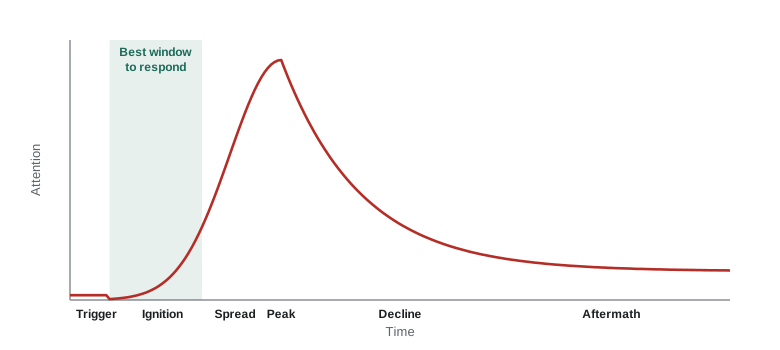
The stages are not equally long. Ignition to peak can take hours for a dramatic clip or weeks for a slow-building issue such as an investigation into a product. The aftermath can last years, especially in search results, where articles and commentary videos continue to appear when people search the creator's name.
How issues spread
Online controversies spread because each share exposes the issue to a new audience, and some members of that audience share it further. Early growth is often roughly exponential: the number of people discussing the issue multiplies over each period, rather than adding a fixed amount. This is why an issue can seem small in the morning and enormous by evening.
Worked problem
How quickly a controversy can grow
A clip has 500 mentions at 9 a.m. Mentions are doubling every two hours. Assuming this continues, how many mentions will there be at 5 p.m., and at what time will mentions first exceed 10,000?
Show solution
- Hours from 9 a.m. to 5 p.m.: 8, which is 8 ÷ 2 = 4 doubling periods.
- Mentions at 5 p.m.: 500 × 2⁴ = 500 × 16 = 8,000.
- One more doubling, at 7 p.m.: 8,000 × 2 = 16,000.
- 10,000 is first exceeded between 5 p.m. and 7 p.m.; solving 500 × 2^(t/2) = 10,000 gives t = 2 × log₂(20) ≈ 8.6 hours, about 5:40 p.m.
Answer: About 8,000 mentions by 5 p.m., passing 10,000 at roughly 5:40 p.m. In practice growth slows as the issue saturates its audiences, but the example shows why the first few hours matter so much.
Exponential growth does not continue forever. Every issue eventually saturates: the people likely to care have seen it, and new topics compete for attention. But the early window, while the issue is still in ignition or early spread, is when a creator has the most influence over the story, because their response can reach audiences before other people's interpretations become fixed.
Pile-ons and context collapse
A pile-on happens when large numbers of people direct criticism at one person at the same time, often far out of proportion to what they did. Pile-ons are driven partly by context collapse: content made for one audience, with shared jokes, history and assumptions, is seen by a completely different audience that lacks that context. A sarcastic remark understood by long-time viewers can look sincere and offensive to strangers seeing a ten-second clip.
Pile-ons often include a mix of legitimate criticism, misunderstanding, opportunistic attention-seeking and harassment. Responding well means separating these strands: acknowledging fair criticism, correcting factual misunderstandings calmly, ignoring bad-faith attacks, and protecting yourself and your team from harassment, which CRE-350 covers.
| Strand | What it looks like | Useful response |
|---|---|---|
| Legitimate criticism | Specific, accurate concerns about harm or wrongdoing | Listen, acknowledge and act |
| Misunderstanding | Reactions based on missing context or edited clips | Calmly share full context and facts |
| Bad-faith attacks | Deliberate distortion, often from people who dislike you anyway | Usually do not engage directly |
| Harassment | Threats, abuse, doxxing, coordinated targeting | Protect, document, report and get support |
| Opportunism | Others using the moment for views or attention | Do not feed it; focus on the substance |
Amplifiers
Certain participants dramatically increase a controversy's reach.
- Commentary and drama channels: creators who make videos about other creators' controversies, often reaching millions of viewers.
- Larger creators and public figures: a single quote post from a big account can expose an issue to a new audience.
- Media outlets: articles legitimize the issue and make it searchable for years.
- Brands: a sponsor publicly ending a partnership signals seriousness to everyone else.
- Platforms: visible enforcement, such as demonetization or removal, becomes part of the story.
Each amplifier also creates an opportunity. Commentary channels and journalists often contact the creator for comment before publishing. A clear, honest response at that point can shape how the story is told. Lesson 8 covers working with media and brands during a crisis.
Composite case patterns
The following composites combine features of many real situations without describing any real person.
Composite A, the old clip. A gaming streamer with a large young audience is found to have made repeated insulting jokes about a minority group in streams from seven years ago. A critic compiles the clips into a two-minute video. Within a day, commentary channels pick it up and two sponsors pause campaigns. The streamer's first response, posted that night, says people should stop digging up the past. Criticism grows. Three days later the streamer posts a longer apology acknowledging the specific jokes, explaining what changed in their understanding, donating to a relevant organization, and committing to a content review. Attention declines within two weeks; one sponsor returns after three months, the other does not.
Composite B, the product failure. A lifestyle creator launches a skincare line with heavy promotion. Customers begin reporting skin reactions. The creator initially deletes critical comments and blames customers for misuse. A consumer journalist investigates and finds the product claims were not supported. The story spreads widely. Retailers drop the product, and the creator eventually offers full refunds and pauses the brand, but the deleted comments become a central part of the story.
Composite C, the misunderstanding. A cooking creator's ten-second clip appears to show them mocking a regional dish. In the full video, the line is clearly self-deprecating and the creator praises the dish. The clip spreads among people who never saw the full video. The creator posts the full context calmly, without attacking critics, and many people who shared the clip correct themselves. Attention fades in two days with little lasting damage.
The patterns are instructive: dismissive first responses and suppressing criticism tend to escalate issues, while specific accountability, real action and calm sharing of facts tend to help. Lesson 7 examines apologies in detail.
When attention fades but consequences remain
Creators sometimes treat the end of public attention as the end of the crisis. It is not. In the aftermath, sponsors make renewal decisions, search results continue to show coverage, platform enforcement may still be under appeal, and the people directly affected may still be dealing with harm. Lesson 11 covers long-term repair. The key point here is that a controversy's life cycle continues well past the peak, and the work done in the quiet weeks afterwards often determines the final outcome.
Reading the stage you are in
Recognizing the current stage helps choose the right action. During ignition, the priority is understanding and preparing, because there may still be time to address the issue directly with the people raising it. During spread and peak, a clear public response, coordinated with partners, matters most. During decline, avoid reigniting the story with unnecessary posts, while continuing the substantive work you committed to. In the aftermath, focus on keeping commitments, rebuilding relationships and measuring recovery.
The role of the creator's own community
A creator's community can help or hurt during a controversy. Loyal fans often rush to defend the creator, which can be comforting but also dangerous. Defensive fans may attack critics, dig up information about them or flood their comments, turning a disagreement into harassment and making the creator look responsible for their audience's behavior. Creators should ask their communities clearly not to harass anyone, including critics, and moderators should enforce that request in the creator's own spaces.
Communities can also be a source of honest feedback. Long-time members who raise concerns respectfully often see problems before outsiders do. Creators who listen to them, rather than dismissing every concern as disloyalty, catch issues while they are still small.
Old controversies resurfacing
Controversies rarely disappear completely. An issue that faded years ago can return when a creator reaches a new milestone, announces a big partnership, or becomes the subject of a commentary video. Resurfacing is more likely if the original issue was never addressed. A creator who apologized clearly and kept commitments can point to that record; a creator who stayed silent will face the original questions again, often with an added question of why they never responded.
Worked problem
Estimating peak timing
An issue starts with 1,000 mentions at noon and grows 50 % every hour. Saturation means growth will stop once mentions reach about 30,000 per hour. Roughly when will the peak arrive?
Show solution
- Each hour, mentions multiply by 1.5.
- We need 1,000 × 1.5^n ≈ 30,000, so 1.5^n ≈ 30.
- n = ln(30) ÷ ln(1.5) ≈ 3.40 ÷ 0.405 ≈ 8.4 hours.
- Peak is around 8:30 p.m.
Answer: The peak would arrive around 8:30 p.m. This gives the creator roughly eight hours from first signal to peak, which is why fast fact-finding and a ready plan matter.
Estimates like this are rough. Real growth is uneven, with bursts when a large account shares the issue and lulls overnight. The value of the exercise is in understanding how little time there may be between ignition and peak.
Silence versus response
Creators often ask whether to respond at all. Silence can be appropriate when an issue is small, based on bad-faith attacks, or fading on its own. It becomes risky when there is a credible claim of harm, when partners or media are asking, or when silence will be read as admission. The escalation ladder and decision tree in lesson 6 help make this choice deliberately rather than by default.
Lessons from the composites
Across many controversies, a few patterns recur. Issues grow fastest when a short, vivid clip or screenshot is easy to share and seems to need no explanation. They grow slower when understanding them requires reading documents or watching long videos. Responses that arrive early, acknowledge what is fair, and provide specific facts tend to shorten the peak. Responses that arrive late, attack critics or contradict earlier statements tend to create second waves of coverage. And the creator's track record shapes how audiences interpret ambiguous evidence: creators known for honesty often receive the benefit of the doubt, while those with past unaddressed issues rarely do.
Common mistakes
MistakeAssuming a small issue in the morning will stay small.
InsteadWatch growth rates; early exponential spread can turn small issues into large ones within hours.
MistakeTreating every critic in a pile-on the same way.
InsteadSeparate legitimate criticism, misunderstanding, bad-faith attacks and harassment.
MistakeDeleting critical comments to make an issue disappear.
InsteadLeave legitimate criticism visible, respond honestly and remove only abuse that breaks your rules.
MistakePosting a defensive first response.
InsteadTake time to understand the issue, then respond with facts and accountability.
MistakeTreating the end of attention as the end of the crisis.
InsteadContinue repair work, partner conversations and commitments in the aftermath.
Summary and key terms
- Controversies typically move through trigger, ignition, spread, peak, decline and aftermath.
- Early spread is often roughly exponential, so the first hours offer the most influence.
- Pile-ons combine legitimate criticism, misunderstanding, bad-faith attacks, harassment and opportunism.
- Context collapse turns content made for one audience into something misunderstood by another.
- Commentary channels, larger creators, media, brands and platforms amplify controversies.
- Dismissive, suppressive first responses tend to escalate; accountability and calm facts tend to help.
- The aftermath can last far longer than public attention and often decides the final outcome.
- Trigger event
- The content, revelation or incident that starts a controversy.
- Ignition
- The early stage when the first people notice and share an issue.
- Exponential growth
- Growth by a constant multiple over each period, such as doubling.
- Pile-on
- A large number of people criticizing one person at the same time.
- Context collapse
- Content made for one audience being seen by another without the original context.
- Amplifier
- A participant who greatly increases an issue's reach.
- Commentary channel
- A creator whose content discusses other creators and their controversies.
- Saturation
- The point at which most people likely to care have already seen an issue.
- Aftermath
- The lasting consequences after public attention fades.
- Composite example
- A fictional case combining features of many real situations.
Practice problems
Work each problem on paper first, then reveal the answer to check.
List the six stages of a controversy.
Show answer
Trigger, ignition, spread, peak, decline and aftermath.
200 mentions doubling every 3 hours. Mentions after 9 hours?
Show answer
1,600.
Why does early growth matter so much?
Show answer
Responses then reach audiences before other interpretations become fixed.
What is context collapse?
Show answer
Content made for one audience being seen by another without the original context.
Name the five strands of a pile-on.
Show answer
Legitimate criticism, misunderstanding, bad-faith attacks, harassment and opportunism.
Name three amplifiers.
Show answer
Commentary channels, media outlets and brands (also larger creators and platforms).
What made Composite B worse?
Show answer
Deleting critical comments and blaming customers.
What helped in Composite C?
Show answer
Calmly sharing the full context without attacking critics.
What should a creator avoid during the decline stage?
Show answer
Reigniting the story with unnecessary posts.
Why does the aftermath matter?
Show answer
Sponsor decisions, search results and repair continue long after attention fades.
Lesson quiz · 5 questions
Score 60% or more to complete this lesson.
Create a free account to save your progress, take quizzes and earn a certificate.