
CRE-430 · Lesson 4 of 12 · 28 min
Monitoring and early warning
Most crises are visible before they explode. A critical thread gains traction on a forum, a clip starts circulating in a group chat, a journalist sends a question, or negative comments start appearing on unrelated videos. Creators who notice these early signals have time to check facts, prepare a response and talk to partners before the issue reaches a mass audience. Creators who do not notice them often learn about a crisis from a sponsor's email or a trending hashtag, when options are already narrower. This lesson covers how to monitor your reputation, how to tell normal noise from real warning signs, and how to set escalation triggers so the right people know when to act.
What to monitor
Reputation monitoring means regularly checking what people are saying about you, your content, your brand partners and your community. It covers more than your own comment sections.
- Your own channels: comments, replies, community posts, livestream chat and direct messages.
- Mentions elsewhere: posts that tag or name you on other platforms, including quote posts and stitches or duets.
- Forums and communities: subreddits, Discord servers, fan forums and commentary channels that discuss creators.
- Search results: what appears when someone searches your name, including autocomplete suggestions.
- News and blogs: articles that mention you or your partners.
- Partner signals: messages from sponsors, agencies, platforms and collaborators that ask about an issue.
For a small creator, monitoring might be a weekly search of your name and a habit of skimming comments on your latest videos. For larger creators, social listening tools track mentions across platforms automatically, measure volume and sentiment, and send alerts when activity spikes. Tools vary in coverage and accuracy, so they work best alongside human judgment.
Dark social and closed spaces
Some of the most important conversations happen where monitoring tools cannot see: private group chats, messaging apps, closed Discord servers and direct messages. This is often called dark social. A clip can circulate widely in private before it appears publicly. Creators cannot and should not try to watch private spaces, but they can keep good relationships with moderators and trusted community members who will tell them when something is circulating. A simple message such as let me know if you see anything about us that I should know, sent to a few trusted people, can provide hours of early warning.
Signals versus noise
Every creator receives criticism. Most of it is normal: people disagreeing with an opinion, disliking a video, or being unpleasant for no particular reason. Reacting to every negative comment wastes energy and can amplify things that would otherwise fade. The skill is distinguishing ordinary noise from signals that something is changing.
| Usually noise | Possible warning signal |
|---|---|
| A few negative comments on a single video | The same specific criticism repeated by many unrelated accounts |
| Trolls posting insults | Detailed allegations with screenshots, clips or dates |
| Disagreement about an opinion | Concerns raised by people with relevant expertise or lived experience |
| Normal day-to-day variation in mentions | Mentions several times higher than usual within hours |
| Critics who always criticize | Long-time supporters, collaborators or sponsors asking questions |
| Comments on your own videos only | Discussion spreading to other platforms, commentary channels or media |
Baselines and deviation
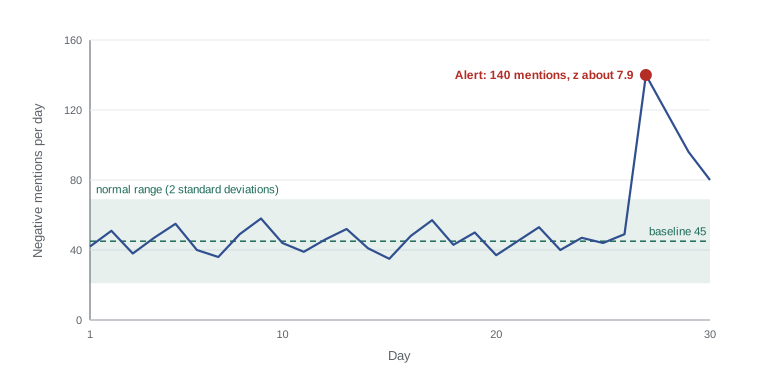
To recognize unusual activity, you first need to know what normal looks like. A baseline is your typical level of a metric, such as daily mentions, negative comments, or the ratio of negative to positive comments, over a recent period. Once you have a baseline and a sense of how much it varies, you can tell when activity is meaningfully higher than usual rather than just a busy day.
A simple statistical tool is the z-score, which measures how many standard deviations a value is from the average. A z-score near 0 means typical activity; a z-score above about 2 or 3 suggests activity is unusually high. The threshold is a judgment call: lower thresholds catch more problems but also produce more false alarms.
In this formula, \(x\) is today's value, \(\mu\) is the baseline average and \(\sigma\) is the standard deviation of daily values over the baseline period.
Worked problem
Spotting an unusual spike
Over the last 30 days, a creator's negative mentions averaged 45 per day with a standard deviation of 12. Today there are 140 negative mentions. The creator uses a z-score above 3 as an alert threshold. Should they escalate?
Show solution
- Difference from average: 140 − 45 = 95.
- z-score: 95 ÷ 12 ≈ 7.9.
- Compare with the threshold: 7.9 is well above 3.
Answer: Yes. Activity is nearly eight standard deviations above normal, far beyond ordinary variation. The creator should find out what is driving it before deciding whether and how to respond.
Baselines should reflect your own channel, not other creators', because volume varies enormously. They also need updating: if your audience grows, your normal level of mentions grows with it. Seasonal patterns, such as spikes after major releases or events, should be expected rather than treated as alarms.
Sentiment ratios
Volume alone can mislead, because a viral positive video also produces a spike in mentions. Sentiment analysis classifies mentions as positive, negative or neutral, and a sentiment ratio compares negative to positive. Automated sentiment tools are imperfect: they struggle with sarcasm, slang, jokes and context, and they may misread criticism of a topic as criticism of the creator. A practical approach is to use automated sentiment as a rough indicator and check a random sample manually.
Worked problem
Tracking a sentiment ratio
In a normal week, a creator's mentions are 2,000 positive and 500 negative. This week a sample shows 1,800 positive and 1,350 negative. A manual check of 50 negative mentions finds that 40 are about a specific sponsored video and 10 are routine. How has the ratio changed, and what does it suggest?
Show solution
- Normal negative-to-positive ratio: 500 ÷ 2,000 = 0.25.
- This week: 1,350 ÷ 1,800 = 0.75.
- The ratio has tripled.
- The manual sample shows 40 ÷ 50 = 80 % of negative mentions relate to one sponsored video.
Answer: The ratio tripled and most of the increase concerns a single sponsored video. That points to a specific issue, such as a disclosure problem or a product complaint, that deserves investigation and possibly a response.
Escalation triggers
An escalation trigger is a pre-agreed condition that moves an issue from routine monitoring to active management. Writing triggers down in advance removes guesswork under pressure and prevents two common failures: ignoring a growing problem because nobody wanted to overreact, and panicking over ordinary criticism.
| Level | Example triggers | Action |
|---|---|---|
| Level 0: routine | Normal criticism, mentions within the usual range | Monitor; respond normally |
| Level 1: watch | z-score above 2, or one credible allegation | Check facts; inform the core team; prepare a holding statement |
| Level 2: active issue | z-score above 3, or spread to other platforms, or a sponsor asks | Convene the response team; decide on a response; brief partners |
| Level 3: crisis | Media coverage, legal threats, platform action, or safety concerns | Full crisis plan; legal advice; coordinated statements |
Triggers should include qualitative signals, not just numbers. A message from a sponsor, a question from a journalist, a credible allegation of harm, or a concern from someone in your community who is usually supportive can all justify escalation even when the numbers look ordinary.
Who watches, and how often
Monitoring only works if someone actually does it. Assign responsibility: in a solo business, it is the creator; in a team, often a community manager or social media lead. Decide how often each source is checked, such as comments daily, mention searches weekly and search results monthly, and who covers when the main person is away. Set up alerts for your name, channel name, product names and common misspellings where tools allow.
Monitoring has a cost to wellbeing. Reading large volumes of criticism, especially hostile or abusive content, is draining. CRE-350 covers protecting yourself from harassment; for monitoring, a useful practice is to let a team member or tool filter the stream and summarize what matters, so the creator sees the signal without absorbing all the noise.
From signal to action
When a trigger fires, the first job is to understand what is happening, not to respond. Find the original source of the discussion, identify the specific claim or content involved, check whether it is accurate, and estimate how far it has spread. Only then decide on next steps, which lesson 6 covers in detail. A short internal summary helps: what happened, what is being said, what we know is true, what we do not know yet, who is affected, and what decisions we need to make.
Monitoring partners and your niche
A creator's reputation can be affected by events that have nothing to do with their own content. Sponsors face recalls, lawsuits and scandals; collaborators get into trouble; platforms change policies; whole niches go through moments of public scrutiny. Good monitoring includes a light watch on these external factors. Set alerts for each current sponsor's name together with words such as recall or lawsuit, follow industry news in your niche, and read platform policy announcements. Learning that a sponsor is in trouble a day before your audience does gives you time to pause content and decide what to say.
A weekly monitoring routine
A simple routine keeps monitoring consistent without taking over your week.
| Frequency | Task | Time |
|---|---|---|
| Daily | Skim comments on recent uploads and check alerts | 10 to 15 minutes |
| Weekly | Search your name and channel on major platforms and forums; review sentiment | 30 minutes |
| Weekly | Check sponsor and collaborator alerts | 10 minutes |
| Monthly | Review search results and autocomplete; update baselines | 30 minutes |
| Quarterly | Review escalation triggers and monitoring tools | 1 hour |
Worked problem
Choosing an alert threshold
A creator's daily mentions average 200 with a standard deviation of 40. They are deciding between alert thresholds of z = 2 and z = 3. What mention counts trigger each alert?
Show solution
- Threshold z = 2: 200 + 2 × 40 = 280 mentions.
- Threshold z = 3: 200 + 3 × 40 = 320 mentions.
Answer: A z = 2 threshold alerts at 280 mentions and will fire more often, including on some normal busy days. A z = 3 threshold alerts at 320 and produces fewer false alarms but may catch problems later. Many creators use z = 2 for a quiet internal check and z = 3 for convening the team.
Record every alert and what it turned out to be. Over a few months, this log shows whether thresholds are set sensibly, which sources produce useful early warnings, and which produce mostly noise. It also provides a timeline if a crisis later develops and you need to reconstruct when the first signals appeared.
Common mistakes
MistakeMonitoring only your own comment sections.
InsteadTrack mentions on other platforms, forums, search results and news, and keep contacts who can flag private discussion.
MistakeReacting to every negative comment.
InsteadCompare activity with a baseline and focus on genuine signals, not ordinary noise.
MistakeTrusting automated sentiment scores blindly.
InsteadUse them as a rough guide and check a sample manually for sarcasm and context.
MistakeDeciding escalation thresholds during a crisis.
InsteadAgree on escalation triggers in advance and write them down.
MistakeResponding before understanding the issue.
InsteadFind the source, check the facts and estimate spread before deciding how to respond.
Summary and key terms
- Most crises show early signals that monitoring can catch, giving time to prepare.
- Monitoring covers your channels, mentions elsewhere, forums, search results, news and partner messages.
- Dark social discussions are invisible to tools, so trusted community contacts matter.
- Signals differ from noise in specificity, credibility, spread and who is raising concerns.
- Baselines and z-scores show when activity is unusually high compared with normal.
- Sentiment ratios add context to volume, but automated sentiment needs manual checking.
- Pre-agreed escalation triggers move issues from monitoring to action without guesswork.
- Social listening
- Tracking mentions and discussion about a creator or brand across platforms.
- Dark social
- Sharing and discussion in private channels such as group chats and messaging apps.
- Baseline
- The typical level of a metric over a recent period, used for comparison.
- Standard deviation
- A measure of how much values typically vary around their average.
- z-score
- The number of standard deviations a value lies above or below the average.
- Sentiment analysis
- Classifying text as positive, negative or neutral.
- Sentiment ratio
- The ratio of negative to positive mentions.
- Escalation trigger
- A pre-agreed condition that moves an issue to a higher level of response.
- False alarm
- An alert that turns out not to indicate a real problem.
- Holding statement
- A brief interim statement used while facts are being established.
Practice problems
Work each problem on paper first, then reveal the answer to check.
Name four places to monitor besides your own comments.
Show answer
Mentions on other platforms, forums, search results and news.
What is dark social?
Show answer
Discussion in private chats and messaging apps that tools cannot see.
Average 30, standard deviation 10, today 75. z-score?
Show answer
4.5.
Why update a baseline as a channel grows?
Show answer
Normal volume rises with audience size, so old baselines cause false alarms.
Negative 600, positive 1,200. Sentiment ratio?
Show answer
0.5.
Why check automated sentiment manually?
Show answer
Tools misread sarcasm, slang and context.
Give two qualitative escalation triggers.
Show answer
A sponsor asking about an issue and a journalist's question.
What is the first job when a trigger fires?
Show answer
Understand what is happening: source, claim, accuracy and spread.
Give one signal that criticism is more than noise.
Show answer
The same specific criticism from many unrelated accounts.
How can creators protect wellbeing while monitoring?
Show answer
Let a team member or tool filter and summarize the stream.
Lesson quiz · 5 questions
Score 60% or more to complete this lesson.
Create a free account to save your progress, take quizzes and earn a certificate.