
CRE-310 · Lesson 3 of 12 · 27 min
Positioning, niche and brand fit
Brands do not buy followers in the abstract; they buy access to a particular audience through a particular voice. A creator with a clear position, meaning a well-defined audience, a recognizable point of view and a consistent standard of quality, is far easier to sell than one who covers everything for everyone. This lesson covers how to define and communicate your position, how brands judge fit, how to decide which brands fit you, and how to protect the trust that makes your recommendations valuable.
What positioning means for a creator
In marketing, positioning is the place a product occupies in the mind of its target customer relative to alternatives. For a creator selling partnerships, there are two customers: the audience, who choose to follow you, and the brands, who choose to pay you. Your position needs to make sense to both. The audience needs a reason to follow you rather than someone else; the brand needs a reason to pay you rather than another creator or a standard ad.
A useful positioning statement completes the sentence: "For [audience], I am the creator who [distinctive value], because [proof]." For example: "For first-time home cooks in their twenties, I am the creator who makes weeknight meals under $10 a serving achievable, because every recipe is tested on a basic stove with supermarket ingredients." The statement guides content decisions and makes your pitch to brands clearer: a grocery chain, a cookware start-up or a meal-planning app can immediately see the fit.
Niche: depth versus breadth
A niche is the subject area and audience you focus on. Narrow niches, such as minimalist trail running, vegan baking or budget travel in Atlantic Canada, attract smaller audiences but deep trust and clear commercial relevance. Broad niches, such as lifestyle or comedy, can attract large audiences but make brand fit less obvious. Many successful creators start narrow, establish authority, then broaden carefully into adjacent topics their audience also cares about.
From a partnership point of view, niches differ in commercial value. Audiences interested in high-value purchases, such as personal finance, technology, business software, home renovation, cars, travel and luxury goods, attract higher sponsorship prices because each customer is worth more to the brand. Audiences in entertainment and general lifestyle niches may be larger but command lower prices per thousand views. This does not mean you should choose a niche purely for money; a niche you cannot sustain or do not genuinely know will show in the content and erode trust. But it explains why two creators with similar audiences can earn very different fees.
| Niche type | Typical audience value to brands | Example sponsors |
|---|---|---|
| Personal finance and investing | Very high | Banks, brokerages, budgeting apps, tax software |
| Technology and software | High | Device makers, software, VPNs, web hosting |
| Home, renovation and real estate | High | Tools, furniture, home services, insurance |
| Beauty and fashion | Medium to high | Cosmetics, skincare, apparel, retailers |
| Food and cooking | Medium | Grocers, cookware, meal kits, appliances |
| Gaming | Medium | Games, peripherals, energy drinks, chairs |
| General entertainment | Lower per view | Mass consumer brands, apps, streaming services |
How brands judge fit
Brands assess fit along several dimensions. Thinking through them yourself, before you pitch or accept a deal, helps you choose well and argue convincingly.
- Audience fit: does your audience match the brand's target customers in age, location, interests and buying power?
- Topic fit: does the product relate naturally to what you already make content about?
- Values fit: do the brand's practices and image align with what you stand for, and vice versa?
- Style fit: does your tone, humor, visual style and production quality suit how the brand wants to be seen?
- Credibility: would your audience believe that you genuinely use and like the product?
- Timing: is this the right moment, given your content plans and other partnerships?
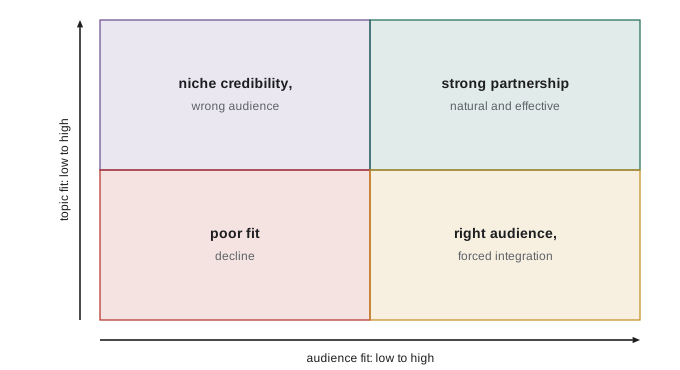
A simple scoring approach can make these judgments more consistent. Rate each dimension from 1 to 5, weight them according to what matters most to you and the brand, and calculate a weighted score. A score threshold helps you say no consistently, which protects your audience and your future earnings.
Worked problem
Scoring brand fit
A creator weights audience fit 30 %, topic fit 25 %, values fit 25 %, style fit 10 % and credibility 10 %. A cookware brand scores 5, 4, 3, 4 and 5 respectively. What is the weighted score out of 5, and would it pass a threshold of 4.0?
Show solution
- Audience: 0.30 × 5 = 1.50; topic: 0.25 × 4 = 1.00; values: 0.25 × 3 = 0.75.
- Style: 0.10 × 4 = 0.40; credibility: 0.10 × 5 = 0.50.
- Total: 1.50 + 1.00 + 0.75 + 0.40 + 0.50 = 4.15.
Answer: A weighted score of 4.15, which passes the 4.0 threshold, though the values score of 3 is worth investigating before signing.
Values, ethics and red lines
Every creator should decide in advance which products and brands they will not promote. Common red lines include gambling, high-interest lending, unproven health supplements, products that make extreme weight-loss or medical claims, cryptocurrency schemes, brands with known labor or environmental abuses and products unsuitable for a young audience. Writing these down before offers arrive makes it easier to decline a tempting fee.
Values fit also runs the other way: brands increasingly assess creators' past content and public statements before hiring them. Content you posted years ago can resurface. This is not a reason to avoid having opinions, but it is a reason to be thoughtful and consistent, and to expect brands to look.
A further consideration is your own use of the product. The disclosure guidance in both countries, covered in Lesson 10 and CRE-320, expects endorsements to reflect the creator's honest opinions and, where claims are made about using a product, actual experience. Promoting something you have never tried, or claiming results you did not get, risks misleading your audience and breaking the law. The practical rule is simple: only endorse what you have actually used and would recommend without payment.
The trust account
A helpful way to think about sponsored content is as withdrawals from a trust account. Every honest recommendation, useful video and refusal to promote something poor is a deposit. Every sponsored post is a withdrawal, small if the product is useful and well matched, large if it feels forced or turns out badly. If you keep withdrawing more than you deposit, the account runs down, engagement falls and brands eventually pay less or stop calling.
Practical ways to protect the account include limiting the share of sponsored content, matching sponsors to audience needs, being transparent about what you liked and did not like, following up when a product disappoints, and keeping editorial independence in non-sponsored content. Many creators set a maximum number of sponsored posts per month or a ratio such as one sponsored piece for every four organic ones.
Worked problem
Setting a sponsorship ratio
A creator publishes 20 pieces of content a month and wants no more than 20 % sponsored. Their average sponsored fee is $1,200. What is their maximum monthly sponsorship income at this ratio, and how many brand slots are available per quarter?
Show solution
- Sponsored pieces per month: 20 × 0.20 = 4.
- Maximum monthly income: 4 × $1,200 = $4,800.
- Slots per quarter: 4 × 3 = 12.
Answer: Up to $4,800 a month from four sponsored pieces, or 12 slots a quarter; growing income then means raising the fee, not the number of slots.
Limiting supply has a useful side effect: scarcity supports price. A creator who accepts every offer has little reason to raise fees; one with a waiting list can.
Communicating your position to brands
Your position should be visible everywhere a brand might look: your profile bios, channel description, website, media kit and pitch emails. Brands skim quickly, often reviewing dozens of creators in a session. Make it easy for them by stating clearly who your audience is, what you cover, the results you have delivered for previous partners and the kinds of partnerships you welcome.
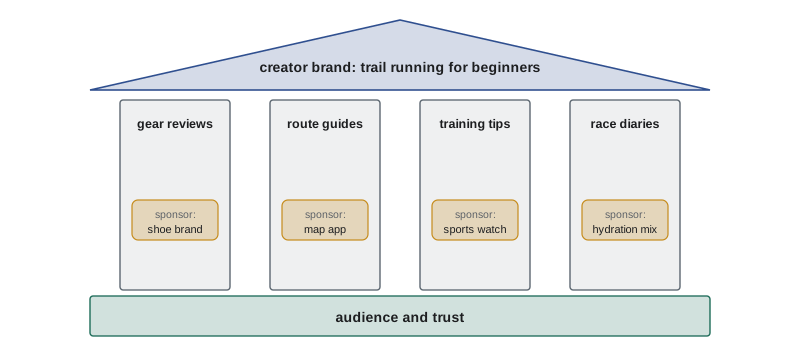
Consistency matters. If your profile says you cover sustainable fashion but your last ten posts are about gaming, brands will be confused. Content pillars, the three to five recurring themes that define your channel, help keep your position clear while still allowing variety. Sponsored content should fit within those pillars wherever possible.
Category conflicts and portfolio thinking
Over time, your partnerships form a portfolio that brands read as a signal. Working with three competing protein bar brands in one month suggests your recommendations are for sale to anyone, and reduces each brand's value. Working with complementary brands, such as a running shoe, a sports watch and a hydration product, reinforces your authority in the niche. Before accepting a deal, check your recent and planned partnerships for conflicts, both to avoid breaching exclusivity clauses and to protect credibility.
Some creators deliberately build long-term relationships with one brand per category, which makes them more valuable to each partner and easier to price for exclusivity. Lesson 12 covers ambassadorships and how to structure them.
When to say no
Declining an offer is a normal part of the business. Good reasons include poor audience or values fit, a fee too low for the work, unacceptable contract terms, unrealistic timelines, a request to make claims you cannot support, or too many sponsored posts already scheduled. A polite, prompt refusal maintains goodwill: thank the brand, give a brief reason if appropriate, and, if the problem is price or timing rather than fit, say what would work. Many future deals come from brands a creator declined politely the first time.
Researching a brand before you agree
Before pitching or accepting a deal, spend some time researching the brand. Read its website, product reviews and recent news; look at how it treats customers and creators; check whether it has faced regulatory action, recalls or controversies; and look at which other creators it has worked with and how those partnerships looked. Ask creators you trust about their experience with the brand, especially on payment and approvals. A brand that pays late, changes briefs constantly or has a poor reputation with customers may not be worth the fee, however attractive it looks.
Research also improves your pitch and content. Knowing a brand's values, product history and target customers lets you propose ideas that feel natural to both the brand and your audience, and makes it easier to explain why the fit is strong.
Fit across platforms
Fit can vary by platform. A brand that suits your long-form YouTube tutorials may feel out of place in your casual short videos, or the reverse. Audiences also differ between platforms: your Instagram followers may be older and more local than your TikTok viewers. Assess fit separately for each platform involved in a deal, and recommend the platform where the match is strongest rather than accepting every platform the brand asks for.
Fit changes over time
Fit is not fixed. Your audience matures, your content evolves and brands change ownership, products and practices. A partner that fitted well two years ago may no longer suit you. Review your long-term partnerships at least once a year against your positioning statement and red lines, and be willing to end relationships that no longer fit, professionally and in line with your contracts.
Ultimately, fit is about whether a partnership makes sense to your audience. If you can explain in one sentence why this brand belongs in your content, the fit is probably strong.
Common mistakes
MistakeTrying to appeal to every brand.
InsteadDefine a clear audience and point of view brands can see.
MistakeChoosing a niche only for its sponsorship rates.
InsteadChoose a niche you know and can sustain.
MistakeEndorsing products you have not used.
InsteadOnly endorse what you have tried and would recommend unpaid.
MistakeAccepting every offer to maximize income.
InsteadLimit sponsored content and use scarcity to support price.
MistakePromoting competing brands back to back.
InsteadManage your partnership portfolio for conflicts.
Summary and key terms
- Positioning defines your audience, distinctive value and proof for both audience and brands.
- Narrow niches build trust; niche commercial value affects sponsorship prices.
- Brands judge audience, topic, values, style, credibility and timing fit.
- A weighted scoring system helps decide consistently.
- Decide red lines in advance and only endorse products you have used.
- Treat sponsorships as withdrawals from a trust account and limit their share.
- Manage your portfolio for conflicts and decline poor fits politely.
- Positioning
- The distinctive place a creator occupies for audience and brands.
- Niche
- The focused subject area and audience of a creator.
- Content pillar
- A recurring theme that defines a creator's content.
- Audience fit
- Overlap between a creator's audience and a brand's target.
- Values fit
- Alignment between a creator's and a brand's principles.
- Red line
- A category or brand a creator will not promote.
- Trust account
- A metaphor for audience goodwill that sponsorships draw down.
- Sponsorship ratio
- The share of content that is sponsored.
- Category conflict
- Working with competing brands in the same product category.
- Weighted score
- A total combining ratings multiplied by their importance.
Practice problems
Work each problem on paper first, then reveal the answer to check.
Complete a positioning statement template.
Show answer
For [audience], I am the creator who [value], because [proof].
Why do finance niches command higher prices?
Show answer
Each customer is worth more to the brand.
Name four dimensions of brand fit.
Show answer
Audience, topic, values, style, credibility, timing.
Weighted score for ratings 4 and 2 weighted 70 % and 30 %?
Show answer
3.4.
Name two common red-line categories.
Show answer
Gambling, payday loans, unproven supplements, crypto schemes.
Maximum sponsored posts from 30 posts at 15 %?
Show answer
4.5, so 4 in practice.
How does scarcity help pricing?
Show answer
Limited slots support higher fees.
What are content pillars?
Show answer
Three to five recurring themes defining the channel.
Why avoid back-to-back competing sponsors?
Show answer
It damages credibility and may breach exclusivity.
Give two good reasons to decline a deal.
Show answer
Poor fit, low fee, bad terms, unsupported claims, timing.
Lesson quiz · 5 questions
Score 60% or more to complete this lesson.
Create a free account to save your progress, take quizzes and earn a certificate.