
CRE-220 · Lesson 7 of 12 · 25 min
Authenticity, persona and vulnerability
Audiences often say they follow creators because they feel "real". Authenticity has become one of the most valued qualities in the creator economy, and one of the most misunderstood. Every creator performs to some extent: choosing what to show, rehearsing, editing and presenting a version of themselves suited to the camera. The question is not whether to perform but how to perform in a way that is honest and true to who you are. This lesson covers what audiences mean by authenticity, the difference between persona and pretense, on-camera personas and characters, vulnerability and its limits, honesty in storytelling and reactions, parasocial relationships, consistency across content, and the pressures that can make authenticity exhausting.
What audiences mean by authenticity
Research on creators and audiences suggests that viewers judge authenticity through several signals: consistency between what a creator says and does over time; apparent sincerity, the sense that the creator believes what they say and cares about the topic; transparency about sponsorships, mistakes and the creation process; and relatability, the sense that the creator shares experiences with viewers. Authenticity is therefore not the same as being unpolished. A carefully produced documentary can feel deeply authentic, and a shaky, unedited vlog can feel fake if the creator seems to be playing a role they do not believe. What viewers reject is perceived deception: hidden sponsorships, staged "spontaneous" moments presented as real, recommendations that seem driven by money rather than conviction, and personas that conflict with how a creator behaves elsewhere.
Persona and pretense
A persona is the version of yourself you present in a particular context. Teachers, nurses, salespeople and comedians all adopt professional personas that emphasize certain traits, and creators do the same. A healthy persona amplifies real parts of you, such as your curiosity, humor, expertise or calm, and leaves out parts that are not relevant or that you prefer to keep private. Pretense presents traits, experiences or beliefs you do not have: claiming expertise you lack, inventing a backstory, or pretending to love products you dislike. The test is whether the persona could survive viewers meeting you in person, or learning more about your life. A persona that is a heightened version of yourself feels authentic; one that contradicts who you are eventually feels false to you and to viewers.
| Healthy persona | Pretense | |
|---|---|---|
| Basis | Amplifies real traits | Invents traits or experiences |
| Privacy | Leaves out private parts | Hides contradictions |
| Expertise | Honest about what you know | Claims knowledge you lack |
| Recommendations | Based on genuine opinion | Driven by undisclosed money |
| Sustainability | Comfortable to maintain | Exhausting and fragile |
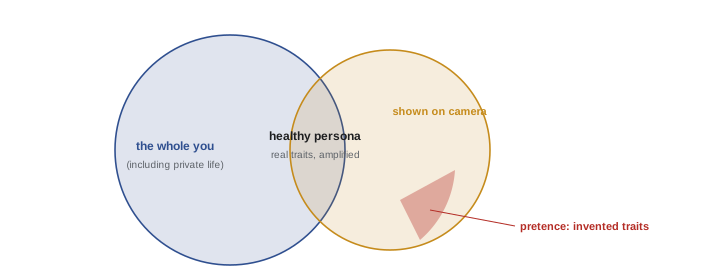
Characters and comedic personas
Some creators perform characters: comedic personas, recurring sketch characters, or fictional narrators. Characters are not inauthentic as long as audiences understand that they are characters. Problems arise when fiction is presented as reality, such as staged pranks, scripted "real" relationship drama or fake confessions presented as genuine, which can mislead viewers, harm people involved and break platform rules on deceptive content. Many comedic creators make the line clear with recurring character names, costumes, title cards or descriptions. When creating characters based on groups of people, be careful not to rely on stereotypes about race, ethnicity, gender, disability, religion or other identities, which can harm communities and alienate audiences.
Vulnerability and its limits
Sharing struggles, doubts, mistakes and emotions can create deep connection, because viewers recognize their own experiences and feel less alone. Researcher Brené Brown's work on vulnerability has been widely cited by creators and presenters, and audiences often respond strongly to honest discussions of mental health, failure, grief and identity. But vulnerability on camera carries risks: content stays online permanently, may be seen by employers, family and future partners, can attract harassment, and can create pressure to keep revealing more to maintain engagement. Strategic or performed vulnerability, such as crying on cue or manufacturing crises for views, is recognized by many audiences and damages trust. Healthy vulnerability is purposeful, shared when you have some perspective on the experience (the "scars, not wounds" principle in Lesson 3), and bounded by your own comfort, not by audience demand.
Worked problem
Deciding whether to share a struggle
A fitness creator went through a period of injury and depression six months ago and is considering a video about it. Many viewers have asked why they stopped posting. How might they decide what to share?
Show solution
- Check perspective: are they able to talk about the experience without being overwhelmed, and do they see what it meant?
- Define the purpose: to explain the absence, to help viewers in similar situations, or to show a more realistic side of fitness.
- Set boundaries: decide in advance what details to leave out, such as medical specifics or other people's roles.
- Prepare: include helpful resources, plan how to handle comments, and consider showing the video to a trusted friend first.
- Remember they can choose not to share, or share only a brief update; viewers are not owed private details.
Answer: Share only with perspective and a clear purpose, set boundaries in advance, prepare resources and support, and remember that not sharing is a valid choice.
Honesty in storytelling and reactions
Authentic delivery depends on honest content. Common forms of dishonesty in creator content include exaggerated reactions (shock or delight that is clearly performed for thumbnails or clips), staged "spontaneous" moments, inflated stories of struggle or success, undisclosed editing that changes meaning, and opinions that change depending on who is paying. Viewers increasingly notice these, and they can undermine years of trust in a single incident. Honesty does not require including every detail or eliminating all performance; it requires that viewers are not misled about things that matter to them. Disclosing sponsorships clearly, which is required by advertising law in Canada and the United States (CRE-320), saying when something is reconstructed or staged, and admitting mistakes openly all build long-term credibility.
Parasocial relationships
Viewers who watch a creator regularly can feel that they know them personally, a one-sided connection psychologists call a parasocial relationship, a term introduced by researchers Donald Horton and Richard Wohl in 1956 to describe audiences' bonds with television personalities. Direct address to camera, personal stories and regular uploads strengthen these bonds. Parasocial relationships are normal and can be positive, providing comfort, community and inspiration. They also carry responsibilities and risks: viewers may feel entitled to a creator's time, information or opinions; some may behave intrusively or obsessively; and creators may feel pressure to maintain constant intimacy. Healthy practices include being warm without promising friendship you cannot provide, setting clear boundaries about personal contact, being mindful of influence on younger or vulnerable viewers, and building community among viewers rather than only between each viewer and you. CRE-350 covers creator wellbeing and safety.
Consistency across content
Authenticity is judged over time, across many videos, posts, streams and interactions. Viewers notice when a creator's tone, values or opinions shift dramatically between platforms or contexts: warm on YouTube and cruel in replies, eco-conscious in videos and wasteful in sponsored hauls. Consistency does not mean never changing; creators grow, learn and change their minds, and explaining those changes openly is itself authentic. It means that your core values and character remain recognizable. Reviewing your content periodically for consistency with your stated values, and being thoughtful about sponsorships that conflict with them (CRE-310), protects trust.
When authenticity becomes exhausting
The demand to be constantly "real" can be draining. Creators may feel they must share every part of their lives, react to every event, and maintain an always-on persona across platforms. Signs that authenticity has become a burden include feeling unable to keep any part of life private, performing emotions you do not feel to meet expectations, and feeling that your identity has merged with your channel. Healthy approaches include defining clear boundaries about what you share, separating work and personal time, using formats that are less personal, such as tutorials or reviews, alongside more personal content, and remembering that being authentic does not mean being available. Your audience deserves honesty, not your entire life.
Authenticity and sponsored content
Sponsorships are where authenticity is most tested. Viewers know that creators are paid, and most accept it; what damages trust is undisclosed payment, recommendations that seem insincere and products that conflict with a creator's stated values. Practices that protect authenticity include accepting only sponsors whose products you would genuinely recommend; using and testing products before promoting them; sharing honest opinions, including limitations; disclosing clearly as advertising law requires (CRE-320); and keeping your usual tone and personality in sponsored segments. Some creators publish a sponsorship policy explaining which brands they work with and how. Turning down a lucrative deal that does not fit is one of the strongest ways to preserve long-term trust.
Authenticity across platforms
Creators often present differently on different platforms: more polished on YouTube, more casual on Instagram Stories, more personal in a newsletter, more playful on TikTok. Varying tone by platform is natural and can be authentic, as long as the underlying values and character remain consistent. Problems arise when personas contradict each other, for example when a creator who presents as supportive in videos behaves aggressively in comments or private messages. Treat every public interaction, including replies, live chat and collaborations, as part of your on-camera presence.
Handling mistakes publicly
Creators make mistakes: factual errors, insensitive jokes, poor judgment in sponsorships or behavior. How they respond strongly affects how authentic they seem. Effective public responses acknowledge the mistake specifically, take responsibility without excuses, explain what you are doing to correct it, and follow through. Vague apologies ("sorry if anyone was offended"), deflection and deleting criticism without comment tend to make things worse. Correcting factual errors promptly, with a pinned comment or updated description, is a simple habit that builds credibility. Serious situations may require advice from a manager, a lawyer or a mental health professional before responding.
The role of AI and filters
Beauty filters, voice changers and AI-generated avatars and voices raise new questions about authenticity. Using filters for fun or creative effect is common and generally understood, but using them to misrepresent your appearance in contexts where it matters, such as reviews of cosmetics or fitness results, misleads viewers. AI tools that clone a creator's voice or generate synthetic presenters can be useful for translation and accessibility, but audiences expect to be told when they are not watching a real person or hearing a real voice. Platforms increasingly require labels for realistic synthetic content. Being open about the tools you use preserves trust.
Authenticity with children and families on camera
Family content raises particular questions of authenticity and consent. Children cannot meaningfully consent to having their lives shared publicly, and scenes staged with children for views can be harmful. Many creators now limit how children appear, avoid sharing identifying details, and let older children decide whether they want to be featured. Some jurisdictions have begun regulating child influencers and the earnings from content featuring children. Authentic family content respects children's privacy and dignity, both now and in the future.
Authenticity checklist
Before publishing, ask: Is everything in this video honest? Have I disclosed sponsorships and staging clearly? Does this persona match how I behave elsewhere? Am I sharing personal material because it serves the audience and I am comfortable with it? Would I be happy for the people featured to watch this? Would my values be recognizable to someone who saw only this video? Answering these questions regularly keeps authenticity a deliberate practice rather than an assumption. When an answer is no, revise the video, add context, or decide not to publish it.
Common mistakes
MistakeEquating authenticity with low production quality.
InsteadFocus on honesty and consistency, whatever the polish.
MistakeInventing traits or experiences.
InsteadBuild a persona that amplifies real parts of you.
MistakePresenting staged moments as real.
InsteadLabel characters, reconstructions and sketches clearly.
MistakeSharing raw crises for engagement.
InsteadShare with perspective, purpose and boundaries.
MistakeFeeling obliged to share everything.
InsteadSet boundaries; honesty is not total disclosure.
Summary and key terms
- Audiences judge authenticity by consistency, sincerity, transparency and relatability.
- A healthy persona amplifies real traits; pretense invents them.
- Characters are fine when audiences know they are characters.
- Vulnerability builds connection but needs perspective and boundaries.
- Honest content avoids misleading viewers about what matters.
- Parasocial relationships are normal but bring responsibilities.
- Consistency over time builds trust; authenticity need not mean total disclosure.
- Authenticity
- Perceived honesty and consistency with one's real self.
- Persona
- The version of yourself presented in a context.
- Pretense
- Presenting traits or experiences you do not have.
- Character
- A fictional or comedic role understood as such.
- Vulnerability
- Sharing struggles, doubts and emotions.
- Performed vulnerability
- Manufactured emotion for engagement.
- Parasocial relationship
- One-sided bond a viewer feels with a creator.
- Transparency
- Openness about sponsorships, process and mistakes.
- Consistency
- Stable values and character across content.
- Boundary
- A limit on what you share or allow.
Practice problems
Work each problem on paper first, then reveal the answer to check.
Name three signals of authenticity.
Show answer
Consistency, sincerity, transparency, relatability.
Can polished content feel authentic?
Show answer
Yes; authenticity is about honesty, not polish.
What test distinguishes persona from pretense?
Show answer
Whether it would survive viewers meeting you or learning more.
When are characters a problem?
Show answer
When fiction is presented as reality.
Name two risks of vulnerability on camera.
Show answer
Permanence, harassment, pressure to reveal more.
What is performed vulnerability?
Show answer
Manufactured emotion or crises for views.
Who introduced the term parasocial relationship?
Show answer
Horton and Wohl in 1956.
Name a healthy parasocial practice.
Show answer
Warmth with boundaries, community among viewers.
Is changing your mind inauthentic?
Show answer
No, if you explain it openly.
Name a sign authenticity has become a burden.
Show answer
No privacy, performed emotions, identity merged with channel.
Lesson quiz · 5 questions
Score 60% or more to complete this lesson.
Create a free account to save your progress, take quizzes and earn a certificate.