
CRE-220 · Lesson 12 of 12 · 25 min
Practice, feedback, inclusive presenting and capstone
Storytelling and presenting are skills, and skills improve through deliberate practice and feedback, not just repetition. Creators who become confident, engaging presenters usually do so by recording often, reviewing their work critically, seeking honest feedback and working on specific weaknesses one at a time. This final lesson covers deliberate practice, self-review methods, getting and using feedback, using audience data as feedback, learning from others, coaching and classes, inclusive and accessible presenting, developing a sustainable presenting style, and the capstone project.
Deliberate practice
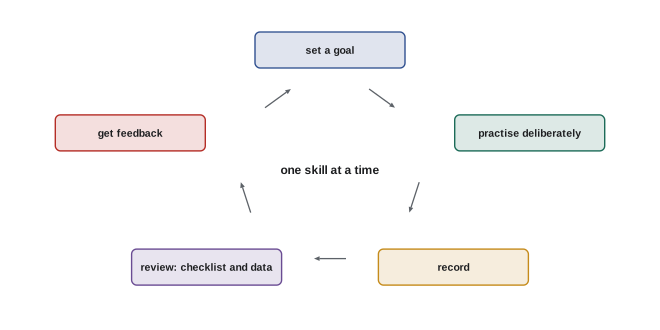
Psychologist Anders Ericsson's research on expert performance distinguished deliberate practice from simple repetition. Deliberate practice focuses on specific aspects of performance just beyond your current ability, with clear goals, immediate feedback and repetition with adjustment. For presenters, this means practicing particular skills, such as eye contact during openings, reducing filler words, or slowing down for key points, rather than just recording more videos. A practice session might involve recording the same 30-second opening ten times, each time focusing on one element, reviewing each take and adjusting. Short, frequent practice is more effective than occasional long sessions, and practicing specific skills outside full productions, where pressure is lower, accelerates improvement.
Self-review methods
Reviewing your own recordings is the most accessible form of feedback. Effective self-review is structured, focusing on specific elements rather than general impressions ("I look awful"), which are rarely useful. Methods include:
- Watching with the sound off to assess body language, expression and eye contact (Lesson 6).
- Listening without video to assess voice, pace, clarity, filler words and vocal variety (Lesson 4).
- Watching at normal speed as a viewer would, noting where your attention wanders.
- Counting specific habits, such as filler words per minute or glances away from the lens, to track improvement.
- Comparing recordings over time, for example your first and latest videos, to see progress.
- Using a checklist covering story, structure, delivery and technical quality.
| Area | Review questions |
|---|---|
| Story | Is there a character, want, obstacle, change and point? |
| Structure | Does the opening hook, the middle escalate and the ending pay off? |
| Voice | Is pace varied, are pauses used, are words clear, are fillers few? |
| Eyes and face | Is there eye contact, and does expression match content? |
| Body | Is posture grounded, are gestures purposeful and in frame? |
| Energy | Does energy suit the format and vary across the piece? |
| Authenticity | Does it sound like me, and is everything honest? |
Getting and using feedback
Other people see what we cannot. Useful sources of feedback include trusted friends, fellow creators, mentors, editors and coaches. To get useful feedback, ask specific questions ("Where did you lose interest?", "Did my opening make you want to keep watching?", "What did you remember afterwards?") rather than "What do you think?", which tends to produce vague praise. Ask people who represent your intended audience as well as people with presenting expertise. Receive feedback openly: listen without defending, ask clarifying questions, and thank people. Then decide what to act on; not all feedback is equally valid, and patterns across several people are more reliable than one opinion. Peer feedback groups, where creators regularly review each other's work using an agreed format, are an efficient way to improve and to build community.
Worked problem
A peer feedback session
Four creators form a monthly feedback group. Each brings a three-minute clip. How could they structure a session so that feedback is useful and kind?
Show solution
- Each creator states one specific goal for their clip, such as "I want my opening to feel more natural".
- The group watches the clip once without comment.
- Each reviewer shares one strength, one specific suggestion related to the goal, and one question.
- The creator listens without defending, then asks clarifying questions.
- The creator chooses one change to try before the next session and reports back.
Answer: State a goal, watch, give a strength, a specific suggestion and a question, listen without defending, and commit to one change.
Audience data as feedback
Analytics provide feedback at scale. Retention curves show where viewers stop watching, which often reveals weak openings, slow sections or confusing explanations (CRE-202). Comments reveal what viewers found memorable, funny, confusing or moving. Comparing retention for videos with different presenting approaches, such as a scripted versus a bullet-point delivery, or a cold open versus a greeting, can show what works for your audience. Treat data as one input among several: retention is affected by topics, packaging and platform changes as well as delivery, so look for patterns across many videos rather than drawing conclusions from one. Combine data with qualitative feedback to understand why viewers respond as they do.
Learning from others
Studying skilled presenters accelerates learning. Choose presenters in your genre and in others, such as documentary narrators, comedians, teachers, news anchors and speakers, and analyze specific techniques: how they open, structure stories, use pauses and gestures, handle guests and recover from mistakes. Watch with the sound off, listen without video, and transcribe short passages to study their language. The goal is to learn techniques, not to copy personalities; your style should remain your own (Lesson 7). Live performance also teaches: watching storytellers at events, open mics and conferences shows how they read and respond to audiences.
Coaching and classes
Structured training can speed progress. Options include public speaking clubs such as Toastmasters International, which offer regular practice and evaluation in a supportive setting; improv classes, which build spontaneity, listening and comfort with uncertainty (Lesson 9); acting classes, which develop expression, voice and presence; voice coaching or speech-language pathology for specific vocal issues (Lesson 4); and media training, offered to executives and spokespeople, which focuses on interviews and on-camera delivery. Many creators also work with presentation coaches or experienced creators as mentors. Consider costs and choose training that targets your specific goals.
Inclusive and accessible presenting
Inclusive presenting makes content welcoming and usable for diverse audiences. Practices include: speaking clearly and at a moderate pace, which helps viewers with hearing loss, those watching with captions and second-language viewers; providing accurate captions (CRE-120, CRE-130); describing important visual information aloud, such as reading text shown on screen or describing a demonstration, for viewers who are blind or have low vision; avoiding jargon or explaining it; using inclusive language about gender, disability, culture and identity; featuring diverse guests and perspectives; avoiding stereotypes in stories and humor; and avoiding rapid flashing effects. Presenters themselves are diverse: disabled, neurodivergent and stuttering presenters, presenters with accents and presenters who use sign language bring valuable perspectives, and audiences increasingly welcome a wider range of voices than traditional broadcasting offered. Inclusive presenting is about clarity and respect, not conformity to a single style.
Developing a sustainable presenting style
Over time, presenters develop a style: a recognizable combination of voice, energy, humor, pacing and approach. A sustainable style is one you can maintain across many videos without exhaustion, that reflects who you are, and that suits your audience and formats. Styles that depend on extreme energy, constant performance or revealing more and more of your life are hard to sustain. Review your style periodically: Is it still enjoyable? Does it still serve the audience? Has it become a caricature? Allow it to evolve as you grow, and protect your wellbeing by building routines, breaks and boundaries into your production schedule (CRE-350).
Capstone: a story-driven video and performance review
The capstone asks you to plan, perform and evaluate a story-driven video of 3 to 8 minutes, or a series of three short videos, in your chosen niche, demonstrating the skills of this course. Your submission should include:
- A story plan: the character, want, obstacle, stakes, change and point, with the structure you chose and why (Lessons 1 to 3).
- The finished video, featuring direct-to-camera delivery with at least one personal story, and either an interview segment with a guest or a co-hosted section (Lessons 5 to 11).
- Evidence of preparation: script, hybrid script or run sheet, and a description of your warm-up and nerves routine.
- A self-review using the checklist in this lesson, with timestamps for strengths and weaknesses.
- Feedback from at least two people, with the specific questions you asked and what you learned.
- A short reflection, about 500 words, on how you handled authenticity, consent and inclusive presenting, and on your plan for deliberate practice over the next month.
If you interview a guest, obtain their consent and a release, and follow the recording laws discussed in Lesson 10.
A month of deliberate practice
A practical plan for improving presenting skills over a month might look like this. Week 1: record a three-minute baseline video and review it with the checklist; choose one priority skill, such as eye contact. Week 2: practice the priority skill daily with short recordings, such as ten takes of a 30-second opening, reviewing each. Week 3: add a second skill, such as reducing filler words, while maintaining the first; ask two people for specific feedback. Week 4: record a new three-minute video, review it against the baseline, and note what improved and what to work on next. Repeating this cycle builds steady, measurable improvement.
Presenting with a stutter or speech difference
Many successful presenters and creators stutter or have other speech differences, and some speak openly about them. Approaches vary: some work with speech-language pathologists on fluency techniques; others focus on communicating confidently while stuttering, without trying to hide it; many combine both. Editing can remove disfluencies in recorded content, but some creators choose to keep them, normalizing speech differences for their audiences. Viewers generally respond to clarity of ideas, warmth and authenticity more than to perfect fluency. Advice for all presenters, such as preparation, pausing and speaking to one person, applies equally.
Presenting in more than one language
Creators who present in a second language, or in more than one language, reach wider audiences but face extra challenges. Preparing key vocabulary, speaking slightly more slowly, using shorter sentences and providing captions help. Some bilingual creators publish separate versions for each language, while others mix languages naturally, which can reflect their communities. In Canada, bilingual English and French content can broaden reach, and Quebec's language laws affect some commercial communications. AI dubbing and translation tools can help reach new audiences but should be checked for accuracy, and viewers should be told when a voice is synthetic.
Keeping a performance journal
A simple journal, kept after each recording or live session, accelerates improvement. Note what you planned, what went well, what felt difficult, how nervous you felt and what you would change next time. Over months, patterns appear: which preparation methods work, which times of day suit you, which formats feel most natural. The journal also provides encouraging evidence of progress on days when confidence is low.
Evaluating the capstone
When evaluating your capstone, use the same checklist as for self-review, and compare the final video with a baseline recording made early in the course. Look for specific evidence of progress: fewer filler words per minute, more consistent eye contact, clearer structure, stronger openings and endings, and more natural energy. Note the skills that still need work, and turn them into goals for your next month of deliberate practice. Storytelling and presenting are lifelong skills; the capstone marks a stage in that development rather than an end point.
Celebrating progress
Improvement in presenting is gradual and easy to overlook. Keep your first recordings, review them every few months, and note specific improvements, such as a stronger opening or calmer delivery. Sharing progress with peers or your audience can be motivating, and many viewers enjoy seeing a creator's journey from awkward beginnings to confident presenting. Recognizing growth reinforces the habits that produced it.
Beyond the course
The skills in this course apply far beyond video: in job interviews, presentations at work, teaching, community events and everyday conversations. Many creators find that the confidence and clarity they develop on camera improve their communication everywhere. Keep practicing, keep collecting stories, and keep seeking feedback.
Common mistakes
MistakePracticing by repetition alone.
InsteadFocus deliberately on one skill with feedback.
MistakeReviewing with vague self-criticism.
InsteadUse a structured checklist and specific measures.
MistakeAsking "What do you think?".
InsteadAsk specific questions about your goals.
MistakeDrawing conclusions from one video's data.
InsteadLook for patterns across many videos.
MistakeCopying another presenter's personality.
InsteadLearn techniques while keeping your own style.
Summary and key terms
- Deliberate practice targets specific skills with goals and feedback.
- Structured self-review separates sound, image and story.
- Specific questions produce useful feedback; look for patterns.
- Audience data shows where delivery and structure work.
- Learn techniques from others; keep your own style.
- Clubs, classes and coaches accelerate progress.
- Present inclusively, build a sustainable style and complete the capstone.
- Deliberate practice
- Focused practice on specific skills with feedback.
- Self-review
- Structured evaluation of your own recordings.
- Feedback
- Information from others about performance.
- Peer feedback group
- Creators who review each other's work regularly.
- Retention curve
- Graph of viewers remaining over a video.
- Media training
- Coaching for interviews and on-camera delivery.
- Inclusive presenting
- Presenting that is clear and welcoming to diverse audiences.
- Audio description
- Describing visual information aloud.
- Presenting style
- A presenter's recognizable approach.
- Sustainable style
- A style that can be maintained without exhaustion.
Practice problems
Work each problem on paper first, then reveal the answer to check.
What distinguishes deliberate practice?
Show answer
Specific goals, feedback and adjustment just beyond current ability.
Name three self-review methods.
Show answer
Sound off, audio only, counting habits, comparing over time, checklist.
Give an example of a specific feedback question.
Show answer
"Where did you lose interest?"
How should you receive feedback?
Show answer
Listen without defending, clarify and thank.
What do retention curves reveal about delivery?
Show answer
Weak openings, slow sections or confusion.
Why combine data with qualitative feedback?
Show answer
Data shows what happens; feedback explains why.
Name two kinds of training for presenters.
Show answer
Toastmasters, improv, acting, voice coaching, media training.
Name three inclusive presenting practices.
Show answer
Clear speech, captions, describing visuals, inclusive language, diverse guests.
What makes a style sustainable?
Show answer
It reflects you, suits the audience and can be maintained.
Name three capstone components.
Show answer
Story plan, video, preparation, self-review, feedback, reflection.
Lesson quiz · 5 questions
Score 60% or more to complete this lesson.
Create a free account to save your progress, take quizzes and earn a certificate.