
CRE-110 · Lesson 11 of 12 · 24 min
Measuring and evolving your brand
A brand is never finished. Audiences change, platforms change, creators change, and what worked in the first year may not work in the fifth. Successful creators treat their niche and brand as a hypothesis that they keep testing: they watch for evidence of how the audience perceives them, they notice when growth slows or their own interest fades, and they make deliberate adjustments rather than sudden, confusing leaps. This lesson covers how to measure a brand (which is different from measuring individual pieces of content), how to gather direct feedback, how to recognize when change is needed, the main ways niches evolve (expanding, narrowing, shifting and pivoting), how to manage a rebrand, and how to reduce the risks of depending on a single platform.
Content metrics and brand metrics
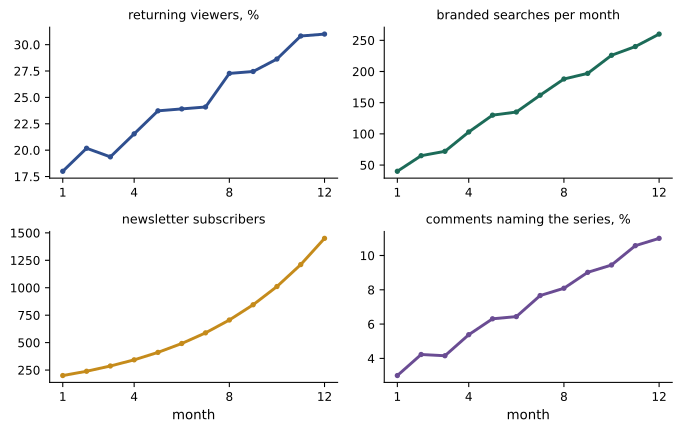
Platform analytics focus on individual pieces: views, click-through rate, retention, likes and shares. These matter, but they say little about the brand itself, whether people remember you, seek you out, trust you and describe you as you intend. Brand metrics capture that relationship. Useful indicators available to individual creators include:
- Returning viewers or readers: the share of your audience that comes back regularly. A rising share suggests a growing relationship.
- Branded search: how often people search for your name or brand, on the platform or in search engines. People who search for you by name have remembered you.
- Direct and owned traffic: newsletter subscribers, open rates, visits to your website, and members of your community spaces.
- Subscriber or follower conversion: the share of viewers who choose to follow after watching.
- Comment content: how often comments mention your name, series, catchphrases, values or the specific differences in your position, and the overall sentiment.
- Share and recommendation language: what people say when they share your work.
- Sponsor and collaborator interest: inbound requests from relevant brands and creators suggest a clear, valued position.
Track a few of these monthly in a simple brand dashboard, alongside content metrics, and look at trends over quarters rather than days.
Asking the audience directly
Analytics show what people do; surveys and conversations reveal what they think. An annual or twice-yearly audience survey can ask how people found you, what they value most, how they would describe you to a friend, what they would like more or less of, and how likely they are to recommend you. Keep surveys short and anonymous, and share what you learned and what you will change, which itself builds trust.
Net Promoter Score (NPS) is a widely used single question: "How likely are you to recommend [brand] to a friend, from 0 to 10?" Respondents scoring 9 or 10 are promoters, 7 or 8 passives, and 0 to 6 detractors. NPS equals the percentage of promoters minus the percentage of detractors, giving a score from −100 to +100. It is a rough measure, but tracking it over time, and especially reading the comments that explain each score, shows whether the relationship is strengthening.
Worked problem
Calculating NPS
Night Shift Kitchen surveys its audience and receives 400 responses: 188 score 9 or 10, 132 score 7 or 8, and 80 score 0 to 6. Calculate the NPS. A year later, with 500 responses, 260 are promoters and 75 are detractors. Has it improved?
Show solution
- Year 1: promoters 188 ÷ 400 = 47 %; detractors 80 ÷ 400 = 20 %.
- NPS = 47 − 20 = +27.
- Year 2: promoters 260 ÷ 500 = 52 %; detractors 75 ÷ 500 = 15 %.
- NPS = 52 − 15 = +37.
Answer: NPS rose from +27 to +37. Reading detractors' comments shows what to fix; reading promoters' comments shows what to protect.
Signs that change is needed
Some signals suggest the niche or brand needs adjusting:
- Plateau: growth has stalled for several months despite consistent quality, and the most successful competitors are growing.
- Audience mismatch: the people actually watching differ from your intended audience, and their interests pull in a different direction.
- Positioning drift: audiences describe you in ways you do not intend or recognize.
- Market change: the topic is declining, a platform has changed what it promotes, or regulations have changed the niche.
- Personal change: you have lost interest, your life situation has changed (a new job, a move, a family), or the niche conflicts with your values.
- Burnout: the workload or emotional cost of the brand is not sustainable.
Distinguish short-term dips (a slow month, one weak video, a seasonal low) from sustained trends. Review the brand dashboard quarterly, and make strategic decisions on trends over at least three to six months.
Ways a niche evolves
- Expanding: adding adjacent topics or audiences once you lead the original niche. Night Shift Kitchen might expand from meal prep to sleep and fitness for shift workers, or from nurses to all shift workers such as paramedics, factory workers and pilots. Expansion works best when the new area shares the same audience or the same core promise.
- Narrowing: focusing more tightly when a broad niche is not working, or when one sub-topic clearly outperforms the rest.
- Shifting format: keeping the topic and audience but changing the main format, for example from long videos to a podcast, or adding short-form clips.
- Pivoting: changing the topic, the audience or both substantially. Pivots are riskier, because part of the existing audience will not follow, but they are sometimes necessary.
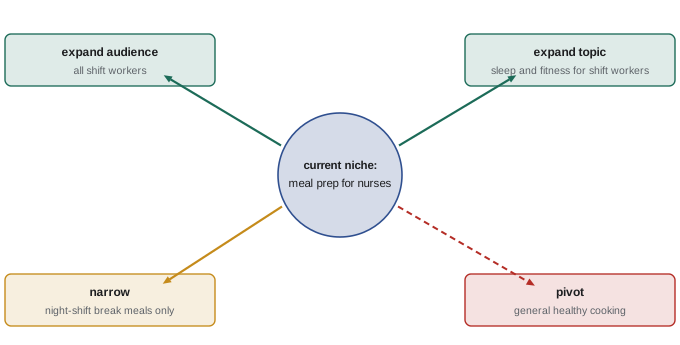
A useful principle is to move in adjacent steps: change one dimension at a time (topic, audience or format) and keep the others stable, so that the existing audience has a bridge to the new direction.
Managing a rebrand or pivot
When a change affects the name, visual identity or core promise, plan it like a project:
- Explain the why: audiences accept change better when they understand the reason, especially if it reflects the creator's growth or the audience's own needs.
- Bridge the old and new: create transitional content that connects the familiar with the new direction, and keep some familiar series running during the transition.
- Preserve findability: when changing a name, update all handles at once if possible, keep the old name in descriptions for a while ("formerly..."), redirect old links, and inform sponsors and collaborators.
- Update the brand plan: revise the positioning statement, pillars, voice and visual guides to match.
- Expect a dip: views and subscribers commonly fall temporarily after a pivot, as the platform re-learns who to show your content to and some followers leave. Set expectations and measure the new direction over months.
Reducing platform dependence
A brand built entirely on one platform is vulnerable: an algorithm change, a policy change, an account suspension or a platform decline can cut income and reach overnight. Strengthen resilience by owning direct channels (an email list, a website, a community space), building a presence on at least one secondary platform, diversifying income sources, keeping copies of your content and data, and following each platform's rules carefully to avoid strikes. Your brand, the relationship with your audience, is portable in a way platform metrics are not, which is one more reason to invest in it.
Learning from other creators’ evolutions
Studying how other creators have evolved can make your own decisions easier. Look for creators in your niche or adjacent ones who have expanded, narrowed or pivoted. What did they change, how did they explain it, and how did their audience respond? Often you will notice that successful evolutions were gradual and well explained, with familiar elements retained during the transition. Unsuccessful ones often changed too much at once, or appeared to abandon the audience without explanation.
It is also worth noticing what stays the same through successful evolutions. A creator who moves from video game reviews to game design tutorials may keep the same voice, the same visual identity and the same values, so long-time viewers still recognize the brand. The core promise may also remain, such as honest, entertaining guidance for people who love games, even as the topics change. When planning your own evolution, identify the elements that define your brand most deeply and protect them.
Growing with your audience
Audiences change over time too. A creator who started making content for university students may find that their early followers have graduated, started careers and families, and now want different things. Some creators choose to grow with their audience, evolving their topics as their followers' lives change. Others keep serving the same life stage and accept that individual followers will move on as new ones arrive. Both approaches can work, but it helps to decide deliberately rather than drift. Audience surveys and analytics showing changes in age and interests can inform the decision.
Collaborations are another tool for evolving a brand. Appearing with creators in an adjacent niche introduces you to new audiences and tests how well your brand travels. If a collaboration on sleep and fitness for shift workers resonates strongly, it may signal a promising direction for expansion.
A quarterly brand review
A structured quarterly review keeps evolution deliberate. Set aside a few hours every three months to look at your brand dashboard, the latest survey or comment analysis, your content library's performance by pillar and series, your capacity and energy, and any changes in your niche or platforms. Then answer four questions: What is working that we should do more of? What is not working that we should stop or change? What has changed in the audience, the market or my life? What one or two experiments will we run next quarter?
Write the answers in your brand plan and update the relevant sections. Most quarterly reviews lead to small adjustments, such as a new series, a retired pillar or an updated thumbnail template. Occasionally a review reveals the need for a larger change, and having the evidence in front of you makes that decision easier and calmer.
Evolution is a normal part of a creator’s career, not a sign of failure. Many of the most respected creators have changed their topics, formats and even names several times over the years, carrying their audiences with them because they explained each change honestly and kept their core promise. Measuring the brand, listening to the audience and reviewing the plan regularly give you the confidence to change when the evidence says it is time, and the patience to stay the course when it is not.
Above all, keep the audience informed and involved. Sharing what you are learning from the dashboard and surveys, and inviting suggestions for new series or directions, turns evolution into a shared project. Audiences who feel part of a brand’s growth are far more likely to follow it through changes than audiences who are surprised by them.
Common mistakes
MistakeJudging the brand only on views per video.
InsteadTrack returning audience, branded search, owned channels and sentiment.
MistakeChanging direction after one weak month.
InsteadDecide on trends over three to six months.
MistakeChanging topic, audience and format all at once.
InsteadMove one dimension at a time with bridge content.
MistakeRenaming without redirecting links or informing partners.
InsteadPlan the rebrand to preserve findability.
MistakeDepending entirely on one platform.
InsteadBuild owned channels and secondary platforms.
Summary and key terms
- Treat the niche and brand as a hypothesis you keep testing.
- Brand metrics include returning audience, branded search, owned channels, conversion and comment content.
- Surveys and NPS (promoters minus detractors) reveal how the audience perceives you.
- Plateaus, mismatches, drift, market and personal change and burnout signal a need to adjust.
- Niches evolve by expanding, narrowing, shifting format or pivoting; move in adjacent steps.
- Plan rebrands with explanation, bridges, findability and updated guides, and expect a dip.
- Reduce platform dependence with owned channels and diversification.
- Brand metric
- A measure of the audience relationship with the brand.
- Returning viewers
- Audience members who come back regularly.
- Branded search
- Searches for a creator's name or brand.
- Net Promoter Score
- Percentage of promoters minus percentage of detractors.
- Plateau
- A sustained period of stalled growth.
- Positioning drift
- A gap between intended and perceived position.
- Expansion
- Adding adjacent topics or audiences.
- Pivot
- A substantial change of topic or audience.
- Bridge content
- Content linking the old and new direction.
- Platform dependence
- Reliance on a single platform for reach and income.
Practice problems
Work each problem on paper first, then reveal the answer to check.
Why are content metrics not enough to measure a brand?
Show answer
They measure pieces, not whether people remember, seek out and trust you.
Name four brand metrics.
Show answer
Returning viewers, branded search, owned channel growth, conversion, comment content.
How is NPS calculated?
Show answer
Percentage scoring 9–10 minus percentage scoring 0–6.
Of 200 responses, 90 are promoters and 50 detractors. What is the NPS?
Show answer
45 − 25 = +20.
Name three signs that change may be needed.
Show answer
Plateau, audience mismatch, positioning drift, market change, loss of interest, burnout.
Over what period should strategic decisions be judged?
Show answer
At least three to six months.
Describe the four ways a niche evolves.
Show answer
Expanding, narrowing, shifting format, pivoting.
What is the adjacent-step principle?
Show answer
Change one dimension at a time to keep a bridge for the audience.
List three steps in managing a name change.
Show answer
Explain why, update handles together, keep "formerly", redirect links, inform partners.
How can creators reduce platform dependence?
Show answer
Email list, website, community, secondary platforms, diversified income.
Lesson quiz · 5 questions
Score 60% or more to complete this lesson.
Create a free account to save your progress, take quizzes and earn a certificate.