
CRE-110 · Lesson 1 of 12 · 25 min
Niches, brands and why they matter
Anyone can post online, and hundreds of millions of people do. Yet only a small share of creators build an audience that grows steadily, trusts them and supports a living. One of the clearest differences between those who grow and those who stall is focus: successful creators usually know exactly what they make, for whom, and why someone should choose them over every other option in the feed. That focus has two parts. The niche is the territory: the subject, the audience and the need you serve. The personal brand is the identity: the consistent impression of who you are, what you stand for and what people can expect from you. This course is about choosing both deliberately rather than drifting into them. This first lesson defines the key ideas, explains why niches and brands matter so much in the creator economy, clears up some common misconceptions, and introduces the brand plan you will build over the course.
What a niche is
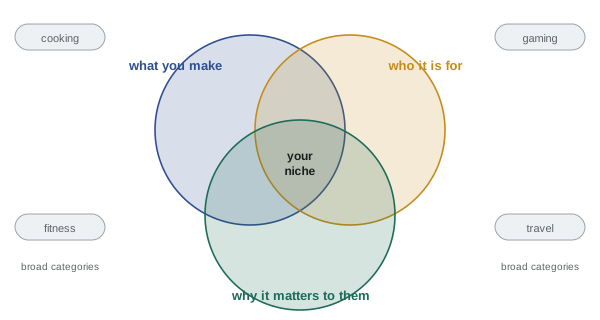
A niche is a specific combination of topic, audience and purpose. "Cooking" is a category, not a niche; "fast weeknight vegetarian dinners for students on a tight budget" is a niche. "Fitness" is a category; "strength training for women over fifty who are new to the gym" is a niche. A good niche statement answers three questions:
- What? The subject or type of content: the skill, hobby, problem, story or experience you cover.
- For whom? The audience: the specific people who will care most, described by their situation, goals or identity rather than just by age.
- Why? The purpose or value: what the audience gets, such as learning a skill, saving money, feeling less alone, being entertained, or making a decision.
Some niches are defined mostly by topic (mechanical keyboards, birdwatching, personal finance), some mostly by audience (new parents, nurses, people living with chronic pain), and some mostly by a perspective or format (a comedian who reviews history, a scientist who tests viral kitchen hacks). Many strong niches combine two unusual elements: a perspective or skill that few people have, applied to a topic many people care about.
What a personal brand is
A brand is the set of associations people hold in their minds about a person, product or organization: what it is, what it is like, and what to expect from it. A personal brand is the brand of an individual. Every creator has one, whether they shape it or not, because audiences form impressions from everything they see: the topics, the tone of voice, the visual style, the way comments are answered, the sponsors accepted and the mistakes acknowledged or ignored. Branding is the deliberate work of making those impressions consistent and true.
A useful way to think about a brand is as a promise. When someone sees your name in a feed, the brand tells them what they will get if they click: a clear explanation, a laugh, a calm half hour, an honest review. Keeping that promise again and again builds trust; breaking it, through clickbait, inconsistent quality or sudden shifts in values, erodes trust quickly. A brand is not a logo or a color palette, although those help people recognize it. It lives in the minds of the audience, and it is earned through behavior over time.
- Identity: who you are and what you care about, which you control.
- Expression: how you present that identity through content, voice, visuals and conduct, which you also control.
- Image: what the audience actually perceives, which you can influence but never fully control.
Branding work aims to close the gap between identity, expression and image, so that what people perceive matches who you are and what you intend.
Why niches matter in the creator economy
- Recommendation systems: platforms recommend content to people likely to watch it, based on what similar viewers watched before. A channel with a clear topic gives the system strong, consistent signals about who will enjoy it, so new uploads find the right viewers faster. A channel that jumps between unrelated topics confuses those signals, and each upload starts nearly from scratch.
- Search and discovery: people search for specific things. Content that answers specific questions in a defined area is easier to find and more likely to be shown.
- Memorability: people remember "the person who explains tax for freelancers" more easily than "a person who posts about lots of things". Clear positioning makes word-of-mouth possible.
- Community: a shared interest gives followers a reason to talk to each other, not just to the creator, which builds loyalty.
- Monetization: brands buy access to specific audiences. A sponsor selling climbing shoes will pay more per viewer for a climbing channel than for a general lifestyle channel, because the audience is more relevant. Products, courses and services are also easier to create and sell to a defined audience with known needs.
- Efficiency: a focused creator builds expertise, a repeatable workflow and a library of related content that keeps attracting viewers over time.
Misconceptions about niches
- "A niche means a tiny audience." Specific does not have to mean small. A niche is a starting point that you dominate before expanding; many creators who now cover broad topics started in a narrow corner. And a small, engaged audience can be worth more than a large, indifferent one.
- "I have to pick one topic forever." Niches evolve. Creators widen, narrow, shift and sometimes pivot completely (Lesson 11). Choosing a niche is a decision for the next stage, not a life sentence.
- "My personality is my niche." For a few entertainers, personality really is the product, but most of them still have a recognizable format or theme. Personality-led channels tend to grow slowly at first, because strangers have no reason to care about someone they do not know yet.
- "The best niches are already taken." Popular topics are crowded, but a different audience, angle, format or level of expertise can create space. There were thousands of cooking channels before each of the successful new ones that launched last year.
- "Branding is about looking professional." Polish helps, but audiences respond more to clarity, consistency and authenticity than to expensive graphics.
Brand, reputation and trust
For creators, the personal brand and the business are closely tied to one person. This brings advantages: audiences connect with people more easily than with companies, and the creator can build trust directly. It also brings risks. A creator's private life, past posts and offhand comments can affect the business; illness or burnout can halt it; and the line between the public persona and private self can blur. Lesson 9 returns to these issues. For now, it is enough to note that a brand built on honest foundations, with clear boundaries, is more durable than one built on an exaggerated or invented persona.
Trust is built through several behaviors that recur throughout this course: delivering what titles and thumbnails promise, being transparent about sponsorships and affiliate links, correcting mistakes publicly, staying within your competence, and treating the audience with respect. Trust compounds: an audience that trusts a creator watches more, recommends more, buys more and forgives more.
Examples of niches and brands
| Category | Possible niche | Brand promise |
|---|---|---|
| Cooking | Fast vegetarian dinners for students on a budget | Cheap, quick, tasty meals anyone can make tonight |
| Fitness | Strength training for women over 50 who are new to the gym | Safe, encouraging progress without intimidation |
| Personal finance | Money basics for new immigrants | Clear, step-by-step answers to unfamiliar systems |
| Gaming | Speedrun history explained like sports commentary | Exciting stories about record-breaking runs |
| Crafts | Repairing and restyling thrifted clothing | Sustainable style on a small budget |
| Science | Testing viral life hacks with real experiments | Honest, fun answers to what actually works |
Worked problem
From category to niche statement
Jordan is a nurse who enjoys cooking and wants to start a channel. Their first idea is "a cooking channel". Turn this into a niche statement.
Show solution
- What: Jordan has a distinctive situation, working twelve-hour night shifts, and real knowledge of nutrition and fatigue.
- For whom: shift workers, especially nurses and other health care workers, who struggle to eat well on irregular schedules.
- Why: to help them prepare healthy meals in advance that are easy to eat on a short break and do not leave them sluggish.
- Niche statement: "Meal prep for shift workers: healthy, make-ahead food that fits twelve-hour shifts, from a nurse who lives it."
- Check: the topic is specific, the audience is identifiable and reachable (nursing communities, hospital groups), and Jordan's personal experience gives credibility.
Answer: A clear niche statement combines Jordan's skill (cooking), credibility (nursing and shift work) and a specific audience with a real problem, giving both the audience and the platform a reason to pay attention.
The brand plan
Throughout this course you will build a brand plan: a short, practical document that captures your decisions about your niche and brand so you can apply them consistently and revisit them as you grow. By Lesson 12 it will contain:
- A self-inventory of your skills, interests, values and constraints (Lesson 2).
- An audience profile based on research (Lesson 3).
- A validated niche with evidence of demand and competition (Lesson 4).
- A positioning statement and competitive map (Lesson 5).
- Content pillars, formats and a series plan (Lesson 6).
- A voice and tone guide (Lesson 7).
- A visual identity guide (Lesson 8).
- Boundaries and an authenticity policy (Lesson 9).
- Name, handles, bios and legal checks (Lesson 10).
- A plan for measuring and evolving the brand (Lesson 11).
Start now with a single page of notes: what you think your niche might be, who you think it is for, and three creators you admire and why. You will test and refine every part of it in the lessons that follow.
How long it takes
Finding a niche is usually iterative. Many creators publish twenty, fifty or a hundred pieces before they discover what resonates with an audience and what they enjoy making. Research and planning reduce the number of wrong turns, but they do not replace the feedback that only publishing provides. The goal of this course is to make your first attempts deliberate, so that each one teaches you something, and to give you a framework for adjusting your niche and brand as you learn.
A short history of niches online
Niche content is not new. Specialist magazines, radio shows and community newsletters served hobbyists and professional groups long before the internet. What changed online is that distribution became nearly free, so audiences too small or scattered for a print magazine became reachable. Early blogs and forums let enthusiasts find each other across distances, and video platforms and social feeds later added recommendation systems that actively connect niche content with the people most likely to enjoy it. Today a creator can serve a few thousand devoted people anywhere in the world and build a sustainable business, something that was rarely possible when reaching an audience required a printing press or a broadcast license.
Common mistakes
MistakeChoosing a broad category such as "lifestyle" as a niche.
InsteadDefine topic, audience and purpose specifically.
MistakeTreating the brand as a logo and color scheme.
InsteadTreat it as a promise kept through content and conduct.
MistakeCopying a successful creator's niche exactly.
InsteadFind an angle, audience or format that is yours.
MistakeBelieving a niche must be permanent.
InsteadChoose for the next stage and evolve with evidence.
MistakeBuilding a persona that differs from who you really are.
InsteadBuild on honest foundations with clear boundaries.
Summary and key terms
- A niche combines what you make, who it is for, and why it matters to them.
- A personal brand is the set of associations people hold about you; it works as a promise.
- Identity and expression are under your control; image is what the audience perceives.
- Niches help recommendation systems, search, memorability, community and monetization.
- Niches can be specific without being tiny, and they evolve over time.
- Trust is built by keeping promises, transparency, correcting mistakes and staying within competence.
- The brand plan built in this course records your decisions and is revised as you learn.
- Niche
- A specific combination of topic, audience and purpose.
- Category
- A broad subject area containing many niches.
- Personal brand
- The associations people hold about an individual.
- Brand promise
- What the audience can expect every time.
- Brand identity
- Who you are and what you stand for.
- Brand image
- What the audience actually perceives.
- Positioning
- Where you sit in the audience's mind relative to alternatives.
- Recommendation system
- Software that chooses content to show each user.
- Trust
- The audience's confidence that you will keep your promise.
- Brand plan
- A document recording niche and brand decisions.
Practice problems
Work each problem on paper first, then reveal the answer to check.
What three questions does a niche statement answer?
Show answer
What, for whom, and why.
Is "travel" a niche? Explain.
Show answer
No, it is a category; a niche would specify audience and purpose, such as accessible travel for wheelchair users.
Define a personal brand.
Show answer
The set of associations people hold about an individual and what to expect from them.
Why do recommendation systems favor focused channels?
Show answer
Consistent topics give clear signals about which viewers will enjoy new content.
Why do sponsors pay more for niche audiences?
Show answer
The audience is more relevant to their product.
Name the three parts of a brand discussed in this lesson.
Show answer
Identity, expression and image.
Give two behaviors that build trust.
Show answer
Keeping title promises, disclosing sponsorships, correcting mistakes, staying within competence.
Correct the misconception "a niche means a tiny audience".
Show answer
A niche is a starting point that can be large or expand, and engagement matters more than size.
Write a niche statement for a retired teacher who loves gardening.
Show answer
Example: simple vegetable gardening lessons for classroom teachers starting school gardens.
Why is finding a niche iterative?
Show answer
Publishing provides feedback that research alone cannot.
Lesson quiz · 5 questions
Score 60% or more to complete this lesson.
Create a free account to save your progress, take quizzes and earn a certificate.