
CRE-101 · Lesson 7 of 12 · 32 min
The realities: income, risk and luck
Stories about creators usually feature the winners: the teenager with a million subscribers, the gamer who signed an eight-figure streaming deal, the influencer whose beauty brand sold for hundreds of millions. These stories are real, but they are the visible tip of a very large pyramid. This lesson looks at the whole pyramid: how creator income is actually distributed, why it is so uneven, how much luck is involved, what the work costs in time, money and wellbeing, and what risks come with building a public profile. The aim is not to discourage you but to let you make decisions with accurate expectations, which is what separates sustainable creators from those who burn out.
A winner-take-most distribution
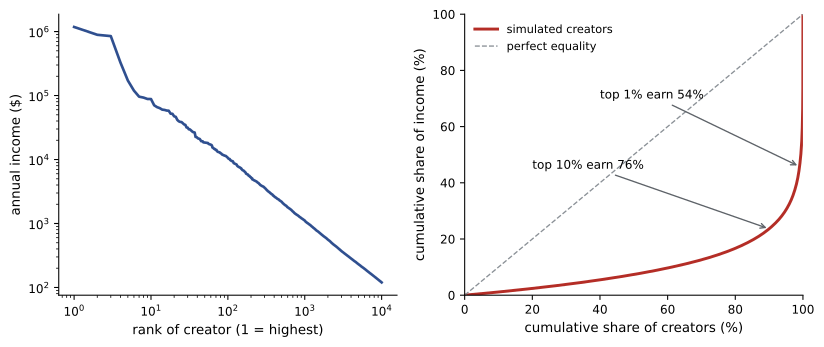
Creator income follows what is called a power-law or long-tail distribution: a small number of creators earn a large share of the total, and most earn little. The same pattern appears in book sales, music streams, app downloads and many other markets where products can be copied and distributed cheaply and attention flows to what is already popular.
Surveys consistently find that most people who call themselves creators earn less than a living from it. The 2023 Goldman Sachs estimate that about 4% of creators earn more than US$100,000 a year is one example; other surveys by creator platforms and researchers report that a majority earn less than a few thousand dollars a year, many earn nothing, and only a small fraction earn enough to replace a full-time job. Platform data tell the same story: on most platforms, a small percentage of channels receive the large majority of views.
| Share of creators | Typical situation |
|---|---|
| Most (well over half) | Earn nothing or a few hundred dollars a year; a hobby or side project |
| A large minority | Earn a meaningful side income, from hundreds to a few thousand a month |
| A small minority | Earn a full-time living, often combining several revenue streams |
| A tiny fraction | Earn very large sums and build companies |
Why the distribution is so uneven
Several mechanisms concentrate attention and income:
- Cumulative advantage: success breeds success. Recommendation algorithms show popular content to more people; popular creators get more search ranking, collaborations, press and sponsorship offers; viewers trust what others already watch. Small early differences grow into large ones.
- Low cost of copies: one video can be watched by a hundred people or a hundred million at almost the same cost, so the best-liked content can serve almost everyone.
- Limited attention: people have a fixed amount of time, and they spend most of it on a small number of creators they already like.
- Brand budgets: advertisers prefer creators with proven audiences, so sponsorship money flows to those already successful.
A famous experiment shows how much this matters. In the MusicLab study published in 2006, researchers Matthew Salganik, Peter Dodds and Duncan Watts let about 14,000 participants download songs by unknown bands. In some groups, participants could see how many times each song had been downloaded; in a control group, they could not. In the "social influence" groups, inequality of success was much greater, and which songs became hits varied unpredictably from group to group. Quality mattered (the best songs rarely did very badly and the worst rarely did very well), but luck and early momentum determined much of the outcome.
Luck, skill and persistence
Creator success involves skill (making content people value, consistently), persistence (publishing for long enough to improve and be discovered), strategy (choosing a niche and platform well) and luck (timing, a video catching a trend, an early share from a large account, an algorithm change in your favor). You can control the first three but not the last. Good practice is to treat each piece of content as a draw from a lottery whose odds you can improve: making more, better and more relevant content increases your chances of a hit, but no single piece is guaranteed to succeed.
Worked problem
Many attempts
Suppose each video has a 1% chance of "breaking out" (reaching far beyond the usual audience), independently. What is the probability of at least one breakout in 50 videos, and in 150 videos?
Show solution
- Probability of no breakout in \(n\) videos: \(0.99^n\).
- 50 videos: \(1 - 0.99^{50} = 1 - 0.605 = 0.395\).
- 150 videos: \(1 - 0.99^{150} = 1 - 0.221 = 0.779\).
Answer: About 40% after 50 videos and about 78% after 150. Real chances are not independent or fixed (skills improve, which raises the odds), but the example shows why creators who publish consistently for years are more likely to succeed than those who stop after a few months, and why one failed video says little.
Survivorship bias
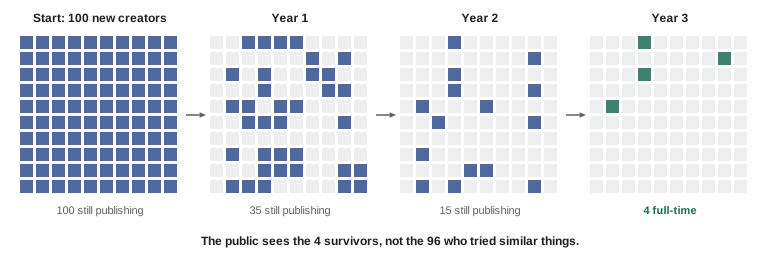
Survivorship bias is the error of drawing conclusions from the examples that succeeded while ignoring the much larger number that failed. Advice from successful creators ("I just posted every day and stayed authentic") is honest but incomplete: thousands of others did the same things and did not succeed. Their stories are not told because nobody watches the channels that failed. When learning from successful creators, ask what was distinctive about their situation (timing, skills, existing networks, resources, luck) and look for evidence from creators at your stage, not only from the top.
The time cost
Content takes much longer to make than to watch. A ten-minute YouTube video may take 10 to 40 hours to research, script, film, edit, design a thumbnail and publish; a polished 60-second short may take several hours; a weekly podcast episode may take a day including editing and promotion. On top of making content, creators spend time on community management (replying to comments and messages), business tasks (emails, negotiations, invoices, bookkeeping), learning, and analytics.
Worked problem
Effective hourly earnings
A creator publishes one long video a week, spending 25 hours per video plus 8 hours a week on other tasks. Monthly income from ads, a sponsor and affiliates is $2,400. Equipment and software cost $150 a month. What is the effective hourly rate (4.3 weeks per month)?
Show solution
- Hours per month: \((25 + 8) \times 4.3 = 141.9\).
- Net income: \(2400 - 150 = \$2250\).
- Hourly: \(2250/141.9 = \$15.86\).
Answer: About $15.86 an hour, before tax and with no paid holidays, benefits or pension, roughly comparable to a minimum-wage job in many places. This is a reasonably successful small creator. Improving the hourly rate means raising income per video (higher-value sponsors, products) or reducing hours (better workflows, help with editing), which later courses cover.
The money cost
Content also costs money, even when the tools are cheap. Typical expenses include equipment upgrades (microphones, lights, lenses, a faster computer for editing), software subscriptions (editing, design, music libraries, scheduling and analytics tools), props and materials for the content itself (ingredients, products to review, travel to locations), freelancers (editors, thumbnail designers), and business costs such as an accountant, a website and insurance. Creators who review products or travel can find that content costs exceed revenue for a long time. A simple rule is to track every expense from the first month and compare it with income each quarter, so that you know whether the activity is paying for itself and can deduct legitimate business expenses at tax time.
Worked problem
Break-even point
A travel creator spends $600 a month on travel and $90 on software. Each video earns about $45 from ads and affiliates. How many videos a month are needed to break even, and is this realistic for one person?
Show solution
- Monthly costs: \(600 + 90 = \$690\).
- Videos to break even: \(690/45 = 15.3\), so 16 videos.
Answer: About 16 videos a month, which is unrealistic for one person making well-produced travel videos. The creator needs higher income per video (sponsored trips, better-paying affiliate partners, products) or lower costs (local content between trips) before the business is viable.
Irregular income and financial risk
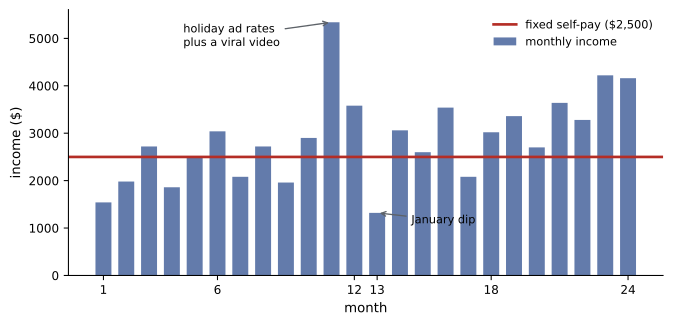
Creator income varies month to month: ad rates swing with seasons, sponsorships arrive irregularly, a viral month is followed by a quiet one, and platform changes can cut income suddenly. Self-employed creators also lack employer benefits (health or dental plans, pensions, paid leave, employment insurance in most cases) and must pay their own taxes. Sensible practices include keeping an emergency fund of several months of expenses, smoothing income by paying yourself a fixed monthly amount from a business account, setting aside tax, and not quitting other income until creator income has been stable for a sustained period.
Wellbeing and burnout
Creator work has particular mental health risks. Surveys of creators report high levels of burnout, anxiety and stress. Common causes include:
- Pressure to post constantly to stay visible in algorithmic feeds.
- Tying self-worth and income to public metrics that fluctuate daily.
- Comparison with more successful creators.
- Negative comments, harassment and parasocial expectations from audiences who feel they know the creator personally.
- Isolation, especially for solo creators working from home.
- Blurred boundaries between work and life when life itself is the content.
Many well-known creators have taken public breaks because of burnout. Protective practices include batching content to build a buffer, scheduled time off, limits on reading comments, separating private life from content, peer communities, and professional support when needed. CRE-360 covers creator wellbeing in depth.
Privacy, safety and reputation
A public profile brings risks that ordinary jobs do not:
- Privacy: viewers may work out where a creator lives from details in videos (street views, landmarks, packages, school uniforms). Doxxing (publishing someone's private information) and stalking are real risks.
- Harassment: targeted abuse, pile-ons and threats, which fall disproportionately on women, minorities and LGBTQ+ creators.
- Permanence: content stays online and can be rediscovered years later; past posts have ended careers.
- Impersonation and scams: fake accounts using a creator's name to defraud fans.
- Family and children: content featuring children raises questions of consent, privacy and earnings.
In the US, several states have passed laws on child influencers; Illinois became the first in 2024, requiring parents who feature minors in monetized content to set aside a share of earnings in trust for them, and other states have followed with similar rules. Creators featuring children should consider their consent, privacy and future, and check their state's current law.
Positive realities
The picture is not all bleak. Creator work offers real advantages: low barriers to start, creative control, the chance to build something of your own, direct connection with people who value your work, flexible location and hours, and skills that are widely valued. A modest audience can be enough: a creator with 2,000 devoted fans each paying $5 a month earns $120,000 a year before fees. Many creators earn well without fame by serving a specific niche (a profession, a craft, a local community) that values them highly. And the skills (storytelling, video production, writing, analytics, marketing, selling) open doors to jobs in marketing, media and communications.
Worked problem
The "true fans" idea
An idea popularized by writer Kevin Kelly in 2008 is that a creator can make a living from about 1,000 "true fans" who buy whatever they make. If 1,000 fans each spend $100 a year and platform and payment fees are 15%, what is net income? How many fans are needed for $60,000 net?
Show solution
- Net per fan: \(100 \times 0.85 = \$85\).
- 1,000 fans: $85,000.
- Fans for $60,000: \(60000/85 = 706\).
Answer: $85,000 from 1,000 fans; about 706 fans for $60,000. The challenge is that true fans are a small fraction of an audience, perhaps 1% to 5%, so 1,000 true fans may require tens of thousands of regular viewers or readers, and products worth paying for.
Lesson 8 shows how to work with brands without spending audience trust, and Lesson 11 covers creators' responsibilities to their audiences.
Common mistakes
MistakeExpecting success from following a famous creator's routine.
InsteadRemember survivorship bias; look at creators at your stage.
MistakeJudging yourself by a single video's performance.
InsteadTreat each piece as one draw; judge trends over many pieces.
MistakeQuitting other income after one good month.
InsteadWait for stable income over a sustained period, with an emergency fund.
MistakeSharing identifying details of your home or routine.
InsteadProtect location, family and personal information.
MistakeIgnoring burnout until it forces a stop.
InsteadBuild buffers, boundaries, breaks and support from the start.
Summary and key terms
- Creator income follows a long-tail distribution: a small share earns most of the money.
- Cumulative advantage, cheap copies, limited attention and brand budgets concentrate success.
- Luck matters; consistent output and improving skills raise the odds over many attempts.
- Survivorship bias hides the many who tried the same things and failed.
- Content takes far longer to make than to watch; effective hourly rates are often low.
- Income is volatile; emergency funds, fixed self-pay and tax savings reduce risk.
- Burnout, harassment and privacy risks are real and need active management.
- A small, devoted audience can support a living through direct support and products.
- Long-tail distribution
- A distribution where a few items earn most of the total and many earn little.
- Power law
- A relationship where frequency falls as a power of size, typical of winner-take-most markets.
- Cumulative advantage
- The process by which early success leads to further success.
- Lorenz curve
- A graph of the cumulative share of income earned by the bottom share of a population.
- Survivorship bias
- Drawing conclusions from successes while ignoring failures.
- Burnout
- Exhaustion and reduced effectiveness from prolonged stress.
- Parasocial relationship
- A one-sided sense of personal connection an audience member feels with a creator.
- Doxxing
- Publishing someone's private identifying information without consent.
- Emergency fund
- Savings covering several months of expenses.
- True fans
- Supporters who will buy most of what a creator makes.
Practice problems
Work each problem on paper first, then reveal the answer to check.
Describe the creator income distribution in one sentence.
Show answer
A few earn most of the income while most earn little or nothing.
Name three mechanisms of cumulative advantage for creators.
Show answer
Algorithms promote popular content, search ranking, collaborations, sponsorship offers, social proof.
What did the MusicLab experiment show?
Show answer
Social influence increased inequality and unpredictability of success; quality mattered but luck shaped outcomes.
With a 2% chance per video, probability of at least one breakout in 40 videos?
Show answer
1 − 0.98⁴⁰ ≈ 0.55.
What is survivorship bias? Give a creator example.
Show answer
Learning only from successes; e.g., copying a famous creator's habits without seeing the many who failed with the same habits.
20 hours per video, 2 videos a month, 10 hours other work, $900 net. Hourly rate?
Show answer
$900/50 = $18.
Name three ways to manage irregular income.
Show answer
Emergency fund, fixed self-pay from a business account, setting aside tax, keeping other income.
List four causes of creator burnout.
Show answer
Posting pressure, metrics and self-worth, comparison, harassment, isolation, blurred boundaries.
How could a video reveal a creator's home location?
Show answer
Window views, landmarks, packages with addresses, school uniforms, car plates.
500 true fans spending $80 a year with 10% fees. Net income?
Show answer
$36,000.
Lesson quiz · 5 questions
Score 60% or more to complete this lesson.
Create a free account to save your progress, take quizzes and earn a certificate.