
CRE-101 · Lesson 5 of 12 · 33 min
How creators earn money
Views alone do not pay the rent. Creators turn attention into income through a handful of business models: sharing advertising revenue with platforms, selling sponsorships to brands, earning commissions on sales, collecting direct support from fans, selling their own products, and offering services. Each has different requirements, risks and rewards, and most creators who earn a full-time living combine several. This lesson explains each model, how much it typically pays, and how to estimate what an audience might be worth. It ends with the basics of taxes and the importance of diversification.
All dollar amounts in this lesson are in US dollars.
Platform advertising revenue
Platforms sell advertising shown with creators' content and share part of the revenue. Two measures are used:
- CPM (cost per mille): what advertisers pay per 1,000 ad impressions. It varies with the audience's location, age and interests, the topic, the season (prices peak before the winter holidays and drop in January) and the ad format.
- RPM (revenue per mille): what the creator actually earns per 1,000 views of their content, after the platform's share and allowing for views that showed no ads. RPM is the number that matters for income planning.
RPMs for long-form YouTube videos commonly range from a few dollars to over $20 depending on the niche, with finance, business, software and technology at the top and gaming, comedy and children's content near the bottom. Short-form video pays far less: Shorts and TikTok's Creator Rewards typically pay well under $1 to a couple of dollars per 1,000 views. These are broad ranges, not promises; each platform's analytics show a creator's actual RPM.
Worked problem
Estimating ad revenue
A personal-finance YouTube channel gets 120,000 long-form views a month at an RPM of $14, and 900,000 Shorts views at an RPM of $0.06. What is its monthly ad revenue?
Show solution
- Long-form: \(120 \times 14 = \$1680\).
- Shorts: \(900 \times 0.06 = \$54\).
- Total: about $1,734 per month.
Answer: About $1,734 a month, almost all from long-form. Shorts bring many views and new subscribers but little direct ad income; their value is in growing the audience for long-form content and other revenue streams.
Platforms also run bonus funds and incentive programs from time to time, often to attract creators to a new feature. These can be generous at launch but are usually temporary and change without notice, so they should not be relied on.
Brand deals and sponsorships
Brand deals (also called sponsorships or partnerships) are the largest income source for most earning creators. A brand pays the creator to feature, mention or create content about a product. Common forms include:
- Integrated sponsorships: a segment within a video or podcast (a "read" of 60 to 90 seconds is typical).
- Dedicated content: a whole video or post about the product.
- Social posts, stories and short videos for a campaign.
- Affiliate or performance deals, paying per sale or sign-up, sometimes combined with a flat fee.
- Long-term ambassadorships over months or a year.
- Usage rights: payments for the brand to use the creator's content in its own advertising, often for a set period.
Prices depend on reach, engagement, audience fit, the creator's production quality, deliverables, usage rights and exclusivity (agreeing not to work with competitors). Rough rules of thumb circulate, such as about $10 to $25 per 1,000 followers for an Instagram post, or a CPM of $20 to $50 on expected views for a YouTube integration, but actual rates vary enormously and niches with valuable audiences (business software, finance, professional tools) command much more. Creators often publish a media kit summarizing their audience, statistics, past partners and rates.
Worked problem
Pricing a sponsorship
A tech channel's videos average 40,000 views in their first 30 days. A software company offers a 60-second integration. Using a CPM of $30 on expected views, plus 30% for six months of paid usage rights, what should the creator quote?
Show solution
- Base: \(40 \times 30 = \$1200\).
- Usage rights: \(1200 \times 0.30 = \$360\).
- Total: $1,560.
Answer: About $1,560, rounded to a clear quote such as $1,600. The creator should also set deliverables (one integration, one link in the description, one revision round), timelines, approval rights and payment terms in a written contract (CRE-330). Accepting sponsorships from brands that do not fit the audience can damage trust and future income more than the fee is worth.
Paid relationships must be disclosed clearly. In the US, the FTC's Endorsement Guides (revised in 2023) require clear and conspicuous disclosure of any material connection, such as payment, free products or family ties, and its 2024 rule on fake reviews and testimonials allows civil penalties. CRE-320 covers these rules.
Affiliate marketing
Affiliate marketing pays a commission on sales made through a creator's unique link or code. Programs range from large retailers (Amazon Associates, with commissions from about 1% to 10% depending on the product category) to individual brands and software companies (often 20% to 50% of the first payment or recurring commissions for subscriptions). Platforms have built shopping features, such as TikTok Shop and YouTube Shopping, that pay creators commissions on products tagged in content.
Worked problem
Affiliate income
A camera-gear reviewer's links get 8,000 clicks a month. 4% of clicks lead to a purchase, the average order is $400, and the commission is 3%. What is monthly affiliate income?
Show solution
- Purchases: \(8000 \times 0.04 = 320\).
- Sales: \(320 \times 400 = \$128{,}000\).
- Commission: \(128000 \times 0.03 = \$3840\).
Answer: About $3,840 a month. Affiliate income works best for content that helps people make buying decisions (reviews, comparisons, tutorials) and depends on trust: recommending poor products to earn commissions erodes the audience.
Direct fan support
Fans can pay creators directly through:
- Memberships and subscriptions: Patreon, YouTube channel memberships, Twitch subscriptions, paid newsletters (Substack, Beehiiv), and similar features on Instagram, Facebook and X.
- Tips and gifts: Super Chat and Super Thanks on YouTube, Bits on Twitch, gifts on TikTok Live, one-time tips.
- Crowdfunding for specific projects through Kickstarter or similar sites.
Platforms take a share: typically around 30% on mobile app purchases (because of app store fees) and smaller fees (often 5% to 12% plus payment processing) on web-based services such as Patreon or Substack. Fan support suits creators with loyal, engaged audiences, even small ones. A rule of thumb from membership platforms is that 1% to 5% of an engaged audience may become paying supporters.
Worked problem
Membership income
A history podcast has 15,000 regular listeners. If 2% become members at $6 a month, and fees total 12%, what is the net monthly income?
Show solution
- Members: \(15000 \times 0.02 = 300\).
- Gross: \(300 \times 6 = \$1800\).
- Net: \(1800 \times 0.88 = \$1584\).
Answer: About $1,584 a month, recurring and predictable compared with ad revenue. Members expect value in return: bonus episodes, early access, community or recognition. The supporters who leave each month (churn) must be replaced to keep income steady.
Selling products and services
Creators with trusted audiences can sell their own:
- Merchandise: clothing and accessories, often through print-on-demand services that produce items as orders arrive; margins are usually modest.
- Digital products: templates, presets, e-books, printables, music samples; high margins once created.
- Courses, workshops and coaching: often the highest-earning product for educational creators.
- Physical consumer brands: food, cosmetics, beverages and apparel; potentially very large but demanding manufacturing, inventory, retail and capital.
- Services: freelance work, consulting, speaking, photography, editing for other creators, or clients for an existing profession.
Products let a creator capture much more value per fan than advertising does. A creator earning $5 per 1,000 views might earn the same from one $200 course sale as from 40,000 views.
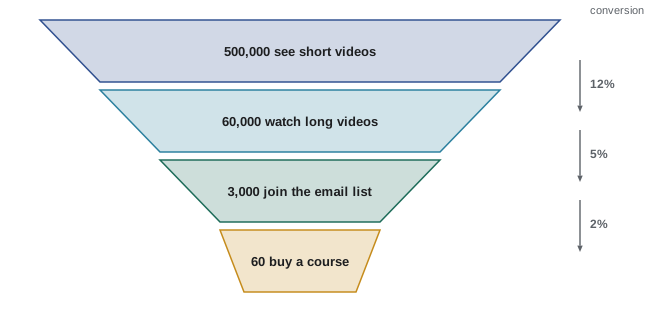
The funnel shows how revenue streams fit together: short-form content reaches many people, long-form content and podcasts build deeper relationships, owned channels such as an email list capture the most interested people, and products and services earn from a small share of them.
Licensing and other income
Other sources include licensing viral clips to media companies and advertisers, selling stock footage or photos, royalties from music, books or podcasts distributed by networks, appearance fees, and in some cases agency or management roles for other creators. Some creators also receive investment for their own companies (CRE-401).
Diversification
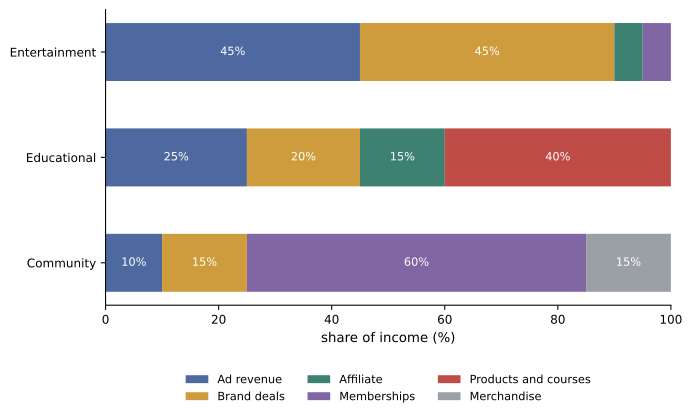
Relying on one income source, especially one controlled by a single platform or brand, is risky. Ad rates fall in recessions; a platform may cut a program; a large sponsor may end its budget. Creators who earn a stable living typically combine several streams, for example ad revenue plus sponsorships plus a product, and build an owned channel (email list or website) that lets them reach their audience whatever happens to a platform.
| Model | Needs | Strength | Weakness |
|---|---|---|---|
| Platform ads | Eligibility, many views | Passive once eligible | Low per view; platform controls rates |
| Brand deals | Fitting audience, engagement | Largest source for many | Irregular; must protect trust |
| Affiliate | Buying-intent content | Scales with useful content | Commissions can be cut |
| Fan support | Loyal audience | Recurring, predictable | Requires ongoing perks |
| Products | Trust, product skills | High value per fan | Upfront work, customer service |
| Services | Expertise | High value, works early | Trades time for money |
Getting paid
Income does not arrive when it is earned. Platforms pay monthly, usually after a payment threshold is reached (for example, YouTube pays through AdSense once the balance reaches US$100), and typically about three to eight weeks after the end of the month in which the money was earned. Brands often pay 30, 60 or even 90 days after content goes live, and some pay late. Affiliate programs may hold commissions until the return period has passed. A creator's cash in the bank can therefore lag well behind their earnings, especially when growing quickly. Practical habits include invoicing promptly, putting payment terms (and late fees) in contracts, asking for part of a sponsorship fee upfront, and tracking what is owed.
Creators with international audiences or sponsors may be paid in other currencies, and banks and payment services charge conversion fees, so check the effective rate received.
Taxes: the basics
In the US, creator income is generally self-employment income, reported on Schedule C, and taxable whether received as money or as free products given in exchange for promotion. Self-employed people pay self-employment tax (15.3% for Social Security and Medicare on most net earnings) as well as income tax, and usually make quarterly estimated tax payments. Payers send Form 1099-NEC for payments above a threshold (raised from $600 to $2,000 for 2026), and payment platforms send Form 1099-K above $20,000 and 200 transactions, but income is taxable even if no form arrives. Some states also require sales tax on merchandise and digital products. Keep records of income and expenses and set aside money for tax. CRE-330 covers this in detail; consult a tax professional for your situation.
Worked problem
Setting aside tax
A creator nets $36,000 of self-employment income in a year (after expenses). Using a rough combined rate of 25% for income and self-employment tax, how much should they set aside each month?
Show solution
- Annual tax estimate: \(36000 \times 0.25 = \$9000\).
- Monthly: \(9000/12 = \$750\).
- Quarterly estimated payments would be about $2,250 each.
Answer: About $750 a month, paid as quarterly estimates of about $2,250. Actual amounts depend on state, deductions and total income.
Lesson 6 turns to the craft of making content worth paying for, and Lesson 8 looks in detail at working with brands.
Common mistakes
MistakeAssuming views pay well by themselves.
InsteadUse RPM to estimate; short-form views pay very little directly.
MistakeAccepting any sponsorship that pays.
InsteadChoose brands that fit the audience to protect trust.
MistakeRelying on a single platform program or sponsor.
InsteadDiversify income and build an owned channel.
MistakeIgnoring tax on gifted products and setting nothing aside.
InsteadTreat gifts for promotion as income and save for tax.
MistakeHiding paid relationships.
InsteadDisclose clearly as the law requires.
Summary and key terms
- RPM, not CPM, determines a creator's ad earnings; long-form pays far more per view than short-form.
- Brand deals are the largest income source for many creators; price on reach, fit, deliverables and usage rights.
- Affiliate income depends on clicks, conversion, order value and commission.
- Fan support is recurring but requires ongoing value; platforms take fees.
- Products and services capture much more value per fan than advertising.
- A funnel connects broad reach to an owned list and a small share of buyers.
- Creator income, including gifted products, is taxable, including self-employment tax.
- CPM
- Cost per thousand ad impressions paid by advertisers.
- RPM
- Revenue per thousand views earned by the creator.
- Brand deal
- Payment from a brand for featuring its product in content.
- Usage rights
- Permission for a brand to use a creator's content in its own advertising.
- Exclusivity
- An agreement not to work with a brand's competitors for a period.
- Media kit
- A document summarizing a creator's audience, statistics and rates.
- Affiliate marketing
- Earning commissions on sales made through the creator's links or codes.
- Churn
- The share of subscribers or members who cancel in a period.
- Funnel
- The path from broad reach to engaged followers to paying customers.
- Diversification
- Spreading income across several sources to reduce risk.
Practice problems
Work each problem on paper first, then reveal the answer to check.
What is the difference between CPM and RPM?
Show answer
CPM is what advertisers pay per 1,000 impressions; RPM is what the creator earns per 1,000 views.
250,000 views at an RPM of $6. Earnings?
Show answer
$1,500.
2 million Shorts views at $0.05 RPM. Earnings?
Show answer
$100.
Expected 25,000 views at a $40 CPM, plus 25% for usage rights. Quote?
Show answer
$1,000 + $250 = $1,250.
5,000 clicks, 3% conversion, $60 average order, 8% commission. Income?
Show answer
150 sales, $9,000 sales, $720.
400 members at $5 with 10% fees. Net monthly?
Show answer
$1,800.
Why do products earn more per fan than ads?
Show answer
One sale can equal the ad revenue from tens of thousands of views.
Give two reasons to diversify income.
Show answer
Ad rates fall, programs end, sponsors leave, platforms change rules.
Is a free product received in exchange for a post taxable?
Show answer
Generally yes, as income in exchange for services.
What tax do self-employed creators pay besides income tax?
Show answer
Self-employment tax of 15.3% on most net earnings.
Lesson quiz · 5 questions
Score 60% or more to complete this lesson.
Create a free account to save your progress, take quizzes and earn a certificate.