
CON-350 · Lesson 11 of 12 · 26 min
Claims, disputes and alternative dispute resolution
When a risk occurs and the parties disagree about who should pay for it, the result is a claim. Claims are a normal part of construction; on large projects there may be dozens. They become a problem when they are poorly documented, left unresolved until the end of the job, or escalated into disputes that cost more to fight than the amount at stake. CON-220 covers the law of changes, delay and termination and the dispute resolution spectrum from negotiation to litigation, and CON-310 lesson 10 covers how changes and claims are tracked in the cost report. This lesson takes a risk management view: how to treat claims and disputes as risks to be identified, valued, reserved for and resolved at the lowest total cost, and how disputes with insurers and sureties fit into the picture.
Why claims arise
Most claims trace back to the risks discussed in this course: unexpected site conditions, design errors and late information, owner changes, delays and disruption, escalation, and disagreements about scope. The contract allocates the risk, but the parties often disagree about what the contract says, about the facts, or about the amount. Studies of construction disputes in North America regularly list the same causes: incomplete or unclear contract documents, failure to understand or comply with contract obligations, poorly administered changes, and unrealistic schedules.
| Cause of dispute | Risk management link | Preventive action |
|---|---|---|
| Unclear scope or documents | Identification (lesson 2), constructability review | Coordination reviews, clear scope sheets, pre-bid questions |
| Differing site conditions | Allocation (lesson 6) | Investigation, baselines, prompt notice |
| Owner changes and late information | Response planning (lesson 4) | Change process, RFI tracking, decision deadlines |
| Delay and disruption | Schedule risk analysis (lesson 3) | Updated schedules, timely notices, contemporaneous records |
| Payment disagreements | Cash flow risk (CON-320) | Prompt payment compliance, clear valuation methods |
| Missed notice periods | Contract review (lesson 5) | A notice calendar and training of site staff |
The subject of notice deserves repeating. Many claims fail not because the contractor was wrong on the merits but because it did not give the written notice the contract required within the time allowed (CON-220 lesson 9). A notice calendar, listing every notice period in the contract and assigning responsibility, is one of the cheapest risk controls available.
Valuing a claim as a risk
For both parties, an unresolved claim is an uncertain future cost or recovery, which makes it a risk that belongs in the register. The owner should estimate what it may have to pay and hold contingency for it; the contractor should estimate what it is likely to recover and avoid booking unlikely recoveries as profit (CON-320 lesson 4 covers the accounting rules for unapproved change orders and claims). The same expected value logic as lesson 3 applies, adjusted for the costs of pursuing or defending the claim.
Worked problem
Should Tallgrass pursue its dewatering claim?
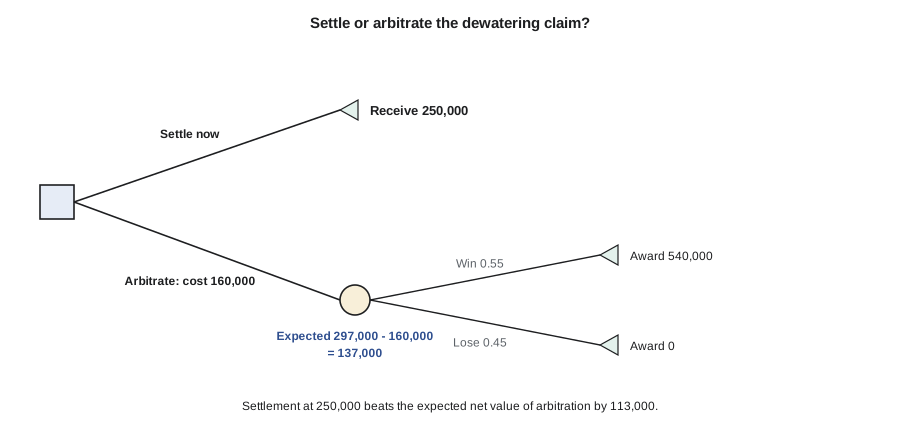
Tallgrass believes the groundwater at Kingfisher Wharf differed materially from the site report and claims $620,000 for extra dewatering and delay. Its lawyers estimate a 55 % chance of success, with an expected award of $540,000 if successful (some items may be reduced). Pursuing the claim through arbitration would cost about $160,000 in legal and expert fees and management time. The city offers to settle for $250,000. What should Tallgrass consider?
Show solution
- Expected award: 0.55 × 540,000 = $297,000.
- Expected net value of arbitration: 297,000 − 160,000 = $137,000.
- Settlement offer: $250,000, received now with no further cost.
- Settlement exceeds the expected net value of arbitration by 250,000 − 137,000 = $113,000.
Answer: On expected value alone, accepting $250,000 is better than arbitrating. Tallgrass should also weigh the relationship with the city, the time value of money and the chance that arbitration costs grow.
Owners use the same analysis from the other side. If the city believes the claim has a 55 % chance of success, its expected cost of defending is 0.55 × 540,000 plus its own legal costs of perhaps $140,000, or about $437,000. Settling at $250,000 is cheaper for the city too. When both parties do this arithmetic honestly, a zone of possible agreement usually appears, which is why most construction claims settle.
# Settlement zone for the dewatering claim (illustrative)
p_win, award = 0.55, 540_000
contractor_cost, owner_cost = 160_000, 140_000
contractor_walkaway = p_win * award - contractor_cost      # minimum it should accept
owner_walkaway = p_win * award + owner_cost                # maximum it should pay
print(f"Contractor's minimum acceptable settlement: {contractor_walkaway:,.0f}")
print(f"Owner's maximum sensible settlement:        {owner_walkaway:,.0f}")
print(f"Zone of possible agreement:                 {owner_walkaway - contractor_walkaway:,.0f} wide")
for p in (0.35, 0.55, 0.75):
print(f"If success probability were {p:.0%}: zone {p * award - contractor_cost:,.0f} to {p * award + owner_cost:,.0f}")Contractor's minimum acceptable settlement: 137,000 Owner's maximum sensible settlement: 437,000 Zone of possible agreement: 300,000 wide If success probability were 35%: zone 29,000 to 329,000 If success probability were 55%: zone 137,000 to 437,000 If success probability were 75%: zone 245,000 to 545,000
The width of the zone equals the two parties' combined costs of fighting, $300,000 here. The more expensive the dispute process, the wider the zone and the stronger the incentive to settle. Disagreement about the probability of success is what most often prevents settlement: if each side is overconfident, the zones may not overlap. Independent evaluation, discussed below, is a way of narrowing that disagreement.
Delay claims and time impact analysis
Delay claims are among the largest and most contested claims, because their value depends on proving what caused the delay and how much of the time-related cost flows from it. CON-220 lesson 9 covers the legal framework, including concurrent delay. The analytical method most commonly used during a project is time impact analysis: a fragment network representing the delay event is inserted into the current updated schedule, the schedule is recalculated, and the change in the completion date is the measured delay. Retrospective methods, such as comparing as-planned and as-built schedules or analyzing windows of time, are used after the fact. The Association for the Advancement of Cost Engineering's recommended practice on forensic schedule analysis is widely cited for these methods.
From a risk point of view, the key controls are a realistic, updated schedule and contemporaneous records. A delay claim built on a schedule that was never updated, or on records reconstructed months later, is weak whatever the merits. Contractors should treat schedule updating and daily records as risk controls, not paperwork.
| Record | Why it matters for claims |
|---|---|
| Updated schedule each month | Baseline for time impact analysis and proof of critical path |
| Daily reports with weather, crews, equipment and events | Contemporaneous evidence of what happened |
| Photographs and video, dated | Evidence of conditions and progress |
| RFI and submittal logs with dates | Proof of late information and its effect |
| Cost codes for extra work and delay | Separates claim costs from base work (CON-310) |
| Meeting minutes and correspondence | Evidence of notice and the parties' positions |
Dispute resolution as a risk choice
The contract's dispute resolution clause decides how disagreements will be settled, and choosing it is itself a risk decision. Faster, cheaper processes reduce the cost of disputes and the time cash is tied up; more formal processes give more thorough decisions but at higher cost and delay.
| Process | Speed | Cost | Binding? |
|---|---|---|---|
| Negotiation between project staff, then executives | Days to weeks | Low | If agreed |
| Dispute review board or standing neutral | Weeks | Moderate, mostly retainer | Usually recommendation, sometimes interim binding |
| Adjudication (statutory or contractual) | About 1 to 2 months | Low to moderate | Interim binding until final resolution |
| Mediation | Weeks to months | Moderate | Only if a settlement is signed |
| Arbitration | Months to years | High | Yes, with limited appeal |
| Litigation | Years | Highest | Yes, with appeal rights |
In the United States there is generally no statutory construction adjudication of the kind used in the United Kingdom and several Canadian provinces, although some contracts create contractual adjudication or initial decision makers. AIA A201-2017 uses an Initial Decision Maker followed by mediation and then arbitration or litigation, as the parties choose. Many construction contracts specify arbitration under the American Arbitration Association's Construction Industry Arbitration Rules, which were updated effective 1 March 2024: the fast-track ceiling rose to $150,000 and the threshold for a three-arbitrator panel in large, complex cases rose to $3 million. Dispute review boards, promoted by the Dispute Resolution Board Foundation, are common on large public infrastructure projects.
Dispute boards illustrate the preventive value of a good process. A board of experienced neutrals is appointed at the start of a large project, visits the site regularly, and hears disagreements as they arise, issuing recommendations within weeks. Because the board knows the project and the parties know it will hear their arguments, many disputes are settled before they are ever referred. Board costs, often a small fraction of a percent of project value, are typically shared equally.
Disputes with insurers and sureties
Some disputes are with the parties who were supposed to absorb the risk. Insurers may deny claims or accept them under a reservation of rights, meaning they will defend or investigate while keeping the right to deny coverage later. Coverage disputes commonly turn on exclusions such as defects (LEG wording, lesson 7), late notice, breach of conditions such as hot work rules, or whether a loss falls within the policy period. Sureties may deny performance bond claims on the grounds that there was no default, that the obligee did not follow the bond's conditions, or that the obligee itself breached the contract (lesson 10).
| Situation | Practical step |
|---|---|
| Insurer reserves rights | Engage the broker and, for significant amounts, coverage counsel; keep documenting |
| Insurer denies on late notice | Report early always; check whether the delay actually prejudiced the insurer, which matters in many jurisdictions |
| Defects exclusion invoked | Separate the defective work from resulting damage and check the exact wording |
| Surety disputes default | Show compliance with notice, termination and payment conditions |
| Multiple insurers involved | Identify which policies respond and in what order; wrap-ups reduce this problem |
The best protection against coverage disputes is preparation before any loss: reading policies and bond forms when they are bought, keeping certificates and endorsements organized, training site staff on notice and loss prevention conditions, and involving the broker early when something happens.
Reserving for claims
Owners and contractors both need to reflect open claims in their forecasts. The owner's forecast at completion should include an allowance for the expected cost of open contractor claims, usually from owner contingency (lesson 4), and the contractor's forecast should include only recoveries it is likely to achieve, with legal costs budgeted. Reporting claims to senior management with their expected value, range and next steps lets the organization see the whole exposure rather than just the optimistic view of the project team.
# Claims reserve for the owner: expected cost of open claims (illustrative)
claims = [   # (description, amount claimed, probability owner pays, expected share of amount if it pays)
    ("Dewatering and delay",        620_000, 0.55, 0.87),
    ("Mechanical coordination",     310_000, 0.40, 0.70),
    ("Rowing club access changes",   95_000, 0.80, 0.90),
    ("Pool tile substitution",      140_000, 0.20, 0.60),
]
total_claimed = sum(c[1] for c in claims)
reserve = sum(amt * p * share for _, amt, p, share in claims)
for name, amt, p, share in claims:
    print(f"{name:<28} claimed {amt:>8,}  expected {amt * p * share:>9,.0f}")
print(f"Total claimed {total_claimed:,}; expected cost {reserve:,.0f} ({reserve / total_claimed:.0%} of claimed)")Dewatering and delay claimed 620,000 expected 296,670 Mechanical coordination claimed 310,000 expected 86,800 Rowing club access changes claimed 95,000 expected 68,400 Pool tile substitution claimed 140,000 expected 16,800 Total claimed 1,165,000; expected cost 468,670 (40% of claimed)
Common mistakes
MistakeLetting claims accumulate until the end of the project.
InsteadResolve claims as they arise through the contract's change and dispute process.
MistakeMissing contractual notice periods.
InsteadKeep a notice calendar and train site staff.
MistakePursuing a claim without valuing it against the cost of pursuit.
InsteadCompare expected net value with settlement offers.
MistakeBuilding delay claims on schedules that were never updated.
InsteadUpdate the schedule monthly and keep contemporaneous records.
MistakeTreating an insurer's reservation of rights as acceptance.
InsteadTreat it as a warning; involve the broker and coverage counsel.
Summary and key terms
- Claims arise when risks occur and parties disagree about allocation, facts or amounts; most trace back to identifiable risks.
- Missed notice periods defeat many claims; a notice calendar is a cheap control.
- Claims are risks: value them by probability of success, expected award and cost of pursuit.
- The settlement zone is as wide as the parties' combined costs of fighting; overconfidence prevents settlement.
- Time impact analysis and contemporaneous records are the foundation of delay claims.
- The dispute resolution clause is a risk choice; adjudication and dispute boards resolve disputes quickly.
- Coverage and bond disputes are avoided by understanding policies and bonds before a loss and reporting promptly.
- Claim
- A demand by one party for additional payment or time under the contract.
- Calendar of notice periods
- A list of contractual notice periods with assigned responsibilities.
- Expected net value
- The probability-weighted recovery from a claim less the cost of pursuing it.
- Zone of possible agreement
- The range of settlements both parties should prefer to fighting.
- Time impact analysis
- Inserting a delay event into an updated schedule to measure its effect on completion.
- Adjudication
- A fast process in which a neutral gives an interim binding decision on a dispute.
- Dispute review board
- A standing panel of neutrals that follows a project and hears disputes as they arise.
- Reservation of rights
- An insurer's notice that it is investigating or defending while keeping the right to deny coverage.
- Coverage counsel
- A lawyer who advises on insurance coverage disputes.
- Claims reserve
- An allowance in a forecast for the expected cost or recovery of open claims.
Practice problems
Work each problem on paper first, then reveal the answer to check.
A claim of $400,000 has a 60 % chance of success, expected award $350,000 and pursuit costs of $90,000. What is the expected net value?
Show answer
0.6 × 350,000 − 90,000 = $120,000.
If the owner's defense costs are $80,000 in the same case, what is the owner's maximum sensible settlement?
Show answer
0.6 × 350,000 + 80,000 = $290,000.
How wide is the settlement zone in that case?
Show answer
290,000 − 120,000 = $170,000, equal to combined costs.
Why do many claims fail regardless of merit?
Show answer
Failure to give contractual notice in time.
What is time impact analysis?
Show answer
Inserting a delay fragment into the current schedule and measuring the change in completion.
Name two records that support a delay claim.
Show answer
Any two of: updated schedules, daily reports, dated photographs, RFI logs, cost codes, minutes.
What does the AAA's 2024 rules update set as the fast-track ceiling?
Show answer
$150,000.
What is the main advantage of a dispute review board?
Show answer
It knows the project and resolves disputes early, often preventing referrals.
What is a reservation of rights letter?
Show answer
A notice that an insurer is investigating or defending while keeping the right to deny coverage.
Why should an owner's forecast include a claims reserve?
Show answer
To show the expected cost of open claims rather than an optimistic view.
Lesson quiz · 5 questions
Score 60% or more to complete this lesson.
Create a free account to save your progress, take quizzes and earn a certificate.