
CON-305 · Lesson 9 of 12 · 27 min
Problem solving and decision making
Superintendents make dozens of decisions a day. Most are small and routine: which crew goes where, whether a delivery can come at 10 instead of 8, how to route a hose around a stair. Some are large and uncertain: whether to pour a slab with rain forecast, how to recover a two-week delay, what to do when a beam arrives the wrong length. And many decisions begin as problems, something has gone wrong and needs fixing, without making things worse. This lesson offers a structured way to solve problems, tools for finding root causes, methods for making decisions under uncertainty, the biases that lead good people to bad decisions and guidance on when to decide and when to escalate.
BUS-130 introduces decision making in organizations; CON-410 covers the A3 problem-solving report and continuous improvement in lean construction; CON-345 covers quality nonconformances; CON-420 covers what happens when problems become claims. This lesson is about the supervisor's everyday problem solving in the field.
A structured approach to site problems
Under pressure, people jump from symptom to solution. The concrete is honeycombed, so patch it; the drywall crew is slow, so add workers; the inspection failed, so fix the item and rebook. Sometimes that is enough. But problems that come back, cost a lot or involve safety deserve a more structured approach. A simple six-step cycle works for most site problems.
| Step | Key questions | Common shortcut to avoid |
|---|---|---|
| 1. Define | What exactly is wrong? Where, when, how much? What is it not? | Defining the problem as a solution ("we need more workers") |
| 2. Contain | How do we stop it getting worse or hurting anyone right now? | Investigating while the hazard or defect keeps spreading |
| 3. Find causes | Why did it happen? What are the root causes, not just the immediate cause? | Stopping at the first cause or at a person to blame |
| 4. Choose a solution | What options fix the root cause? What are their costs, risks and side effects? | Taking the first idea without considering alternatives |
| 5. Implement | Who does what by when? Who needs to know? | Assuming the fix is done because it was agreed |
| 6. Check and standardize | Did it work? How do we prevent a repeat on this and future projects? | Never confirming results; same problem next floor |
Defining the problem
A well-defined problem is half solved. Charles Kepner and Benjamin Tregoe, whose methods are still taught widely, recommended describing a problem by what it is and what it is not: where it occurs and where it does not, when it started and when it does not happen, how big it is and how big it could be. The contrasts point to causes. If drywall screw pops appear on level 3 but not levels 2 or 4, in units on the north side but not the south, and only in ceilings, something specific to those ceilings on level 3 is different, perhaps a different framing crew, a different joist supplier or a period of high humidity when the board was hung.
It also helps to state the problem in terms of its impact on the project's goals: 'level 3 north ceilings show screw pops in about 30 % of units, which will fail the owner's finish inspection and delay turnover of 14 units' is a problem statement that tells everyone why it matters and how big it is.
Contain first
For safety and quality problems, the first action is containment: stop the problem from growing while the cause is found. If a guardrail post is found loose on one floor, the immediate action is to secure the area and check other posts installed by the same crew, before investigating why. If a batch of concrete cylinders breaks low, the immediate action is to identify where that concrete was placed and whether further loading should wait for engineering advice. Containment is not the fix; it buys time to find the real fix without adding damage.
Finding root causes
The immediate cause of a problem is rarely the whole story. A pour is delayed because the pump truck was late; the pump truck was late because it was booked for the wrong day; it was booked for the wrong day because the pour date changed and the change was communicated by text to someone who was on holiday. Fixing only the immediate cause, by shouting at the pump company, does nothing to stop the next missed booking. The root cause is the weak communication of schedule changes.
The five whys, a technique associated with Toyota and Taiichi Ohno, asks 'why?' repeatedly, usually about five times, until it reaches a cause that can be fixed in the system. It is simple and quick, but it has a weakness: it tends to follow a single chain and can stop at a person ('because Jim forgot'). Good practice is to keep asking why Jim forgot, which usually reveals a system weakness, and to consider several branches.
Worked problem
Five whys for a failed inspection
On Larkspur Commons, the municipal inspector failed the level 4 framing inspection because fire blocking was missing in several wall cavities. Apply the five whys.
Show solution
- Why did the inspection fail? Fire blocking was missing in about a dozen wall cavities on level 4.
- Why was it missing? The framing crew on that floor did not install it.
- Why not? Two new framers on the level 4 crew did not know the fire blocking requirement for those wall types; the requirement is on a detail sheet, not on the floor plans they were using.
- Why were they working only from the floor plans? Ridgeline's foreman gave them a printed plan set, and the detail sheet was not included; nobody walked the floor with them at start-up.
- Why was there no check before the inspection was called? Thornbury's pre-inspection walk was skipped that week because the assistant superintendent was covering another area.
Answer: Root causes: incomplete information given to new workers and a skipped internal check. Fixes: include detail sheets in floor packages, add fire blocking to Ridgeline's start-up briefing for new workers and make the pre-inspection walk a hold point that cannot be skipped. Blaming the two new framers would have fixed nothing.
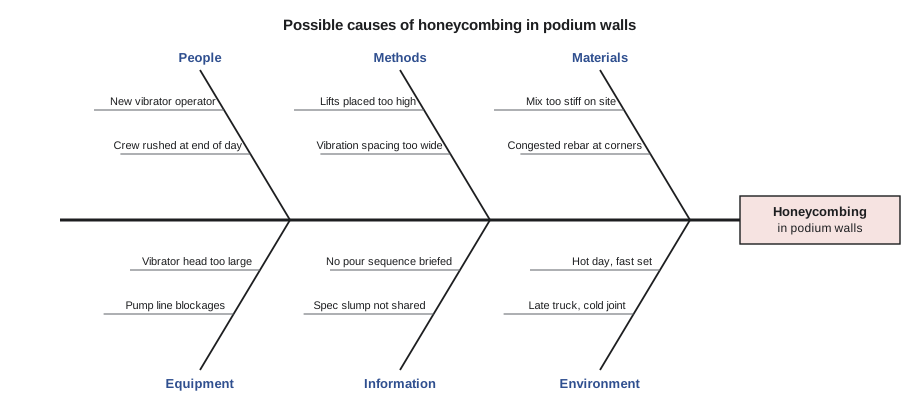
The fishbone or cause-and-effect diagram, developed by Kaoru Ishikawa, helps teams think more broadly. The problem is written at the head of the fish and the main bones represent categories of cause. Manufacturing uses the 6Ms (manpower, methods, materials, machines, measurement and mother nature); for construction a useful set is people, methods, materials, equipment, information and environment. The team brainstorms possible causes under each heading, then tests the most likely ones with evidence.
Making decisions
Many site decisions are programmed: they follow established rules or company procedures, such as how to respond to a near miss or when a hot work permit is needed. Others are non-programmed: new, unstructured situations that need judgment. Non-programmed decisions benefit from a few disciplines. Generate more than one option before choosing; the first idea is rarely the best. Be clear about the criteria that matter, such as safety, cost, schedule, quality and relationships. Involve the people who will carry out the decision or who know the most. Consider what could go wrong. And decide at the right speed.
A useful distinction, popularized by Jeff Bezos, is between reversible decisions, which can be undone cheaply if they turn out wrong, and irreversible ones, which cannot. Reversible decisions, such as moving a laydown area or trying a new crew arrangement for a week, should be made quickly by the person closest to the work. Irreversible decisions, such as cutting a post-tensioned slab, pouring concrete or removing shoring, deserve more care, more information and often a second opinion or engineering approval. Many site delays come from treating reversible decisions as if they were irreversible; many site disasters come from treating irreversible decisions as if they were reversible.
Comparing options with a decision matrix
When options differ on several criteria, a weighted decision matrix makes the trade-offs visible. List the criteria, give each a weight reflecting its importance, score each option against each criterion and calculate weighted totals. The result is not an answer to be followed blindly, but it forces the team to state what matters and why, and it often reveals that the favorite option is weaker than it seemed.
On Larkspur Commons, the wood frame is running two weeks behind and Dana is considering three recovery options: a second framing crew from another subcontractor on the upper floors, a Saturday shift for the existing crew for six weeks, or resequencing so that mechanical and electrical rough-in follows framing floor by floor more closely.
# Weighted decision matrix for three schedule recovery options (scores 1-5, higher is better)
criteria = {"safety": 0.30, "schedule recovery": 0.25, "cost": 0.20, "quality risk": 0.15, "relationships": 0.10}
options = {
    "Second framing crew":     {"safety": 3, "schedule recovery": 5, "cost": 2, "quality risk": 3, "relationships": 2},
    "Saturday shift (6 weeks)": {"safety": 2, "schedule recovery": 3, "cost": 3, "quality risk": 3, "relationships": 3},
    "Tighter resequencing":    {"safety": 4, "schedule recovery": 3, "cost": 5, "quality risk": 4, "relationships": 4},
}
assert abs(sum(criteria.values()) - 1) < 1e-9
results = {}
for name, sc in options.items():
    results[name] = sum(criteria[c] * sc[c] for c in criteria)
for name, total in sorted(results.items(), key=lambda kv: -kv[1]):
    print(f"{name:26s} weighted score {total:.2f}")
# Sensitivity: does the ranking change if schedule recovery matters much more?
alt = {"safety": 0.25, "schedule recovery": 0.45, "cost": 0.10, "quality risk": 0.10, "relationships": 0.10}
print("If schedule recovery is weighted 45 %:")
for name, sc in options.items():
print(f" {name:26s} {sum(alt[c] * sc[c] for c in alt):.2f}")Tighter resequencing weighted score 3.95 Second framing crew weighted score 3.20 Saturday shift (6 weeks) weighted score 2.70 If schedule recovery is weighted 45 %: Second framing crew 3.70 Saturday shift (6 weeks) 2.75 Tighter resequencing 3.65
With the original weights, tighter resequencing scores best: it is safer, cheaper and kinder to relationships, though it recovers less time than a second crew. The sensitivity check shows that if recovering every day of schedule mattered far more than cost, the second framing crew would edge narrowly ahead, 3.70 against 3.65, so the ranking depends on how much the owner values each day recovered. In practice Dana might combine options: resequence now, and line up a second crew in case the resequencing does not recover enough within three weeks. The matrix did not make the decision, but it focused the discussion with Priya on what mattered.
Deciding under uncertainty
Many site decisions involve uncertainty: weather, inspection outcomes, delivery reliability. One way to reason about them is expected value: multiply each possible outcome's cost by its probability and add them up. Consider a decision to pour the level 2 slab tomorrow with a 30 % chance of heavy rain. Pouring and getting lucky costs nothing extra; pouring in heavy rain might cost $40,000 in surface repairs and protection; postponing costs about $9,000 in crew time, pump rebooking and schedule. The expected cost of pouring is \(0.30 \times 40{,}000 = 12{,}000\), higher than the $9,000 cost of postponing, so on expected value alone the pour should be postponed, unless the forecast improves or better protection can reduce the damage.
Expected value is a useful discipline, but it has limits. Probabilities are often guesses, and some outcomes are so severe that their expected cost understates them: a small chance of a structural failure or a fatality is never acceptable just because its probability-weighted cost is small. For safety-critical decisions, the right question is not 'what is the expected cost?' but 'can we make this safe?'. Herbert Simon's idea of satisficing is also relevant: in real conditions people rarely find the optimal choice, and a good-enough decision made in time often beats a perfect one made too late.
Biases that trap good supervisors
Psychologists such as Daniel Kahneman and Amos Tversky have documented systematic biases in human judgment. Several are especially dangerous on construction sites.
| Bias | How it shows up on site | Countermeasure |
|---|---|---|
| Overconfidence | "We always get that done in two days"; underestimating durations and risks | Check against actual records; ask what could go wrong |
| Anchoring | The first estimate or schedule date sticks even when conditions change | Re-estimate from current facts |
| Confirmation bias | Looking only for evidence that the favored plan will work | Ask someone to argue the other side |
| Sunk cost | Continuing a failing method because so much has been spent on it | Decide on future costs and benefits only |
| Groupthink | Nobody challenges the superintendent in the meeting | Ask for dissent; ask quiet people first |
| Normalization of deviance | A shortcut that has not caused harm yet becomes the accepted way | Compare practice with the standard, not with last week |
| Plan continuation | Pressing on with a plan despite warning signs, such as pouring as rain starts | Set decision points and criteria in advance |
Normalization of deviance, a term coined by sociologist Diane Vaughan in her study of the Challenger space shuttle disaster, deserves special attention. It describes how people gradually come to accept a departure from a standard because nothing bad has happened yet. A crew that skips one shoring check under time pressure, gets away with it and skips it again has normalized the deviance. Each time feels safe because the last time was. Supervisors counter it by comparing current practice with the standard, not with recent habit, and by treating near misses as warnings rather than proof that the shortcut is safe.
Decide, involve or escalate
Supervisors also need to judge who should make a decision. Some decisions belong to the superintendent; some should involve the crew or foremen; some must be escalated. Decisions should be escalated when they exceed the supervisor's authority (contract scope, money beyond a limit, commitments to the owner), when they involve design (any change to structural elements, fire separations, building envelope or anything the engineer or architect of record controls, which goes through an RFI or the consultant), when they involve engineered temporary works such as shoring and formwork designed by an engineer (CON-325), when they involve legal or regulatory questions, or when the consequences are severe and the supervisor is unsure.
Escalating is not a sign of weakness. Superintendents get into serious trouble not by asking too many questions but by making design or contract decisions they had no authority to make: telling a framer to drill through a beam, approving a substitute product without review, agreeing with an owner's representative to a change in finishes. The good habit is to escalate with a recommendation: 'here is the problem, here are the options, here is what I recommend and why'.
Finally, record important decisions: what was decided, by whom, on what information, and why. A note in the daily report or a short email takes two minutes and can save weeks if the decision is questioned later (CON-375 and CON-420). After significant problems, a short after-action review, asking what was supposed to happen, what actually happened, why there was a difference and what we will do next time, turns experience into learning.
Common mistakes
MistakeJumping from symptom to solution without defining the problem.
InsteadDefine what, where, when and how much, including what the problem is not.
MistakeInvestigating while a hazard or defect keeps spreading.
InsteadContain first, then find the cause.
MistakeStopping the five whys at a person's mistake.
InsteadKeep asking why the mistake was possible and fix the system weakness.
MistakeTreating irreversible decisions, such as pouring or removing shoring, as casually as reversible ones.
InsteadSlow down for irreversible decisions; get information, a second opinion or engineering approval.
MistakeMaking design or contract decisions in the field to save time.
InsteadEscalate through RFIs, the consultant or the project manager, with a recommendation.
Summary and key terms
- Recurring, costly or safety-related problems need a structured cycle: define, contain, find causes, choose, implement and check.
- Good problem definitions describe what, where, when and how much, including where the problem is not.
- Containment stops problems growing while causes are investigated.
- Five whys and fishbone diagrams help find root causes in the system rather than blaming individuals.
- Decisions should consider several options and explicit criteria; reversible decisions can be fast, irreversible ones need care.
- Weighted decision matrices and expected value clarify trade-offs but never override safety.
- Overconfidence, anchoring, confirmation bias, sunk cost, groupthink and normalization of deviance distort site decisions.
- Escalate decisions beyond your authority, involving design, temporary works, law or severe consequences, and record important decisions.
- Containment
- Immediate action to stop a problem from growing or causing harm while its cause is found.
- Root cause
- The underlying system cause that, if fixed, prevents the problem from recurring.
- Five whys
- A technique that repeatedly asks why to move from a symptom to a root cause.
- Fishbone diagram
- A cause-and-effect diagram that groups possible causes into categories.
- Weighted decision matrix
- A table that scores options against weighted criteria to compare them.
- Expected value
- The sum of each outcome’s value multiplied by its probability.
- Normalization of deviance
- The gradual acceptance of departures from a standard because no harm has yet occurred.
- After-action review
- A short structured discussion of what was planned, what happened, why and what to change.
Practice problems
Work each problem on paper first, then reveal the answer to check.
List the six steps of the problem-solving cycle.
Show answer
Define, contain, find causes, choose a solution, implement, check and standardize.
Why describe what a problem is not?
Show answer
The contrasts between where it occurs and where it does not point to causes.
What were the root causes of the failed framing inspection?
Show answer
Incomplete information for new workers (missing detail sheets, no start-up briefing) and a skipped internal pre-inspection check.
Name six fishbone categories suited to construction.
Show answer
People, methods, materials, equipment, information and environment.
Give an example of a reversible and an irreversible site decision.
Show answer
Reversible: moving a laydown area. Irreversible: pouring concrete or cutting a slab.
In the pour example, compare the expected cost of pouring with the cost of postponing.
Show answer
Pouring: 0.30 × $40,000 = $12,000; postponing: $9,000; postpone unless conditions change.
What is normalization of deviance and how can supervisors counter it?
Show answer
Gradual acceptance of shortcuts because no harm has occurred; compare practice with the standard and treat near misses as warnings.
Give three situations in which a superintendent should escalate a decision.
Show answer
Design changes, engineered temporary works, contract or money beyond authority, legal questions, severe and uncertain consequences.
Lesson quiz · 5 questions
Score 60% or more to complete this lesson.
Create a free account to save your progress, take quizzes and earn a certificate.