
CON-305 · Lesson 10 of 12 · 26 min
Conflict, negotiation and difficult conversations
Construction sites generate conflict. Fourteen companies share one building, each with its own schedule, budget and pressures. The electrician needs the ceiling space the duct installer wants; the drywall crew finds the framing out of plumb; the painter blames the drywall finisher for a poor surface; a foreman is furious that his material was moved; the owner's representative wants a finish the budget did not include. Conflict is not a sign that something is wrong with the project. It is a normal result of interdependent people working under pressure. What matters is how it is handled.
This lesson covers the sources and types of site conflict, the Thomas–Kilmann modes for responding to it, how a superintendent can mediate between trades, the basics of principled negotiation and how to prepare for and conduct difficult conversations. Formal disputes and claims under the contract are covered in CON-420, and violence, harassment and de-escalation in HSE-108. BUS-130 covers conflict and negotiation theory more broadly.
Sources and types of conflict
Common sources of conflict on site include competition for space, access and equipment; sequence and timing (who goes first, who is holding up whom); damage to completed work; cleanup and housekeeping; scope gaps and overlaps between subcontracts; quality and workmanship disputes; money, especially back charges and extras; and personality clashes. Many conflicts that look personal are really about the work system: two foremen who seem to hate each other may simply have been given conflicting instructions or overlapping areas.
Researchers distinguish task conflict, disagreement about the work itself, from relationship conflict, personal friction and hostility. Karen Jehn's studies and later research found that relationship conflict almost always harms team performance, while moderate task conflict can sometimes improve decisions by surfacing different views, although that benefit is fragile and disappears when task conflict turns personal. A superintendent's goal is not to eliminate disagreement about the work, which may reveal a better sequence or a hidden problem, but to keep it focused on the work and stop it becoming personal.
The Thomas–Kilmann modes
Kenneth Thomas and Ralph Kilmann described five ways of responding to conflict, arranged on two dimensions: assertiveness (how much you try to satisfy your own concerns) and cooperativeness (how much you try to satisfy the other person's concerns).
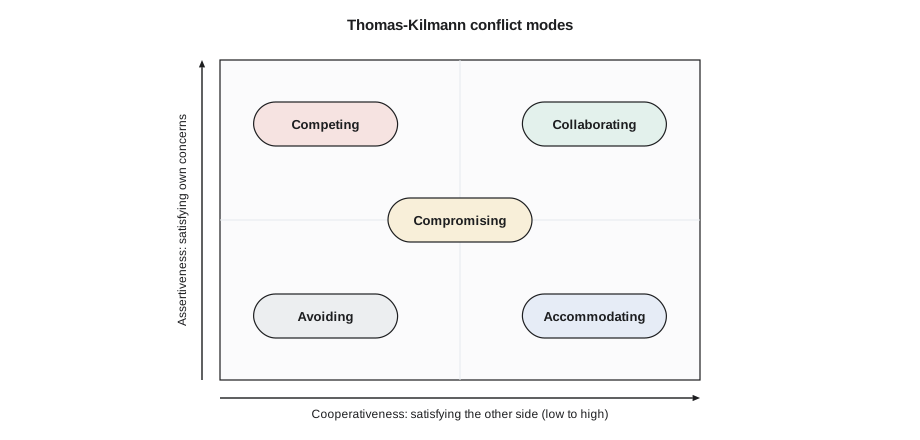
| Mode | What it means | Useful when | Risk if overused |
|---|---|---|---|
| Competing | Pursue your position firmly | Safety is at stake; an urgent decision is needed; rules must be enforced | Damaged relationships; others stop raising concerns |
| Collaborating | Work together for a solution that meets both sides’ concerns | Both concerns are important and there is time; long-term relationships matter | Slow; can be used on trivial issues |
| Compromising | Each side gives something up | A quick, fair split is acceptable; collaboration has failed | Nobody fully satisfied; better solutions missed |
| Avoiding | Postpone or sidestep the conflict | The issue is trivial; emotions need to cool; more information is needed | Problems grow; people feel ignored |
| Accommodating | Yield to the other side | You are wrong; the issue matters more to them; goodwill is worth building | Being taken advantage of; own goals neglected |
Each mode has its place. When a subcontractor's worker is about to work at height without fall protection, Dana competes: the answer is no, and there is nothing to negotiate. When the mechanical and electrical foremen disagree about ceiling space in the corridors, she encourages them to collaborate with Mei and the drawings, because both concerns are legitimate and the best answer might satisfy both. When two trades argue about who should sweep a shared area, a quick compromise, alternate days, may be good enough. When a foreman is shouting, avoiding the substance until he has calmed down is wise. When she realizes Thornbury's laydown change caused a subcontractor's delay, accommodating, admitting it and helping fix it, builds credibility.
Most people have a preferred mode. Supervisors who come from the tools often default to competing or avoiding; both work some of the time and fail badly the rest. The skill is noticing your default and choosing deliberately. The worked example is a simple aid for thinking through which mode fits a situation, based on how important the outcome and the relationship are and how urgent the matter is.
# A simple aid for choosing a conflict mode (rating scores 1-5; a thinking tool, not a rule)
def suggest(outcome, relationship, urgency, safety_critical=False, you_are_wrong=False):
    if safety_critical:
        return "competing (hold firm on safety)"
    if you_are_wrong:
        return "accommodating (own it and help fix it)"
    if outcome <= 2 and relationship <= 2:
        return "avoiding (not worth the energy)"
    if outcome >= 4 and relationship >= 4:
        return "collaborating" if urgency <= 3 else "compromising now, collaborate later"
    if outcome >= 4:
        return "competing" if urgency >= 4 else "collaborating"
    if relationship >= 4:
        return "accommodating"
    return "compromising"

cases = [
    ("Worker about to work at height untied", 5, 3, 5, True, False),
    ("Duct vs cable tray space in corridors", 4, 4, 2, False, False),
    ("Who sweeps the shared stair landing", 2, 3, 2, False, False),
    ("Laydown change by GC delayed a trade", 3, 4, 3, False, True),
    ("Painter wants a second hoist slot today", 4, 4, 5, False, False),
    ("Radio channel preference", 1, 2, 1, False, False),
]
for name, o, r, u, s, w in cases:
print(f"{name:42s} -> {suggest(o, r, u, s, w)}")Worker about to work at height untied -> competing (hold firm on safety) Duct vs cable tray space in corridors -> collaborating Who sweeps the shared stair landing -> compromising Laydown change by GC delayed a trade -> accommodating (own it and help fix it) Painter wants a second hoist slot today -> compromising now, collaborate later Radio channel preference -> avoiding (not worth the energy)
The function is deliberately crude, and real situations rarely fit neat scores. Its value is the questions it forces: how much does this outcome matter, how much does the relationship matter, how urgent is it, is safety involved and am I actually in the wrong?
Mediating between trades
Superintendents often find themselves in the middle of conflicts between subcontractors. A simple mediation process helps keep these disputes about the work.
| Step | What Dana does |
|---|---|
| 1. Cool down and separate | If tempers are high, separate the people and agree a time to talk, often within the hour |
| 2. Listen to each side | Hear each foreman separately first if needed; let them finish; summarize what they said |
| 3. Establish the facts | Go to the work; look at drawings, photos, schedule, subcontract scopes |
| 4. Find the interests | Ask what each side actually needs: space for its system, time, protection of its work, money |
| 5. Generate options together | Bring both together; look for solutions that meet both sets of interests |
| 6. Agree and record | Confirm who does what by when; record it in the daily report or action log |
| 7. Follow up | Check the agreement worked; fix the system cause so it does not recur |
Worked problem
Damaged work between trades
Summit Drywall's foreman complains angrily that Northgate Mechanical's crew cut several large holes in finished, taped drywall on level 3 to fix a leaking pipe, and says he will back-charge Northgate. Northgate's foreman says the leak was caused by a drywall screw driven through the pipe. How should Dana handle it?
Show solution
- Separate and cool down: agree to meet both foremen at the location in an hour; ask them not to argue in front of their crews.
- Get the facts: look at the pipe and the screw, take photos, check whether the plumbing was tested and inspected before board went on, and check the daily reports for when the board was installed.
- Find the interests: Summit wants its repair cost covered and its schedule protected; Northgate wants to avoid paying for something it did not cause and to get the leak fixed fast.
- Options: fix the leak and patch the board now so the schedule is protected, with Thornbury tracking the cost on a time and material record; decide who pays once the facts are clear, through the project manager and the subcontract back charge process (CON-330, CON-420).
- Fix the system: the root cause is a screw through a pipe, so add a step to the pre-board checklist to mark pipe locations on studs on the remaining floors.
Answer: The work moves forward, the money question is separated from the repair and handled through the proper process, and a system fix reduces the chance of repeats. Dana does not decide liability on the spot under pressure.
Principled negotiation
Supervisors negotiate constantly: with subcontractors over manpower and sequence, with suppliers over delivery times, with inspectors over scheduling, with crews over overtime, with the owner's representative over access. Roger Fisher and William Ury's book Getting to Yes, based on the Harvard Negotiation Project, set out four principles of what they called principled negotiation. Separate the people from the problem: be soft on the person and hard on the issue. Focus on interests, not positions: a position is what someone says they want ('I need the hoist all morning'); an interest is why they want it ('I have 40 carts of board to stock before the framers start on the floor above'). Invent options for mutual gain: once interests are known, there are often solutions neither side started with. Insist on objective criteria: use the contract, the schedule, industry practice or measured quantities rather than willpower to settle differences.
Fisher and Ury also introduced the BATNA, the best alternative to a negotiated agreement: what you will do if this negotiation fails. Knowing your BATNA, and estimating the other side's, tells you how strong your position really is and when to walk away. The zone of possible agreement, or ZOPA, is the range in which a deal is better than both sides' alternatives.
# Zone of possible agreement for a disputed time-and-material ticket (illustrative)
claimed = 18400          # subcontractor's ticket
sub_walkaway = 12500     # sub's minimum: below this it would rather pursue the full claim
gc_walkaway = 15000      # GC's maximum: above this it would rather contest under the subcontract
low, high = sub_walkaway, gc_walkaway
if low <= high:
    print(f"ZOPA exists: ${low:,} to ${high:,} (width ${high-low:,})")
    print(f"Midpoint settlement: ${(low+high)/2:,.0f}, i.e. {((low+high)/2)/claimed:.0%} of the claim")
else:
    print("No ZOPA: one side must improve its alternative or change its assessment")
# Objective criteria: measured hours x agreed contract rates
hours, rate = 172, 82.0
print(f"Objective check from verified hours: {hours} h x ${rate:.0f}/h = ${hours*rate:,.0f}")ZOPA exists: $12,500 to $15,000 (width $2,500) Midpoint settlement: $13,750, i.e. 75% of the claim Objective check from verified hours: 172 h x $82/h = $14,104
The numbers show a zone of possible agreement between $12,500 and $15,000. But rather than haggling to the middle, a principled negotiator looks for objective criteria: the verified hours from the daily reports multiplied by the contract rates give about $14,100, which falls inside the zone and is defensible to both companies. In practice, negotiations over money on subcontracts are normally led by the project manager; the superintendent's verified records of hours and conditions are what make an objective settlement possible.
Supervisors should also know the limits of their authority in negotiations. Agreeing to pay for extra work, waiving a contract requirement or promising a schedule date to an owner can bind the company. When in doubt, a supervisor can explore options and interests, then say 'I think this could work; let me confirm with Priya and get back to you today'.
Difficult conversations
Some of the hardest moments in supervision are conversations: telling a long-serving worker his work is not good enough, telling a subcontractor foreman his crew is being removed from an area, telling the owner the project will miss a milestone, raising a colleague's drinking, or confronting a foreman about a racist comment. Douglas Stone, Bruce Patton and Sheila Heen, also from the Harvard Negotiation Project, observed in Difficult Conversations that each such conversation is really three conversations at once: the 'what happened' conversation (facts, intentions and blame), the feelings conversation and the identity conversation (what this says about me as a competent, good person).
Their advice includes moving from certainty about what happened to curiosity about the other person's view; separating intent from impact (the other person may not have meant the harm they caused); replacing blame with an exploration of how each side contributed; acknowledging feelings rather than ignoring them; and recognizing that both sides may feel their identity is under threat. In practical terms, a supervisor preparing for a difficult conversation should plan it.
| Step | Questions to prepare |
|---|---|
| Purpose | What do I want to achieve? A changed behavior, shared understanding, a decision? |
| Facts | What specifically did I observe? What evidence do I have? What might I not know? |
| Their view | How might they see it? What pressures might explain their behavior? |
| Opening | How will I start, briefly and neutrally, without a long lead-in? |
| Setting and timing | Private, soon, when neither of us is rushed or angry |
| Outcome and follow-up | What agreement do I need? How will I check it? |
A good opening is short and direct: 'Luc, I need to talk to you about the framing tolerances on level 5. The drywall crew found several walls out of plumb by more than the specification allows. I want to understand what happened and agree how we fix it.' Long, nervous introductions make the other person anxious and obscure the message. Then listen. Most difficult conversations go better than expected when the supervisor is calm, specific and genuinely curious.
Dealing with anger
Sooner or later every supervisor faces an angry person: a foreman whose material was damaged, a worker who feels unfairly treated, a neighbor upset about noise. De-escalation starts with staying calm yourself, keeping a safe distance, speaking slowly and quietly, listening without interrupting, acknowledging the person's feelings ('I can see you're really frustrated about this') and focusing on what can be done. Arguing about facts while someone is shouting rarely works; the facts can wait a few minutes. If a situation becomes threatening, the supervisor's priority is safety: leave, get help and follow the site's violence prevention procedures. HSE-108 covers de-escalation and workplace violence prevention in more detail.
Supervisors also need to handle their own anger. Shouting at a crew might feel justified in the moment, but it damages trust, discourages reporting (lesson 3) and can cross the line into harassment. A useful habit is to take a pause, a walk around the floor, before responding to something that makes you angry.
After the conflict
Conflict leaves traces. After a heated disagreement, a short follow-up, a word at the next huddle, a thank-you for resolving it, a check that the agreement is working, helps repair the relationship. Recurring conflicts usually point to a system cause: overlapping scopes, unclear sequencing, inadequate laydown or a congested floor. Fixing the system is better than mediating the same argument every week.
Common mistakes
MistakeUsing the same conflict mode, usually competing or avoiding, for every situation.
InsteadRecognize your default and choose the mode that fits the stakes, the relationship and the urgency.
MistakeDeciding liability for damaged work on the spot while tempers are high.
InsteadProtect the work and schedule first, gather facts and route money questions through the contract process.
MistakeBargaining over positions in a negotiation.
InsteadExplore interests, generate options and use objective criteria such as verified hours and contract rates.
MistakeCommitting the company to costs or dates beyond your authority during a negotiation.
InsteadExplore options, then confirm with the project manager before agreeing.
MistakeOpening a difficult conversation with a long, vague lead-in.
InsteadPlan the conversation; open briefly and specifically; then listen with curiosity.
Summary and key terms
- Conflict is normal on interdependent, pressured construction sites; how it is handled matters.
- Task conflict focused on the work can help; relationship conflict almost always harms performance.
- The Thomas–Kilmann modes are competing, collaborating, compromising, avoiding and accommodating; each fits certain situations.
- A field mediation process cools down, listens, establishes facts, finds interests, generates options, records agreements and fixes system causes.
- Principled negotiation separates people from the problem, focuses on interests, invents options and uses objective criteria.
- The BATNA and the zone of possible agreement show when a deal is possible and when to walk away.
- Difficult conversations combine facts, feelings and identity; plan them, open directly and listen with curiosity.
- De-escalate anger by staying calm, listening and acknowledging feelings; put safety first if a situation becomes threatening.
- Task conflict
- Disagreement about the work itself, such as methods or sequences.
- Relationship conflict
- Personal friction or hostility between people.
- Thomas–Kilmann modes
- Five conflict-handling modes: competing, collaborating, compromising, avoiding and accommodating.
- Principled negotiation
- Negotiation based on interests, options and objective criteria rather than positions.
- Interest
- The underlying need or concern behind a stated position.
- BATNA
- Best alternative to a negotiated agreement.
- Zone of possible agreement
- The range of outcomes acceptable to both negotiating parties.
- De-escalation
- Techniques for calming an angry or agitated person and reducing the risk of violence.
Practice problems
Work each problem on paper first, then reveal the answer to check.
Give four common sources of conflict on construction sites.
Show answer
Space and access, sequence and timing, damage to work, cleanup, scope gaps, quality, money, personalities.
Why should supervisors keep conflict focused on the task?
Show answer
Task conflict can surface better ideas, but relationship conflict almost always harms performance.
Which conflict mode fits a worker about to work at height without fall protection?
Show answer
Competing: hold firm on safety.
List the steps of field mediation.
Show answer
Cool down and separate, listen, establish facts, find interests, generate options, agree and record, follow up.
State Fisher and Ury's four principles.
Show answer
Separate people from the problem, focus on interests, invent options for mutual gain, insist on objective criteria.
What is a BATNA and why does it matter?
Show answer
The best alternative to a negotiated agreement; it shows your real bargaining strength and when to walk away.
In the ZOPA example, what objective figure supported settlement?
Show answer
Verified hours times contract rates: 172 × $82 ≈ $14,100, inside the zone.
What are the three conversations in a difficult conversation?
Show answer
What happened, feelings and identity.
Lesson quiz · 5 questions
Score 60% or more to complete this lesson.
Create a free account to save your progress, take quizzes and earn a certificate.