
CON-100 · Lesson 2 of 12 · 25 min
The sectors of construction
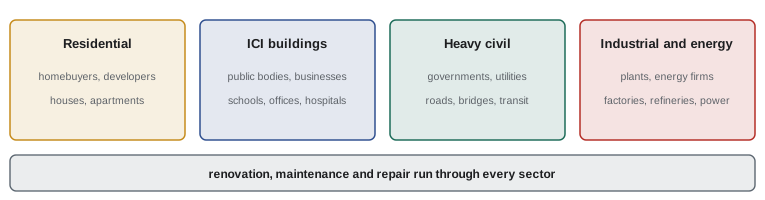
Construction is not one market but several, each with its own clients, contractors, contracts, risks and ways of working. A firm that builds single-family homes in suburban subdivisions operates very differently from one that builds hospitals, one that paves highways or one that installs process piping in a refinery. Construction managers usually specialize in one or two sectors, and understanding the differences helps you choose a career path and recognize why practices that work in one sector may fail in another. This lesson describes the main sectors: residential; institutional, commercial and industrial buildings; heavy civil and infrastructure; and industrial and energy construction, along with renovation and maintenance work, which runs through all of them.
How the industry is divided
Industry associations, forecasters and statistical agencies divide construction in slightly different ways, but the common categories are:
In the United States, the Census Bureau reports construction spending as residential and non-residential, each split into private and public, and non-residential further into categories such as commercial, office, health care, educational, manufacturing, power, highway and street, sewage and water. Industry groups represent sectors: the National Association of Home Builders for residential, the Associated General Contractors of America and Associated Builders and Contractors for commercial and heavy work, and the American Road and Transportation Builders Association for transportation.
| Sector | Typical clients | Typical projects | Main drivers |
|---|---|---|---|
| Residential | Homebuyers, developers, landlords | Houses, townhouses, apartments, condominiums, renovations | Interest rates, population growth, housing policy |
| Institutional | Governments, school boards, hospitals, universities | Schools, hospitals, courthouses, long-term care | Public budgets, demographics |
| Commercial | Developers, businesses, investors | Offices, retail, hotels, warehouses, data centers | Business investment, vacancy, e-commerce, technology |
| Industrial | Manufacturers, energy and resource companies | Factories, plants, refineries, mines, energy facilities | Commodity prices, industrial policy, energy transition |
| Heavy civil | Governments, utilities, transit agencies | Roads, bridges, transit, water, sewer, power lines | Infrastructure budgets, maintenance needs |
Residential construction
Residential construction includes single-family homes, semi-detached houses and townhouses, low-rise and high-rise apartments and condominiums, and renovations and additions. It is the most visible sector and often the largest by number of firms. Single-family and townhouse construction is dominated by builders who buy land, obtain approvals, design or adapt standard plans, and sell homes to buyers, either before construction or after completion; the builder acts as both developer and contractor, and much of the work is done by specialized trade subcontractors such as framers, roofers, plumbers and drywallers. Multi-unit residential buildings, especially high-rise concrete towers, are closer to commercial construction, with developers hiring general contractors or construction managers. Residential construction is highly sensitive to interest rates, mortgage rules, land costs and housing policy, and it is subject to home warranty programs that protect buyers.
In the United States, home warranties are usually provided by builders or third-party warranty companies, with a few states having statutory warranty requirements, and residential contractors are licensed by many states and municipalities. Housing starts are reported monthly by the Census Bureau and the Department of Housing and Urban Development, and housing policy is shaped by federal, state and local programs.
Institutional, commercial and industrial buildings
Non-residential buildings, often grouped as ICI, are built for organizations rather than individual homebuyers. Institutional buildings, such as schools, hospitals, universities and government buildings, are usually funded by public bodies and procured through formal public tendering or alternative delivery methods; they have demanding requirements for building systems, accessibility, durability and, in hospitals, infection control and complex mechanical and medical systems. Commercial buildings, such as offices, shopping centers, hotels, warehouses and data centers, are built for developers, investors and businesses, and their timing is driven by market demand, rents and financing. Light industrial buildings, such as warehouses and manufacturing plants, overlap with commercial construction. ICI projects are typically built by general contractors or construction managers who subcontract most of the trade work, and they involve architects, engineers, extensive specifications and formal contract administration.
Heavy civil and infrastructure construction
Heavy civil construction builds the infrastructure that connects and serves communities: highways, streets, bridges, tunnels, rail and transit lines, airports, ports, dams, water and wastewater treatment plants, water mains, sewers and power and telecommunications lines. Most clients are public agencies, such as provincial or state transportation departments, municipalities, transit authorities and utilities, and work is usually procured through competitive bidding on detailed engineering designs, often with unit-price contracts in which contractors are paid for measured quantities of work. Heavy civil contractors own or rent large fleets of equipment, and their productivity depends heavily on equipment selection, earthwork balancing and logistics (CON-250). Large transit and highway projects may use design-build or public-private partnership delivery (CON-340). The sector is less sensitive to private business cycles but depends on government infrastructure budgets and long-term programs.
Worked problem
Unit-price versus lump-sum payment
A road contract estimates 40,000 cubic meters of excavation at a unit price of $12 per cubic meter. During construction, the measured quantity turns out to be 46,000 cubic meters. How is the contractor paid under a unit-price contract, and how would this differ under a lump-sum contract?
Show solution
- Unit-price contract: payment = measured quantity × unit price = 46,000 × $12 = $552,000.
- The estimated amount was 40,000 × $12 = $480,000, so the owner pays $72,000 more because the quantity grew.
- Lump-sum contract: the contractor would have agreed a fixed price for the work shown; unless the increase came from a change or differing site conditions under the contract, the contractor would bear the cost of the extra quantity.
- Many unit-price contracts allow unit prices to be renegotiated if quantities vary by more than a set percentage, often around 15 to 25 %.
Answer: The contractor is paid $552,000 for the measured quantity; under a lump sum, the risk of quantity growth would largely sit with the contractor.
Industrial and energy construction
Industrial construction builds facilities for production: oil and gas processing plants, refineries, petrochemical plants, mines and mills, pulp and paper mills, power plants, renewable energy projects, battery and semiconductor factories, and, increasingly, large data center campuses. These projects are dominated by process equipment, piping, structural steel, electrical and instrumentation work, and they are often managed under engineering, procurement and construction (EPC) contracts, in which one firm or joint venture designs the facility, buys the equipment and builds it. Industrial projects can be very large, with thousands of workers on site, remote camps, modular fabrication in yards far from the site, and complex commissioning and start-up. The sector follows commodity prices and industrial policy, such as energy transition investment, which can create rapid booms and busts in particular regions.
Renovation, maintenance and repair
Not all construction is new building. Renovation, repair and maintenance of existing buildings and infrastructure is a very large share of construction activity, especially as building stocks age: replacing roofs, windows and mechanical systems, upgrading for energy efficiency and accessibility, converting offices to residences, retrofitting for seismic resilience, and rehabilitating bridges and water systems. Renovation work has its own challenges: unknown existing conditions, hazardous materials such as asbestos and lead in older buildings (HSE-372), work in occupied buildings, and careful phasing (CON-385). Maintenance and turnaround work in industrial plants, when parts of a plant are shut down for inspection and repair, is a specialized field with intense, tightly scheduled work.
Public and private clients
A further important distinction is between public and private clients. Public owners, such as governments, school boards, hospitals, municipalities and utilities, spend taxpayers' money and must follow procurement rules that emphasize openness, fairness and value for money, typically requiring public advertisement of tenders, published evaluation criteria, bid bonds and security, and sometimes trade agreements that open bidding to firms from other provinces, states or countries. Private owners can choose contractors more freely, negotiate contracts directly, and adapt their approach to their own priorities, such as speed to market. Public work often has stricter documentation, fair wage or prevailing wage requirements, and social procurement goals, such as local hiring or Indigenous participation.
In the United States, federal construction is governed by the Federal Acquisition Regulation, with the Davis-Bacon Act requiring prevailing wages on federally funded construction over $2,000 and the Miller Act requiring performance and payment bonds on federal construction contracts above a threshold set in the Federal Acquisition Regulation and adjusted periodically for inflation; states have their own procurement codes, "little Miller Acts" and, in many cases, prevailing wage laws. Buy America and Buy American requirements apply to many federally funded projects.
Choosing a sector
Each sector offers different career experiences. Residential building offers fast-paced, repetitive production and close contact with buyers; ICI buildings offer complex, varied projects with design teams; heavy civil offers large-scale earthwork, structures and equipment operations, often outdoors and seasonal; industrial offers massive, technically demanding projects, frequently in remote locations, with rotational schedules; renovation offers problem solving in existing buildings. Many construction managers move between sectors during their careers, and skills such as estimating, scheduling, contract management, leadership and safety transfer well. Understanding the sectors also helps you read the market: when one sector slows, another may be growing.
Size and structure of firms in each sector
The structure of firms differs by sector. Residential construction includes a small number of large production builders, which may build thousands of homes a year using standardized plans, and a very large number of small builders and renovators. ICI building construction is dominated by general contractors and construction managers of all sizes, from regional firms to national companies with revenues in the billions, which subcontract most trade work. Heavy civil contractors tend to be capital-intensive firms that own large equipment fleets and self-perform much of their work, including earthwork, paving and structures. Industrial construction is led by large engineering and construction firms and specialized industrial contractors, often working in joint ventures for the largest projects. Specialty trade contractors serve all sectors, but many specialize, such as residential electricians versus industrial electrical contractors.
Risk profiles by sector
Each sector carries characteristic risks. Residential builders face market risk, because they often build before selling, and interest rate risk on both their financing and buyers' mortgages. ICI contractors face design coordination risk, subcontractor performance risk and fixed-price exposure. Heavy civil contractors face ground conditions, weather, quantity variations, traffic management and public scrutiny. Industrial contractors face very large scale, complex commissioning, remote logistics and the risk that owners cancel or pause projects when commodity prices fall. Renovation contractors face hidden conditions and hazardous materials. Understanding these profiles helps construction managers price work sensibly and choose the projects that suit their firm's strengths.
Seasonal and regional patterns
Sectors also follow seasonal and regional patterns. Heavy civil work, especially paving and earthwork, is concentrated in the warmer months in northern regions, so contractors plan for intense summers and quieter winters. Industrial work concentrates in resource and manufacturing regions. Residential construction follows population and job growth, which in recent years has been strongest in certain metropolitan areas and fast-growing regions. Construction managers who understand these patterns can plan workforce, equipment and bidding strategies accordingly.
Mixed-use and hybrid projects
Many modern projects cross sector boundaries. A mixed-use tower may combine retail at street level, offices above and residential units at the top, each with different codes, systems, owners and buyers. A hospital may include an energy plant that resembles industrial construction. A transit project may include stations that are complex buildings and tunnels that are heavy civil works. Data centers combine commercial building techniques with industrial-scale electrical and mechanical systems. Construction managers on hybrid projects must understand the practices of several sectors and coordinate teams who are used to working differently.
Sector knowledge in practice
A construction manager moving into a new sector should study its standard contracts, typical schedules, key trades, common risks and leading firms, visit active projects, and ask experienced colleagues about the practices that differ from those they know. Industry associations for each sector publish guides, cost data and safety resources that speed up this learning. Within a year or two, most managers can work comfortably in a new sector, but the first projects are where mistakes are most likely, so extra review and mentorship are wise.
Common mistakes
MistakeTreating construction as a single market.
InsteadRecognize the distinct sectors and their drivers.
MistakeAssuming public and private procurement work the same way.
InsteadLearn the rules that govern public owners.
MistakeOverlooking renovation and maintenance.
InsteadTreat them as a major, specialized part of the industry.
MistakeIgnoring quantity risk in contracts.
InsteadUnderstand who bears quantity changes under unit-price and lump-sum terms.
MistakeApplying residential practices to industrial projects.
InsteadAdapt methods to the sector's scale and complexity.
Summary and key terms
- Construction divides into residential, ICI buildings, heavy civil and industrial sectors.
- Residential is driven by interest rates, land and housing policy.
- ICI buildings involve design teams, general contractors and formal contracts.
- Heavy civil uses public bidding, unit prices and large equipment fleets.
- Industrial projects often use EPC contracts and large modular programs.
- Renovation and maintenance are large and growing.
- Public clients follow procurement rules; private clients have more freedom.
- ICI
- Industrial, commercial and institutional construction.
- Residential construction
- Building homes and multi-unit dwellings.
- Heavy civil construction
- Building infrastructure such as roads and utilities.
- Industrial construction
- Building plants and production facilities.
- Unit-price contract
- Payment based on measured quantities and agreed rates.
- Lump-sum contract
- Fixed price for defined work.
- EPC
- Engineering, procurement and construction contract.
- Turnaround
- Planned shutdown of a plant for maintenance.
- Public owner
- Government or public agency client.
- Home warranty program
- Protection for buyers of new homes.
Practice problems
Work each problem on paper first, then reveal the answer to check.
What does ICI stand for?
Show answer
Industrial, commercial and institutional.
Name two drivers of residential construction.
Show answer
Interest rates, population, land costs, housing policy.
Who are typical heavy civil clients?
Show answer
Governments, transit agencies, utilities.
Payment for 12,000 m³ at $15/m³ under unit price?
Show answer
$180,000.
Who bears quantity growth under a lump sum, usually?
Show answer
The contractor, unless a change or differing condition applies.
What is an EPC contract?
Show answer
One firm designs, procures and builds.
Name two challenges of renovation work.
Show answer
Unknown conditions, hazardous materials, occupied buildings.
Why do public owners follow procurement rules?
Show answer
To ensure openness, fairness and value for public money.
Name a public procurement rule in your country.
Show answer
CFTA or trade agreements (CA); FAR, Davis-Bacon, Miller Act (US).
Which skills transfer between sectors?
Show answer
Estimating, scheduling, contracts, leadership, safety.
Lesson quiz · 5 questions
Score 60% or more to complete this lesson.
Create a free account to save your progress, take quizzes and earn a certificate.