
CON-100 · Lesson 12 of 12 · 25 min
Ethics, professionalism and capstone
Construction managers control large sums of money, direct many people, make decisions that affect public safety, and work in an industry where competition is intense and margins are thin. These conditions create ethical pressures: to cut corners, overlook safety, misrepresent progress, favor friends, accept gifts, exploit subcontractors or hide mistakes. The industry has also seen serious scandals involving bid rigging, corruption, unsafe buildings and worker exploitation. Professionalism means meeting obligations to the public, clients, employers, colleagues and workers even when doing so is inconvenient or costly. This final lesson examines the ethical issues construction managers face, codes of ethics, the duty to the public and workers, conflicts of interest, fair dealing with subcontractors, honesty in documentation, sustainability as an ethical responsibility, and the capstone industry profile.
Why ethics matters in construction
Ethical failures in construction can cause catastrophic harm. Building collapses, crane accidents, fires and infrastructure failures have killed workers and members of the public, and investigations often find that warnings were ignored, inspections skipped, materials substituted or schedules prioritized over safety. Corruption in public construction wastes public money and erodes trust; several provinces, states and countries have held public inquiries into collusion and corruption in construction contracting, such as Quebec's Charbonneau Commission (2011–2015), which documented collusion, bribery and illegal political financing in public construction contracts. Exploitation of workers, including wage theft and misclassification of employees as independent contractors, harms vulnerable people and undercuts honest firms. Ethical conduct is therefore not a luxury but a foundation of a safe, fair and functioning industry.
Codes of ethics
Many organizations publish codes of ethics or conduct for construction professionals. Common principles include:
- Protect the health, safety and welfare of the public and workers.
- Act with honesty and integrity in all dealings.
- Avoid conflicts of interest and disclose them when they arise.
- Compete fairly and comply with laws, including competition and anti-corruption laws.
- Respect confidentiality of clients' and others' information.
- Perform only work within one's competence.
- Treat colleagues, workers and subcontractors with respect and fairness.
- Protect the environment and promote sustainable practices.
- Continue professional development.
In the United States, the Construction Management Association of America and the American Institute of Constructors publish codes of ethics for their certified members, AGC and ABC promote ethics programs for contractors, and state licensing boards enforce professional conduct rules for licensed engineers, architects and contractors. Federal contractors are subject to suspension and debarment rules under the Federal Acquisition Regulation for serious misconduct.
Duty to the public and workers
Construction managers have duties that go beyond their contracts. They must not knowingly allow work that endangers the public or workers, even if the owner or their employer would prefer to ignore a problem. This includes refusing to cover up defective structural work, reporting unsafe conditions, not pressuring workers to work without proper fall protection to save time, and stopping work when imminent danger exists. Workers in both countries have the right to refuse unsafe work, and supervisors have legal duties to protect them (HSE-101, CON-355). Ethical managers create environments where people can raise concerns without fear of retaliation, and they treat near misses and warnings as information to act on rather than inconveniences.
Worked problem
An ethical dilemma on site
A superintendent is two weeks behind schedule on a parking structure. A concrete test report shows that one level's slab strength is below specification. The project manager suggests waiting to report it until after the next pour, to avoid delay. What should the superintendent do?
Show solution
- Recognize that low-strength concrete may affect structural safety and that the contract requires reporting test results to the design team.
- Report the result promptly to the project manager and the structural engineer of record, as the contract and quality plan require.
- Protect the area from additional loading until the engineer evaluates it, for example by delaying shore removal if needed.
- Follow the engineer's instructions, such as additional testing, cores or remediation, and document all actions.
- If pressured to conceal the problem, escalate within the company, because concealment risks public safety and is likely a breach of contract and law.
Answer: Report the test result immediately to the engineer, protect the structure, follow the engineer's direction and document everything; schedule pressure never justifies concealing a potential safety issue.
Conflicts of interest, gifts and corruption
A conflict of interest arises when personal interests could influence, or appear to influence, professional decisions: for example, awarding a subcontract to a relative's company, holding shares in a supplier, accepting expensive gifts or trips from subcontractors, or hiring a firm that offers a personal favor. Most companies and public owners have policies that require disclosure of conflicts, limit gifts to modest values and prohibit accepting anything that could influence decisions. Bribery of public officials is a criminal offense in both countries, and bribery of foreign officials is prohibited by Canada's Corruption of Foreign Public Officials Act and the US Foreign Corrupt Practices Act, which matter for firms working internationally. When in doubt, disclose, decline and document.
Fair dealing with subcontractors and workers
Because general contractors hold power over subcontractors, through payment, scope decisions and future work, fair dealing is an important ethical issue. Unfair practices include bid shopping (Lesson 6), withholding payment without valid reason, imposing unreasonable contract terms, back-charging without proper notice, and pressuring subcontractors to absorb costs that are not their responsibility. Prompt payment legislation in many provinces and states now sets deadlines for payment through the contracting chain and provides adjudication for disputes (CON-220), reflecting long-standing concerns about late payment. Worker exploitation, such as unpaid wages, misclassification of employees, unsafe housing for traveling workers and abuse of temporary foreign or undocumented workers, is illegal and harmful; general contractors increasingly take responsibility for labor practices throughout their supply chains.
Honesty in documentation and reporting
Construction relies on accurate records: daily reports, test results, inspections, progress claims, schedules, cost reports and safety records. Falsifying or manipulating records, such as overstating progress to obtain payment, backdating documents, altering test reports, hiding incidents to protect safety statistics, or misrepresenting schedules to owners, is unethical and often illegal. It can also have severe consequences when disputes or failures lead to investigations. Ethical construction managers record facts accurately, report bad news promptly, and give clients realistic assessments even when they are unwelcome. Honesty also means acknowledging one's own mistakes and working to correct them.
| Situation | Unethical response | Ethical response |
|---|---|---|
| Progress behind schedule | Report a misleading schedule | Report the delay with a recovery plan |
| Defective work found | Cover it before inspection | Report, correct and document |
| Supplier offers a gift | Accept quietly | Decline or disclose per policy |
| Subcontractor dispute | Withhold all payment as leverage | Pay undisputed amounts and resolve the rest fairly |
| Incident on site | Hide it to protect statistics | Report, investigate and learn |
Sustainability and the public interest
Construction decisions affect communities and the environment for generations. Ethical practice increasingly includes reducing waste and pollution, protecting waterways from sediment and spills, respecting heritage and Indigenous rights and interests, minimizing disruption to neighbors, and contributing to low-carbon, resilient buildings. Construction managers can advocate for better choices, implement them well on site, and report environmental performance honestly. Community benefits agreements, social procurement and local hiring commitments also reflect a broader understanding of construction's role in society.
Capstone: an industry profile
The capstone asks you to apply this course by preparing an industry profile of construction in a region of your choice, such as your province or state, a metropolitan area or a sector. Your profile should include:
- An overview of the region's construction economy: size, sectors, major current projects and recent trends, using credible statistics with sources and dates.
- The main players: major owners, contractors, designers, associations and regulators.
- A description of how a typical project in one sector is procured and delivered, including the standard contracts and delivery methods in use.
- The workforce: key trades, apprenticeship and certification rules, union and open shop presence, and labor supply challenges.
- Technology and sustainability trends affecting the region.
- Career opportunities for construction managers, including designations and licensing requirements.
- A short reflection, about 500 words, on an ethical issue relevant to the region's industry and how you would respond as a construction manager.
Present the profile as a concise report of about 2,500 to 3,500 words with tables and figures, as you might prepare for an employer or industry association.
Whistleblowing and speaking up
Sometimes ethical concerns cannot be resolved within a project team. Employees who report illegal or dangerous practices to regulators or authorities are protected by law in many situations, such as reprisal protections in occupational health and safety legislation in both countries, and some companies have confidential reporting lines for ethics concerns. Before escalating, it is usually best to raise concerns with supervisors and follow company procedures, document the facts carefully and seek advice. But when public or worker safety is at risk and internal routes fail, professionals have a duty to act. Creating a culture in which concerns are raised early, and taken seriously, reduces the need for whistleblowing.
Ethics in everyday decisions
Most ethical decisions in construction are not dramatic. They involve small choices made many times a day: whether to tell a subcontractor honestly when their work is late, whether to report a minor incident, whether to accept a supplier's lunch invitation, whether to represent progress accurately in a meeting, whether to treat a worker's concern with respect. These everyday choices shape a manager's reputation and a project's culture. People in the industry remember who kept their word, who paid fairly and who told the truth, and that reputation follows construction managers throughout their careers.
Professional responsibility and competence
Professionalism also means recognizing the limits of one's competence. Construction managers are not structural engineers, and they should not make design decisions that belong to licensed professionals, such as modifying structural elements, changing fire separations or approving temporary works without proper engineering. When unsure, they seek qualified advice. Professionals also keep their knowledge current and admit when they do not know something, rather than guessing in ways that put people or projects at risk.
Ethics and the law
Ethics and law overlap but are not the same. Many unethical acts are also illegal, such as bid rigging, bribery, fraud and knowingly violating safety regulations, and can lead to fines, imprisonment, debarment from public work and loss of designations. But some conduct may be legal yet still unethical, such as exploiting a subcontractor's financial weakness, misleading a client through technically accurate but incomplete statements, or ignoring a hazard that no regulation specifically addresses. Professionals are expected to meet a higher standard than the legal minimum, guided by codes of ethics and their own judgment.
Building an ethical culture
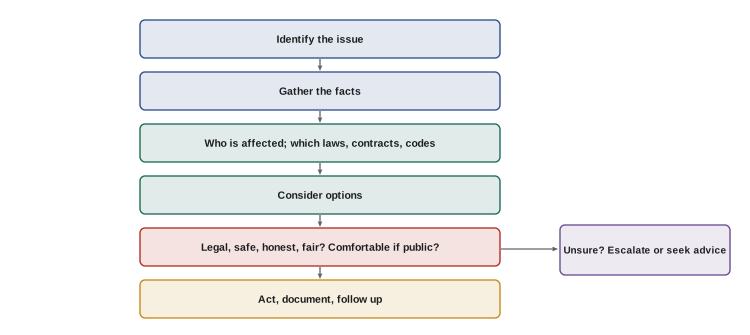
Individual integrity matters, but organizations shape behavior. Companies build ethical cultures through clear codes of conduct, training, leaders who model integrity, confidential reporting systems, fair treatment of people who raise concerns, and consequences for misconduct regardless of seniority. On a project, the superintendent and project manager set the tone: if they cut corners or tolerate disrespect, others will follow; if they insist on honesty, safety and fairness, the whole project team will tend to rise to that standard.
Ethics and the capstone
As you prepare your industry profile, look for ethical issues that matter in your chosen region or sector: perhaps payment practices and prompt payment legislation, labor standards for temporary workers, community impacts of a megaproject, Indigenous consultation and participation, or safety performance in a particular trade. Consider how a construction manager could make a practical difference.
Common mistakes
MistakeLetting schedule pressure override safety.
InsteadReport and address safety concerns immediately.
MistakeAccepting gifts that could influence decisions.
InsteadDecline or disclose according to policy.
MistakeUsing payment as unfair leverage.
InsteadPay undisputed amounts and resolve disputes fairly.
MistakeAdjusting records to look better.
InsteadRecord facts accurately and report bad news early.
MistakeSeeing ethics as someone else's job.
InsteadModel integrity and create a speak-up culture.
Summary and key terms
- Ethical failures in construction can cost lives, money and public trust.
- Codes of ethics stress safety, honesty, fairness, competence and sustainability.
- Construction managers owe duties to the public and workers beyond contracts.
- Conflicts of interest must be disclosed; bribery is a crime.
- Fair dealing with subcontractors and workers is an ethical and legal obligation.
- Records and reports must be accurate and honest.
- Sustainability and community interests are part of professional responsibility.
- Professionalism
- Meeting obligations with competence and integrity.
- Code of ethics
- Principles of conduct for members of a profession.
- Conflict of interest
- Personal interest that could influence professional judgment.
- Bribery
- Offering or accepting benefits to influence decisions.
- Collusion
- Secret cooperation to deceive or defraud.
- Debarment
- Exclusion from public contracting for misconduct.
- Misclassification
- Treating employees as independent contractors improperly.
- Prompt payment legislation
- Laws setting payment deadlines in the contracting chain.
- Speak-up culture
- Environment where concerns can be raised safely.
- Community benefits agreement
- Commitments to local benefits from a project.
Practice problems
Work each problem on paper first, then reveal the answer to check.
Name two harms of ethical failures in construction.
Show answer
Deaths and injuries, wasted public money, lost trust, worker exploitation.
What did the Charbonneau Commission investigate?
Show answer
Collusion and corruption in Quebec public construction.
Name four common code of ethics principles.
Show answer
Safety, honesty, conflict avoidance, fair competition, competence, respect.
What should you do with low concrete test results?
Show answer
Report to the engineer promptly and follow direction.
Give an example of a conflict of interest.
Show answer
Awarding work to a relative's company.
Name a foreign bribery law.
Show answer
CFPOA (Canada) or FCPA (US).
Name two unfair practices toward subcontractors.
Show answer
Bid shopping, unjustified withholding, unfair back-charges.
What does prompt payment legislation do?
Show answer
Sets payment deadlines and adjudication in the contracting chain.
Why must records be honest?
Show answer
They protect safety and are evidence in disputes.
Name three parts of the capstone profile.
Show answer
Economy, players, procurement, workforce, technology, careers, ethics reflection.
Lesson quiz · 5 questions
Score 60% or more to complete this lesson.
Create a free account to save your progress, take quizzes and earn a certificate.