
CMPUT-291 · Lesson 6 of 12 · 31 min
Entity–relationship modeling
Before writing CREATE TABLE statements for a new application, a designer must decide what the database should record. The entity–relationship (ER) model is the standard tool for that conceptual design. It describes the world in terms of entities, the things we keep information about, the attributes of those things, and the relationships among them, together with constraints such as 'each copy of a book belongs to exactly one branch'. An ER diagram is a picture that clients, analysts and developers can all discuss before any code exists. This lesson teaches the concepts and notation of ER modeling and the judgment needed to use them well, through a running example: a public library system. Lesson 7 turns ER diagrams into tables.
Why design first
A database schema outlives most of the programs that use it. Tables designed in a hurry, with the wrong keys or with one fact stored in several places, cause bugs and awkward queries for years, and changing a schema once millions of rows and dozens of programs depend on it is costly. Conceptual design separates two questions: what information the organization needs, and how to store it. Answering the first well, with the people who know the domain, is most of the work. The usual steps are to gather requirements by interviewing users and reading existing forms and reports, build an ER model, review it with the users, map it to relations, refine those relations with normalization (lesson 8), then choose physical structures such as indexes (lesson 9).
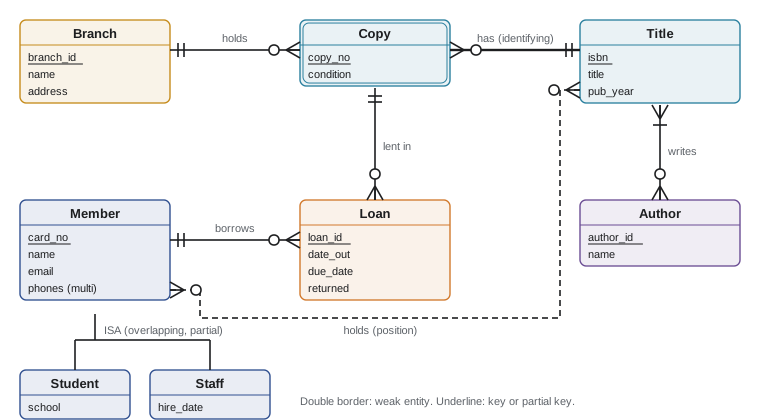
Here are the requirements for the running example, as a librarian might state them. The Riverbend Public Library has several branches, each with a name and address. It holds titles, each with an ISBN, a title and a publication year, written by one or more authors. A title can have many physical copies; each copy has a copy number unique within its title, a condition, and belongs to one branch. Members have a card number, name, email and phone, and borrow copies; the library records the date out, the due date and the date returned for each loan, and keeps loan history. Members may place a hold on a title (not a particular copy) and are notified in order. Some members are students, for whom the library records the school; staff members are employed at one branch and have a hire date.
Entities and attributes
An entity is a distinguishable thing in the domain, such as a particular member or a particular branch; an entity set is the collection of all entities of one kind, such as Member. In diagrams the words entity and entity set are often used loosely for the set. Each entity set has attributes that describe its members, and a key, an attribute or set of attributes that uniquely identifies each entity. For Member the key is the card number; for Title it is the ISBN.
| Kind of attribute | Meaning | Library example | Typical treatment in tables |
|---|---|---|---|
| Simple | One atomic value | Member name | One column |
| Composite | Made of parts | Branch address: street, city, postal code | One column per part |
| Multivalued | Several values for one entity | A member's phone numbers | A separate table |
| Derived | Computable from other data | Days overdue, from due date and today | Usually not stored; computed in queries or views |
| Key | Uniquely identifies the entity | Card number, ISBN | Primary key |
Deciding what is an entity and what is an attribute is a judgment call. A useful rule: if something has its own attributes or takes part in relationships of its own, make it an entity; otherwise it can be an attribute. An author has a name and a biography and writes many titles, so Author is an entity, not an attribute of Title. A copy's condition has no further properties, so it is an attribute. A member's school is an attribute until the library needs to store information about schools, at which point School becomes an entity.
Relationships
A relationship associates entities: a member borrows a copy; an author writes a title; a copy belongs to a branch. A relationship set is the collection of such associations of one kind. Relationships can have attributes of their own: a loan has a date out, a due date and a date returned, which describe neither the member nor the copy alone but the borrowing event. The degree of a relationship is the number of entity sets it connects. Most are binary, connecting two; a ternary relationship connects three, and lesson 7 discusses when it is truly needed. A relationship can connect an entity set to itself, a recursive relationship, such as a staff member supervising other staff; the two participants then have role names such as supervisor and supervisee.
Cardinality and participation
Cardinality constraints say how many entities can take part in a relationship with a given entity. For a binary relationship between A and B the main possibilities are one-to-one (1:1), one-to-many (1:N), and many-to-many (M:N). A copy belongs to one branch, and a branch has many copies, so Branch to Copy is one-to-many. An author can write many titles, and a title can have many authors, so Writes is many-to-many. If the library gave each staff member at most one desk and each desk to at most one person, Assigned would be one-to-one.
Participation says whether every entity must take part. If every copy must belong to a branch, Copy's participation in Belongs is total (mandatory); a branch might have no copies yet, so Branch's participation is partial (optional). Together, cardinality and participation give the minimum and maximum number of related entities: a copy belongs to exactly one branch (min 1, max 1); a branch has zero or more copies (min 0, max many). These numbers will decide where foreign keys go, and whether they may be NULL, in lesson 7.
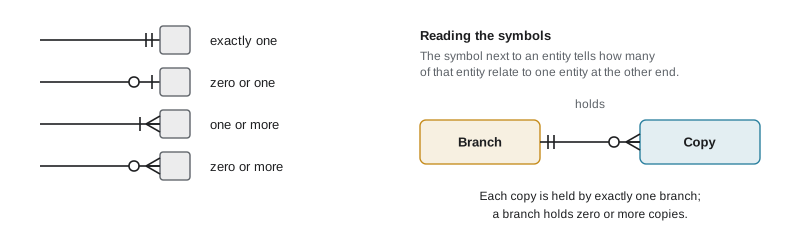
Several notations exist. Peter Chen's original 1976 notation draws entity sets as rectangles, relationships as diamonds and attributes as ovals, with cardinalities written on the lines. Crow's foot notation, used by most drawing tools and in this course's figures, puts relationship names on lines and shows cardinality with symbols at each end: a bar for one, a circle for zero, and a three-pronged crow's foot for many. UML class diagrams express the same ideas with multiplicities such as 1, 0..1 and 0..*. The concepts matter more than the symbols; always include a legend when sharing a diagram with people who may know a different notation.
# Infer the cardinality ratio a sample of relationship data is CONSISTENT with.
# (Data can rule a cardinality out; only requirements can confirm it.)
from collections import Counter

writes = [("Okri", "978-1"), ("Atwood", "978-2"), ("Atwood", "978-3"),
          ("Gaiman", "978-4"), ("Pratchett", "978-4")]           # (author, isbn)
belongs = [("978-1#1", "Central"), ("978-1#2", "Northside"), ("978-2#1", "Central")]  # (copy, branch)

def consistent_with(pairs):
    left  = max(Counter(a for a, _ in pairs).values())   # max partners per left entity
    right = max(Counter(b for _, b in pairs).values())   # max partners per right entity
    l = "many" if left > 1 else "one"
    r = "many" if right > 1 else "one"
    return f"each left entity relates to {l}, each right entity to {r}"

print("Writes :", consistent_with(writes))
print("Belongs:", consistent_with(belongs))Writes : each left entity relates to many, each right entity to many Belongs: each left entity relates to one, each right entity to many
The sample shows Atwood with two titles and title 978-4 with two authors, which rules out anything but many-to-many for Writes. For Belongs it shows each copy at one branch and Central with two copies, which is consistent with many-to-one; but three rows cannot prove that a copy could never be recorded at two branches. The requirement 'each copy belongs to exactly one branch' is what decides. As with keys in lesson 2, data can disprove a constraint but never prove it.
Weak entities
Some entities cannot be identified by their own attributes alone. Copy number 2 is meaningful only within a particular title: copy 2 of one ISBN is a different copy from copy 2 of another. Such an entity set is a weak entity set. It is identified by its partial key (copy number) together with the key of its owner or identifying entity set (Title), through an identifying relationship in which the weak entity's participation is total and one-to-many from the owner. In Chen notation weak entities and identifying relationships are drawn with double lines; in crow's foot diagrams the partial key is often marked and the relationship line drawn solid. Other common weak entities are line items within an order, rooms within a building and dependants of an employee.
Not every dependent thing needs to be weak. If the library stamped every copy with a unique barcode, the barcode would be a key on its own, and Copy would be an ordinary (strong) entity with a many-to-one relationship to Title. Designers often prefer such surrogate identifiers because they simplify foreign keys. The weak entity concept remains useful for understanding identity, and many real schemas use composite keys that come from it.
Worked problem
Placing cardinalities from requirements
From the requirements, state the cardinality and participation of (a) Member borrows Copy over time, keeping history; (b) Staff works at Branch; (c) Member places a hold on Title.
Show solution
- (a) Over time a member borrows many copies and a copy is borrowed by many members, so it is many-to-many. Participation is partial on both sides (new members, unborrowed copies). Because history is kept and the same member can borrow the same copy twice, each loan event needs its own identity, a point lesson 7 develops.
- (b) A staff member is employed at one branch and a branch has many staff: many-to-one from Staff to Branch. Staff participation is total (every staff member works somewhere); Branch participation is partial.
- (c) A member can hold many titles and a title can be held by many members: many-to-many, with relationship attributes such as the date placed and the queue position. Participation is partial on both sides.
Answer: (a) M:N, partial both sides, with loan dates as relationship attributes; (b) N:1 from Staff to Branch, total for Staff; (c) M:N with attributes date placed and position.
Specialization and generalization
Sometimes entities of one set fall into subsets with extra attributes or relationships. Every student member and every staff member is a member, with a card number and name, but students also have a school and staff have a hire date and a branch. The ER model expresses this with specialization, also called an ISA (is-a) hierarchy: Member is the superclass, and Student and Staff are subclasses that inherit Member's attributes and key and add their own. Generalization is the same structure reached in the other direction, by noticing that several entity sets share attributes and factoring them into a superclass.
Two constraints describe a specialization. Disjointness says whether an entity can belong to more than one subclass: if a staff member can also be a student, the subclasses overlap; otherwise they are disjoint. Completeness says whether every superclass entity must belong to some subclass: if ordinary members exist who are neither students nor staff, the specialization is partial; otherwise it is total. The library's specialization is overlapping and partial. Lesson 7 shows three ways to turn such a hierarchy into tables.
Design choices and common pitfalls
ER modeling involves trade-offs, and experienced designers learn a few recurring patterns. An entity versus an attribute: model a thing as an entity when it has its own properties or relationships. An entity versus a relationship: an event such as a loan, which has its own attributes and history and may happen repeatedly between the same pair, is often clearer as an entity of its own, an associative entity, connected to Member and Copy, than as a plain relationship. A binary versus a ternary relationship: use a ternary only when the fact genuinely involves three entities at once and cannot be reconstructed from binary relationships.
Worked problem
Binary or ternary?
A university records which instructor teaches which course in which term. One designer proposes a ternary relationship Teaches(Instructor, Course, Term). Another proposes two binaries: Instructor teaches Course, and Course offered in Term. Which is right?
Show solution
- Test whether the binaries lose information. Suppose Okafor teaches CMPUT-204 and CMPUT-304, and both are offered in Fall and Winter.
- From the binaries we know Okafor teaches CMPUT-204 and that CMPUT-204 is offered in Fall, but not whether Okafor teaches the Fall offering or the Winter one.
- The fact "Okafor teaches CMPUT-204 in Fall" involves all three at once, so the ternary is needed, or, more commonly, an entity Section (course, term) with a relationship to Instructor, which is what the college database does.
Answer: The two binaries lose information; the fact is ternary. Modeling it as a Section entity is often the cleanest equivalent.
| Pitfall | Symptom | Better design |
|---|---|---|
| Redundant relationships | Member related to Branch directly and also through their loans' copies | Keep only relationships that record independent facts |
| Storing derived values | An age or overdue-days attribute that drifts out of date | Store birth date or due date; derive the rest |
| Fan traps | Branch has staff and branch has copies, then a query tries to link a staff member to copies | Model the real relationship explicitly if it exists |
| Attributes on the wrong side | Date returned stored on Copy | Put event attributes on the relationship or associative entity |
| Overusing 1:1 | Splitting one entity into two for no reason | Merge unless there is a reason (security, optional large data, distinct lifecycles) |
Finally, an ER diagram is a communication tool. Name entity sets with singular nouns (Member, not Members) and relationships with verbs read in a stated direction (Member borrows Copy). Record constraints the diagram cannot show, such as 'a member may have at most ten copies on loan' or 'the due date is after the date out', in accompanying notes; many become CHECK constraints or application rules later. Review the diagram with users by reading it back in sentences: 'Each copy belongs to exactly one branch; a branch may have many copies.' Mistakes that users catch at this stage cost nothing to fix.
Common mistakes
MistakeMaking something an attribute that has its own properties, such as author as a text attribute of title.
InsteadIf it has attributes or relationships of its own, model it as an entity.
MistakeDeciding cardinalities from sample data.
InsteadData can rule out a cardinality but not establish one; take cardinalities from the requirements and domain experts.
MistakeModeling a repeated event with history, such as loans, as a plain M:N relationship keyed only by its participants.
InsteadThe same member can borrow the same copy twice. Use an associative entity with its own identifier, or include the date in the key.
MistakeReplacing a genuinely ternary fact with binary relationships.
InsteadCheck whether the binaries can reconstruct the fact; if not, keep the ternary or introduce an entity such as Section.
MistakeStoring derived attributes such as age.
InsteadStore the base fact (birth date) and compute the derived value when needed.
Summary and key terms
- Conceptual design with the ER model decides what to record before deciding how to store it, working from requirements gathered with users.
- Entities have attributes and keys; attributes can be simple, composite, multivalued or derived.
- Relationships associate entities, can have attributes, and have a degree (binary, ternary) and possibly role names.
- Cardinality (1:1, 1:N, M:N) and participation (total or partial) give the minimum and maximum number of related entities.
- A weak entity is identified by a partial key plus its owner's key through an identifying relationship.
- Specialization (ISA) hierarchies have subclasses that inherit the superclass key and attributes, with disjointness and completeness constraints.
- Good diagrams use clear names, record extra constraints in notes, avoid redundancy and derived attributes, and are validated by reading them back to users.
- Entity set
- A collection of similar entities, such as all members of a library.
- Relationship set
- A collection of associations among entities of given entity sets.
- Cardinality ratio
- The maximum number of entities that can relate to one entity: 1:1, 1:N or M:N.
- Participation
- Whether every entity must take part in a relationship (total) or not (partial).
- Weak entity set
- An entity set identified by a partial key together with the key of an owner entity set.
- Partial key
- The attribute that distinguishes weak entities with the same owner.
- Multivalued attribute
- An attribute that can have several values for one entity.
- Derived attribute
- An attribute whose value can be computed from other data.
- Specialization
- Defining subclasses of an entity set that inherit its attributes and add their own.
- Associative entity
- An entity that represents a relationship, often an event, so it can have its own key and relationships.
Practice problems
Work each problem on paper first, then reveal the answer to check.
In a hospital, should "ward" be an attribute of Patient or an entity? Justify.
Show answer
An entity, if wards have their own attributes (name, floor, capacity) or relationships (nurses assigned); an attribute only if nothing else is recorded about wards.
State the cardinality and participation of: each course section is taught by at most one instructor, and an instructor may teach none or many sections.
Show answer
Many-to-one from Section to Instructor; Section participation is partial (unassigned sections exist) and Instructor participation is partial.
Why is Copy a weak entity when copies are numbered 1, 2, 3 within each title?
Show answer
Copy number alone does not identify a copy; it must be combined with the title's ISBN.
Give an example of a composite attribute and how it would become columns.
Show answer
A name with first and last parts becomes first_name and last_name columns.
A member can have several phone numbers. How should the ER model show this?
Show answer
As a multivalued attribute, which will become a separate table of (card number, phone).
What is the difference between disjoint and overlapping specialization?
Show answer
In a disjoint specialization an entity belongs to at most one subclass; in an overlapping one it may belong to several.
Why should "age" not be stored as an attribute?
Show answer
It changes over time and can be derived from a birth date, so a stored value would become wrong.
When is a ternary relationship necessary?
Show answer
When a fact involves three entities together and cannot be reconstructed from binary relationships.
Read this aloud as sentences: Branch (1, exactly one) — holds — (0..many) Copy.
Show answer
Each copy is held by exactly one branch; a branch may hold zero or more copies.
Name two notations for ER diagrams.
Show answer
Chen notation (rectangles, diamonds, ovals) and crow's foot notation; UML class diagrams are a third.
Lesson quiz · 5 questions
Score 60% or more to complete this lesson.
Create a free account to save your progress, take quizzes and earn a certificate.