
CIV-450 · Lesson 9 of 12 · 20 min
Claims, delays and dispute resolution
In the second week of July, on day 57 of the Ridgeway schedule, Northline's excavator opened the footing trench for the retaining wall. Two meters down, where the geotechnical report showed firm gray-brown varved clay, the bucket met soft, wet clay that squeezed into the trench as fast as it was dug. Marc Bélanger stopped the work, called Owen to the site, and that afternoon Joel Ostrowski sent written notice of a differing site condition. This lesson follows that event from notice to settlement: what the contract says about unexpected ground, how the delay is analyzed, how the claim is valued, and what happens when the parties cannot agree.
What a claim is
In construction, a claim is simply a request by one party for an adjustment it believes the contract entitles it to: more money, more time, or both. Claims are not hostile in themselves. They are the contract's mechanism for dealing with events that the price did not cover. A well-run project has claims, assessed promptly and fairly; a badly run one has disputes, claims that have been rejected, ignored or delayed until both sides hire lawyers. The contract administrator's aim is to keep claims from becoming disputes.
Most claims fall into a few families: changes the owner ordered or caused, differing site conditions, delay and disruption caused by the owner or its consultants, acceleration demanded without a time extension, and payment disputes. Each needs the same three elements to succeed: entitlement, a contractual or legal basis for the adjustment; causation, proof that the event caused the effect claimed; and quantum, the amount of money or time, proven from records.
Differing site conditions
Federal construction contracts include the differing site conditions clause of the Federal Acquisition Regulation, and AIA A201 and EJCDC C-700 contain similar provisions, which most states and cities adopt. Two types are recognized. A Type I condition is a subsurface or latent physical condition that differs materially from those indicated in the contract documents; a Type II condition is an unknown condition of an unusual nature, differing materially from those ordinarily encountered in work of the kind. The contractor must give prompt written notice before the conditions are disturbed. The policy behind the clause is economic: if owners carry the risk of unforeseeable ground, bidders need not price a contingency for it, and the owner pays only when the conditions actually occur.
On the Ridgeway package, the contract included the geotechnical report from CIV-340, with its borehole logs and laboratory results, as a reference document. Dr. Kowalczyk inspected the trench the next morning. The nearest borehole, 28 meters away, had shown firm clay with an undrained strength of about 45 kPa at footing level; field vane tests in the trench gave 18 to 22 kPa, softened by a sand seam carrying artesian water from the till that the borehole had missed. The condition differed materially from what the documents indicated. Kestrel Bay accepted entitlement within five working days and redesigned the footing: subexcavation of 0.8 m of soft clay, a geotextile and granular pad, and a wider heel, the design method of CIV-440.
Some owners now include a geotechnical baseline report in the contract, separate from the factual data. A baseline report states, in measurable terms, the conditions the contractor should assume when pricing: for example, that soft clay with strength below 25 kPa will be found over no more than 10 % of the wall length. Conditions within the baseline are the contractor's risk; conditions beyond it are the owner's. Baselines replace arguments about what the documents indicated with a comparison against a number. Kestrel Bay recommended one for the city's next soft-ground project.
Delay analysis
The soft clay stopped the wall, which was on the critical path, so the project was delayed. But by how much, and who was responsible for each day? Delay analysis answers those questions, and its methods are described in recommended practices such as AACE International's forensic schedule analysis guide and the Society of Construction Law's delay and disruption protocol. The common methods differ in the information they use. An as-planned versus as-built comparison simply contrasts the baseline with what happened. An impacted as-planned analysis inserts delay events into the baseline. A collapsed as-built analysis removes events from the as-built schedule. A time impact analysis inserts each event into the schedule update current when it occurred. A windows analysis divides the project into periods between updates and measures the change in the forecast completion date in each window, attributing it to the events in that window.
Delays are classified by who bears their risk. An excusable delay entitles the contractor to more time; if it is also compensable, to money as well. Owner-caused delays, such as differing site conditions, late approvals or owner changes, are usually excusable and compensable. Neutral delays, such as unusually severe weather or an area-wide strike, are usually excusable but not compensable. Contractor-caused delays are neither, and if they push completion beyond the contract date, the contractor pays liquidated damages, a sum per day fixed in the contract as a genuine pre-estimate of the owner's loss. Concurrent delay, when owner and contractor delays overlap so that either alone would have delayed the project, is usually resolved by granting time but not money for the overlapping days.
# Windows analysis of the culvert delay and the quantum of the contractor's claim
UNITS = "US"
SI = UNITS == "SI"
CUR = "CAD" if SI else "USD"
# each window: forecast completion (working day) at the start and end, and the cause found for the slip
windows = [
    ("W1 start to wall excavation", 133, 133, None),
    ("W2 soft varved clay at wall footing", 133, 147, "owner"),    # differing site condition, footing redesign
    ("W3 curb crew late from another job", 147, 150, "contractor"), # contractor resourcing
    ("W4 wet September, paving",       150, 152, "neutral"),       # weather beyond the contract's normal allowance
    ("W5 recovery by added crew",      152, 149, "contractor"),    # acceleration at the contractor's own cost
]
tot = {"owner": 0, "contractor": 0, "neutral": 0}
for name, a, b, who in windows:
    d = b - a
    if who: tot[who] += d
    print(f"{name:37s} forecast {a:3d} -> {b:3d}  slip {d:+3d}  {who or '-'}")
print(f"Net slip {windows[-1][2] - windows[0][1]} days: owner {tot['owner']}, contractor {tot['contractor']}, neutral {tot['neutral']}")
# concurrency: inside window 2, the contractor's late wall formwork would itself have caused 3 days of delay
concurrent = 3
exc_comp = tot["owner"] - concurrent
exc_noncomp = concurrent + tot["neutral"]
print(f"Excusable and compensable: {exc_comp} days; excusable, time only: {exc_noncomp} days")
# quantum: time-related costs per working day, verified from the contractor's records
if SI:
    site_oh, equip_stand, traffic = 3850, 2400, 900
else:
    site_oh, equip_stand, traffic = 3100, 1950, 750
per_day = site_oh + equip_stand + traffic
direct = 168000 if SI else 139000          # subexcavation, granular replacement and footing redesign, from records
claimed = 412000 if SI else 341000
assessed = direct + exc_comp * per_day
markup = 0.10                               # contract markup on the time-related costs
assessed += markup * exc_comp * per_day
print(f"Time-related cost per day {per_day:,} x {exc_comp} days + {markup:.0%} markup, plus direct costs {direct:,}")
print(f"Engineer's assessment {assessed:,.0f} {CUR} against {claimed:,} claimed ({assessed / claimed:.0%})")
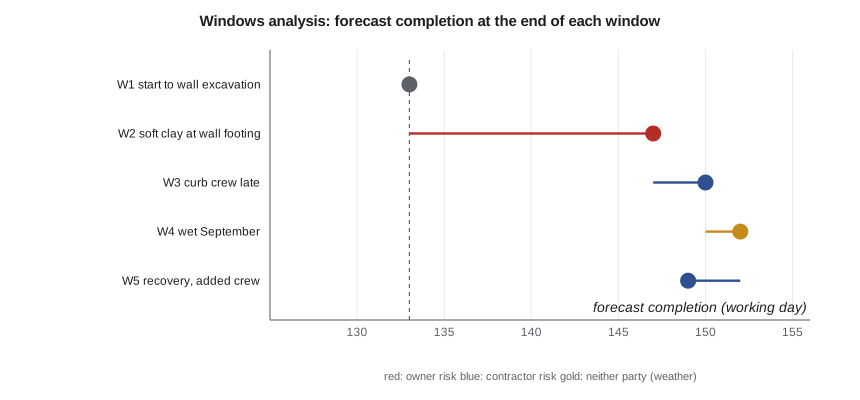
print(f"Extension of time: {exc_comp + exc_noncomp} working days; liquidated damages waived for those days")W1 start to wall excavation forecast 133 -> 133 slip +0 - W2 soft varved clay at wall footing forecast 133 -> 147 slip +14 owner W3 curb crew late from another job forecast 147 -> 150 slip +3 contractor W4 wet September, paving forecast 150 -> 152 slip +2 neutral W5 recovery by added crew forecast 152 -> 149 slip -3 contractor Net slip 16 days: owner 14, contractor 0, neutral 2 Excusable and compensable: 11 days; excusable, time only: 5 days Time-related cost per day 5,800 x 11 days + 10% markup, plus direct costs 139,000 Engineer's assessment 209,180 USD against 341,000 claimed (61%) Extension of time: 16 working days; liquidated damages waived for those days
Reading the windows
Window 2 contains the soft clay: the forecast finish moved from day 133 to day 147, 14 working days of owner-risk delay. But within that window, Northline's formwork supplier was also late; even without the clay, the wall would have started three days late. Those three days are concurrent, so they earn time but not money. Window 3 shows a contractor delay, the curb crew arriving late from another job, which Northline then recovered in window 5 by adding a second crew at its own cost; the two cancel. Window 4 shows two days of rain beyond the weather allowance in the contract, a neutral delay. The result: 16 working days of extension, 11 of them compensable, and the completion date moves from day 133 to day 149, which is exactly when the work finished, so no liquidated damages apply.
Quantum
Northline's claim asked for USD 341,000. Kestrel Bay assessed it at USD 209,180, about 61 % of the claim. The direct costs of the redesigned footing, subexcavation, geotextile, granular pad and extra concrete, USD 139,000 from verified records and contract unit prices, were accepted in full. The time-related costs were accepted for 11 compensable days at USD 5,800 a day: site overhead and supervision, standby of the excavator and crane that could not be released, and extended traffic control, plus the contract's 10 % markup. The engineer rejected costs for the concurrent days, for productivity losses claimed across the whole project without evidence linking them to the clay, and for home office overhead calculated by the Eichleay formula, which US federal boards accept mainly where the contractor was on standby and could not take other work, a condition not shown here.
Worked problem
Assessing the time-related costs
Time-related costs are USD 3,100 site overhead, USD 1,950 equipment standby and USD 750 traffic control per day, with a 10 % markup, for 11 compensable days. Add direct costs of USD 139,000.
Show solution
- \[(3100 + 1950 + 750) \times 11 \times 1.10 = 5800 \times 12.1 = 70{,}180\]
- \[70{,}180 + 139{,}000 = 209{,}180\]
Answer: The assessed claim is USD 209,180 with a 16-day extension of time.
Resolving disputes
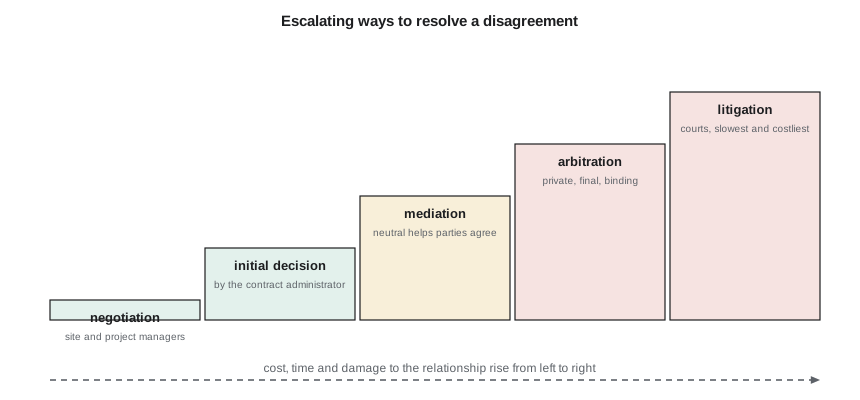
If the contractor does not accept the engineer's decision, the contract's dispute resolution clause takes over. Most standard forms set out a ladder of steps, each more formal and costly than the last: negotiation between the parties' representatives, a decision by the engineer or another designated person, mediation by a neutral third party who helps the parties agree but cannot impose a result, arbitration by a private tribunal whose award is final and binding, and finally litigation in the courts. Some large projects add a dispute board, a standing panel that visits the site regularly and gives recommendations as issues arise.
Minnesota has no statutory adjudication scheme of the kind used in Ontario or the United Kingdom, so construction disputes follow the contract's ladder. EJCDC C-700 provides for a decision by the engineer on claims, followed by mediation and then arbitration or litigation as the parties have agreed; AIA A201 uses an initial decision maker, mediation and binding dispute resolution. Arbitration is commonly administered under the American Arbitration Association's construction industry rules. Federal contracts follow the Contract Disputes Act, with claims decided by the contracting officer and appeals to a board of contract appeals or the Court of Federal Claims.
For the Ridgeway claim, the parties negotiated. Northline accepted the extension of time and the direct costs, and argued for some of the rejected productivity costs. Lesson 12 completes the story with the settlement decision. The lesson for the engineer is in the records: the claim could be assessed in weeks rather than years because Owen's diary recorded the crews, equipment and hours every day, the trench was photographed and tested the day the clay was found, and the schedule updates had been kept current.
Practical points
- Give and demand prompt written notice of any event that may lead to a claim.
- Investigate differing conditions before they are disturbed, and document them thoroughly.
- Analyze delay with the schedule updates, separating owner, contractor, neutral and concurrent delay.
- Assess quantum from contemporaneous records, not formulas or totals.
- Use the dispute ladder deliberately; most claims should be settled at the first or second step.
Common mistakes
MistakeRejecting a differing site condition claim because the contractor 'should have expected' soft clay.
InsteadCompare the conditions with what the documents indicated; that is the test.
MistakeGranting money for concurrent delay.
InsteadConcurrent days usually earn time only.
MistakeAccepting a total-cost claim, the difference between actual and bid cost.
InsteadIt assumes the bid was right and the contractor blameless; insist on causation.
MistakeWaiting for the end of the job to deal with claims.
InsteadRecords fade and positions harden; assess claims as they arise.
Summary and key terms
- A claim needs entitlement, causation and quantum.
- Differing site conditions clauses put unforeseeable ground on the owner, so bidders need not price it.
- Windows analysis attributes changes in forecast completion to events in each period between updates.
- Owner delays are excusable and compensable; neutral delays earn time only; concurrent delays usually earn time only.
- The Ridgeway claim was assessed at USD 209,180 and a 16-day extension, about 61 % of the amount claimed.
- Minnesota disputes follow the contract's ladder of decision, mediation and arbitration or litigation.
- Claim
- A request by a contracting party for an adjustment of price or time under the contract.
- Differing site condition
- A physical condition that differs materially from those indicated in the contract or ordinarily encountered.
- Geotechnical baseline report
- A contract document stating, in measurable terms, the ground conditions to be assumed for pricing.
- Excusable delay
- A delay for which the contractor is entitled to more time.
- Compensable delay
- An excusable delay for which the contractor is also entitled to money.
- Concurrent delay
- Overlapping owner and contractor delays, either of which would have delayed completion.
- Liquidated damages
- A fixed sum per day set in the contract as a pre-estimate of the owner's loss from late completion.
- Windows analysis
- Delay analysis that measures the change in forecast completion within successive periods.
Practice problems
Work each problem on paper first, then reveal the answer to check.
The documents showed firm clay, but the contractor's own estimator noted soft clay on a nearby project. Does that defeat a differing site condition claim?
Show answer
Generally not; the test is what the contract documents indicated, though a site visit or known local conditions may be argued.
In a window, forecast completion moved 10 days; 6 were owner delay and 4 overlapped a contractor delay. How should they be treated?
Show answer
6 days excusable and compensable; 4 days excusable but not compensable.
Time-related costs are USD 4,000 a day with a 10 % markup. Value 8 compensable days.
Show answer
4,000 × 8 × 1.10 = USD 35,200.
Why do contracts require notice before conditions are disturbed?
Show answer
So that the owner's engineer can see and test them, and consider alternatives, before the evidence is gone.
Lesson quiz · 5 questions
Score 60% or more to complete this lesson.
Create a free account to save your progress, take quizzes and earn a certificate.