
CIV-450 · Lesson 8 of 12 · 19 min
Contract administration: submittals, RFIs, changes and quality
Contract administration is the day-to-day work of making a construction contract function: answering questions, reviewing the contractor's submissions, inspecting and testing the work, recording what happens, and managing changes. It is where most young civil engineers learn construction, and it is where small failures, an unanswered question, a lost test report, a verbal instruction, become large claims months later. This lesson follows the paper and data trail of the Ridgeway package from the pre-construction meeting to the end of the season.
The pre-construction meeting
Before Northline mobilized, Priya chaired a pre-construction meeting with the city, Northline, its main subcontractors, the utilities, the testing laboratory and the city's traffic and transit staff. The agenda set the ground rules for the whole job: the chain of authority and who may issue instructions, the communication channels, the submittal list and review times, the schedule submission dates, the measurement and payment procedure, the change procedure, the site safety requirements, the environmental permit conditions and the meeting schedule. The minutes, issued within three days and agreed by all parties, became the first entry in the project record.
Submittals and shop drawings
The contract requires the contractor to submit information before certain work proceeds: shop drawings for the precast culvert segments, the retaining wall reinforcement and the lighting poles; product data for the bioretention soil and the storm sewer pipe; mix designs for concrete and asphalt; the cofferdam and dewatering design by the contractor's engineer; the traffic control plans; and the quality control plan. The engineer reviews each one for general conformance with the design intent and the contract. The review stamp usually says so in careful words: reviewed for general conformance, the contractor remains responsible for dimensions, quantities, fabrication and construction methods, and for coordination.
Those words matter. If the engineer approves a shop drawing that contains an error, the error does not become the engineer's, but an engineer who reviews carelessly, or who reviews temporary works design that is the contractor's responsibility as if approving it, can share liability. The cofferdam design is a good example. It is the contractor's temporary work, designed and sealed by the contractor's engineer. Kestrel Bay reviews it only for its effects on the permanent work and the permit conditions: the creek diversion capacity, the fish rescue plan, the dewatering discharge, not for its structural adequacy.
Requests for information
A request for information, RFI, is the contractor's formal question about the contract documents: a dimension that does not close, a conflict between a drawing and a specification, a utility found where none was shown. The answer must come in writing, within the time the contract allows, from the person with authority to give it. An RFI answer that changes the scope, cost or time of the work is a change and must go through the change process; an answer that merely clarifies does not. Telling the two apart is a judgment the contract administrator makes many times a week.
# Pricing two changes on the Ridgeway contract and checking the RFI and submittal logs
UNITS = "US"
SI = UNITS == "SI"
CUR = "CAD" if SI else "USD"
# Change 1: extra subexcavation of soft clay below the roundabout, paid at contract unit prices
if SI:
    q_ex, p_ex, q_gr, p_gr = 380, 21.0, 380, 55.0   # m3 excavated, m3 granular replaced
else:
    q_ex, p_ex, q_gr, p_gr = 500, 15.0, 500, 38.0   # yd3
c1 = q_ex * p_ex + q_gr * p_gr
print(f"Change 1, unit prices: {q_ex} x {p_ex:.2f} + {q_gr} x {p_gr:.2f} = {c1:,.0f} {CUR}")
# Change 2: abandoning an unrecorded cast-iron watermain found in the trench, by force account
LAB = "labor"
crew = [("foreman", 10, 78 if SI else 64), ("pipe layer", 10, 62 if SI else 52), ("two helpers", 20, 52 if SI else 44)]
equip = [("excavator, 30 t class", 10, 195 if SI else 160), ("tandem truck", 6, 125 if SI else 105)]
mats = 3900 if SI else 3200
L = sum(h * r for _, h, r in crew); E = sum(h * r for _, h, r in equip)
mk = {"crew": 0.25, "equipment": 0.10, "materials": 0.15}    # markups set in the contract
c2 = L * (1 + mk["crew"]) + E * (1 + mk["equipment"]) + mats * (1 + mk["materials"])
print(f"Change 2, force account: {LAB} {L:,} + {mk['crew']:.0%}, equipment {E:,} + {mk['equipment']:.0%}, "
      f"materials {mats:,} + {mk['materials']:.0%} = {c2:,.0f} {CUR}")
# Change 3: the contractor's lump-sum quote for added curb ramps, checked against an independent estimate
quote, check = (48500, 41200) if SI else (40100, 34000)
print(f"Change 3, quote {quote:,} vs the engineer's check {check:,}: {quote / check - 1:+.0%}; negotiate or direct the work")
# RFI and submittal turnaround (working days) against the 10 days in the contract
rfi = [3, 5, 2, 8, 12, 4, 6, 15, 3, 7, 9, 4, 11, 5, 2, 6]
subm = [8, 12, 6, 10, 14, 9, 7, 18, 10, 5]
for name, xs in (("RFIs", rfi), ("Submittals", subm)):
    late = sum(x > 10 for x in xs)
print(f"{name:10s} n {len(xs):2d} mean {sum(xs) / len(xs):4.1f} days longest {max(xs):2d} over 10 days: {late}")Change 1, unit prices: 500 x 15.00 + 500 x 38.00 = 26,500 USD Change 2, force account: labor 2,040 + 25%, equipment 2,230 + 10%, materials 3,200 + 15% = 8,683 USD Change 3, quote 40,100 vs the engineer's check 34,000: +18%; negotiate or direct the work RFIs n 16 mean 6.4 days longest 15 over 10 days: 3 Submittals n 10 mean 9.9 days longest 18 over 10 days: 3
The logs tell a story. RFIs were answered in 6.4 working days on average, well within the 10 days in the contract, but three took longer, the longest 15 days. Submittals averaged 9.9 days, right at the limit, and three exceeded it, one by eight days: the retaining wall reinforcement drawings, which waited while Kestrel Bay's structural engineer was on another site. Late reviews are a classic source of delay claims, because the contractor can show that it could not proceed. Priya added a second reviewer for structural submittals and reported the turnaround at every progress meeting from then on.
Changes
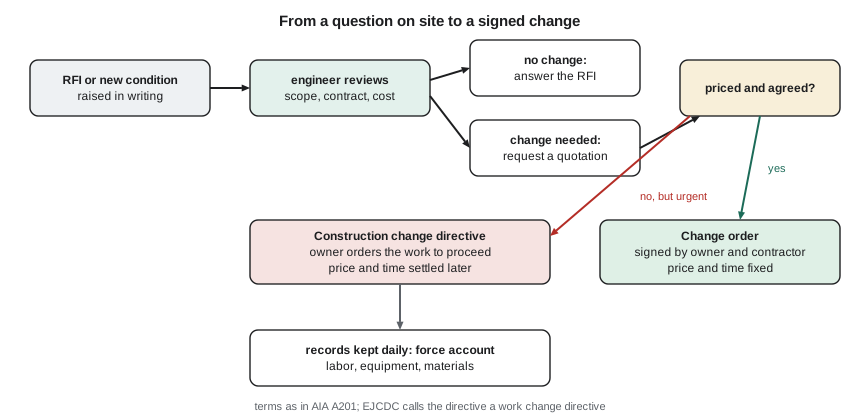
Every construction contract allows the owner to change the work within the general scope, and every one requires that changes be adjusted for in price and time. The standard forms provide two instruments. A change order is agreed by both parties and fixes the adjustment to the price and the time. When the parties cannot agree on the price, or the work cannot wait, the owner issues a directive ordering the work to proceed, with the price and time to be settled later, usually on the basis of the contractor's recorded costs.
Under AIA A201 these are the change order and the construction change directive; under EJCDC C-700, the change order and the work change directive. In each case, the directive requires the contractor to proceed while the adjustment is determined, normally from the contractor's actual cost records plus agreed markups. State transportation specifications use similar instruments, often called supplemental agreements and extra work orders.
Pricing changes
Changes are priced in one of three ways. Where the change is more of a bid item, such as additional excavation or curb, the contract unit prices apply. Where no unit price fits, the contractor quotes a lump sum, which the engineer checks against an independent estimate. And where the work is urgent or its extent unknown, it is done on force account, also called time and materials: the contractor records labor, equipment and materials daily, the inspector verifies the records, and payment is cost plus contractual markups.
Sofia's script prices three Ridgeway changes. Soft clay found under the roundabout needed 500 yd³ of subexcavation and granular replacement, priced at the contract unit prices for USD 26,500. An unrecorded cast-iron water main, abandoned decades ago, was found in the storm sewer trench; cutting, capping and removing it took one day and was paid by force account at USD 8,683, including markups of 25 % on labor, 10 % on equipment and 15 % on materials. The city added curb ramps at two bus stops; Northline quoted USD 40,100 against the engineer's check of USD 34,000, 18 % higher, and after a negotiation the parties agreed USD 36,400.
Worked problem
A force account day
A force account day has labor of USD 2,040, equipment of USD 2,230 and materials of USD 3,200, with markups of 25 %, 10 % and 15 %. What is the payment?
Show solution
- \[2040(1.25) + 2230(1.10) + 3200(1.15)\]
- \[2550 + 2453 + 3680 = 8{,}683\]
Answer: The payment is USD 8,683.
Changes also have a time element. The contractor is entitled to a time extension if, and only if, the change delays the critical path. The subexcavation under the roundabout took two days, but the roundabout had float at the time, so no extension was due. The curb ramps were built in parallel with other work, also without delay. Assessing time is a schedule exercise using the latest update, not a matter of adding up the days each change took.
The weekly progress meeting holds all this together. On the Ridgeway package it ran every Tuesday on site, with a standing agenda: safety first, then the three-week look-ahead schedule, open RFIs and submittals, changes in progress, quality issues, environmental matters, utilities and any public complaints. Owen wrote the minutes and circulated them within two days, and each meeting began by confirming the previous minutes. Minutes that record decisions and who will act on them, with dates, are among the most useful records in any later dispute.
Quality assurance, inspection and testing
Quality on a public works contract is shared. The contractor is responsible for quality control: building the work to the specifications, testing its own materials and processes, and correcting defects. The owner carries out quality assurance: inspection by the resident inspector and acceptance testing by an independent laboratory, to verify that the work meets the contract. The two must not be confused. An inspector who sees a defect and says nothing does not make the defect acceptable, but an owner whose inspectors routinely accept work cannot easily reject it later.
On the Ridgeway package the laboratory tests compaction of the aggregate layers with a nuclear density gauge, concrete for slump, air content and cylinder strength, and asphalt for density and mix properties, at frequencies set in the specifications. Owen keeps a nonconformance log. When two density tests on the east segment base came in below the specified percentage of maximum density, the area was reworked and retested before paving, and the log records both the failure and the correction. Acceptance is by lot: a defined quantity of work is accepted or rejected on the results of the tests in it, sometimes with a price reduction for marginal results rather than removal.
Records
Everything above depends on records. The daily diary, the weekly meeting minutes, the RFI, submittal and change logs, the test results, the measurement sheets, photographs dated and located, and correspondence filed by subject: these are the project's memory. In a dispute, the party with better contemporaneous records usually prevails, because they show what actually happened when it happened. On the Ridgeway package the records live in a shared project management platform, but the discipline is the same as with paper: write it down the same day, factually, and file it where others can find it.
Practical points
- Set the ground rules at the pre-construction meeting and minute them.
- Review submittals for conformance with the design intent, not for the contractor's means and methods.
- Answer RFIs in writing, on time, and route any that change scope through the change process.
- Price changes by unit prices, checked quotations or verified force account records.
- Keep quality control and quality assurance distinct, and record every nonconformance and its correction.
Common mistakes
MistakeGiving verbal instructions on site.
InsteadInstructions that affect scope, cost or time must be in writing.
MistakeReviewing temporary works design as if approving it.
InsteadReview only its effect on the permanent work and permit conditions; the contractor's engineer is responsible.
MistakeGranting time for every change by adding its duration.
InsteadOnly changes that delay the critical path earn an extension.
MistakeLetting submittal reviews run late without telling anyone.
InsteadLate reviews delay work and support claims; track and report turnaround.
Summary and key terms
- Contract administration turns the contract into daily practice: meetings, submittals, RFIs, changes, inspection and records.
- Submittal review checks general conformance; responsibility for methods stays with the contractor.
- RFI answers that change scope, cost or time are changes and must be priced.
- Change orders fix price and time by agreement; directives order work to proceed while valuation is settled.
- Changes are priced by unit prices, quotations or force account with contractual markups.
- The contractor controls quality; the owner assures it through inspection and acceptance testing.
- Submittal
- Information the contractor must submit for review before certain work proceeds, such as shop drawings.
- Shop drawing
- A detailed drawing prepared by the contractor or supplier for fabrication or installation.
- Request for information
- A contractor's formal written question about the contract documents.
- Change order
- A written agreement adjusting the work, the price and the time.
- Construction change directive
- A written order to proceed with changed work before its price and time are agreed.
- Force account
- Payment for work on the basis of recorded labor, equipment and materials plus markups.
- Quality assurance
- The owner's inspection and testing to verify that the work meets the contract.
- Nonconformance
- Work or material that does not meet the contract requirements.
Practice problems
Work each problem on paper first, then reveal the answer to check.
An extra 400 ft of curb is needed. The bid unit price is USD 24 per foot. Price the change.
Show answer
400 × 24 = USD 9,600.
The contractor asks whether a pipe may be laid at 0.5 % instead of the 0.6 % shown. Is the answer an RFI response or a change?
Show answer
It depends on whether the answer alters scope, cost or time; if accepting a different grade changes the design, record it as a change, even at no cost.
A change takes six days but the activity has eight days of float. How much time extension is due?
Show answer
None, unless the change consumes float that leads to a later critical delay; the critical path is not delayed.
Who carries out quality control on the Ridgeway package, and who carries out quality assurance?
Show answer
Northline carries out quality control; the city, through Kestrel Bay's inspectors and the independent laboratory, carries out quality assurance.
Lesson quiz · 5 questions
Score 60% or more to complete this lesson.
Create a free account to save your progress, take quizzes and earn a certificate.