
CIV-450 · Lesson 10 of 12 · 19 min
Construction safety management
Construction is one of the most dangerous industries in North America. Workers are killed or injured by falls, by being struck by vehicles and equipment, by trench collapses and by contact with electricity far more often than in most other occupations. On a road and culvert project, the hazards are concentrated: heavy equipment working beside live traffic, deep trenches in soft ground, a cofferdam in a flowing creek, overhead power lines and buried gas mains. Safety is first the contractor's legal duty, but owners and engineers have duties too, and the decisions made in design and contract administration shape how safe the site can be. This lesson looks at those duties and at the tools used to manage safety on the Ridgeway package. CON-355 covers safety leadership for site supervisors in more depth.
Who is responsible
The federal Occupational Safety and Health Act places the main duty on employers, and Minnesota runs its own state plan, MNOSHA, which enforces standards at least as effective as the federal ones, including the construction standards of 29 CFR 1926. On a multi-employer site, OSHA's multi-employer citation policy, issued in 1999, decides who can be cited for a hazard: the creating employer that caused it, the exposing employer whose workers are exposed, the correcting employer responsible for fixing it, and the controlling employer with general supervisory authority over the site. A general contractor such as Northline is usually the controlling employer and must use reasonable care to prevent and detect violations by its subcontractors. An owner or engineer that takes on control of site safety can also become a controlling employer.
The engineer's position is delicate. Kestrel Bay's contract administrators are on site every day and see the work, but they do not control the means and methods, and the contract says so. If they start directing safety measures, they may assume a duty they cannot discharge. If they ignore an obvious danger, they fail their professional duty to the public and, possibly, their legal duty. The accepted course is clear: an engineer who sees an imminent danger tells the contractor's supervisor at once, records it, and, if the danger is not addressed, uses the contract's power to stop the affected work and informs the owner and, if necessary, the regulator. Professional codes of ethics in both countries put public safety first.
Designing for safety
Many hazards are fixed in design, long before a contractor arrives. Prevention through design, sometimes called safety in design, asks designers to remove hazards or reduce them at source. On the Ridgeway package that meant precast culvert segments rather than cast-in-place work in the creek, which shortened the time workers spent in the cofferdam; locating the storm sewer away from the overhead power line along the north side; specifying anchor points on the retaining wall for fall protection during later maintenance; and staging the road so that crews work behind barriers, not cones, beside traffic. The designer's risk register, handed to the contractor in the tender documents, listed the residual hazards that design could not remove: the soft, wet clay, the live gas main crossing the trench at the roundabout, and the creek.
The contractor's safety program
Northline's site-specific safety plan, submitted before mobilization and reviewed by Kestrel Bay for completeness, covers hazard identification and job hazard analyzes for each major task, the competent persons named for excavations and the cofferdam, emergency response and rescue, first aid, traffic management, training and orientation of every worker and visitor, daily tailgate meetings, inspections, incident reporting and investigation, and subcontractor management. Tasha Greene, Northline's safety coordinator, runs it. A plan on paper is only the start; the measure is whether the field crews actually do what it says, which is why inspections and leading indicators matter.
Excavations and trenches
Trench collapses kill workers every year, often in trenches only a few feet deep, because a cubic yard of soil can weigh more than a small car. OSHA's excavation standard, 29 CFR 1926 Subpart P, requires a protective system, sloping, benching, shoring or a trench shield, for any excavation 5 ft or deeper unless it is in stable rock, and requires protective systems for excavations deeper than 20 ft to be designed by a registered professional engineer. A competent person must inspect excavations daily. Soft, wet clay that squeezes into the excavation, like the varved clay at the culvert, is Type C soil, the weakest class, with a maximum allowable slope of 1.5 horizontal to 1 vertical.
# Safety statistics for the Ridgeway season, a taper length check and the culvert trench slope
UNITS = "US"
SI = UNITS == "SI"
hours = 96400                        # worker-hours on the contract, May to October
recordable, lost_time, restricted, first_aid, near_miss = 2, 1, 1, 14, 37
trir = recordable * 200000 / hours
ltifr = lost_time * 200000 / hours
dart = (lost_time + restricted) * 200000 / hours
print(f"Worker-hours {hours:,}: TRIR {trir:.2f}, lost-time rate {ltifr:.2f}, DART {dart:.2f} per 200,000 hours")
print(f"Leading indicators: {near_miss} near misses and {first_aid} first aids reported; ratio {near_miss / max(recordable, 1):.0f} near misses per recordable")
# work zone taper: the familiar US formula, used here as an engineering check against the manual's tables
if SI:
    W, S = 3.5, 60                       # lane width m, posted speed km/h
    W_ft, S_mph = W / 0.3048, S / 1.609
else:
    W_ft, S_mph = 12, 35
Lft = W_ft * S_mph ** 2 / 60 if S_mph < 45 else W_ft * S_mph
print(f"Merging taper: L = W S^2 / 60 = {Lft:.0f} ft" + (f" = {Lft * 0.3048:.0f} m; compare with the Book 7 tables" if SI else ""))
# culvert trench: 3.6 m deep in soft, wet varved clay
depth = 3.6 if SI else 12.0
ratio = 3.0 if SI else 1.5              # horizontal : vertical for the soil type assigned (see text)
top = 2 * ratio * depth + (5.6 if SI else 18.0)   # base width for the 4.5 m box plus working room
u = "m" if SI else "ft"
print(f"Trench {depth} {u} deep at {ratio}H:1V each side: top width {top:.1f} {u} (base {5.6 if SI else 18.0} {u})")
print("Too wide for the creek corridor: use a braced trench box or sheet piling designed by an engineer instead.")Worker-hours 96,400: TRIR 4.15, lost-time rate 2.07, DART 4.15 per 200,000 hours Leading indicators: 37 near misses and 14 first aids reported; ratio 18 near misses per recordable Merging taper: L = W S^2 / 60 = 245 ft Trench 12.0 ft deep at 1.5H:1V each side: top width 54.0 ft (base 18.0 ft) Too wide for the creek corridor: use a braced trench box or sheet piling designed by an engineer instead.
The sloped trench for the culvert would be 54 ft wide at the top, far wider than the creek corridor allows and wider than the cofferdam. The answer is a protective system: Northline's engineer designed a braced sheet-pile excavation, which also serves as part of the cofferdam, and Kestrel Bay reviewed it for its effect on the permanent culvert and the creek. The calculation is a good example of why engineers should check constructability early: the sloped option was never realistic, and the support system had to be priced and scheduled from the start.
Work zones and traffic control
Road workers are struck by vehicles in work zones every year, and a road reconstruction that keeps traffic moving puts crews within a few feet of passing cars for months. In the United States, temporary traffic control follows Part 6 of the Manual on Uniform Traffic Control Devices, whose 11th edition took effect in January 2024, and MnDOT publishes a field manual with typical layouts that Minnesota cities use. A work zone has an advance warning area, a transition area where traffic is shifted by a taper of cones or drums, a buffer space, the activity area, and a termination area. For a merging taper on a road posted below 45 mph, Part 6 gives the length as L = WS²/60, about 245 ft for a 12 ft lane at 35 mph.
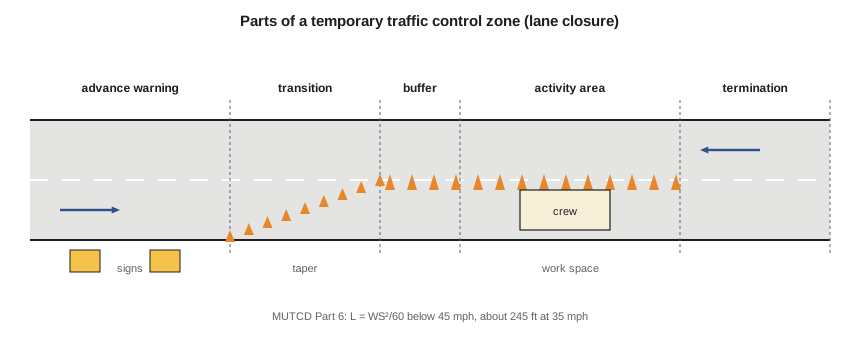
The Ridgeway traffic plan used concrete barriers rather than cones wherever crews worked beside traffic for more than a few days, a reduced posted speed through the work zone, police enforcement during peak hours in the first weeks, and a flagging plan for short closures. Each change in stage was set up under the eye of Northline's traffic control supervisor and inspected by Owen before work resumed.
The cofferdam, the creek and other high hazards
Work in and beside water adds hazards of its own: drowning, cold-water shock, the sudden failure of a cofferdam, and flash rises in the creek after a storm upstream. The Ridgeway cofferdam plan, prepared by Northline's engineer, set a creek level at which the crew must leave the enclosure, a rescue plan with a throw bag and a boat on standby, personal flotation devices for anyone working near open water, and daily inspection of the sheet piles and the diversion pipe. Owen checked the creek gauge each morning and recorded it in the diary, so that the record would show whether the trigger level had been respected.
Two other high hazards needed specific controls. The live gas main crossing the roundabout excavation was located by the utility, marked, and exposed by hand or vacuum excavation before any machine dug near it, under the utility's supervision. The overhead power line along the north side meant a limit of approach for the excavators and the crane setting the culvert segments; Northline posted a spotter whenever a boom worked within the warning distance and installed height markers on the haul route. In both cases the controls came from the hazard list in the tender documents, which is where prevention through design hands over to the contractor's safety program.
Confined spaces also appeared on the project: the new storm sewer maintenance holes and the culvert itself before its ends were opened. Entry required atmospheric testing, ventilation, an attendant outside and a rescue plan, under the confined space rules in each jurisdiction. Most entries could be avoided by inspecting with cameras, which is the first control to consider.
Measuring safety performance
Injury rates are the familiar measures. The total recordable incident rate, TRIR, is the number of recordable injuries and illnesses per 200,000 hours worked, roughly 100 full-time workers for a year; the lost-time rate counts only injuries that kept the worker off the next shift; DART counts cases with days away, restricted work or transfer. These are lagging indicators: they count harm already done, and on a single project the numbers are too small to be statistically meaningful. Over the 2027 season, 96,400 hours were worked on the Ridgeway package, with two recordable injuries, one of them a lost-time injury, a TRIR of 4.15.
Leading indicators measure the activities that prevent harm: inspections completed, hazards reported and corrected, near misses reported, training delivered, toolbox talks held. Northline's crews reported 37 near misses, about 18 for every recordable injury. A high near-miss count is a good sign, not a bad one, because it shows that crews feel safe reporting small events, which is how the large ones are prevented. Kestrel Bay included both kinds of indicator in its monthly report to the city.
Worked problem
Comparing incident rates
Contractor A worked 150,000 hours with 3 recordable injuries; contractor B worked 60,000 hours with 2. Which had the lower TRIR?
Show solution
- \[\text{TRIR}_A = 3 \times 200{,}000 / 150{,}000 = 4.0\]
- \[\text{TRIR}_B = 2 \times 200{,}000 / 60{,}000 = 6.7\]
Answer: Contractor A has the lower rate, though both samples are small.
Practical points
- Know who the law makes responsible on your site, and do not take on control you cannot exercise.
- Remove hazards in design where you can, and tell the contractor about those that remain.
- Check that excavation, cofferdam and traffic control plans exist, are designed where required, and are followed.
- Act on imminent danger at once, in writing, using the contract's power to stop work if needed.
- Track leading indicators as well as injury rates.
Common mistakes
MistakeDirecting the contractor's safety measures in detail.
InsteadPoint out hazards and non-compliance; leave the means and methods to the contractor.
MistakeAssuming a shallow trench is safe.
InsteadTrench collapses kill in trenches only a few meters deep; follow the regulation's limits.
MistakeJudging safety by injury rates alone.
InsteadSingle-project rates are statistically weak; watch leading indicators too.
MistakeTreating near-miss reports as bad news.
InsteadThey show a reporting culture that prevents serious injuries.
Summary and key terms
- In Minnesota, MNOSHA enforces the construction standards, and OSHA's multi-employer policy decides who can be cited.
- Engineers must act on imminent danger without taking control of the contractor's methods.
- Prevention through design removes or reduces hazards before construction starts.
- Excavations 5 ft or deeper need a protective system; Type C soil allows a maximum slope of 1.5H:1V.
- Work zones have advance warning, transition, buffer, activity and termination areas.
- TRIR counts recordable injuries per 200,000 hours; leading indicators such as near-miss reports show prevention at work.
- Controlling employer
- Under OSHA policy, an employer with general supervisory authority over a worksite.
- Prevention through design
- Removing or reducing hazards through decisions made during design.
- Support system
- Shoring, a trench box or similar structure that prevents excavation walls from collapsing.
- Competent person
- A person trained and experienced to identify hazards and authorized to correct them.
- Temporary traffic control
- Signs, devices and layouts that guide traffic safely through a work zone.
- Taper
- A diagonal line of channelizing devices that moves traffic out of a lane.
- TRIR
- Total recordable incident rate: recordable cases per 200,000 hours worked.
- Leading indicator
- A measure of preventive activity, such as inspections or near-miss reports.
Practice problems
Work each problem on paper first, then reveal the answer to check.
A subcontractor's crew enters an unsupported trench in soft clay while the resident inspector is on site. What should the inspector do?
Show answer
Tell the crew's supervisor and Northline's superintendent immediately, record it, and if the hazard continues, stop the work under the contract and inform the owner.
Find the TRIR for 4 recordable injuries in 250,000 hours.
Show answer
4 × 200,000 / 250,000 = 3.2.
Using L = WS²/60, find the taper length for an 11 ft lane at 30 mph.
Show answer
L = 11 × 900/60 = 165 ft.
Give two hazards the Ridgeway design removed or reduced.
Show answer
Cast-in-place culvert work in the creek, by using precast segments; the storm sewer near the overhead line, by relocating it.
Lesson quiz · 5 questions
Score 60% or more to complete this lesson.
Create a free account to save your progress, take quizzes and earn a certificate.