
CIV-450 · Lesson 2 of 12 · 19 min
Project delivery methods and contract forms
Before the city can tender the Ridgeway package, it has to decide how the project will be delivered: who designs, who builds, when the builder joins, and how the price is set. These choices, together called the project delivery method and the contract form, allocate risk between the parties more than any clause written later. A good choice matches the method to the project's certainty, schedule and the owner's capacity. A poor one can turn a straightforward job into years of disputes. This lesson surveys the options from an engineer's point of view; CON-340 treats delivery methods in more depth for construction managers.
Delivery method and pricing are two separate choices
It helps to separate two questions. The delivery method answers who is contracted to do what, and when: whether design and construction are bought separately or together, and whether a builder is involved during design. The pricing arrangement answers how the contractor is paid: a fixed lump sum, unit prices for remeasured quantities, the actual cost plus a fee, or cost plus a fee up to a guaranteed maximum. Most combinations are possible. Design-bid-build is usually paired with a lump sum or unit prices, construction management with cost plus a fee or a guaranteed maximum price, and design-build with a lump sum or a progressive price developed during design.
Design-bid-build
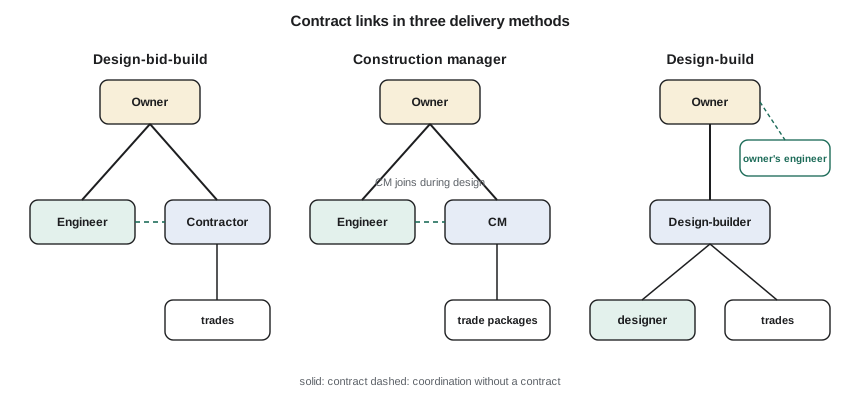
In design-bid-build, the traditional method for public works, the owner hires a designer to complete the drawings and specifications, then invites bids from contractors, and awards the construction contract to the lowest compliant bidder. The owner warrants the design to the contractor, so errors and omissions in the documents become the owner's cost, recovered if possible from the designer's professional liability insurance. The method is well understood, transparent and fair to bidders, and it gives a firm price at award for the work as designed. Its weaknesses are a sequential schedule, no contractor input during design, and an adversarial tendency because the low bidder needs changes and claims to recover thin margins.
Construction management
In construction management, a construction manager joins the team during design to advise on cost, schedule, staging and constructability, then manages construction, usually by procuring the work in trade packages. Under construction management for a fee, the manager acts as the owner's agent and the trade contracts are often held by the owner; under construction management at risk, the manager holds the trade contracts itself and commits to a guaranteed maximum price once the design is far enough along. The construction manager/general contractor model used by many transportation agencies is a version of the at-risk approach for heavy civil work. The method allows early work packages to start before design is complete and brings builders' knowledge into design decisions, at the cost of a less certain final price and more owner involvement.
Design-build
In design-build, the owner contracts with a single entity for both design and construction, usually after preparing a performance specification and preliminary design, sometimes called bridging documents. The single point of responsibility removes the owner's warranty of the design, allows design and construction to overlap, and often shortens the schedule. In exchange, the owner gives up detailed control of the design and must state its requirements precisely, because what is not required need not be provided. Owners using design-build normally hire their own engineer, the owner's engineer, to write the requirements and review the design-builder's work. Progressive design-build lets the owner select the design-builder early on qualifications, develop the design together, and agree the price partway through, closing much of the gap with construction management.
Public-private partnerships and collaborative contracts
For large infrastructure, US public agencies have used public-private partnerships, in which a private concessionaire designs, builds, finances and often operates and maintains an asset for decades, paid by tolls or availability payments tied to performance. Many states have enabling legislation, and federal credit programs support some projects. Partnerships transfer long-term risks of design, construction and life-cycle cost to the concessionaire, but their transaction costs are high, so they suit projects worth hundreds of millions of dollars, not a city road contract. At the collaborative end of the spectrum, integrated project delivery and alliance contracts bind owner, designer and builder into a single agreement with shared risk and reward, used mainly on private and health-care buildings.
Pricing arrangements and risk
Pricing allocates cost risk. In a stipulated or lump-sum price, the contractor commits to deliver the defined work for a fixed amount and carries the risk of its own quantities and productivity. In a unit-price contract, the contractor bids a price per unit for each item, quantities are measured as the work is done, and the owner carries the quantity risk. Unit prices suit civil work where quantities cannot be known exactly in advance: excavation, granular fill, pipe length. In cost-plus contracts the owner reimburses actual costs and pays a fee, carrying almost all cost risk; a guaranteed maximum price caps that exposure, often with shared savings below the cap.
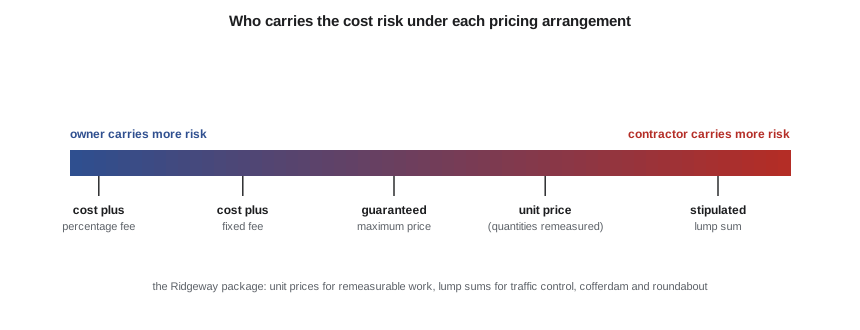
The Ridgeway package uses a hybrid that is common on municipal civil work: unit prices for the remeasurable items, such as removals, excavation, granular materials, asphalt, curb and pipe, and lump sums for items whose scope is defined but whose quantity is not a meaningful measure, such as traffic control, the cofferdam and creek diversion, and the roundabout. The engineer's estimate in lesson 4 is built in the same structure as the bid form, so that each bid can be compared item by item.
Standard contract forms
Most US owners use, or adapt, published standard forms rather than writing contracts from scratch. For engineered public works such as roads, water and sewer, the forms of the Engineers Joint Contract Documents Committee are common; the EJCDC C-700 Standard General Conditions of the Construction Contract, in the 2018 edition of the C-series, is the core document. The American Institute of Architects' A201-2017 General Conditions dominate building construction, and ConsensusDocs, endorsed by a broad group of industry associations, offers an alternative family. Federal agencies contract under the Federal Acquisition Regulation, and state departments of transportation use their own standard specifications, whose general provisions act as the contract conditions. Owners attach supplementary conditions to adapt the general conditions to the project.
Standard forms matter because they represent a negotiated balance of risk that courts and the industry understand. Heavy amendment of the general conditions, especially to push unforeseeable risks onto the contractor, tends to raise bid prices, deter good contractors and invite disputes. An engineer drafting supplementary conditions should know why each standard clause exists before changing it.
Choosing a method for the Ridgeway package
The city's team scored the options in a workshop against six criteria. Design was complete and permitted, so methods that rely on design being unfinished lost their main advantage. Public procurement rules and the city's experience favored open tendering. On the other hand, the soft clay, the in-water work window and the utility relocations made early contractor input attractive. Sofia turned the workshop scores into a weighted matrix and tested how sensitive the result was to the weight on early contractor input.
# Choosing a delivery method for the Ridgeway package with a weighted scoring matrix
criteria = {  # criterion: weight
    "design already complete and permitted": 0.20,
    "price certainty at award": 0.20,
    "speed to start construction": 0.10,
    "owner control of design details": 0.15,
    "early contractor input on staging and risk": 0.15,
    "fit with public procurement rules and staff experience": 0.20,
}
# scores 1 (poor) to 5 (good) agreed in the team workshop
scores = {
    "design-bid-build":           [5, 4, 3, 5, 1, 5],
    "construction manager (CM)":  [3, 3, 4, 4, 5, 3],
    "design-build":               [1, 4, 4, 2, 4, 3],
    "progressive design-build":   [1, 2, 4, 3, 5, 2],
}
w = list(criteria.values())
res = sorted(((sum(a * b for a, b in zip(w, s)), m) for m, s in scores.items()), reverse=True)
for total, m in res:
    print(f"{m:28s} weighted score {total:.2f} / 5")
# sensitivity: how heavily must early contractor input count before CM overtakes design-bid-build?
for k in [0.15, 0.25, 0.35, 0.45]:
    ww = [x * (1 - k) / (1 - 0.15) if i != 4 else k for i, x in enumerate(w)]
    s1 = sum(a * b for a, b in zip(ww, scores["design-bid-build"])); s2 = sum(a * b for a, b in zip(ww, scores["construction manager (CM)"]))
print(f"weight on early contractor input {k:.2f}: design-bid-build {s1:.2f}, CM {s2:.2f}")design-bid-build weighted score 4.00 / 5 construction manager (CM) weighted score 3.55 / 5 design-build weighted score 2.90 / 5 progressive design-build weighted score 2.60 / 5 weight on early contractor input 0.15: design-bid-build 4.00, CM 3.55 weight on early contractor input 0.25: design-bid-build 3.65, CM 3.72 weight on early contractor input 0.35: design-bid-build 3.29, CM 3.89 weight on early contractor input 0.45: design-bid-build 2.94, CM 4.06
Design-bid-build scores 4.00 out of 5, ahead of construction management at 3.55. The sensitivity test shows that construction management would win only if early contractor input carried a weight of about 0.22 or more, a value the team judged too high for a project with complete, permitted design. Since the risks that early input would address are mostly about ground and utilities, the team chose to manage them in other ways: a more thorough geotechnical baseline in the contract, a pre-bid site meeting, and a provisional item for subexcavation of soft clay.
Worked problem
Weighted score
Construction management scored 3, 3, 4, 4, 5 and 3 on the six criteria, weighted 0.20, 0.20, 0.10, 0.15, 0.15 and 0.20. Find its weighted score.
Show solution
- \[S = 0.20(3) + 0.20(3) + 0.10(4) + 0.15(4) + 0.15(5) + 0.20(3)\]
- \[S = 0.60 + 0.60 + 0.40 + 0.60 + 0.75 + 0.60 = 3.55\]
Answer: The weighted score is 3.55 out of 5.
Risk allocation principles
A widely quoted principle is that each risk should be carried by the party best able to control it, or, if no one can control it, by the party best able to bear it at least cost. Applied to the Ridgeway package, the contractor controls productivity, its own equipment and subcontractors, and safety on site, so those risks stay with it. The owner controls the design and the information about the site, so it carries design errors and conditions that differ from those described. Weather and market price swings are controlled by no one; the contract shares them through a weather allowance in the schedule and, on longer projects, price adjustment clauses for fuel and asphalt cement.
Pushing a risk onto a party that cannot control it does not make the risk disappear. A contractor asked to carry unknown ground conditions on a fixed price adds a contingency to its bid, which the owner pays whether or not the conditions occur, or underprices it and later fights to recover the loss. Lessons 3 and 9 show how the differing site conditions clause handles the varved clay.
Risk allocation also has a price on the owner's side. Every risk the owner keeps needs management capacity: staff who can review submittals, assess claims and make decisions quickly. An owner that chooses a method or a risk allocation beyond its own capacity, for example a complex alliance contract without experienced staff to run it, may do worse than with a simpler method run well. The city of the Ridgeway package has a small capital projects group that knows design-bid-build well, and that familiarity weighed in the decision.
Practical points
- Separate the delivery method from the pricing arrangement, then choose both to fit the project.
- Use design-bid-build when design is complete, the scope is clear and open tendering is required.
- Consider construction management or progressive design-build when early builder input or early start is worth more than price certainty.
- Start from a standard form and amend it with care; know why each clause exists.
- Allocate each risk to the party best able to control it.
Common mistakes
MistakeTreating design-build as a way to transfer all risk to the contractor.
InsteadThe owner still carries risks it controls, and must state its requirements precisely.
MistakeUsing a lump sum for work whose quantity cannot be known in advance.
InsteadUse unit prices for remeasurable civil work so that the owner pays for actual quantities.
MistakeRewriting standard general conditions to shift unforeseeable risk onto the contractor.
InsteadBidders price it or fight it; the owner pays either way.
MistakeChoosing a method by habit rather than by the project's characteristics.
InsteadScore the options against explicit criteria and test the sensitivity.
Summary and key terms
- The delivery method decides who designs and builds and when; the pricing arrangement decides how the contractor is paid.
- Design-bid-build gives price certainty for a complete design but no early builder input.
- Construction management brings a builder in during design; at risk, the manager commits to a guaranteed maximum price.
- Design-build gives a single point of responsibility and overlapping design and construction, with less owner control.
- Unit prices put quantity risk on the owner and suit remeasurable civil work.
- Risks should go to the party best able to control them.
- Design-bid-build
- Delivery in which design is completed before construction is bid and awarded to a separate contractor.
- Construction management at risk
- Delivery in which a construction manager advises during design and then holds the trade contracts under a guaranteed maximum price.
- Design-build
- Delivery in which one entity is contracted for both design and construction.
- Progressive design-build
- Design-build in which the builder is selected early and the price is agreed during design development.
- Unit-price contract
- A contract in which the contractor is paid a bid price per unit of measured quantity.
- Stipulated price
- A fixed lump-sum price for the defined work.
- Guaranteed maximum price
- A cost-plus arrangement capped at an agreed maximum.
- Supplementary conditions
- Project-specific changes and additions to the standard general conditions.
Practice problems
Work each problem on paper first, then reveal the answer to check.
A transit agency must open a station in time for a major event, but design is only 30 % complete. Which delivery methods would you consider, and why?
Show answer
Construction management at risk or design-build, possibly progressive, because they allow construction to start before design is finished.
Recompute the design-bid-build score if early contractor input is weighted 0.25 and the other weights are scaled to keep the total at 1.
Show answer
About 3.65, compared with 3.72 for construction management.
Why are unit prices used for excavation but a lump sum for the cofferdam?
Show answer
Excavation quantity is measurable and uncertain; the cofferdam is a defined temporary work whose cost depends on the contractor's design, not on a quantity.
Give one risk the contractor should carry and one the owner should carry on the Ridgeway package.
Show answer
Contractor: crew productivity or equipment breakdowns. Owner: subsurface conditions that differ from the geotechnical report.
Lesson quiz · 5 questions
Score 60% or more to complete this lesson.
Create a free account to save your progress, take quizzes and earn a certificate.