
CIV-450 · Lesson 1 of 12 · 20 min
The construction industry and the engineer's roles
Every civil engineering course before this one ended with a design: a beam sized, a culvert selected, a wall checked for sliding. This course is about what happens next, when a design becomes a contract, a contract becomes a construction site, and a construction site becomes a finished road that a city can open to traffic. The thread through all twelve lessons is one real-sized public contract, the Ridgeway Road East Reconstruction and Kestrel Creek Crossing, which brings together work you have already met: the road diet and the roundabout at the operations center access from CIV-390, the 15 × 8 ft embedded box culvert from CIV-470, the cantilever retaining wall from CIV-440, the storm sewers and bioretention cells from CIV-470, and the soft varved clay that has followed the project since CIV-340.
The owner is the City of Duluth. Its capital projects manager, Carla Mendes, holds the budget and signs the contract. Kestrel Bay Engineering designed the work and will act as the city's engineer during construction: Priya Raman, PE, leads, with Owen Lachance, EI, as resident inspector on site and Sofia Martel, the co-op student, building the project's schedules and spreadsheets in Python. Anika Rao and Dr. Lena Kowalczyk return as the water resources and geotechnical specialists. The contractor, chosen by public bidding in lesson 3, is Northline Civil, with Joel Ostrowski as project manager and Marc Bélanger as superintendent.
The construction industry in brief
Construction is one of the largest sectors of the US economy, employing several million people, and civil and infrastructure work, roads, bridges, water and sewer systems, transit and energy, is a large share of it. Much of that infrastructure is owned by cities, counties and state departments of transportation, often with federal funding attached, so public bidding laws and federal and state requirements shape how it is bought and built. In Minnesota, city road work is often specified with reference to MnDOT's Standard Specifications for Construction, and contract terms come from the city's own documents or from standard forms such as those of the Engineers Joint Contract Documents Committee, EJCDC.
The industry has features that make its management different from manufacturing. Every project is a prototype built once, on a site with its own ground, weather, neighbors and utilities. The work is done by temporary organizations, a general contractor and a dozen subcontractors and suppliers assembled for this one job and disbanded at the end. Margins are thin, typically a few percent of the contract value, so a single bad estimate or an unpriced risk can turn a job into a loss. Productivity has grown more slowly than in most other sectors, which is one reason why digital tools and lean methods, the subject of lesson 11, attract so much attention.
Who the parties are
A construction project brings together three core parties and many supporting ones. The owner wants the facility, pays for it and carries the risks that the contract does not transfer. The designer, here Kestrel Bay Engineering, prepares the drawings and specifications that define what is to be built. The contractor builds it, choosing the means, methods, sequence and crews, and is responsible for safety on its site. Around them sit subcontractors and suppliers, utility companies whose pipes and cables share the road allowance, regulators who issue permits, testing laboratories, sureties who guarantee the contractor's performance, insurers, lenders and the public who live along the road.
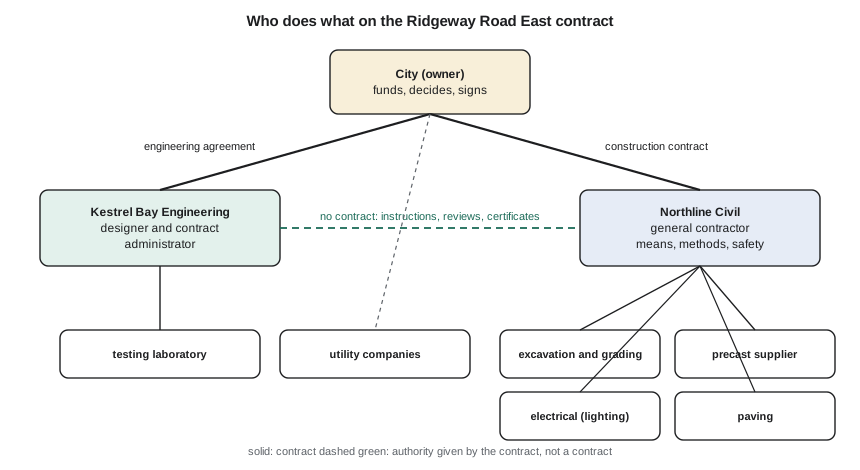
The diagram shows a point that surprises many graduates. The engineer and the contractor have no contract with each other. The engineer's authority on site comes from the construction contract between the owner and the contractor, which names the engineer, or contract administrator, and gives that role specific powers: to interpret the documents, to review submittals, to issue instructions, to measure and certify work for payment, and to decide on disputes in the first instance. Outside those powers, the engineer cannot direct the contractor. An engineer who tells a superintendent how to brace a trench, for example, may take on liability for the contractor's means and methods without having any contractual authority to do so.
The roles an engineer can play
Civil engineers work on every side of a construction project. In consulting firms they design and then administer contracts for owners. In owner organizations, cities, transportation departments and utilities, they plan capital programs, manage projects and act as the owner's representative. In contracting firms they estimate, schedule, engineer temporary works such as shoring and falsework, manage field operations and run projects. A growing number work as construction managers, as program managers for large capital programs, or as independent experts on claims and disputes. Each role sees the same project through a different lens, and the most effective engineers understand the others' incentives.
| Role | Typical employer | Main responsibilities on the Ridgeway package |
|---|---|---|
| Designer | consulting engineer | drawings, specifications, engineer estimate, permits |
| Contract administrator | consulting engineer | interpretation, submittals, inspection, payment certificates, changes |
| Owner's project manager | city | budget, approvals, council reports, stakeholder relations |
| Contractor project manager | general contractor | cost, schedule, subcontracts, claims, client relations |
| Superintendent | general contractor | daily field operations, crews, safety, production |
| Temporary works engineer | contractor or specialist | shoring, cofferdam, falsework design |
| Resident inspector | consulting engineer | daily inspection, quantities, field records |
In Minnesota, engineering work done in these roles must be done by, or under the direct supervision of, a licensed professional engineer, and engineers' first duty under state rules and the NSPE code is to public safety, health and welfare. ENGG-404 covered that framework; here it shows up practically. When the city's engineer certifies that work is complete, or a temporary structure is designed and stamped, that certification carries professional responsibility.
The project life cycle
Projects move through recognizable stages: need and planning, concept and feasibility, preliminary and detailed design, procurement, construction, commissioning and handover, then operation and eventual renewal. The Ridgeway package is now at the end of detailed design. The planning studies and environmental assessment are done, the culvert and wall designs are stamped, the permits for in-water work and water taking are in hand or applied for, and the drawings are being assembled into a tender package.
The stages matter for management because the ability to influence cost falls steeply as a project advances, while the cost of making a change rises. At concept, moving the culvert ten meters downstream is a line on a sketch. During construction, it means new excavation, a new cofferdam, wasted precast segments and a delay claim. This relationship, sometimes drawn as the MacLeamy curve or simply the influence curve, is the economic case for spending effort early on constructability reviews, site investigation and risk workshops, three topics that recur in every lesson of this course.
Constructability
Constructability is the extent to which a design makes construction easy, safe and economical. A constructable design uses standard sizes and repeated details, leaves room for equipment to work, allows sensible staging of traffic and utilities, avoids work in the creek outside the permitted season, and specifies tolerances that crews can achieve. The best way to get it is to involve people with construction experience during design, either the owner's own construction staff, the consultant's contract administrators, or, under some delivery methods, the contractor itself.
For the Ridgeway package, Kestrel Bay held a constructability review at 90 % design with a retired superintendent from the city's roads department. Three changes came out of it. The precast culvert was split into segments short enough to ship without a special permit. The retaining wall footing was moved half a meter back from the property line so a 3 ft excavator bucket could work alongside it. And the road was staged in two halves so that one lane each way stays open during school terms, which shaped the traffic control plan in lesson 10.
Budget and the first numbers
Before the city can tender anything, council must approve a capital budget. The budget is more than the construction estimate: it includes design and contract administration fees, testing, property, permits and utility agreements, the city's own staff time, and a contingency for risk. Sofia's first script builds the request from the engineer's estimate that lesson 4 develops in detail.
# Capital budget for the Ridgeway Road East and Kestrel Creek crossing project
UNITS = "US"
SI = UNITS == "SI"
CUR = "CAD" if SI else "USD"
construction = 7.54e6 if SI else 6.24e6     # engineer's estimate (lesson 4), rounded
lines = [
    ("Construction (engineer's estimate)", construction),
    ("Design engineering, about 8 %", 0.08 * construction),
    ("Contract administration and inspection, about 5 %", 0.05 * construction),
    ("Materials testing (independent lab)", 0.012 * construction),
    ("Property, permits and utility agreements", 0.035 * construction),
    ("City staff and project management", 0.02 * construction),
]
base = sum(v for _, v in lines)
risk = 0.113 * construction                  # P80 contingency from the Monte Carlo run in lesson 4
for name, v in lines:
    print(f"{name:52s} {v:>12,.0f}")
print(f"{'Base project cost':52s} {base:>12,.0f}")
print(f"{'Owner contingency (to the P80 level)':52s} {risk:>12,.0f}")
print(f"{'Capital budget requested (' + CUR + ')':52s} {base + risk:>12,.0f}")
print(f"Construction share of the budget: {construction / (base + risk):.0%}")
# the cost of a change rises steeply as the project advances (illustrative multipliers)
print("Moving the culvert 30 ft downstream costs about:")
for stage, k in (("at concept", 1), ("in detailed design", 3), ("at tender", 6), ("during construction", 15), ("after completion", 40)):
print(f" {stage:20s} {k:>2d} x the concept-stage cost")Construction (engineer's estimate) 6,240,000 Design engineering, about 8 % 499,200 Contract administration and inspection, about 5 % 312,000 Materials testing (independent lab) 74,880 Property, permits and utility agreements 218,400 City staff and project management 124,800 Base project cost 7,469,280 Owner contingency (to the P80 level) 705,120 Capital budget requested (USD) 8,174,400 Construction share of the budget: 76% Moving the culvert 30 ft downstream costs about: at concept 1 x the concept-stage cost in detailed design 3 x the concept-stage cost at tender 6 x the concept-stage cost during construction 15 x the concept-stage cost after completion 40 x the concept-stage cost
Construction is about three quarters of the total. The USD 705,000 contingency is not padding: it is the amount needed to bring the estimate to an 80 % chance of not being exceeded, from the risk analysis in lesson 4, and the city council approves it as a separate line that only the project manager can release. The multipliers at the end are illustrative, but the pattern is consistent across studies of real projects: a change made after contract award typically costs an order of magnitude more than the same change made in design.
Worked problem
Fees as a share of construction
A design fee of 8 % and construction engineering and inspection of 5 % are applied to a construction estimate of USD 6.24 million. What do they total, and what share of the base project cost of USD 7.47 million is that?
Show solution
- \[0.08 \times 6.24 + 0.05 \times 6.24 = 0.499 + 0.312 = 0.811\ \text{million}\]
- \[0.811 / 7.47 = 10.9\,\%\]
Answer: Engineering is about 11 % of the base cost; cutting it to save money is a false economy if it raises the chance of changes during construction.
What the contract administrator does
Much of this course is written from the contract administrator's chair, because that is where many civil engineers spend their early careers. The role has three faces. To the owner, the administrator is an agent who protects the owner's interests, checks quality and keeps the budget informed. To the contractor, the administrator must be a fair interpreter of the contract who decides questions impartially, even when the answer costs the owner money. And to the public, the administrator is a professional engineer who must not certify work that is unsafe or non-compliant. Balancing these duties is the core of the job.
The daily work is concrete: reviewing shop drawings for the precast culvert, answering requests for information, attending weekly site meetings and writing the minutes, inspecting compaction and concrete, measuring quantities for the monthly payment certificate, pricing changes, and keeping records that would stand up if the project ended in a dispute. Owen's site diary, written every day in plain language with photographs, weather, crews, equipment and events, is the single most valuable document if anything goes wrong. Lessons 7 to 9 return to all of these tasks in detail.
Practical points
- Know which contract gives you your authority, and stay inside it.
- Do not direct the contractor's means and methods; comment on compliance with the contract instead.
- Spend effort early: constructability reviews and site investigation pay back many times.
- Build the budget from the estimate, fees, owner costs and a risk-based contingency.
- Keep a daily diary from the first day on site.
Common mistakes
MistakeAssuming the engineer has a contract with the contractor.
InsteadThe engineer's powers come from the owner-contractor contract, which names the engineer and lists those powers.
MistakeTelling the contractor how to do the work to speed things up.
InsteadMeans and methods are the contractor's; directing them can shift liability and support a claim.
MistakeTreating contingency as spare money.
InsteadContingency is sized to the risks; it is released under control as risks occur.
MistakeWaiting until tender to think about construction.
InsteadConstructability is cheapest to improve during design, before the documents are fixed.
Summary and key terms
- Construction projects are one-off prototypes built by temporary organizations on unique sites, with thin margins.
- The owner, the designer and the contractor are the core parties; the engineer's site authority comes from the owner-contractor contract.
- Engineers work as designers, contract administrators, owner's representatives, contractors' staff and specialists.
- The ability to influence cost falls, and the cost of change rises, as a project advances.
- Constructability reviews during design improve safety, cost and schedule.
- A capital budget adds fees, owner costs and a risk-based contingency to the construction estimate.
- Owner
- The party that commissions, pays for and will use the facility.
- Contract administrator
- The person named in the construction contract to interpret it, review and inspect the work, and certify payment.
- Means and methods
- The contractor's choice of equipment, techniques, sequence and temporary works.
- Constructability
- The extent to which a design makes construction easy, safe and economical.
- Influence curve
- The relationship between project stage and the ability to influence cost.
- Capital budget
- The total approved funding for a project, including construction, fees, owner costs and contingency.
- Contingency
- Money set aside for identified and unidentified risks, released under control.
- Resident inspector
- The engineer's representative on site who inspects work and keeps daily records.
Practice problems
Work each problem on paper first, then reveal the answer to check.
List four parties other than the owner, designer and contractor who influence a municipal road project.
Show answer
For example: utility companies, regulators issuing permits, subcontractors and suppliers, sureties and insurers, testing laboratories, residents and businesses.
A construction estimate is USD 5.0 million. With 8 % design, 5 % construction engineering, 1.2 % testing, 3.5 % owner costs and 2 % staff time, what is the base project cost?
Show answer
5.0 × 1.197 = USD 5.99 million.
Why is a design change after award typically far more expensive than the same change in design?
Show answer
Work may need to be undone, materials are already ordered, crews stand by, the schedule slips, and the change is priced without competition.
The superintendent asks the resident inspector whether a trench box is good enough. What should the inspector do?
Show answer
Point to the contract and the regulations, record the question, and refer it to the contractor's own competent person or engineer; do not approve means and methods.
Lesson quiz · 5 questions
Score 60% or more to complete this lesson.
Create a free account to save your progress, take quizzes and earn a certificate.